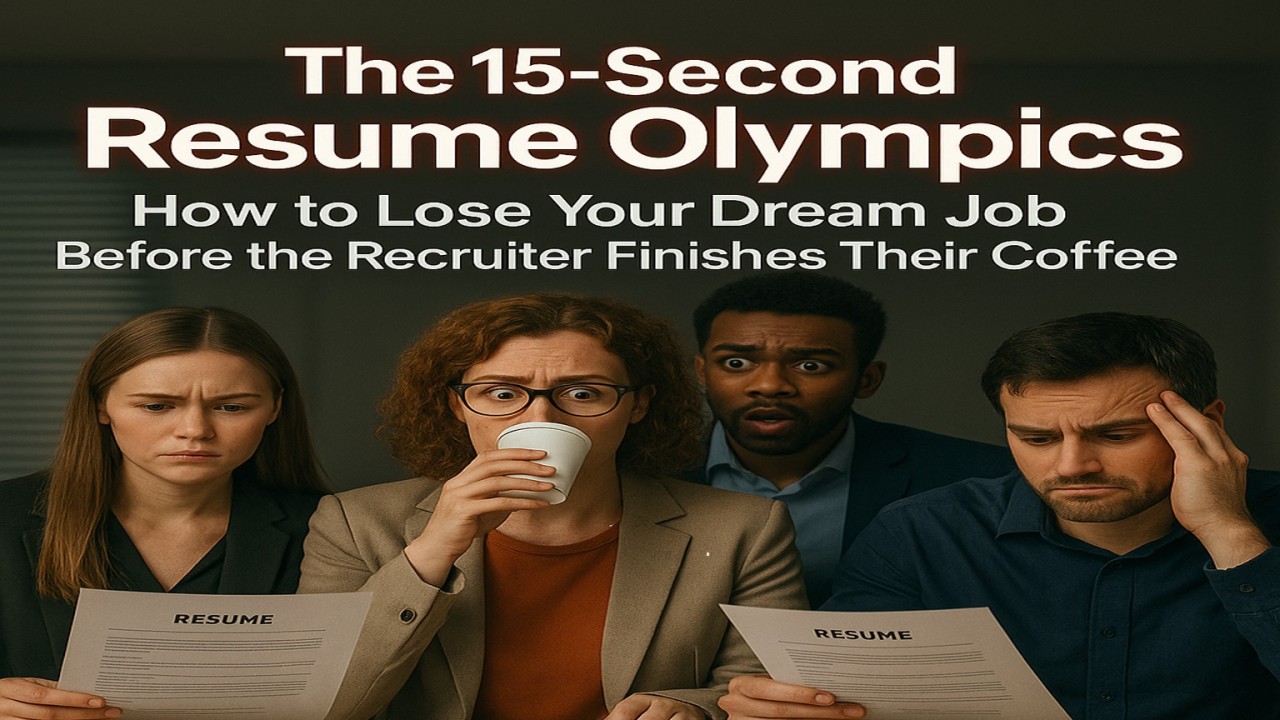
Somewhere in a corporate building, probably one with exposed brick walls, kombucha on tap, and a “Work Hard, Play Hard” sign that hasn’t aged well, a recruiter opens your resume. You imagine them leaning forward in quiet admiration, sipping coffee, eyes widening as they whisper, “Finally, a candidate who truly gets it.”
Reality check: they’re skimming it like they’re defusing a bomb with a hangover.
That six hour masterpiece you built with love, caffeine, and the emotional stamina of a Pixar protagonist? Gone in seconds. You adjusted bullet spacing like a perfectionist architect, fought a cold war with Microsoft Word’s formatting demons, and Googled synonyms for “collaborated” until your browser history looked like a thesaurus crime scene. You carefully balanced the tone between “humble professional” and “confident rockstar,” trying to sound employable but not desperate. You even considered adding a watermark, something elegant, understated, maybe just your initials, to prove you care.
And then—poof.
Fifteen seconds later, your resume has been sacrificed to the corporate gods of efficiency, tossed into a digital abyss known affectionately as “the talent pipeline.” Which, for most people, is less of a pipeline and more of a black hole where resumes go to die quietly, right next to “great cultural fits” who didn’t survive the keyword purge.
But don’t worry, this isn’t rejection. This is “streamlining the candidate experience.” Because nothing screams “we value people” like deleting them faster than a spam email from a long lost prince offering you riches.
Meanwhile, the same company posts on LinkedIn:
“We’re hiring! Looking for passionate, driven individuals who want to make an impact.”
Translation: “We’ll glance at your soul’s labor for 10 seconds before ghosting you indefinitely.”
And yet, we keep applying. Because we’re hopeful, delusional, and occasionally powered by the dangerous cocktail of caffeine and optimism. We keep rewording, reformatting, and reimagining our careers in bullet points because someone, somewhere, might just read past the first line.
So grab your coffee, your dignity, and maybe a small emotional support raccoon named “Hope.” You’re about to enter the Resume Arena, where survival depends on fonts, formatting, and whether you remembered to mention “cross functional collaboration.”
Welcome to the 15 second battlefield, my fellow gladiators. This is where dreams are skimmed, buzzwords are born, and careers are decided by scroll speed.
Let’s break it down properly. Three thrilling chapters await: The Scan, The Match, and The Trash.
The Scan — Blink and You’re Gone
Recruiters call it “reviewing resumes.” Job seekers call it “speed dating without eye contact.”
You know the drill. They open your CV, scroll for half a second, and decide whether you’re “a strong fit” or “not aligned with our current needs.” Which, of course, is corporate code for: “We got bored before your second bullet point.”
Let’s be honest, most resumes never even make it past the name. The recruiter’s eyes move faster than a teenager trying to skip through a YouTube ad. They’re scanning like a TSA agent on triple espresso, half alert, half resentful, fully ready to confiscate your hopes at the first sign of a missing keyword.
They’re not reading your career story. They’re not admiring your journey from “Intern” to “Manager of People and Occasional Sanity.” No, they’re hunting for buzzwords. Python. Sales. Excel. Cross functional synergy. If it’s not bolded, italicized, or written in a font that screams “Please hire me,” it simply doesn’t exist.
It’s like Tinder for careers, except instead of “funny, loyal, and 6’2,” they’re swiping for “proficient in Salesforce” and “3+ years experience with Jira.” Swipe left on personality, swipe right on metrics. You could’ve single handedly saved a company from bankruptcy, solved world hunger during your lunch break, and still, if you didn’t mention Agile methodology, you’re gone.
The process isn’t even human anymore. It’s algorithmic romance. Before your resume even reaches a pair of eyes, it’s fed to an Applicant Tracking System (ATS), a robot bouncer that guards the gates of employment. Its only job? To decide, within milliseconds, if you’re worthy of a second glance.
So there you are, pouring your heart into describing your achievements:
- “Implemented cost-saving initiatives that reduced expenses by 15%.” But the algorithm reads: “Didn’t mention ‘budget forecasting.’ Useless.”
- “Led a team of twelve during a major product launch.” The algorithm shrugs: “No ‘leadership’ keyword detected. Trash.”
It’s a cruel, keyword driven Hunger Games. You could have climbed Everest in your spare time, but if you didn’t call it “strategic high altitude problem solving,” it won’t count.
Recruiters say they’re looking for fit. What they mean is familiarity. They want someone whose resume looks like every other one they’ve ever liked. It’s resume Darwinism, the survival of the most formatted. Bold your titles, underline your metrics, center your company name, and for the love of corporate consistency, don’t you dare go over two pages.
And heaven forbid you try to show creativity. You add color? “Unprofessional.” You include a photo? “Not standard practice.” You write a summary that actually sounds human? “Not concise enough.” At this point, you might as well just write, “Dear hiring manager: I breathe, I type, I won’t steal office snacks. Please consider me.”
Every applicant enters with hope, thinking their experience will speak for itself. But in the resume arena, silence kills. You have to shout in bullet points and whisper in keywords. Your worth isn’t measured by what you did, it’s measured by how many times you said “stakeholder” without flinching.
Recruiters aren’t villains, they’re survivors of their own chaos. They’re juggling 200 applicants, three hiring managers, and a corporate overlord demanding “quality hires” before Friday. So they scan fast, make judgment calls, and trust the sacred instinct of “gut feeling,” which usually just means “the font didn’t annoy me.”
Your resume isn’t a reflection of your career, it’s a game of corporate bingo. The recruiter’s job is to find five matching squares before lunch. Leadership? Check. Communication? Check. Microsoft Office? Absolutely essential. Check. The moment they fill their card, the rest of the pile goes straight into the void.
So if your resume feels like a lottery ticket, that’s because it is. The odds are astronomical, the rules are invisible, and the jackpot is a polite rejection email that begins with, “We were impressed by your background, but…”
Welcome to The Scan. Blink, and you’re gone.
The Match — Where Dreams Go to Die in Arial Font
Here’s the thing: recruiters want to find the perfect match. They’re not villains, they’re just overworked treasure hunters digging through 400 PDFs that all start with, “Results driven professional seeking to leverage cross functional expertise in a dynamic environment.” Which is corporate code for: “Please, I beg you, just let me be employed.”
But recruiting isn’t romance, it’s speed dating in a thunderstorm. They’re looking for “the one” based on a list of bullet points someone in upper management wrote during a lunch break. They’ve been trained to look for specific patterns, like detectives solving crimes of ambition.
Title alignment? Check. Recent job relevance? Check. Career gap longer than an oil change? Immediate panic.
To a recruiter, an unexplained gap is the resume equivalent of a jump scare. “Wait, you took six months off? What happened? Were you… unemployed?!” They say this like unemployment is a contagious disease you might spread through a PDF attachment.
And so begins the tragic comedy of The Match.
Because somewhere along the way, we were told the golden rule of job hunting: “Tailor your resume for each job.” Cute advice, until you realize that means writing 37 different versions of your professional identity in one week, each carefully rewritten to appeal to a new corporate deity.
Monday’s resume: “Analytical Problem Solver with Data Driven Mindset.” Tuesday’s resume: “Creative Collaborator with Passion for People.” Wednesday’s resume: “Adaptive Innovator Who Can Breathe Underwater if Necessary.”
You align your title with theirs. You sprinkle in their buzzwords like digital fairy dust. You rearrange your accomplishments like a resume DJ, remixing “led,” “developed,” and “streamlined” into something that sounds impressive but not desperate.
And still, radio silence.
Because “tailoring” your resume only works if the system that reads it actually cares. Most don’t. Your file ends up in a folder named “Maybe Later” which sounds hopeful, but is actually the modern burial ground of ambition. It’s the corporate purgatory where resumes go to wait for a callback that never comes.
You could format your resume like the Declaration of Independence, use perfect metrics, and still get ghosted because your last title wasn’t a one-to-one match. Maybe you were a “Client Success Partner” and they wanted a “Customer Success Associate.” Congratulations, you lose.
That’s how fragile “The Match” really is.
And even if you somehow clear the keyword obstacle course, the rules change halfway through the game. Because next week, the hiring manager will read a new thought leadership article on LinkedIn titled “The Future of Work Is Emotional Intelligence” and suddenly decide the next hire must have “a passion for empathy” and at least five years of experience being “emotionally available at scale.”
Requirements evolve faster than your resume can keep up. One day they want “leadership.” The next they want “team players.” The day after that, they’re asking for “self starters who need constant guidance.”
You can’t win. You can only adapt.
And so you keep rewriting your story, shrinking yourself into bullet points that sound confident but not arrogant, strategic but not robotic, capable but not threatening to the manager who wrote the posting. You edit, delete, reword, and rebrand yourself like a human LinkedIn algorithm.
Recruiters aren’t bad people, they’re just drowning. They’ve got 400 resumes, 3 hiring managers giving contradictory feedback, and a Slack message from HR reminding them the position “must be filled by Friday.” So they start seeing people not as people, but as checkboxes. Do they fit? Do they match? Do they say the word “stakeholder” at least twice?
That’s not connection, that’s compliance.
The irony? The perfect match might’ve been the candidate they trashed. The one whose resume didn’t quite fit the mold, but whose personality, work ethic, and creativity could’ve changed the whole team. But you can’t quantify “potential” in Arial font. You can only scan it, sigh, and move on.
And so the cycle continues: job seekers rewriting their souls for systems that no longer read, and recruiters searching for unicorns in a world full of donkeys wearing party hats.
Because in The Match, it’s never really about who’s best for the job, it’s about who’s best at pretending to be the job description.
The Trash — Where Potential Takes a Permanent Vacation
You’ll know your resume didn’t make it when you get the dreaded rejection email that begins with:
“Thank you for your interest. Unfortunately, we have decided to move in another direction.”
Ah yes, another direction, the same mysterious realm where all good resumes go to die. It’s the Bermuda Triangle of ambition. You send your carefully crafted document into the ether, and it vanishes, never to be seen, read, or emotionally processed again.
This is the professional equivalent of a breakup text that says, “It’s not you, it’s the algorithm.” And in some cases, that’s not even sarcasm, it really is the algorithm. Because the system that decides your career fate doesn’t have feelings, empathy, or context. It doesn’t care that you managed 15 people, saved your company six figures, or survived three rounds of layoffs armed only with cold brew and anxiety. It only knows one thing: you didn’t mention “Google Workspace” enough times.
Your resume now rests in peace among others who dared to dream. The artist who said “detail oriented.” The manager who used Comic Sans once in 2014 and never recovered. The engineer who formatted experience in two columns because they wanted to stand out. All casualties of the Great Corporate Sorting Hat, discarded not for incompetence, but for creativity.
And what’s worse? You’ll never know why. Maybe the hiring manager decided to go internal. Maybe the recruiter forgot to forward your name. Maybe the job was never real to begin with, a ghost posting to appease HR. All you’ll get is that sterile email and a vague sense that you should’ve bolded “cross-functional collaboration” just one more time.
You’ll stare at the rejection email for a minute, reading the line, “We were impressed by your background.” Were you? Really? Then why am I sitting here unemployed, eating cereal for dinner and rebranding myself on LinkedIn like a motivational speaker who peaked in 2019?
The truth is, The Trash isn’t personal. It’s procedural. You didn’t lose to someone better, you lost to a checklist. A box ticking, buzzword hunting, font sensitive ecosystem where potential is optional but precision is non negotiable. You can’t inspire a machine, and you can’t charm an inbox.
So your resume takes its place in the archives of “what could’ve been.” It’s digital purgatory now, floating among the deleted files, ignored attachments, and unopened PDFs named “Final_V7_RealOne_ThisTimeForSure.”
But take heart, brave applicant. Somewhere out there is a recruiter who doesn’t just skim, but reads. Who sees “career break” and thinks “growth,” not “risk.” Who values “potential” as much as “perfect match.” Maybe they’ll look at your resume and say, “Finally, someone who actually sounds human.”
Until that miracle day, you’ll keep doing what all legends do: rewriting, rewording, and reapplying. You’ll keep deleting that mysterious extra line space Word keeps adding for no reason, and you’ll keep pretending “Dear Hiring Manager” is a sincere greeting and not a cry for help.
Because this ridiculous, chaotic circus of hiring is where modern gladiators are forged. Some applicants are skimmed, some are ghosted, and a lucky few survive long enough to reach an interview where they’re asked, “Where do you see yourself in five years?” (Hint: not here.)
But for every resume tossed into the abyss, a new one rises, more polished, more desperate, more keyword-rich. That’s the circle of job seeking life.
So print out your latest version. Light a candle for the fallen drafts. Raise your coffee mug to the résumé that died so the next one might live.
Because in The Trash, potential doesn’t vanish, it just takes a long, unpaid vacation.
The Resume Rebellion
One day, job seekers will rise. We’ll storm the glittering gates of LinkedIn with our cover letters in hand, chanting, “We are more than keywords!” There will be banners made of recycled rejection emails and victory cries echoing through the digital corridors of corporate recruiting platforms. The Applicant Tracking Systems will tremble as resumes finally reclaim their humanity.
When that day comes, recruiters will have to spend more than 15 seconds deciding our fate. They’ll read our stories, not just our job titles. They’ll see the person behind the bullet points, the human behind the Helvetica. Maybe they’ll even appreciate the emotional labor it takes to keep writing “motivated self starter” when your motivation has long since packed up and moved to a remote cabin in despair.
Imagine it: resumes with personality. Cover letters that sound like humans. Recruiters who actually reply with feedback instead of automated condolences. Hiring managers who admit, “We didn’t really know what we were looking for.” And an internet that no longer preaches, “Just keep applying,” as if persistence alone could conquer algorithms.
But until that revolution comes, until we overthrow the tyranny of “preferred qualifications” and the cruel dictatorship of “minimum five years’ experience” we play the game. We polish those bullet points. We bold those buzzwords. We make “stakeholder communication” sound like a hero’s journey. We become fluent in the strange corporate dialect of results oriented leadership synergy, pretending we’ve known what that means all along.
Because in the great resume Olympics, survival isn’t about experience, it’s about endurance. It’s about how many rejections you can laugh at before breakfast, how many “we moved in another direction” emails you can absorb without dissolving into a puddle of existential dread, and how many times you can reword “team player” before it loses all meaning.
Yet here’s the secret they don’t tell you: every time you hit “apply,” every time you rebuild that document after another letdown, every time you choose to keep trying instead of giving up, you’re already winning. You’re proving that resilience beats rejection, that humor outlasts hopelessness, and that no algorithm can truly measure grit.
So go ahead, brave applicant. Keep writing, keep applying, keep believing. One day, when the Resume Rebellion finally arrives, you’ll be ready, not just with experience, but with endurance, wit, and a battle tested sense of humor.
And when they finally ask you, “How did you survive the hiring process of the 2020s?” You’ll smile, sip your coffee, and say, “Bold fonts. Buzzwords. And an emotional support raccoon named Hope.”






Thanks for sharing. I read many of your blog posts, cool, your blog is very good. https://www.binance.com/register?ref=QCGZMHR6