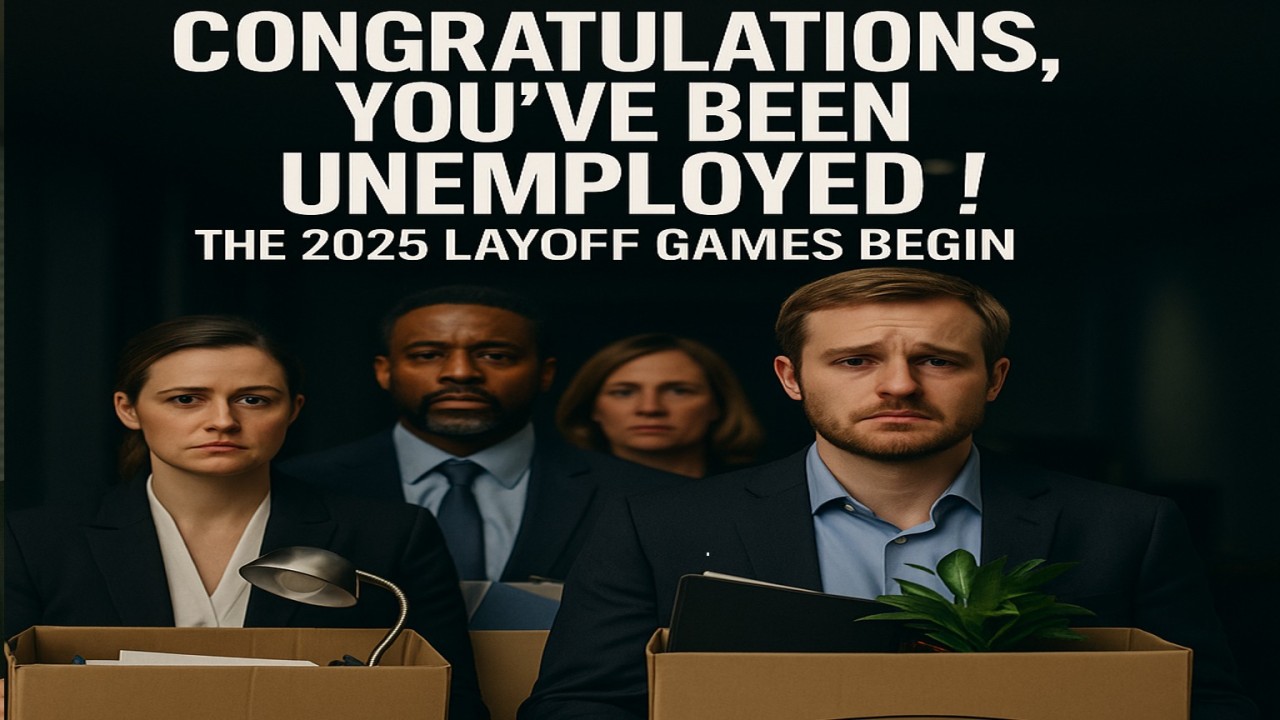
Somewhere between “The economy is strong!” and “We’re right sizing to ensure future growth,” thousands of employees just got handed cardboard boxes and a corporate pen they can’t even keep because it’s “company property.”
The 2025 layoff wave has officially arrived, uninvited, overcaffeinated, and spreading faster than an HR email about “remaining positive during this transition.” You can almost hear the copy pasted sympathy in every internal memo: “This decision was not made lightly.” Of course it wasn’t. It was made in a boardroom, over catered lunch, by people whose bonuses depend on it.
For years, we were told that “labor hoarding” was the new normal. Companies were holding onto workers like clingy exes afraid of being alone. “We value stability,” they said. “We’re investing in people,” they said. “We’re all in this together,” they said, right before quietly revoking your building access.
Now, the same executives who preached about “employee retention” are suddenly allergic to payroll. The moment the economy coughed, they remembered we’re all “at will employees,” which is corporate code for “we can love you one quarter and lay you off the next.”
It’s poetic, really, watching LinkedIn transform in real time from a digital networking platform into a televised emotional support group. Motivational quotes have been replaced with #OpenToWork borders, “thought leadership” has been replaced by trauma bonding, and recruiters are suddenly silent, probably because they were laid off, too.
You scroll through your feed and it’s a chaotic symphony: people sharing goodbye posts that sound like Oscar speeches, ex coworkers turning their termination into TED Talks, and influencers telling everyone to “stay positive” while secretly scheduling their own “transition announcement” for next week.
Bloomberg News calls it “a warning sign for the job market.” The rest of us call it what it is: Tuesday. Because, let’s face it, layoffs aren’t breaking news anymore, they’re just the recurring season of a show no one asked to be cast in. It’s the longest running drama in corporate history: Survivor: Open Office Edition.
The cast changes every season, but the script stays the same. Cue the buzzwords: “economic headwinds,” “operational efficiency,” “strategic realignment.” Every phrase carefully crafted to make losing your livelihood sound like a visionary business move. You almost want to applaud the PR department, if you weren’t too busy calculating how long you can stretch your severance package.
And the timing is impeccable, as always. Right before the holidays. Because nothing says “season of giving” like being handed your exit paperwork and a lukewarm HR hug. One day you’re planning a team potluck, the next you’re Googling “how to get health insurance before January.”
But maybe there’s a strange beauty in the chaos. Maybe there’s something oddly human about watching millions of people rally, reinvent, and reintroduce themselves all over again. Because beneath the panic, the layoffs, and the jargon, there’s a shared understanding: we’re all just trying to survive the world’s weirdest job market with our humor, our pride, and whatever’s left in our 401(k).
So grab your cardboard box, your dignity, and that office succulent you’ve been nurturing since the last downsizing. It’s time to unpack what this new round of corporate chaos really means, in three bittersweet, caffeine fueled chapters: The Fall, The Feels, and The Fight.
Because even in the middle of a layoff wave, one truth remains: we might lose our jobs, but we will never lose our sarcasm.
The Fall — When the Email Hits Your Inbox
It always starts the same way: a mysterious 30 minute meeting invite titled “Quick Sync.” You check the attendees—HR, your manager, and someone from “People Operations” you’ve never met before. That’s when you know it’s not a sync. It’s a silent funeral for your paycheck.
You click “Join Meeting” with the same nervous optimism as someone buying a lottery ticket. Maybe it’s good news, you tell yourself. Maybe they’re promoting you. Maybe you’re finally getting that raise they mentioned six months ago. But deep down, you already know. You can feel the pre-written HR script through the Wi-Fi.
Your manager smiles like someone who’s been practicing sympathy in front of a mirror. “This is never an easy conversation,” they begin.
Translation: We’ve already disabled your email, but let’s pretend this is collaborative.
You nod slowly, trying to look composed while your brain sprints through every possible outcome. And then it happens. The phrase that slices through all your denial like a corporate katana: “Your position has been impacted.”
Impacted. Such a gentle word for professional decapitation. You almost have to respect the creativity “terminated” sounds harsh, “fired” sounds personal, but “impacted”? That sounds like you were just brushed aside by the invisible hand of capitalism.
The fall is fast. One moment you’re a “valued team member,” the next you’re a line item on a spreadsheet labeled “Cost Reduction.” HR assures you it’s “not performance related,” as if that makes the cardboard box any lighter. You’re told this decision “aligns with company strategy,” which is corporate shorthand for “we needed to make the stockholders smile.”
And then comes the final blow, the HR script about “continued access to our alumni network.” Because nothing heals the trauma of losing your job like joining a Slack channel full of other people who also lost theirs. The irony is rich, you’re unemployed, but somehow still invited to “stay connected.”
Outside, the economy looks fine. The markets are up. The executives still have their bonuses, and the CEO just posted a LinkedIn essay about “gratitude in times of change.” Meanwhile, you’re standing in your kitchen at 10:47 a.m., holding a company mug you’re technically supposed to return, wondering if it’s stealing or just severance in ceramic form.
The absurdity sinks in. The company that once called you “family” has just issued your professional divorce papers, complete with outplacement services and a list of “resources to help you transition.” You want to laugh, but your laugh sounds like crying with better posture.
You start to wonder, was the “labor hoarding” era just a PR campaign? Did we all get tricked into believing loyalty was a two-way street? Spoiler alert: it wasn’t. It’s a roundabout. And you just got exited while the CEO took the express lane to “record quarterly results.”
And yet, amid the confusion, there’s a strange calm. After the adrenaline fades, you realize something: they took your job, but not your humor. Not your resilience. Not your ability to turn this moment into a story that makes others laugh through the ache.
Because beneath the chaos and corporate jargon, there’s an unspoken truth: in a world that moves this fast, everyone’s one “Quick Sync” away from an existential crisis.
And yet, here you are. Still standing. Slightly unemployed, entirely unhinged, but somehow still ready to show up again tomorrow. With a new résumé, a stronger spine, and a newfound appreciation for people who call it what it is: not a “restructuring,” not a “shift,” but a good old fashioned corporate plot twist.
The Feels — Between Panic and Peace
The first 48 hours post-layoff are emotional chaos, a cocktail of panic, disbelief, and poorly timed optimism. You’re simultaneously furious, free, anxious, and hungry. Mostly hungry. Because stress-snacking is cheaper than therapy and significantly more reliable than your last benefits package.
You sit there refreshing your email like a gambler at a slot machine, hoping for a miracle. Maybe they’ll send a follow-up: “Oops, wrong Alex!” But no such luck. The only thing that lands in your inbox is a LinkedIn notification: “Your coworker just updated their profile to ‘Open to Work.’” Great. The unemployment domino effect has begun.
You tell yourself it’s fine. You needed a break anyway. You can finally “find yourself.” You can rest, recharge, and reinvent. Except “finding yourself” is hard when your rent just sent a passive-aggressive reminder, your bank account looks like a countdown timer, and your last paycheck is already locked in mortal combat with inflation.
Then come the well meaning advice givers, people who haven’t been laid off since dial-up internet was a thing.
“Everything happens for a reason.” “This might be your chance to follow your dreams!” “Have you tried freelancing?”
Yes, Carol, I have dreams. Unfortunately, none of them come with health insurance or a 401(k) match.
You start doomscrolling, articles about “resilience,” “embracing career pivots,” and “redefining success.” Every headline reads like a bad breakup pep talk. You half expect one to say, “It’s not you, it’s capitalism.”
The hours blur together. You toggle between job boards, existential dread, and snacks. Your mind swings between confidence and crisis like a malfunctioning pendulum. One moment you’re sure you’ll land on your feet; the next, you’re calculating how many noodles you can stretch a week on.
You join online groups full of fellow “transitioning professionals.” Everyone’s posting upbeat messages like: “So excited to see what’s next!” Translation: “I just cried in my car.” You type your own post, delete it, rewrite it again. Eventually, you settle on something vague but hopeful “Grateful for the journey.” Because that’s what we do now: we brand our breakdowns.
And somewhere between the doomscrolling and the panic applications, something starts to shift. Not dramatically, more like a quiet realization sneaking in between job alerts. You’re still here. Still capable. Still slightly sarcastic, but alive.
You start remembering that you were never just an employee, you were a person who made impossible deadlines possible. The one who kept the team afloat when half the staff was out sick. The one who answered messages during dinner because you cared, even if no one thanked you for it. You’ve survived office politics, quarterly reviews, and eight different “urgent company initiatives” that vanished faster than your PTO balance.
That resilience? It’s still there. Buried under rejection emails and corporate jargon, but beating steadily like a stubborn little drum. You start to see that maybe this isn’t the end, it’s the very messy middle of a story you’re still writing.
Yes, you’re panicking. But you’re also adjusting. Breathing. Healing. Realizing that your worth doesn’t expire just because your job did. You may not have a new title yet, but you’ve earned something better, clarity, grit, and the realization that your identity isn’t built from PowerPoints and performance reviews.
By day three, the panic starts to fade, just a little. You wake up, make coffee, and open your laptop, not because you have to, but because you want to. You start imagining possibilities instead of catastrophes.
It’s not peace, not yet, but it’s close enough to keep you going.
The Fight — Rising with Coffee and Chaos
Every great underdog story begins with unemployment and caffeine.
The first week after a layoff feels like a foggy montage from an indie film, coffee stains, open job tabs, a resume that looks like it’s been through five stages of grief. But once the shock fades and the tears dry (or at least take longer to arrive), something inside you wakes up. The part that’s been running on adrenaline for years finally remembers how to fight, but this time, it’s for you.
You rebuild your resume like a phoenix rising from the ashes of bad formatting. You question every word: Was I really “innovative”? Did I truly “lead cross functional initiatives”? What even is synergy? You rewrite, reframe, and rebrand yourself as “a strategic problem solver passionate about transformation,” which is just poetic code for “someone who needs a job before rent is due.”
Then comes the applying stage. It’s a strange mix of hope, delusion, and copy paste. You apply to everything, some jobs you qualify for, some you don’t, and a few that sound like they were written by AI and meant for another species. You tell yourself, “The worst they can say is no,” but after the 57th “we went in another direction,” you start wondering if that direction is just “anyone but me.”
Your resume becomes a piece of art, tailored, keyword rich, and filled with just enough professional delusion to survive the Applicant Tracking System. You’ve tailored it so many times it now reads like fan fiction about your own life. Somewhere in there, you’re the heroic protagonist who “drove organizational impact” and “championed scalable initiatives.”
And yet, amid the chaos, something changes. You begin to notice the absurdity, the humor hiding beneath the struggle. You realize that every “reduction in force” leaves behind a secret underground network of people who refuse to quit, even when they’ve technically been told to. The job market might be broken, but the people inside it are remarkable.
You see it in the LinkedIn posts that start as heartbreak and end as hope. In strangers leaving encouraging comments on your “Open to Work” update. In people who lost everything one month and launch something new the next, podcasts, side hustles, or Etsy shops selling artisanal candles named “Corporate Trauma” and “Smells Like Severance.”
You find humor where you can. A recruiter ghosts you after three interviews? That’s comedy now. An application ghosted since August? That’s an ongoing bit. Because once you stop taking it personally, you start taking it as material.
You begin reaching out, to old coworkers, to new connections, to yourself. You remember what it feels like to root for people again, even in the middle of your own uncertainty. You start seeing yourself not as “unemployed,” but as “between chapters.” It’s not a euphemism, it’s the truth. The last story ended. The next one is still being written.
So no, maybe the economy isn’t fine. Maybe companies are cutting costs while cutting corners on humanity. Maybe “efficiency” has become a synonym for “soulless.” But you? You’re still standing. Bruised, caffeinated, and slightly traumatized, but standing nonetheless.
You’ve learned how to take rejection and turn it into redirection. You’ve learned that career stability is an illusion, but adaptability is armor. You’ve learned that even when the market feels like a black hole, people still show up, for themselves, and for each other.
Because if there’s one thing this chaotic job market has proven, it’s that you can’t downsize grit. You can’t outsource resilience. And no matter how much AI they roll out, you can’t automate hope.
And when that next recruiter finally calls, their voice polished and polite, saying, “You seem like a great fit,” you’ll smile, not out of relief, but recognition. Because you’ve been fighting for this moment. You’ve survived the chaos, learned to laugh through the mess, and discovered your own unshakable worth.
You’ll sip your coffee, lean back, and think, Damn right I am. And this time, I’m bringing my own mug.






Thanks for sharing. I read many of your blog posts, cool, your blog is very good.
Thank you for your sharing. I am worried that I lack creative ideas. It is your article that makes me full of hope. Thank you. But, I have a question, can you help me?