Once upon a time — back when the internet was still a place of chaos and unfiltered opinions — social media was your digital diary. You could post about how much you hated Mondays, how your boss microwaved fish again, or how your company’s “unlimited PTO” somehow never made it past two days without a guilt trip. It was your corner of the internet to vent, laugh, and maybe overshare.
Then, one fateful day, a memo arrived. Not to you directly, of course — it arrived in the inbox of someone in HR who had recently discovered that employees, shockingly, had personalities outside of work. And thus began the age of the Corporate Social Media Policy.
This was the modern equivalent of an emotional NDA. The same organization that told you to “bring your authentic self to work” now warned that your authentic self might violate community guidelines. “We value transparency,” they said — right before threatening to “review your digital footprint.” Suddenly, every post, like, and share was a potential professional landmine.
You could no longer just exist online as a human being; you had to exist as a brand representative. That meant every tweet had to be “aligned with company values,” every meme had to be “contextually appropriate,” and every sigh had to be “strategically timed for maximum corporate compliance.”
The irony? The company that sold discount tires, life insurance, or ergonomic staplers now believed your personal Instagram story was a matter of national security.
Thou Shalt Not Post Without Permission
Here’s the first unwritten rule of corporate digital life: you are always one post away from HR enlightenment.
What used to be a harmless thought like “I need caffeine to survive another meeting” is now “a potential threat to workplace morale.” You can’t post about your weekend because it “doesn’t align with professional values.” You can’t post about work because it’s “confidential.” You can’t post about not working because that’s “not the image we want to project.”
You exist in a paradox: be visible enough to seem engaged, but invisible enough to avoid scrutiny.
Every company now claims to “trust employees to make sound judgment online,” which is a polite way of saying, “We absolutely don’t, and we’re watching everything.” They create ten-page policy documents filled with vague legal phrases like “reasonable interpretation” and “brand perception.” Translation: if someone somewhere gets offended by something you posted, you’re toast.
There’s always that one line buried deep in the handbook:
“Employees are expected to uphold company integrity both during and outside of working hours, including on social platforms, personal accounts, and any digital space where their association with the company could be inferred.”
That’s corporate for, “We own your weekend now.”
So you stop posting about work entirely. Then they ask why you’re not “sharing enough company culture.” You post a nice picture from the office — suddenly it’s “unapproved logo usage.” You share a motivational quote — now you’re accused of “implying dissatisfaction with leadership.” You can’t win.
It’s as if your LinkedIn profile has become a minefield, and every like, share, or sarcastic emoji is one step closer to an “HR incident report.”
Meanwhile, your manager can post a wine meme about “needing a bottle after another day with this team,” and everyone laughs. But when you share a meme about burnout? “Let’s schedule a meeting to discuss your attitude.”
The Algorithm Is Watching
You ever feel like your phone is listening to you? Now imagine your employer doing the same thing — but with software.
Companies have “brand monitoring” tools that track employee mentions, hashtags, and tone. Yes, tone. Somewhere out there, an algorithm is reading your tweet about how “meetings could’ve been emails” and labeling it as “potential negativity.”
That’s right — sarcasm is now a performance metric.
You thought your privacy settings would save you? Think again. HR Janet doesn’t need to follow you. She’s got a subscription to Social Sentinel Pro: The Morale Surveillance Edition. The software flags your posts faster than you can type “#MondayMood.”
The system doesn’t even need context. You could post a picture of your cat on a laptop, and the AI might report: “Possible mockery of remote work policy.” You tag your friend at Starbucks? “Unauthorized brand association.” You share a mental health quote? “Potential criticism of company wellness efforts.”
And if you think “private account” means safe zone, oh sweet summer child — screenshots exist. There’s always that one coworker who forwards your Instagram story “just in case.” The same person who pretends to like your posts is also the reason you’re suddenly in an HR Zoom call titled “Clarification Regarding Online Activity.”
You’ll spend the next 30 minutes explaining a meme to people who still think “LOL” stands for “lots of love.”
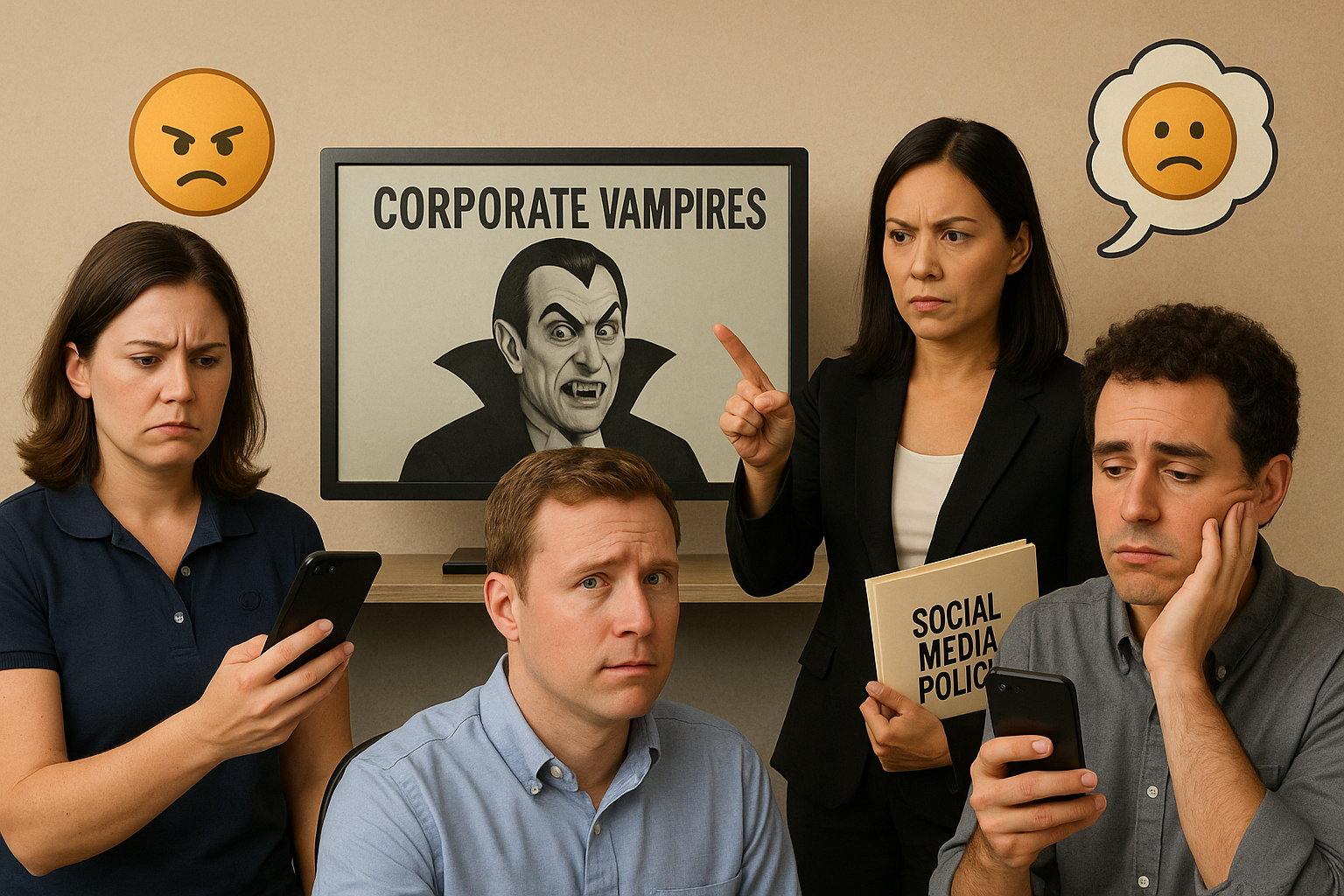
“So, when you said ‘corporate vampires,’ were you referring to… management?”
“No, Janet. It was a Halloween meme.”
“But you posted it in February.”
The Redemption Arc (a.k.a. The HR Re-Education Camp)
It always begins the same way — the email with the subject line “Quick Chat About a Recent Post.” Quick, of course, being corporate code for “We’ve already looped in three managers and legal.”
You join the meeting, and there it is — your post, displayed on the screen like an FBI evidence photo. Everyone stares. The HR rep clears her throat: “Can you explain this?”
You glance at the screen, seeing your tweet: “If meetings are ‘productive,’ why am I dead inside?”
You attempt humor. “It’s satire.”
They respond, “We understand, but satire can be misinterpreted.”
You reply, “So can leadership.”
It doesn’t land well.
Then comes the lecture about “company image” and “social media as an extension of the workplace.” They’ll quote the handbook. They’ll mention “employee responsibility.” They’ll even reference that one time someone got fired in 2018 for posting a TikTok in uniform — as if it’s now part of corporate folklore.
Finally, they’ll offer you a path to redemption: an online training module. You’ll watch five slides of clip art featuring ethnically diverse coworkers high-fiving under a banner that says “Think Before You Post!” You’ll answer questions like, “Is it appropriate to tag your employer in a meme about burnout?”
The correct answer is “no,” but the real answer is, “I’m doing it on my burner account anyway.”
After you pass the quiz (with flying colors, because you’ve learned nothing except how to click “next”), you’ll get a digital certificate in your email titled “Certified Responsible Digital Citizen.” Congratulations — you’ve completed your reprogramming.
You’ll smile, close the tab, and open your secret alt account where you post memes that say:
“I survived another HR training. My reward? Existential dread and a Teams notification.”
Final Thoughts: Freedom, But Make It Corporate
The modern workplace loves to talk about “culture,” “transparency,” and “authenticity.” But scroll through their social media policies, and you’ll see what they really mean: curated compliance disguised as culture.
They say “be yourself,” but only within the pre-approved emotional color palette. They say “speak up,” but not about that. They say “we’re a family,” but it’s the kind where you’ll get grounded for tweeting about dinner.
The truth is, companies don’t fear bad press — they fear honesty. Because honesty is contagious. If one person posts the truth about burnout, others might agree. And that’s how revolutions start: not with protest signs, but with viral posts that say, “We’re tired.”
So maybe the next time someone gets “written up” for a policy violation, we should thank them. They’re the unsung heroes of the modern workplace — the digital rebels who remind the rest of us that humor is still a survival skill.
Because if we can’t laugh about it, we’ll cry about it. And crying, according to the new handbook, is “unprofessional conduct, Section 7(b).”
So post carefully, my fellow wage earners. The algorithm is watching, HR is listening, and your meme about corporate life just might be your legacy.
And if they ever drag you into that “quick chat,” remember — freedom of speech may not exist at work anymore, but sarcasm? That’s eternal.






Your article helped me a lot, is there any more related content? Thanks! https://accounts.binance.info/register-person?ref=IHJUI7TF