There was a time when job interviews were simple, or at least simple in the way a dentist appointment is simple. You knew it was going to be uncomfortable, someone was going to judge you under fluorescent lighting, and eventually a person with authority would tell you whether things looked good or whether there were “areas of concern,” which is also how companies now describe entire departments held together by caffeine, panic, and one person named Melissa who knows where the spreadsheet lives.
Back then, interview questions made a little bit of sense. Someone would ask about your experience, your strengths, your weaknesses, your goals, and maybe why you wanted the job. You would answer like a normal human being trying to exchange labor for money, which used to be understood as the general point of employment. Nobody asked you what kind of kitchen appliance represented your leadership style. Nobody needed you to submit a three minute video explaining your passion for accounts payable while smiling like your rent was not watching from the corner.
But in 2026, interview questions have evolved into something stranger, more dramatic, and somehow less connected to the actual job. The modern interview no longer feels like two professionals discussing whether your skills match a role. It feels like being trapped inside a corporate escape room designed by HR, Legal, a consultant named Bryce, and an AI tool that has never had a job but is very confident about “culture alignment.”
You apply for a position called Operations Manager, and by round three you are being asked to describe a time you influenced a stakeholder without authority during a cross-functional ambiguity event while maintaining emotional agility and business ownership. Meanwhile, you are sitting there trying not to say, “I once got three grown adults to stop arguing over who forgot to order printer paper. Does that count as executive leadership?”
Every question sounds like it was assembled from a leadership podcast, a broken LinkedIn post, and a refrigerator magnet that survived a corporate retreat in Scottsdale. They do not ask, “Can you do the job?” anymore. That would be too honest. Too direct. Too dangerously close to a hiring decision.
Instead, they ask, “Tell me about a time you created measurable impact in a fast-paced environment with limited resources.”
And you think, “Every job I have ever had was a fast-paced environment with limited resources. That is not a scenario. That is capitalism with a badge scanner.”
The interview process now has the emotional structure of a hostage negotiation. You enter with hope, a polished resume, and the fragile belief that maybe this time will be different. Then someone joins the Zoom seven minutes late, camera off, says, “Sorry, I was stuck in another meeting,” and immediately asks why you are interested in the company, as if they did not just demonstrate the company culture in real time.
You answer politely. You say something about mission, growth, team building, and bringing your experience to an organization that values innovation. What you mean is, “Your salary range looked survivable, and the job description did not contain the phrase ‘rock star,’ so I took a chance.”
But you cannot say that. Not in this economy. So you perform. You become Interview You, the polished version of yourself who loves challenges, welcomes feedback, thrives under pressure, and has somehow never once fantasized about throwing a laptop into a decorative pond during a quarterly planning meeting.
Interview You is impressive. Interview You has stories. Interview You turns trauma into bullet points. Interview You can describe burnout as “resilience,” layoffs as “organizational change,” micromanagement as “stakeholder engagement,” and being abandoned by leadership as “autonomous decision making.”
That is the real talent employers are looking for in 2026. Not skills. Not experience. Not proof that you can actually do the job. They want to know whether you can narrate workplace chaos in a way that makes it sound like professional development.
And then come the questions.
“Tell Me About Yourself,” Also Known as the Opening Ceremony of Corporate Theater
“Tell me about yourself” used to sound friendly. Almost casual. Like the interviewer wanted to understand who you were, where you came from, and what made you a good fit for the role.
In 2026, “tell me about yourself” is not a question. It is a trapdoor with Wi-Fi.
Because they do not actually want you to tell them about yourself. Absolutely not. Do not tell them too much. Do not mention your actual life. Do not say you have children, bills, hobbies, aging parents, lower back pain, or a soul that now makes a faint clicking sound when someone says “circle back.” That is too human, and human beings are risky in hiring processes because they may eventually require boundaries, pay, or dental insurance.
What they want is a clean, rehearsed, emotionally neutral commercial about your professional existence. You are expected to summarize twenty years of experience in ninety seconds while sounding passionate but not desperate, confident but not arrogant, friendly but not informal, experienced but not expensive, strategic but still willing to do the work of four people because “the team is lean right now.”
You begin carefully.
“I started my career in operations, where I developed a strong foundation in leadership, process improvement, and team development.”
That sounds nice. It sounds professional. It also sounds like a sentence you created after deleting the more honest version, which was, “I learned how to manage people because nobody else wanted to talk to the angry customers, the broken systems, the underperforming team members, or the manager who thought accountability was something that happened to other departments.”
Then they ask the follow-up.
“What made you interested in this opportunity?”
This is one of the most delicate questions in the entire interview process because the honest answer is almost always illegal in spirit, if not in writing.
“I am interested because I enjoy eating food, living indoors, and avoiding the emotional adventure of explaining overdraft fees to myself at midnight.”
But again, no. You cannot say that. You have to pretend the job description moved you. You have to act like the phrase “dynamic team environment” touched your heart. You have to behave as if you read the company values and whispered, “Finally, a place where collaboration, integrity, and innovation live together in a PDF.”
So you say, “I was really drawn to the company’s growth and the opportunity to make an impact.”
Which is corporate for, “You appear to be hiring, and I appear to need employment. Look at us building alignment.”
The strangest part is that everyone knows this dance. The interviewer knows you are performing. You know they are performing. They know you know. You know they know. Yet the ritual continues because modern hiring is not about truth. It is about whether both parties can maintain the illusion long enough for someone to say, “We have a few more candidates to speak with.”
By the end of the first interview, you have explained your background, your motivation, your leadership style, and your interest in the role without once saying anything too real. You have turned your entire adult life into a professional appetizer.
And then they say, “Great, we’d love to move you to the next round.”
That should feel encouraging.
Instead, it feels like being told you survived the first room of a haunted house and there are six more floors.
Behavioral Questions, Where Your Trauma Needs a Beginning, Middle, End, and Measurable Outcome
Behavioral interview questions are based on the idea that past behavior predicts future performance, which sounds reasonable until you realize companies now use that logic to ask you to repackage every terrible workplace experience into a cheerful little bedtime story with metrics.
“Tell me about a time you dealt with a difficult coworker.”
A difficult coworker? Which genre would you like? The passive aggressive email scholar? The meeting hijacker? The lunch thief? The manager who said “my door is always open” but meant “emotionally, there is a moat”? The coworker who replied-all to company emails like they were trying to summon federal attention?
You cannot answer honestly.
You cannot say, “I dealt with a difficult coworker by documenting everything, limiting unnecessary interaction, praying for emotional restraint, and eventually watching them get promoted because leadership described their chaos as ‘high visibility.’”
So you build a story.
“I had a coworker whose communication style was different from mine.”
That is the approved phrase. “Communication style was different from mine” is corporate language for “This person made every conversation feel like a hostage video filmed in a conference room.”
You continue with structure because now every answer needs a format. Situation. Task. Action. Result. The STAR method. Because apparently even your suffering needs project management.
Situation: A coworker created tension.
Task: You needed to maintain collaboration.
Action: You scheduled a one on one, listened actively, aligned expectations, and created a communication plan.
Result: Productivity improved, the relationship strengthened, and the team achieved its goals.
What actually happened: You sent one calm email after writing six drafts that could never be subpoenaed.
That is the modern interview skill. Not leadership. Not operations. Not strategy. Emotional laundering. You take the ugliest workplace experience imaginable and wash it through professional language until it comes out sounding like a leadership seminar with complimentary bottled water.
Then they ask, “Tell me about a time you failed.”
This one is especially hilarious because companies claim they want vulnerability, but only the decorative kind. They want you to admit a failure, but not a real one. Not the kind that makes them question you. Not the kind that involves budget damage, team conflict, bad judgment, or accidentally replying “sounds good” to an email that absolutely did not sound good.
They want a failure that is humble, brief, educational, and somehow still impressive.
So you say something like, “Earlier in my career, I took on too much myself because I wanted to make sure everything was done correctly. I learned the importance of delegation.”
That is not a failure. That is a humblebrag wearing safety goggles.
But it works because the interviewer gets to write down “self-aware” and “growth mindset,” and you get to avoid saying, “My real failure was believing loyalty would protect me from a calendar invite titled ‘Quick Touch Base.’”
By the end of the behavioral round, you have told six stories, forgiven five imaginary coworkers, turned three failures into lessons, and described burnout as if it were a leadership certification. You feel like you should receive either a job offer or a therapist referral.
Instead, they say, “The team really enjoyed speaking with you. We’d like to schedule one more conversation.”
One more conversation.
The official anthem of people who are about to have four more conversations.
The Weird Questions Have Entered the Building
At some point in the interview process, usually after you have already proven you can do the job, someone decides it is time to ask a question that belongs in a personality quiz from a magazine found in a dentist’s office in 2004.
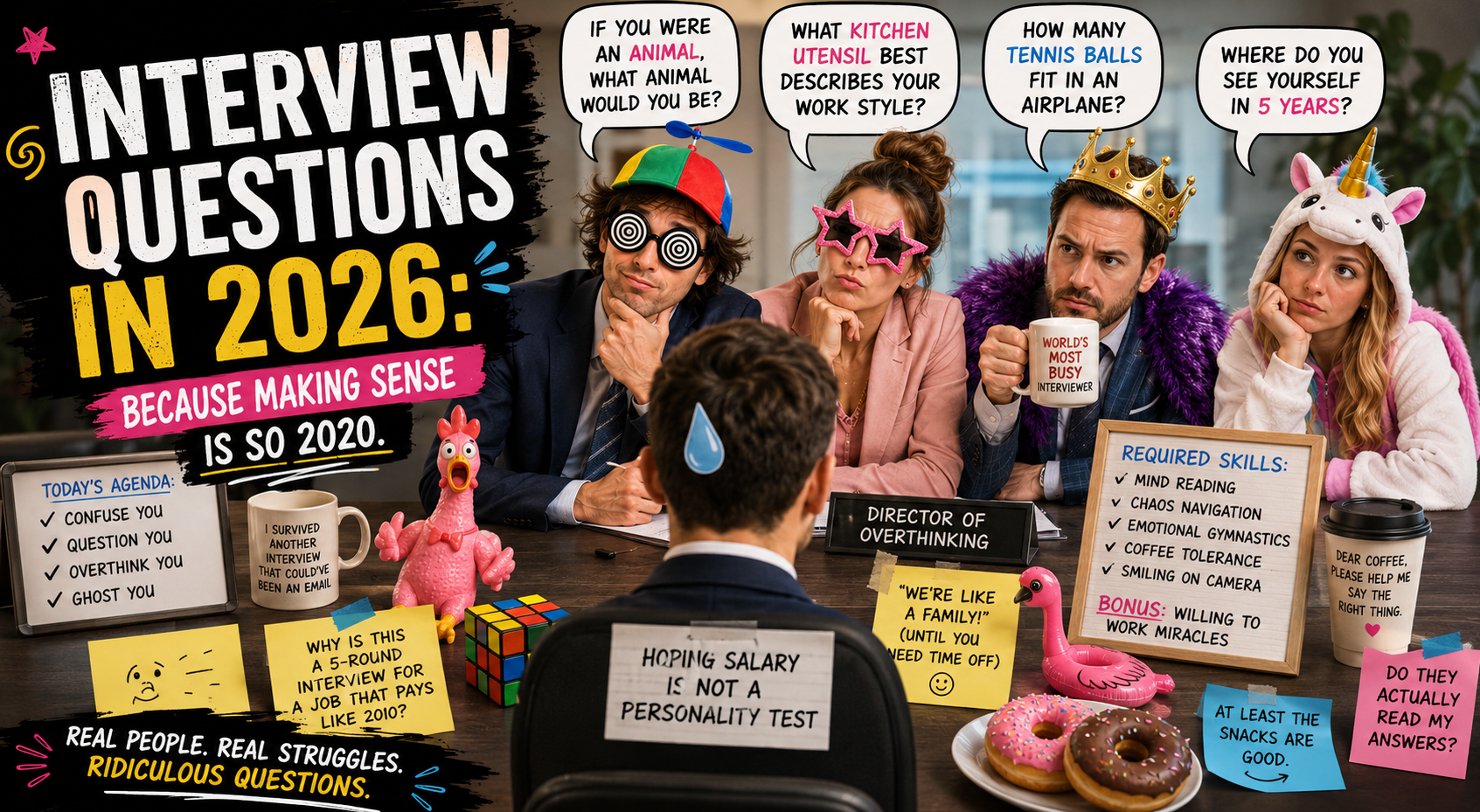
“If you were an animal, what animal would you be?”
Sir, this is a regional operations role.
“What kitchen utensil best describes your work style?”
A spatula, because I keep flipping bad situations into something edible while leadership asks why breakfast is behind schedule.
“How many tennis balls fit inside an airplane?”
Hopefully enough to distract whoever approved this question.
These questions are always introduced with a strange little smile, like the interviewer knows it is ridiculous but has been told by someone in talent strategy that it reveals creativity, problem solving, or cultural fit. And maybe it does. Maybe my answer to “what kind of tree would you be?” will finally reveal whether I can manage payroll, improve margins, coach underperforming teams, and survive a budget meeting where three executives say “efficiency” like it is a sacred bird.
The worst part is that you still have to answer. You cannot look confused. You cannot say, “I would be the tree outside this building because at least it gets fresh air and does not have to explain gaps in employment.” You have to play along.
“I’d probably be an oak tree because I’m steady, resilient, and able to provide support during changing seasons.”
Beautiful. Completely insane, but beautiful.
Now the interviewer is impressed because apparently you have strong forestry based leadership instincts.
Then comes the classic question.
“Where do you see yourself in five years?”
Alive, hopefully. Employed, ideally. Hydrated, if things go really well.
But you say, “I see myself growing with a company where I can continue developing as a leader, creating impact, and contributing to long term success.”
This is the safest answer because it says absolutely nothing while sounding like it belongs on a lobby wall next to a plant nobody waters.
Nobody wants the honest answer. Nobody wants to hear, “In five years, I would like to be in a role where the salary keeps up with groceries, the leadership team communicates before the crisis, and the phrase ‘we are like a family’ is treated as a warning label.”
The final boss question is always some version of, “Do you have any questions for us?”
This is where candidates must perform curiosity while carefully avoiding the questions they actually have.
You cannot ask, “Why is this position open?”
Too risky.
You cannot ask, “How many people have cried in this role?”
Too direct.
You cannot ask, “Why has this job been reposted six times?”
Too observant.
You cannot ask, “What happened to the last person?”
Too documentary.
So you ask something safe.
“What does success look like in the first ninety days?”
They love this question. It makes you sound proactive. It also gives them the opportunity to say something vague like, “We’re looking for someone who can come in, assess the landscape, build relationships, and start making an impact quickly.”
Translation: “There is a mess. We will not describe the mess. You will discover the mess after accepting the offer. The mess has tenure.”
By the time the interview ends, you are thanked for your time, told the team will regroup, and promised an update soon. Soon is a magical word in hiring. It can mean tomorrow, next week, three months from now, or never, depending on budget approvals, internal candidates, leadership alignment, Mercury retrograde, and whether someone remembered to move your name from Column C to Column D.
And then you wait.
Three days later, you get the email.
“We were impressed with your background, but we’ve decided to move forward with candidates whose experience more closely aligns with our needs.”
And somehow, the job is reposted by lunch.
Final Thoughts: The Interview Process Needs a Wellness Check and Possibly an Exorcism
Interview questions in 2026 have become less about discovering whether someone can do the job and more about testing whether they can survive a ritual of vague language, emotional gymnastics, and corporate riddles without visibly losing faith in society.
Candidates are expected to be polished but authentic, ambitious but humble, experienced but affordable, confident but not threatening, flexible but not desperate, strategic but hands-on, human but not inconveniently human. You have to explain your past without sounding wounded by it, describe your future without sounding like you need money, and demonstrate passion for a company you discovered four business days ago while applying to jobs at midnight.
And yet we keep showing up.
We show up because bills do not care about hiring timelines. Rent does not accept “the team is still evaluating candidates.” Groceries do not become cheaper because a recruiter said you were “very impressive.” Life keeps moving, and so do we, with our resumes, our rehearsed stories, our carefully lit Zoom corners, and our ability to say “great question” when the question was clearly assembled during a leadership offsite by people with matching lanyards.
The most impressive candidates in 2026 are not the ones who answer perfectly. They are the ones who keep going after the rejection emails, the ghosting, the fake urgency, the five round interviews, the reposted jobs, the assessments, the personality tests, the awkward video screens, and the hiring managers who ask where you see yourself in five years while refusing to tell you where the position will be in five weeks.
Because the truth is, job seekers have become experts in translation.
We know “competitive salary” means mystery.
We know “fast-paced environment” means staffing issue.
We know “wear many hats” means the budget left the building.
We know “family culture” means boundaries may be treated as betrayal.
We know “we’ll be in touch soon” means emotionally unsubscribe immediately for your own safety.
Still, we answer. We smile. We adjust the camera. We say, “Thank you for the opportunity.” We pretend the process is normal because apparently adulthood is mostly pretending absurd things are normal while attaching your resume again.
So the next time someone asks, “Tell me about a time you overcame a challenge,” just remember this entire job market counts.
You are overcoming a challenge right now.
You are applying into systems that make you create passwords for jobs that may not exist. You are writing cover letters to companies that respond with silence. You are interviewing with panels who forgot your name but still want to assess your passion. You are explaining your worth to people who use the word “alignment” because saying “decision” feels too dangerous.
And somehow, you are still standing.
That is leadership. That is resilience. That is adaptability. That is executive presence.
That is also probably why they will call you overqualified.
For more sarcastic survival notes from the hiring circus, follow me here: facebook.com/interviewgames
Because if we have to keep answering ridiculous interview questions, we might as well laugh loudly enough for HR to schedule a follow-up.