
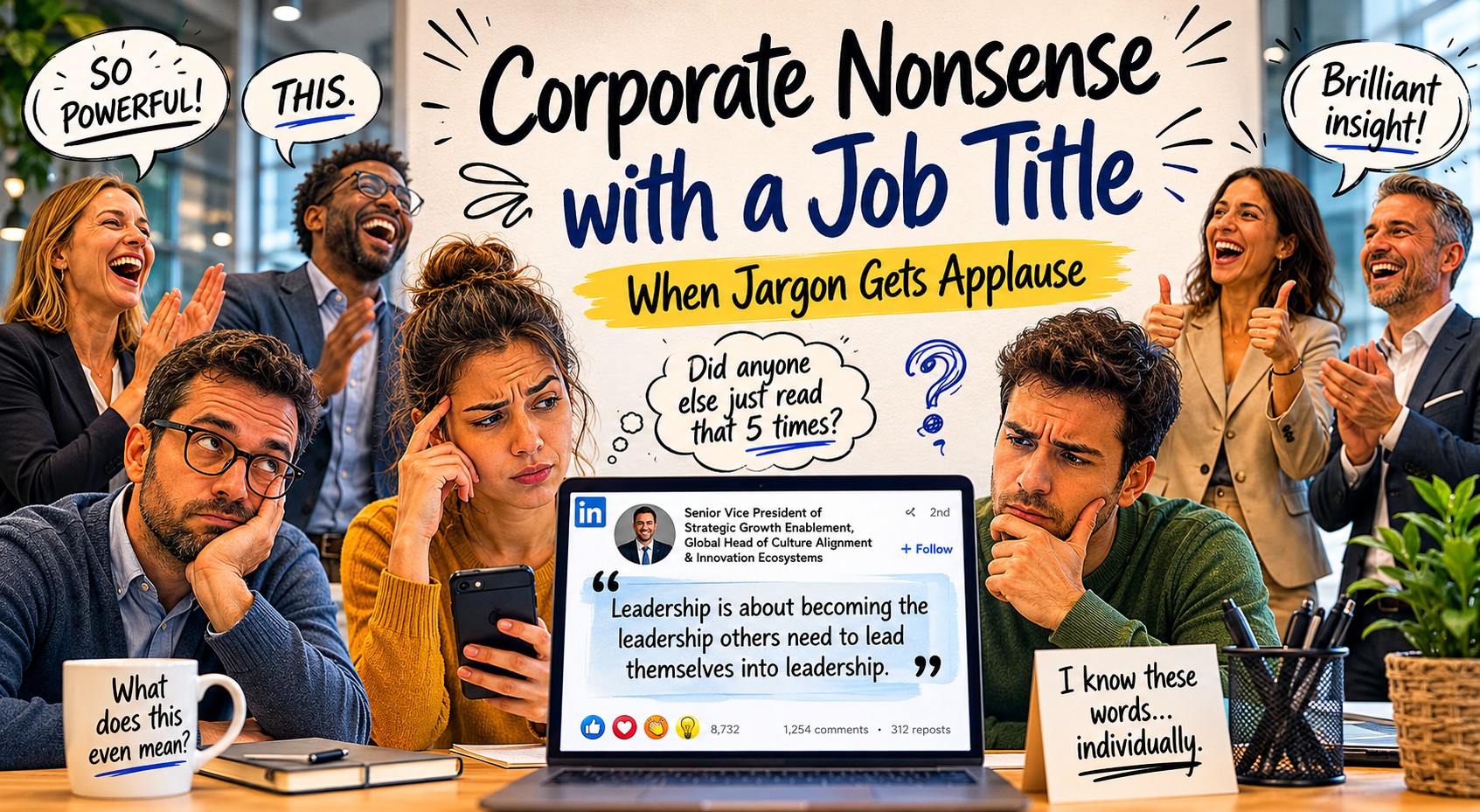
There is a special kind of confusion that only happens on LinkedIn, and it is not the ordinary confusion of trying to understand your health insurance benefits, assembling patio furniture with instructions written by someone who clearly had a personal grudge against diagrams, or reading a job description that wants leadership experience, technical expertise, emotional resilience, forklift certification, and the ability to thrive in chaos for eighteen dollars an hour. No, this confusion is more polished than that. It arrives wearing a navy blazer, a clean headshot, and a title so long it looks like it was approved by a committee during a leadership retreat with no windows and too many breakout sessions. It is the confusion that happens when someone important posts a sentence that technically contains words, but spiritually contains fog.
You are scrolling peacefully, minding your business, maybe trying not to apply for another job that has been reposted every eleven days since the invention of Wi-Fi, when you see a post from someone whose title sounds less like employment and more like a government agency created to regulate vibes. Senior Vice President of Strategic Growth Enablement. Global Head of Culture Alignment and Organizational Belonging. Executive Director of Thought Leadership, Synergy, Transformation, and Light Snacks. Before you even read the post, you already know the sentence is about to either change your life or make your brain submit a help ticket to IT.
Then you read it.
“Leadership is not about leading. It is about creating leaders who lead leadership through the leadership others need to lead themselves.”
And immediately the comment section loses its mind.
“THIS.”
“So powerful.”
“Needed this today.”
“Brilliant insight.”
“Couldn’t agree more.”
Couldn’t agree more with what, Denise? I have read the sentence four times, tilted my head like a golden retriever watching a PowerPoint presentation, and I still do not know if this person gave leadership advice or accidentally spilled a bowl of Scrabble tiles into a motivational calendar. But because the title is long, the headshot is professionally lit, and the post has enough white space to look expensive, everyone treats it like wisdom just descended from a conference room wearing a Patagonia vest and carrying a reusable water bottle with a company logo on it.
That is the magic of corporate language. If you say something simple, people ignore it. If you say something confusing with confidence, suddenly it becomes thought leadership. Someone can say, “Pay people fairly, stop wasting their time, and communicate clearly,” and the post gets twelve likes, one pity comment, and a thumbs-up from someone’s aunt who still thinks LinkedIn is Facebook with fewer recipes. But let a person with “Chief Visionary Strategy Architect” in their title write, “The future of work belongs to those brave enough to reimagine the future through future focused imagination,” and suddenly professionals gather in the comments like they are attending a candlelight vigil for vague sentences.
The Longer the Title, the Less the Sentence Has to Work
There is an unspoken rule in corporate culture that nobody admits out loud because admitting things out loud would require transparency, and transparency still has not cleared Legal. The rule is simple: the longer the title, the less the sentence has to make sense. A regular employee cannot post, “Success is about succeeding successfully through the success of success,” and expect applause. If a normal person posts that, coworkers will quietly check on them, offer water, and ask if they have been getting enough sleep. But if someone with a title containing “Global,” “Enterprise,” “Transformation,” “Strategic,” or “Enablement” posts it, suddenly the same sentence becomes a leadership framework, and people start commenting like they just witnessed a TED Talk discover fire.
The title does the heavy lifting. The words do not need to arrive with meaning because the title has already convinced everyone that meaning must be hiding in there somewhere, probably behind “alignment” or underneath “intentionality.” Corporate titles have become their own form of theater. Nobody is just a manager anymore. They are a People Experience Optimization Partner. Nobody schedules meetings. They are a Cross-Functional Collaboration Enablement Lead. Nobody fixes problems. They are a Strategic Solutions Architect of Operational Excellence, which sounds impressive until you realize they mostly send emails that begin with “circling back” and end with “thoughts?”
And because the title walks into the room first, wearing polished shoes and carrying a leather notebook, the actual sentence can stumble in behind it wearing flip flops and holding a balloon, and people will still clap. That is why someone can write, “Growth is not a destination. It is a mindset that becomes a movement when people move toward the mindset of growth,” and the comments immediately turn into a business revival. “Love this.” “Saving this.” “Exactly what our teams need.” Saving it for what? A hostage negotiation with a mission statement? A quarterly meeting where the Wi-Fi is weak and the trust falls are mandatory?
Meanwhile, useful thoughts get treated like background noise. Someone will post, “Train managers better. Stop ghosting candidates. Tell employees the truth. Put the salary in the job description. Do not call people family and then lay them off through a calendar invite.” That post will get mild traction, maybe a few nods from exhausted professionals who have seen enough corporate theater to qualify for an honorary drama degree. But the minute someone with a title longer than a CVS receipt says, “Human centered transformation begins when people courageously become the humans at the center of transformation,” LinkedIn starts clapping like the sentence just pulled a sword from a stone.
That is the power of hierarchy. It does not only decide who gets promoted, who gets invited to the meeting, who gets copied on the email, and who somehow receives credit for an idea they heard three weeks ago from someone with less authority. It also decides how much nonsense people are willing to treat as profound. The same sentence can be ridiculous from one person and revolutionary from another, depending entirely on whether the author has executive lighting, a board seat, and a profile banner that looks like it was designed by a consulting firm during a thunderstorm.
The Comment Section Knows the Assignment
The comment section is where the real performance begins, because the post itself may be confusing, but the comments are always crystal clear in their mission: applaud first, understand later, preferably never. There is a ritual to it. The first person comments “THIS,” in all capital letters, as if they found the Ark of the Covenant buried under a paragraph about workplace culture. Then someone else writes, “So powerful.” Then another person says, “Needed this today,” which always amazes me because I did not know someone could wake up needing to hear that “belonging begins when belonging belongs to the people building belonging,” but apparently the human spirit is more fragile than we thought.
Nobody wants to break the spell. Nobody wants to be the person who says, “Respectfully, what in the LinkedIn soup does this mean?” because that is dangerous in a world where visibility is currency and confusion can be mistaken for weakness. So instead, everyone joins the applause line. One person says, “Couldn’t agree more,” even though agreeing would require identifying a point. Another says, “This is the conversation leaders need to be having,” because consultants can turn any sentence into an invoice. Someone from HR says, “Culture starts here,” although nobody can locate “here” on a map, in a budget, or in the employee handbook.
Then there is always the ambitious networker who comments with their own equally vague sentence, because on LinkedIn, the safest way to respond to fog is with a smaller fog machine. “Absolutely. When leaders empower alignment, teams unlock the courage to scale authenticity.” What are we doing? Why does every sentence sound like it was written by a whiteboard after three LaCroix and a panic attack? How did we get to a place where people can assemble impressive sounding phrases from corporate vocabulary leftovers and everyone treats it like scripture delivered through Microsoft Teams?
The funniest part is that the comment section never looks confused. It looks deeply moved. People are thanking the author. People are tagging other people. People are saying “great reminder,” even though the only thing I was reminded of was that some sentences can wear a suit and still be completely unemployed. It becomes a synchronized swimming routine of professional approval, elegant and terrifying, everyone smiling above the surface while kicking frantically underneath because nobody wants to admit they do not know what the post means either.
And that is the real corporate survival skill nobody teaches you during onboarding. You learn when to speak, when to nod, when to laugh at the executive joke that was not funny, and when to pretend “strategic intentionality” is a real phrase instead of a business raccoon rummaging through the vocabulary bin. You learn that some meetings are not about decisions, some emails are not about information, and some comments are not about agreement. They are about being seen clapping in the right room, under the right post, near the right title, while the algorithm quietly takes attendance.
Corporate Language Is a Fog Machine With Benefits
Corporate language is not always designed to clarify. Sometimes it is designed to hover. It floats above the room like a fog machine at a middle school dance, making everything look more dramatic while preventing anyone from seeing the actual floor. That is why simple statements are rarely allowed to remain simple. You cannot say, “We need to communicate better.” You have to say, “We are entering a new phase of cross-functional communication alignment designed to enhance stakeholder visibility and accelerate clarity across the enterprise.” Which means Kevin forgot to tell accounting again.
You cannot say, “People are tired.” You have to say, “Teams are navigating capacity challenges in a dynamic environment.” Which means everyone is one email away from chewing through a conference table. You cannot say, “We are understaffed.” You have to say, “We are optimizing talent resources.” Which means three people quit, one person is crying in their car, and the company is still pretending the pizza party counts as retention strategy. Corporate language takes reality, puts it in a suit, removes the pulse, and sends it through seven approval layers until nobody can be blamed for anything.
That is why vague LinkedIn posts survive so well. They sound familiar. They sound official. They sound like every town hall where an executive said “transformation” eleven times and somehow never explained who was losing access to the building. They sound like emails that begin with “exciting update” and end with your workload doubling. They sound like performance reviews where your manager says you are exceeding expectations but your raise is not aligned with current budget priorities, which is corporate for, “Great job, but please continue being excellent at last year’s price.”
The more abstract the language becomes, the safer it is. Specific language creates accountability. Vague language creates escape routes. If you say, “We need to pay employees more,” someone might ask about budgets. If you say, “We need to rethink value creation through a people first lens,” everyone can nod, schedule a follow-up meeting, and go back to doing absolutely nothing. If you say, “Stop wasting candidates’ time,” someone might have to fix the hiring process. If you say, “We must humanize the talent journey through intentional candidate experience ecosystems,” everyone can create a committee, build a slide deck, and call it progress by Q4.
That is the beauty of the fog. Nobody has to move. Nobody has to fix anything. Nobody has to admit the sentence is empty. Everyone can simply stand inside it, smiling professionally, while pretending the lack of clarity is actually depth. And honestly, it would be less funny if it were not so familiar, because we have all been in the room where someone says a sentence nobody understands and everyone writes it down. We have all watched a direct question receive a six minute answer made entirely of vocabulary smoke. We have all left a meeting described as “productive” even though nobody knows what was decided, who owns the next step, or why the meeting existed in the first place.
LinkedIn is just the public version of the same performance. A stage. A microphone. A polished headshot. A title with eighteen syllables. A sentence that walks in circles until the algorithm rewards it. Beneath it, a crowd of professionals clapping because corporate culture has trained us to confuse confidence with clarity, authority with intelligence, and vague phrases with wisdom, especially when the font is clean enough and the person posting looks like they have successfully used the word “leverage” in a sentence without laughing.
Final Thoughts: Somewhere, a Normal Person Is Whispering, “I Know These Words Individually”
Not every leadership post is bad. Some people really do share helpful insight. Some leaders know how to communicate clearly, treat people well, and explain complicated things without sounding like they locked themselves inside a thesaurus during a quarterly planning session. Some executives have earned their credibility, and some posts deserve every bit of applause they receive. But a lot of what gets celebrated online is not wisdom. It is word smoke. It is corporate incense. It is a sentence dressed up as strategy because the person who posted it has enough authority to make confusion feel like your personal problem.
And that is why we need to give ourselves permission to stop pretending every polished paragraph is profound. You are allowed to read a leadership quote and say, “This does not mean anything.” You are allowed to see a comment section full of applause and still trust your own brain. You are allowed to recognize that sometimes people are not celebrating insight at all. They are celebrating status. They are clapping for the title, the lighting, the proximity to power, and the tiny hope that maybe a little professional glitter will fall on them if they stand close enough to the vague sentence.
Because the workplace has trained people to reward nonsense when it comes from above. We do it in meetings. We do it in emails. We do it in town halls. We do it in comment sections. Someone important says, “We are moving toward a more agile, human centered, purpose driven operating model,” and everyone nods like they did not just hear a Roomba bump into a thesaurus. Then the normal people go back to doing the actual work, fixing the actual problems, answering the actual phones, handling the actual customers, cleaning up the actual messes, and translating the corporate fog into something human beings can use before lunch.
The people doing the work know the difference between leadership and theater. They know clarity when they hear it. They know when a sentence has a spine and when it is just wandering around the building looking for a badge reader. They know that “leadership is not about leading leaders into leadership” is not a philosophy. It is a sentence wearing too much cologne. They also know that the most useful advice in business is usually painfully simple: tell the truth, pay people fairly, train your managers, respect people’s time, stop hiding behind jargon, and do not call every basic act of decency a strategy.
So the next time you are scrolling and you see a long title followed by a paragraph that makes your brain request technical support, breathe. You are not broken. You are not behind. You are not too simple to understand brilliance. There is a very good chance the post is just nonsense with better lighting. The comments may be clapping. The executives may be nodding. The consultants may be invoicing. The algorithm may be handing out visibility like communion wafers at the church of professional ambiguity. But somewhere out there, another normal person is reading the same post, squinting at the screen, watching everyone type “powerful,” and quietly whispering the most honest sentence in modern professional life:
“I know these words individually, but not in this order.”