
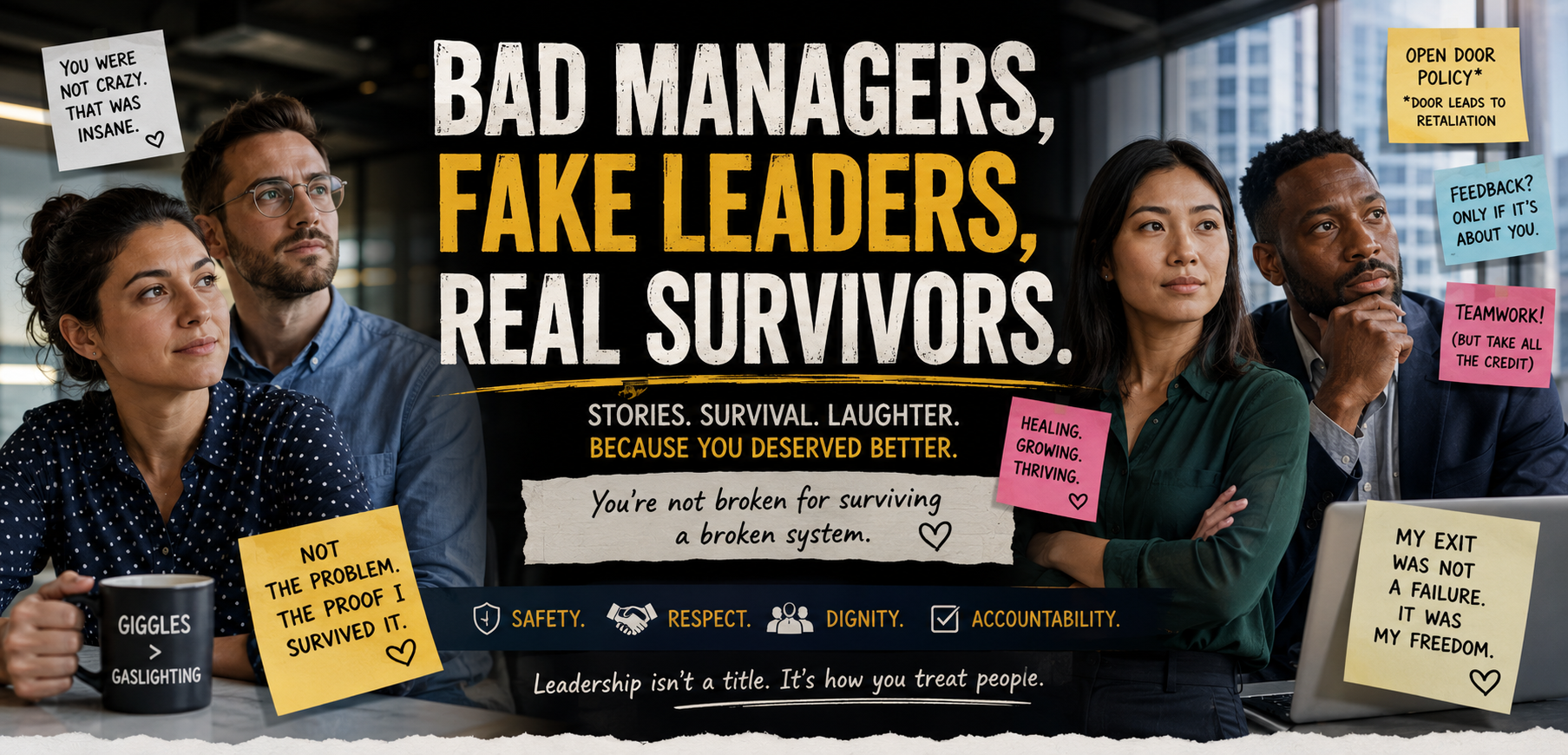
Some messages do not just land in your inbox. They walk in slowly, pull up a chair, turn off the fluorescent lights, and make the entire room feel different.
Because sometimes someone will say something casually that should never be casual. They will write, “My last company forced me out, my boss sexually harassed me,” and then somehow still end the message with kindness, humor, and “thanks for the giggles,” as if they did not just hand you a file folder labeled, “Evidence That Corporate America Needs Adult Supervision.”
That is the part that stops me.
Not just the pain itself, although that is awful enough. It is the way people have learned to package workplace damage into sentences that are safe enough to survive LinkedIn. People are walking around with headshots, polished headlines, carefully edited About sections, and entire haunted houses of professional trauma tucked behind phrases like “challenging environment,” “poor leadership fit,” and “I learned a lot.”
Which is corporate code for, “I survived a manager who treated power like a rental car.”
And somehow, after everything, the person who was harmed still has to do the emotional tax paperwork.
They have to update their resume without sounding angry. They have to interview without sounding wounded. They have to explain why they left without saying, “Because my boss belonged in a compliance training video with dramatic reenactments.” They have to sit across from a recruiter and turn a professional escape route into something elegant, calm, and legally digestible.
“I was looking for growth.”
No, Sharon. They were looking for oxygen.
Meanwhile, the manager who made the workplace feel like a psychological obstacle course is still out there posting about leadership. They are writing things like, “Culture is built through trust,” even though their actual management style was closer to a raccoon loose in a courtroom holding a stapler and refusing accountability.
And LinkedIn lets them do it.
No warning label. No badge. No gentle pop-up that says, “Several former employees have described this person as a leadership weather event.”
Nothing.
Just a smiling profile picture, a banner with mountains, and a headline that says, “People-first leader,” which is fascinating because the people were apparently first in line for emotional damage.
So let us talk about it.
Not in the polished corporate way. Not in the “let’s unpack this over a listening session that changes absolutely nothing” way. Let us talk about the bad managers who dress up as leaders, the people who survive them, and the strange miracle of turning pain into comedy because sometimes laughter is the only flashlight bright enough to expose the absurdity.
Some Managers Do Not Lead Teams, They Collect Witnesses
There is a special category of manager who does not build culture. They create folklore.
Years after people leave, former employees still gather in group chats and speak their name like villagers discussing the old castle on the hill.
“Do you remember the Monday meeting?”
“Do you remember when they said we were a family?”
“Do you remember when they called retaliation ‘coaching’?”
That is not leadership. That is a documentary waiting for a streaming platform.
Bad managers have a very specific talent for making normal work feel like survival training. They can turn a simple email into a psychological escape room. They can make a one-on-one feel like a deposition. They can say, “My door is always open,” while somehow making the door feel like it leads directly into a performance improvement plan, a gaslighting seminar, and a conference room where hope went to update its resume.
And the worst part is that they are often fluent in leadership vocabulary.
That is what makes them dangerous.
They know all the words. Accountability. Empathy. Transparency. Psychological safety. Ownership. Collaboration. Respect.
They sprinkle those words across meetings like parmesan over a plate of cold corporate pasta. But when it is time to actually demonstrate any of those values, suddenly they become archaeologists searching for a policy loophole.
A bad manager can say, “We value open communication,” and then punish the first person who communicates openly.
They can say, “Bring your whole self to work,” then become deeply uncomfortable when your whole self has boundaries, documentation, and access to email timestamps.
They can say, “We are a team,” but the second something goes wrong, they turn into a motivational escape artist and disappear through a trapdoor labeled “individual accountability.”
Some managers do not lead teams. They collect direct reports like witnesses. Every meeting becomes evidence. Every email becomes a future exhibit. Every vague Teams message arrives with the emotional temperature of a subpoena.
“Quick question.”
No, it is not.
A quick question is, “Do you want coffee?” A quick question is, “Did you move the meeting?” A quick question is not a 4:57 p.m. message from a manager who uses punctuation like a weapon.
And somehow, these people keep getting promoted.
That is the part nobody wants to explain at the leadership summit.
We have built entire corporate ecosystems where the person causing the most damage can still look successful on paper because turnover gets called “natural attrition,” fear gets mistaken for discipline, silence gets mistaken for respect, and exhausted employees are praised for being “resilient” instead of being asked why they needed to become that resilient in the first place.
Bad managers love resilience because it lets them avoid repair.
They love saying, “People need to be adaptable,” when what they really mean is, “Please keep absorbing chaos while I continue calling it strategy.”
And the employees? They adapt. They survive. They become experts at reading tone. They learn which questions are safe. They learn when to speak, when to stay quiet, when to document, when to call someone after work and say, “Please tell me I am not losing my mind.”
That is not professional development.
That is workplace weather survival.
The Person Who Was Harmed Still Has to Sound Employable
One of the cruelest parts of a bad workplace is what happens after you leave.
Because leaving should be the victory scene.
There should be music. There should be sunlight. There should be a slow-motion exit where you throw your badge into the air and a choir of former employees appears from behind the printer singing, “You made it out.”
But instead, you get job applications.
You get Workday.
You get interview questions designed by people who have clearly never tried to explain a toxic workplace without sounding like the problem.
“So, why did you leave your last role?”
What a beautiful little grenade of a question.
Because the honest answer might be, “Because my boss treated boundaries like optional software updates.”
Or, “Because leadership created an environment so unstable that my nervous system started recognizing calendar invites as predators.”
Or, “Because the company had values printed on the wall, but apparently nobody installed them in management.”
But you cannot say that.
Not really.
Because now you have to perform professionalism for an audience that claims to want authenticity but gets nervous when authenticity arrives without a blazer.
So you say something smooth.
“I was looking for an opportunity more aligned with my long-term goals.”
That sentence deserves an award for emotional gymnastics.
What you mean is, “I wanted to work somewhere my boss did not make eye contact with accountability and immediately call legal.”
But you smile. You nod. You protect your future. You take the entire truth, put it in a tiny corporate suitcase, and carry it through the interview like it is not heavy.
That is what so many people are doing.
They are not just job hunting. They are healing in public while trying to look hireable. They are rewriting trauma into bullet points. They are turning survival into “adaptability.” They are turning betrayal into “stakeholder management.” They are turning, “I had to leave before this place turned me into a ghost with dental insurance,” into “seeking a healthier culture.”
And let me be clear: there is nothing wrong with being strategic. Sometimes you protect yourself because the world has not earned the full story. Sometimes professionalism is not pretending nothing happened; sometimes professionalism is refusing to hand your pain to people who will mishandle it.
But it is still exhausting.
It is exhausting to be the person who went through it and still has to carry the burden of sounding pleasant.
Do not sound bitter.
Do not burn bridges.
Do not be negative.
Do not make people uncomfortable.
Meanwhile, the bridge was on fire when you got there, the manager was holding matches, HR was asking if you had tried building a stronger relationship with the flames, and now everyone wants you to describe the experience as a “learning opportunity.”
Beautiful.
Absolutely beautiful.
Someone get corporate America a helmet.
Humor Is Not Denial. Sometimes Humor Is Evidence.
People sometimes misunderstand workplace humor.
They think jokes mean you are not taking something seriously. They think sarcasm means you are exaggerating. They think comedy is just a coping mechanism, like stress eating, impulse-buying office supplies, or updating your LinkedIn headline at midnight with the confidence of a person one rejection away from becoming a motivational speaker.
But humor is often the most honest thing in the room.
Humor says what professionalism has been trained not to say.
Humor looks at a boss posting about “servant leadership” after terrorizing an entire department and says, “Interesting. Did the servants know?”
Humor looks at a company that says, “We are a family,” while laying people off through a calendar invite and says, “Yes, but apparently one of those families from a true crime documentary.”
Humor looks at the phrase “people-first culture” and asks, “First where? In line for burnout?”
That is not denial.
That is diagnosis with better timing.
Comedy gives people language when the official language has failed them. Because corporate language is often designed to make nonsense sound reasonable.
A layoff becomes “rightsizing.”
A toxic boss becomes “a strong personality.”
Retaliation becomes “misalignment.”
Burnout becomes “capacity challenges.”
A workplace where everyone is afraid to speak becomes “fast-paced.”
No, thank you.
Sometimes the funniest person in the room is not the person avoiding reality. Sometimes they are the only one brave enough to point at the elephant wearing a leadership badge and say, “That thing has been in charge of performance reviews?”
Humor does not erase what happened. It gives people a way to breathe around it.
That matters.
Because when someone laughs at a joke about bad managers, they are not only laughing because it is funny. They are laughing because something in them feels recognized. They are laughing because someone finally said the quiet part without wrapping it in a webinar. They are laughing because for one second, they are not alone with the story.
That is why the message mattered.
When someone says, “My last company forced me out, my boss sexually harassed me, and your posts made me laugh,” that is not just a compliment. That is a reminder that humor can be shelter. Not the whole house. Not the legal remedy. Not the policy change. Not the accountability that should have happened much earlier.
But shelter.
A place to stand for a second.
A place to say, “No, I was not crazy.”
A place to remember, “What happened to me was real.”
A place to laugh, not because it was okay, but because you are still here.
And that is no small thing.
Final Thoughts: You Were Not Broken. The System Was Just Wearing Dress Shoes.
To everyone who has ever survived a bad manager, a toxic workplace, a forced exit, a humiliating interview explanation, or one of those jobs where the company values were printed in beautiful font while the actual culture was crawling through the ceiling vents, I want you to know something.
You were not weak because it affected you.
You were not dramatic because you noticed.
You were not bitter because you told the truth.
You were not unprofessional because you expected basic respect from someone with authority, a title, and apparently unlimited access to leadership buzzwords.
Some workplaces are not “challenging environments.” They are emotional obstacle courses with payroll.
Some bosses are not “difficult personalities.” They are walking HR investigations with LinkedIn Premium.
Some leaders are not misunderstood. They are just bad at power and excellent at vocabulary.
And people should not have to become comedians, legal scholars, therapists, documentation experts, and escape artists just to survive a paycheck.
But somehow, many do.
They survive the meetings. They survive the comments. They survive the gaslighting. They survive being pushed out. They survive watching the person who caused the damage continue posting about empathy like they did not personally drive morale into a ditch and then blame the tires.
And after all that, they still show up.
They still help other people laugh. They still send kind messages. They still rebuild. They still apply. They still interview. They still believe there are better workplaces out there, even if they have to sort through corporate haunted houses to find one with working lights.
That is strength.
Not the fake kind companies put on posters.
The real kind.
The kind that gets up after being mishandled and says, “I am still here, but I am not pretending that was okay.”
So yes, I will keep making jokes about bad managers, haunted job descriptions, HR theater, LinkedIn leadership cosplay, and bosses who should have come with a warning label and a mandatory cooling-off period.
Because laughter may not fix the system.
But it does something the system often refuses to do.
It tells the truth.
It hands people a little oxygen.
It reminds someone reading quietly from their desk, their couch, their car, or the emotional witness protection program known as “open to work” that they are not broken for surviving something that should never have happened.
And if a few giggles help someone carry a heavy chapter for one more day, then I will keep handing them out like tiny emotional helmets.
Because bad managers may parade around as leaders.
But the people who survived them?
They are the ones who know what real leadership should have looked like all along.