
There is a version of LinkedIn that lives only in my imagination, and I visit it often, usually after reading the seventeenth layoff announcement of the week written in the emotional tone of a hotel cancellation policy.
It is a magical place. A dangerous place. A place where people stop saying, “My role was impacted,” and start saying, “At 10:03 this morning, my calendar invited me to my own professional funeral, and the officiants were my manager, HR, and a finance spreadsheet wearing noise-canceling headphones.”
That version of LinkedIn would either heal society or immediately require a legal defense fund.
Because the LinkedIn we have now is built on professional translation. Nobody is ever fired. They are “impacted.” Nobody is ever blindsided. They are “entering a new chapter.” Nobody is ever sitting at their kitchen table staring into the middle distance wondering how health insurance became a luxury item. They are “excited to explore what’s next.”
Excited.
That word does more unpaid labor on LinkedIn than any intern in America.
People lose their jobs and somehow feel pressured to describe the experience like they just returned from a leadership retreat in Sedona where everyone learned vulnerability from a man named Brent who owns linen pants. They write posts thanking the company that just removed their paycheck, praising leaders who did not have the courage to say goodbye directly, and promising they are “open to new opportunities,” which is a very polished way of saying, “Please rescue me from this emotional escape room with direct deposit.”
And listen, I understand why people do it.
The job market is not exactly a safe place for honesty. The same companies that claim to value authenticity often react to actual authenticity like someone released a raccoon into a board meeting. Everyone says, “Bring your whole self to work,” but what they usually mean is, “Bring the version of yourself that claps during town halls, says ‘great question’ before asking a question, and never publicly mentions that leadership called you family three weeks before deleting your badge access.”
So people soften the truth.
They sand down the corners.
They take the most destabilizing moment of their professional life and turn it into corporate haiku.
“After an amazing journey…”
“My role has been impacted…”
“I am grateful for the memories…”
Meanwhile, in real life, they are sitting there trying to calculate how long severance lasts, whether COBRA was invented by someone who hates breathing, and whether cereal counts as dinner if eaten with the dignity of a person who once had a 401(k).
But imagine, just for a moment, a different LinkedIn.
Imagine a LinkedIn where the layoff post was honest.
Not cruel. Not reckless. Not unhinged.
Just honest.
A LinkedIn where people tagged the decision-makers with the same cheerful energy companies use when tagging employees in award posts.
A LinkedIn where “business decision” was no longer allowed to hide in the corner wearing a blazer.
A LinkedIn where HR could not toss a phrase like “your role has been eliminated” into the room and then disappear behind a shared mailbox called People Operations.
That LinkedIn would be terrifying.
It would also be the most interesting professional networking platform ever created.
Because the fully tagged layoff post would change everything.
“My Role Was Impacted” and Other Corporate Fairy Tales
“My role was impacted” is one of the most impressive phrases in modern employment because it says everything and nothing at the same time.
It has the emotional range of a paper towel dispenser.
It sounds gentle, almost accidental, like your job slipped on a wet floor sign and HR is asking everyone to respect its privacy during this difficult time. It makes the layoff sound like weather. Like nobody did anything. Like a cold front moved through the department and unfortunately your paycheck was standing near a window.
But a role does not get impacted on its own.
A role gets placed inside a spreadsheet. A number gets highlighted. A meeting gets scheduled. Someone says “headcount reduction” with the confidence of a person whose own head remains comfortably counted. Then leadership nods, finance nods, legal nods, HR nods, and suddenly your entire professional existence is summarized in a calendar invite titled “Quick Touch Base.”
That is how they get you.
No layoff meeting is ever named honestly.
Nobody sends an invite called “Your Mortgage Has Been Entered Into a Business Decision.”
Nobody writes, “Mandatory Meeting: Please Attend While We Reorganize Your Life.”
Nobody says, “Join Teams at 2:00 p.m. so we can speak in rehearsed sentences while you try not to panic on camera.”
No. They call it “Quick Sync.”
The most dangerous phrase in corporate America.
Because nothing good has ever happened in a surprise “Quick Sync.” A quick sync is where hope goes to be professionally escorted out of the building. A quick sync is a calendar invite wearing a trench coat. A quick sync is the workplace equivalent of your dog staring at an empty corner at midnight.
And once you enter, the theater begins.
Your manager is there, looking serious but not legally responsible.
HR is there, wearing the facial expression of someone who has practiced empathy in front of a mirror.
A second HR person may also be there, usually silent, possibly training, possibly documenting, possibly present because sorrow now requires witnesses.
Then comes the sentence.
“As you know, the business has been going through changes.”
Actually, no, Susan, I did not know. I knew we had a pizza lunch last Thursday and a town hall where Brad said we were entering a season of growth. I knew leadership sent an email about resilience, agility, and the importance of staying focused. I knew someone ordered cupcakes because the company hit a milestone. I did not know the milestone was my exit.
Then comes the phrase.
“This is not a reflection of your performance.”
Beautiful. Stunning. Comforting. Completely useless.
Because if it is not a reflection of my performance, then apparently I have been laid off for being too decoratively employed in the wrong section of the org chart.
Then comes the paperwork.
Then the benefits explanation.
Then the “we appreciate your contributions.”
That phrase always arrives at the exact moment the system is removing your access, which is a level of irony only corporate America could laminate.
“We appreciate your contributions.”
Do you?
Because my contributions are still in the shared drive, but I am locked out of it like a ghost haunting my own Q4 planning document.
And then, after all that, people are expected to go on LinkedIn and write something graceful.
“After an amazing journey…”
No.
After a surprise meeting that smelled like printer toner and betrayal, I am now available for opportunities.
That is the post.
That is the truth.
The Fully Tagged Layoff Post
Now imagine if people started tagging everyone.
Again, not in a wild way. Not in a “burn it all down and forward this to legal” way. Just in the calm, professional, LinkedIn-approved tone of someone who understands visibility is a two-way street.
The post would begin politely.
“I want to share that today was my last day at the company after my position was eliminated.”
So far, normal. Respectable. Safe.
Then the tags arrive.
“Special thanks to Brad from leadership for explaining last month that our people are our greatest asset, right before converting several of those assets into savings.”
Now we are awake.
“Thank you to Karen from HR for delivering the phrase ‘business decision’ with the warmth and emotional depth of an airport kiosk.”
Now the comments are refreshing themselves.
“And of course, shoutout to the executive team for reminding us during every town hall that we are a family, then apparently submitting several relatives for budget optimization.”
That is when LinkedIn becomes a live event.
People would gather.
Recruiters would pretend not to look.
Former coworkers would hover over the like button, sweating through their quarter zips.
HR would open Slack channels with names like urgent-reputation-alignment.
Legal would ask if anyone saved screenshots.
Brad would suddenly update his profile to “Leadership | Transformation | People-First Culture | Opinions Are My Own.”
And the comments would be incredible.
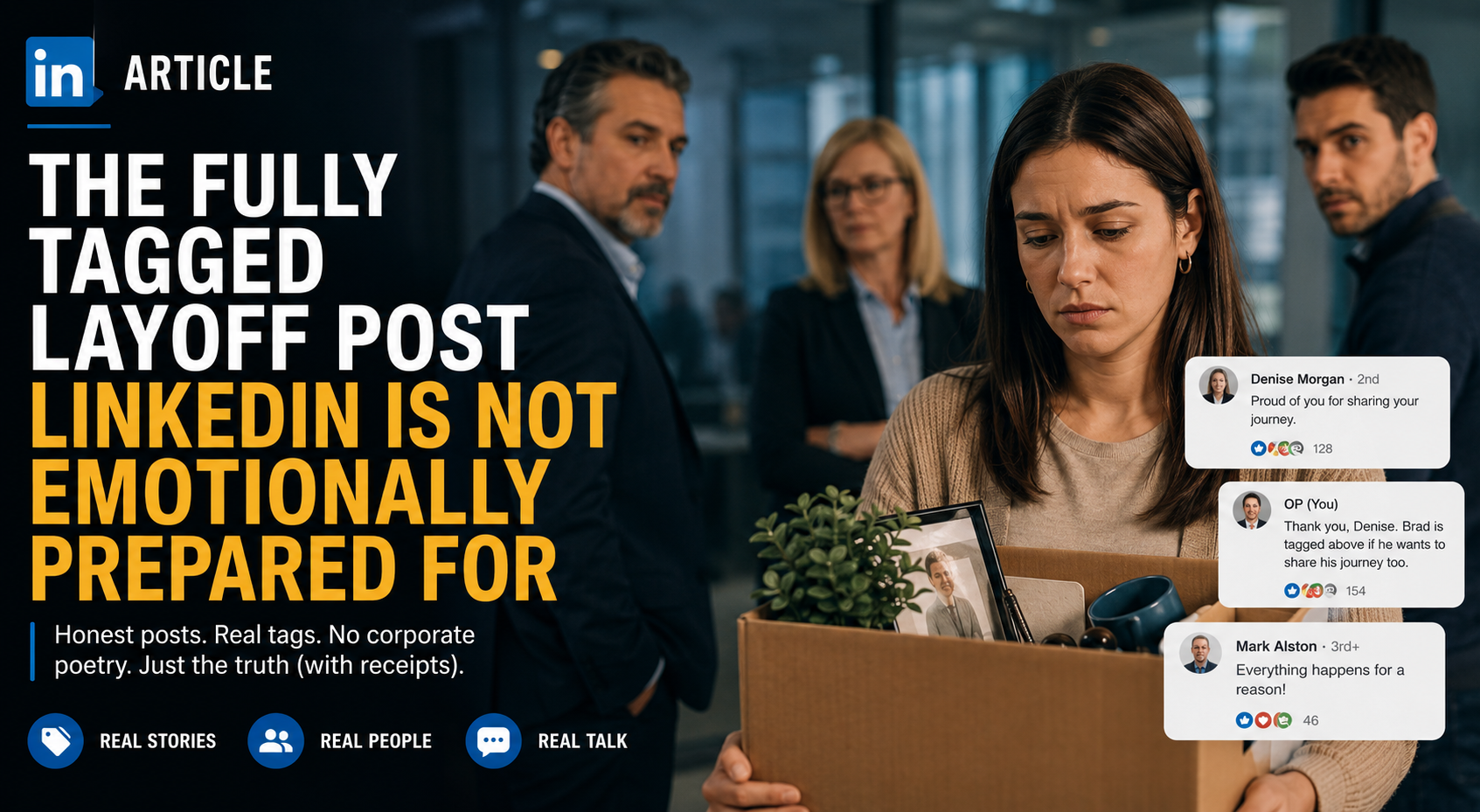
“Proud of you for sharing your journey.”
“Thank you, Denise. Brad is tagged above if he wants to share his journey too.”
“Everything happens for a reason.”
“Agreed, Mark. In this case, the reason appears to be a spreadsheet and executive bonus preservation.”
“You are so brave.”
“Thank you. I was mostly unemployed, but brave is also available.”
This is the transparency companies claim to love until transparency includes names, dates, and the exact wording from the layoff script.
Because companies love storytelling when they control the narrator.
They love employee spotlights.
They love culture posts.
They love smiling team photos from volunteer day where everyone is wearing matching shirts and pretending the event was not scheduled during the busiest week of the quarter.
They love saying, “Our people are our greatest strength.”
But the moment one of the people says, “Great, then let’s discuss why several of us were removed after the third consecutive record-breaking quarter,” suddenly everyone wants to move the conversation offline.
That is always the phrase.
“Let’s take this offline.”
Translation: Please stop letting the public watch the building catch fire.
Corporate America does not fear negativity. It fears documentation.
It fears the sentence that is both calm and specific.
It fears a layoff post that does not scream, but simply says, “Here is what happened.”
Because screaming can be dismissed.
Bitterness can be dismissed.
A post with clean grammar, measured tone, and accurate tags?
That is not messy.
That is minutes from the meeting.
The Performance of Grace
The strangest part about layoffs is not just that people lose their jobs.
It is that they are expected to lose them beautifully.
There is an entire performance required.
You must be hurt, but not too hurt.
Honest, but not too honest.
Grateful, but not delusional.
Available, but not desperate.
Professional, but still human enough to inspire engagement.
You have to stand in the wreckage of your income and write something that makes hiring managers comfortable.
That is the part nobody says out loud.
Most layoff posts are not written for the person who was laid off. They are written for the imaginary future employer watching from the bushes with a clipboard.
So people perform resilience.
They perform gratitude.
They perform emotional stability at a moment when their nervous system has been placed into an Excel formula.
They say things like, “I am excited for what’s next,” because “I am terrified and my stomach has been making whale noises since the meeting” does not fit the brand.
They say, “I will miss my amazing coworkers,” which is often true.
They say, “I am thankful for everything I learned,” which may also be true.
But they rarely say, “I am angry that leadership made decisions from a safe distance and then handed the emotional cleanup to HR.”
They rarely say, “I gave years of energy to a place that called me essential until I became expensive.”
They rarely say, “I wish companies were as careful with people as they are with press releases.”
And that is the tragedy hiding under the comedy.
Because most people are not trying to be dramatic.
They are trying to survive.
They are trying to stay employable in a world where being honest about harm can be treated like a character flaw.
They are trying to avoid being labeled bitter by people who have never had to smile through a severance explanation while mentally calculating rent.
They are trying to turn pain into something acceptable enough for LinkedIn, digestible enough for recruiters, and polished enough for strangers who will comment “you got this” before scrolling to a post about productivity hacks.
So they write the nice version.
They write the safe version.
They write the version where the company gets protected by soft language and the employee gets the burden of grace.
But somewhere underneath that polished post is the real one.
The one that says:
“I cared.”
“I worked hard.”
“I did not deserve to be surprised.”
“I am allowed to be disappointed.”
“I am allowed to be scared.”
“I am allowed to tell the truth without turning into a liability.”
That is the post people want to write.
That is the post companies are afraid of.
And that is why comedy becomes the translator.
Comedy lets us say the thing without getting immediately escorted out by the LinkedIn Tone Police.
Comedy lets us point at the absurdity and say, “Is anyone else seeing this, or have we all agreed that losing your job should be described like a spa retreat?”
Comedy gives people a safe door into the truth.
And sometimes that is enough.
Final Thoughts
Maybe one day LinkedIn will be brave enough for the fully tagged layoff post.
Maybe one day people will not have to turn professional heartbreak into inspirational branding content. Maybe “my role was impacted” will finally retire to a small lake house where it can sit quietly with “new chapter,” “bittersweet update,” and “I’m humbled to announce.”
Maybe one day companies will stop asking people to be graceful in moments the company did not handle gracefully.
Until then, we will keep seeing the same posts.
“After an amazing journey…”
“My role was impacted…”
“I am excited for what comes next…”
And we will understand what they really mean.
They mean, “I am trying to stay composed.”
They mean, “I am scared.”
They mean, “Please keep me in mind.”
They mean, “I still have bills.”
They mean, “I am translating devastation into a format the algorithm can tolerate.”
So here is to everyone writing the polished version when the honest version is sitting in drafts wearing a hoodie and holding a baseball bat.
Here is to everyone who lost a job and still found a way to show up with dignity.
Here is to everyone who wanted to tag Brad, Karen, the spreadsheet, the town hall, the fake family language, and the conference room where empathy went to die, but instead wrote something measured because survival sometimes requires restraint.
And here is to the quiet truth beneath every graceful layoff post:
Your job was not “impacted.”
Your life was interrupted.
Your paycheck was removed.
Your plans were shaken.
Your confidence took a hit.
And still, somehow, you got up the next day.
That deserves more than a polished phrase.
That deserves honesty.
And if honesty is too much for LinkedIn, then fine.
We will keep doing what we do best.
We will translate corporate silence into comedy, turn “business decision” into evidence, and laugh just loudly enough for HR to check who got tagged.