
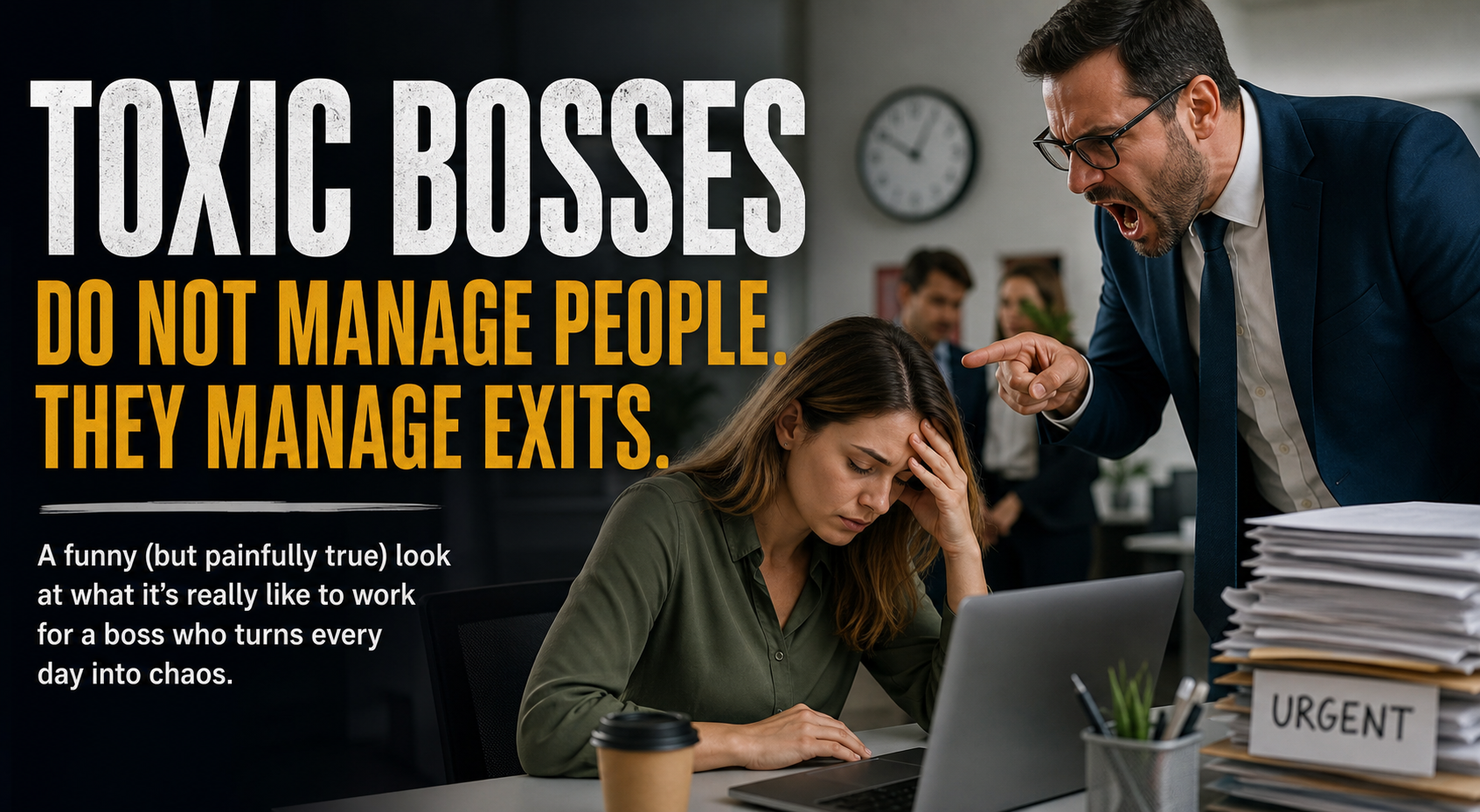
You ever worked for a toxic boss who made every normal workday feel like an unpaid internship inside an escape room designed by someone who recently discovered middle management and decided empathy was a subscription feature? Oh, I have. Sadly. Tragically. With enough emotional receipts to qualify for a class action lawsuit sponsored by lukewarm break room coffee.
The funny part about toxic bosses is they never think they are toxic. That would require reflection, and reflection is usually blocked on their calendar by something called “Leadership Sync” where four people discuss why everyone else has poor communication skills. Toxic bosses do not wake up and say, “Today I will make the office feel like a haunted LinkedIn post.” No. They wake up convinced they are passionate, direct, accountable, high standards, results-driven, and maybe even inspirational, when really they are just one forwarded email away from turning a team meeting into a hostage documentary with screen sharing.
They think yelling is urgency. They think confusion is strategy. They think “I am just being honest” gives them diplomatic immunity from being emotionally exhausting. They think “we are a family” means they can text you at 6:41 a.m. like your nervous system signed an unlimited data plan with the company. And the worst part is, toxic bosses are rarely chaotic in a dramatic, obvious, movie-villain way. They are usually chaotic in the small daily ways that make you slowly question whether employment should come with a helmet.
It starts quietly. One message before business hours. One “real quick” call that lasts forty-seven minutes and rearranges your entire day like a raccoon got into the calendar. One meeting where they ask why something was not done, even though they personally told you to pause it last Tuesday during a conversation they now claim never happened. One moment where you realize the job description said “fast-paced environment,” but what it actually meant was “your boss creates emergencies the way toddlers create crumbs.”
And eventually, the workplace stops feeling like a workplace. It becomes a survival simulation. You are not just completing tasks anymore. You are interpreting tone. You are decoding punctuation. You are studying the difference between “Thanks” and “Thanks.” You are watching Slack bubbles appear and disappear like weather alerts from the Department of Workplace Nonsense. You know exactly which version of “Can we talk?” means feedback, which version means blame, and which version means the boss’s boss asked a question five minutes ago and now everyone beneath the food chain must emotionally evacuate.
Because toxic bosses do not simply manage work. They manage fear. They manage confusion. They manage pressure. They manage their own insecurity by turning it into everyone else’s Monday morning problem. And after enough time under that kind of leadership, you stop asking, “What do they need?” and start asking, “What version of reality are we pretending exists today?”
That is not leadership. That is corporate improv with consequences.
The Urgency Olympics
A toxic boss loves urgency the way a squirrel loves electrical wires. Everything is urgent. The report is urgent. The meeting is urgent. The thing they ignored for three weeks is suddenly urgent because someone above them asked one innocent question, and now the entire department is being treated like they personally misplaced the Ten Commandments in a shared drive folder named “Final_Final_UseThisOne_REVISED.”
They have a unique ability to turn the most normal request into a building-wide emergency. You could ask, “When do you need this spreadsheet?” and somehow the conversation becomes a sermon about ownership, hustle, standards, accountability, and how people today just do not take pride in their work. Sir, I asked whether you wanted the file before lunch or before close of business. I did not request a TED Talk from a stapler with unresolved childhood issues.
The urgency is never clean either. It is always messy, emotional, and suspiciously avoidable. Toxic bosses do not plan ahead because planning ahead would rob them of the opportunity to panic publicly. They ignore deadlines until the deadline gains legal citizenship, then appear with the energy of a fire marshal at a candle factory, demanding updates, timelines, backup plans, summaries, summaries of summaries, and a “quick recap” of the situation they personally created by not reading the first six emails.
And somehow, when the crisis arrives, it is never their fault. Their boss asked for something, so now you should have anticipated it. A client followed up, so now you should have known. A task changed direction, so now you should have read their mind during the original meeting where they spoke in vague corporate fog and ended with, “You know what I mean.”
No, Greg. We did not know what you meant. We were trying to survive the sentence.
The toxic boss thrives in this chaos because chaos gives them a stage. They get to rush into meetings, sigh heavily, say things like “I need solutions, not excuses,” and act like they are leading people through Normandy when really the team is just trying to update a PowerPoint deck with the correct font. They love the drama of being needed, but they hate the responsibility of being clear. So they create confusion, disappear, return with panic, blame the team for the confusion, and then put “drives accountability” on their self-review.
That is the toxic boss magic trick. They light the fire, hide the extinguisher, criticize your smoke management strategy, then ask why morale smells burnt.
The Family Culture Funeral
Anytime a boss says, “We are a family here,” a tiny HR compliance bell should ring in the distance while someone quietly updates their resume. Because when toxic bosses say “family,” they rarely mean support, trust, honesty, respect, or shared responsibility. They mean boundaries are decorative. They mean your time belongs to the company. They mean emotional access is included in the benefits package, but only from your side.
Healthy families do not schedule performance improvement plans because someone asked for clarification. Healthy families do not emotionally body slam you in a conference room and then say, “Let’s circle back.” Healthy families do not send Saturday texts about metrics with the spiritual warmth of a parking ticket. Healthy families do not say, “We care about work-life balance,” while acting surprised that you have a life available for balancing.
The toxic boss version of family is fascinating because it always seems to benefit the person with the most power. When they need you late, you are family. When they need loyalty, you are family. When they need someone to absorb chaos, accept blame, stay quiet, answer after hours, tolerate disrespect, or pretend burnout is just “being committed,” suddenly the family language arrives wearing a company polo and carrying a clipboard.
But when you need support, flexibility, fairness, a normal workload, a day off, or basic human communication, the family becomes a business very quickly. Suddenly there are policies. Suddenly there are expectations. Suddenly the warm emotional language disappears and Legal is sitting in the corner wearing noise-canceling headphones.
That is the part that makes people exhausted. It is not just the work. People can handle work. People can handle busy seasons, deadlines, difficult customers, hard conversations, and pressure when the environment is honest. What breaks people is having to perform gratitude inside dysfunction. What breaks people is being told they are valued while being treated like a replaceable printer cartridge with anxiety. What breaks people is being expected to smile during a meeting where their nervous system is filing an OSHA complaint.
And toxic bosses are shocked when people leave. Absolutely shocked. They stand there looking confused, like, “Why is turnover so high?” Meanwhile, employees are sprinting toward the exit with the urgency of passengers escaping a cruise ship buffet after the seafood got suspicious. The boss starts blaming the market, the younger generation, remote work, lack of loyalty, poor attitude, compensation expectations, and “people not wanting to work anymore,” because it is much easier to blame society than admit that your management style has the emotional texture of a wet cardboard box.
People do not always leave jobs because the job is hard. They leave because the person leading it makes hard feel hopeless.
Becoming a Workplace Weather App With Trauma
The strangest thing about working under a toxic boss is that over time, you become less of an employee and more of a workplace weather app with trauma. You start forecasting their moods. You learn the tone of their emails. You learn when a one-word reply means nothing and when it means a storm system is forming over Accounting. You learn which footsteps in the hallway carry feedback, which ones carry confusion, and which ones mean they just came out of a meeting with their boss and now your afternoon has been declared a federal disaster zone.
You begin adjusting your behavior around their personality instead of the actual work. You schedule conversations based on their mood. You delay updates until they have eaten lunch. You rewrite messages six times to avoid triggering a lecture about “communication.” You keep receipts, not because you are petty, but because surviving under chaotic leadership requires documentation the way camping requires bug spray.
And eventually, you realize how much energy the toxic boss is stealing. Not just time. Energy. Mental space. Confidence. Creativity. Peace. You are still doing your job, but now you are also doing the invisible job of managing their reactions. You are trying to complete tasks while also protecting yourself from whatever version of leadership arrives that day. Cheerleader at 9:00 a.m. Prosecutor by 11:15. Motivational speaker by 2:30. Funeral director for morale by 4:00.
The mood swings become office theater. One minute they are telling you how much they appreciate your effort. The next minute they are acting like you personally sabotaged the quarterly results by asking whether the meeting had an agenda. They send inspirational quotes about teamwork after spending the morning turning the team into emotional confetti. They ask why people are quiet after creating an environment where speaking up feels like volunteering to be blamed professionally.
And because people are adaptable, they adapt to dysfunction. That is the sad part. They stop bringing ideas. They stop asking questions. They stop challenging bad decisions. They stop caring loudly. They become polite, quiet, careful, and emotionally unavailable to the workplace. The toxic boss sees this and calls it disengagement, never realizing disengagement is often just self-protection in business casual.
A good boss makes people braver. A toxic boss makes people smaller.
That is the difference.
A good boss creates clarity. A toxic boss creates weather.
A good boss helps people grow. A toxic boss teaches people how to leave without making eye contact.
Final Thoughts: Some Bosses Do Not Lead Teams. They Haunt Them.
So yes, I have worked for a toxic boss, and as much as I would love to say the experience built character, mostly it built a highly sensitive radar for nonsense, a deep appreciation for silent notifications, and the ability to detect emotional instability in an email subject line before the preview even loads.
I learned patience. I learned restraint. I learned how to remain professional while my soul quietly packed a suitcase. I learned that not every urgent message deserves urgent panic. I learned that leadership is not volume. Authority is not wisdom. Fear is not culture. Confusion is not strategy. And a boss who constantly has to remind everyone they are in charge is usually standing on a very small emotional ladder.
The best leaders I have known did not need to scare people into performance. They did not need to create emergencies to feel important. They did not need to confuse intensity with intelligence. They created calm. They gave direction. They owned mistakes. They listened before reacting. They made people feel safe enough to be honest and challenged enough to get better.
Toxic bosses do the opposite. They make people cautious. They make people tired. They make people rehearse conversations in the shower like opening statements before a workplace trial. They turn talented employees into escape artists. They turn teams into weather systems. They turn Mondays into psychological obstacle courses with fluorescent lighting.
And then, when people finally leave, they act surprised.
But they should not be surprised.
Because some bosses do not manage people.
They manage exits.