
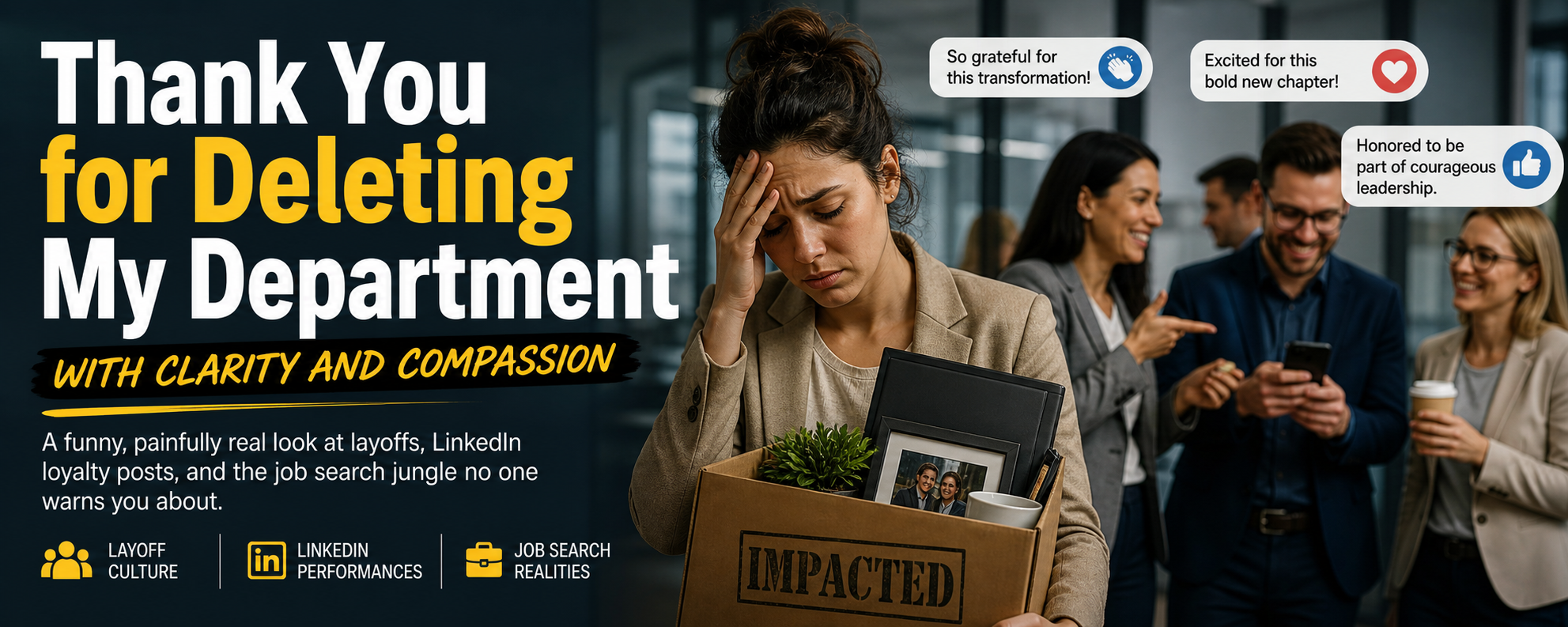
There is a special kind of corporate nausea that arrives during layoff season, and it does not come quietly, either; it walks in wearing a company-branded quarter zip, holding a lukewarm coffee, speaking in phrases like “strategic realignment,” “organizational agility,” and “difficult but necessary decisions,” as if the entire executive team gathered in a conference room, dimmed the lights, opened a spreadsheet, and decided the best way to improve morale was to remove several hundred human beings from the payroll before lunch.
Layoffs are already hard enough without the theatrical fog machine of corporate language making everything sound like a TED Talk delivered inside a burning building. People are scared. Calendars are suddenly full of mysterious meetings titled “Business Update,” which is corporate for “please attend this meeting where your stomach will attempt to leave your body before your laptop does.” Teams go quiet. Slack channels start feeling like haunted hallways. Everyone refreshes their inbox like it contains either salvation or a professionally worded trapdoor.
And then, somehow, while actual human beings are trying to figure out how to pay mortgages, keep insurance, explain things to their kids, and update resumes they have not touched since 2017, LinkedIn turns into an inspirational hostage video festival.
“So grateful for this transformation.”
“Excited to support this bold new chapter.”
“Honored to be part of courageous leadership during this period of change.”
Sir, your coworker just got deleted from the org chart like a formatting error, and you are posting like the company discovered electricity.
That is one of the strangest parts of corporate life. It is never just the layoff. It is the performance around the layoff, the careful choreography of sadness, loyalty, ambition, fear, and corporate survival instincts wearing business casual. Nobody wants to say, “This is terrible and I am scared I might be next,” because honesty in corporate America has to pass through six layers of brand compliance before it is allowed to breathe. So instead, people write these polished little loyalty poems to leadership, hoping someone with a title containing the word “Senior” or “Global” sees it and mentally moves them from the “possibly expendable” pile to the “emotionally useful during chaos” pile.
And that is where the absurdity becomes almost impressive. A layoff happens, and before the severance emails finish loading, someone is already online thanking the executive team for their compassion. Compassion. That word gets thrown around during layoffs like decorative parsley on a plate of bad news. “We handled this with compassion,” says the company, right after revoking badge access before someone could say goodbye to the plant they watered for seven years.
Nobody is fired anymore. They are “impacted.” Nobody loses income, insurance, stability, routine, confidence, and sleep. They are “part of a workforce transition.” Nobody gets pushed into a job market that looks like a haunted carnival run by Workday and unpaid enthusiasm. They are “invited to explore external opportunities.”
Invited.
Like it is a spa weekend.
Like someone handed you cucumber water and said, “We believe this unexpected financial cliff will help you reconnect with your personal brand.”
No, they handed you a box, disabled your login, and gave you a PDF called “Resources for Your Journey,” which contains three links, two broken phone numbers, and the emotional warmth of a printer jam.
The Business Update Meeting, Also Known as Corporate Thunder Before the Storm
The first sign that something is wrong is always the calendar invite.
It appears suddenly, usually with a title so vague it should be investigated by federal authorities. “Business Update.” “Team Alignment.” “Organizational Direction.” “Important Conversation.” These titles are never used for anything good. Nobody schedules an urgent “Business Update” because they found extra money and want to give everyone a raise. Nobody invites the whole department to “Organizational Direction” because they are installing better snacks in the break room. No, these meetings arrive with the emotional energy of a raccoon standing in your kitchen holding your car keys.
Everyone knows.
Nobody says it.
That is the ritual.
People start messaging each other privately with the calm professionalism of passengers on a plane hearing the pilot say, “We are currently reviewing our altitude strategy.” Someone asks, “Do you know what this is about?” Someone else says, “No idea,” which means they absolutely have an idea but do not want to type it because typing it makes it real. Another person says, “Maybe it is just a restructure,” which is the corporate version of saying, “Maybe the bear is friendly.”
Then the meeting begins.
Leadership appears on camera looking serious, concerned, and professionally moisturized. There is always one person from HR sitting there silently with the expression of someone guarding a locked drawer full of severance templates. The executive starts with, “First, I want to acknowledge that today is difficult,” which is your signal that nothing helpful is coming for at least eight minutes. They talk about market conditions, shifting priorities, efficiency, future growth, and the need to remain competitive, which is impressive because it takes real talent to use that many words without saying, “We decided fewer people should do more work.”
Then comes the phrase: “some roles have been impacted.”
Some roles.
Not people.
Roles.
Because it is easier to delete “roles” than say Tina from accounting, Marcus from customer success, Priya from product, and Jim who knew where every spreadsheet was hidden because he built half the reporting system with caffeine and unresolved resentment.
Corporate language is designed to make pain sound administrative. A person does not lose their job; a role is impacted. A department does not get gutted; the organization is streamlined. A team does not get thrown into chaos; resources are reallocated. The company does not admit it overhired, mismanaged priorities, chased bad strategy, or let executives play fantasy football with headcount. No, no, no. The company is “positioning itself for sustainable growth,” which sounds very elegant until you realize sustainable growth apparently requires sending Nancy from operations into the job market with a LinkedIn headline that now says “Open to Work” because someone in finance wanted the quarter to look prettier.
After the meeting, everyone walks around emotionally holding their breath. The people who survived feel guilty, relieved, terrified, and weirdly busy because the work did not disappear with the people. It just got redistributed like trauma confetti. Suddenly, one person owns three workflows, two dashboards, four vendor relationships, and a process nobody documented because the person who understood it was “impacted” at 9:14 a.m.
But leadership says, “We are confident this new structure will make us stronger.”
Of course.
Nothing says strength like making the remaining employees do the work of an entire missing village while pretending the vibe is innovation.
The LinkedIn Loyalty Parade Begins
The second act of the layoff circus happens online, because apparently no corporate disaster is complete until someone turns it into personal branding content.
Before people even know who survived, LinkedIn starts filling up with posts that read like they were written at emotional gunpoint by someone hoping the chief people officer has notifications turned on.
“I am deeply grateful to work for a company that makes hard decisions with empathy.”
Are you?
Are you deeply grateful, Brian?
Because Lisa from marketing was just removed from the company directory before her coffee got cold, and you are out here acting like the executive team personally carried her résumé across a river.
Then comes the person who writes, “Change is never easy, but I believe in our leadership and the path forward.” This is the corporate version of clapping while the ship tilts. It is not even optimism at that point. It is career-preservation jazz.
And listen, people cope differently. Some people post because they are scared. Some post because they feel pressure. Some post because they genuinely believe the company handled things as well as it could. But some people, and we all know exactly who they are, treat layoffs like networking weather. They see a crisis and immediately ask, “How can I make this look like emotional maturity with visibility?”
That is when the sycophants arrive in full formation.
They do not just thank leadership. They practically nominate them for sainthood.
“I want to recognize our executive team for navigating this moment with courage, grace, and transparency.”
Transparency?
The calendar invite was called “Business Update,” Karen.
That was not transparency. That was corporate fog with a meeting link.
“I am inspired by how our leaders continue to put people first.”
People first where?
First out the door?
First to lose healthcare?
First to receive a severance packet written by a law firm and a robot that recently completed a certificate in empathy?
The strangest part is watching the people who still have jobs publicly praise the people who made other people lose theirs, while the actual people who were laid off are expected to be graceful, grateful, and professionally inspirational about being thrown into financial uncertainty. They write posts that say things like, “After an amazing journey, my role has been impacted,” because apparently even when you get laid off, you have to write like you are announcing a scholarship.
Nobody wants to say, “I am devastated, angry, confused, and would like my badge access restored long enough to delete the snacks from my drawer.”
Instead, they write, “I am excited for what comes next.”
Which may be true eventually.
But at that exact moment, what comes next is usually panic, insurance paperwork, unemployment websites, resume updates, and quietly wondering whether the job market is real or just a psychological experiment conducted by applicant tracking systems and companies reposting the same job every six days to harvest hope.
Meanwhile, the leadership appreciation posts keep coming.
It becomes a full parade.
There is always one person writing, “Proud of our resilience.”
Proud of whose resilience?
The people who got laid off are resilient because they have no choice. The people left behind are resilient because their workload just got multiplied. Leadership is resilient because they had to deliver bad news from a webcam and then probably attend a private meeting called “Next Steps.” Let us not hand out medals too quickly.
At some point, LinkedIn starts looking less like a professional network and more like a corporate survival bunker where everyone is smiling too hard and complimenting the people holding the flashlight.
Welcome to the Job Market, Please Retype Your Resume Into This Portal of Despair
After the layoff comes the job search, which is where optimism goes to get asked for a password reset.
The modern job market is already absurd on a normal day, but being dropped into it after a layoff feels like being pushed out of a moving vehicle and handed a brochure about resilience. Suddenly you are expected to become a motivational speaker, data analyst, resume architect, networking wizard, emotional athlete, and LinkedIn content strategist while also trying to remember what your achievements were without sounding either too humble or too alive.
You update your resume.
Then you upload it.
Then the application portal asks you to retype everything you just uploaded because technology has advanced so far that it can recognize your file but not respect your time.
Then you answer questions.
Are you willing to relocate?
Are you legally authorized to work?
Do you have ten years of experience in a tool invented four years ago?
Can you explain a gap in employment caused by the same companies now asking why you have a gap in employment?
Then, if you are lucky, you receive an automated email saying, “We were impressed by your background, but we have decided to move forward with other candidates,” which is corporate for “a machine skimmed your life and rejected your soul before lunch.”
And the jobs themselves are a museum of nonsense.
Entry-level roles requiring seven years of experience.
Remote roles that are only remote if you live within eight minutes of a building in Ohio.
Hybrid roles that say “flexible” but mean “three days in office, possibly four, spiritually five.”
Director-level roles paying like assistant manager positions at a haunted candle store.
Jobs posted yesterday with 1,200 applicants, three internal candidates, and a recruiter who will reach out enthusiastically, schedule a screening call, ask you to walk them through your resume, then vanish into the same mist where all follow-up emails go to become folklore.
The whole process feels designed by someone who hates both people and efficiency.
You survived a reorg only to enter a system where companies say they cannot find talent while ignoring thousands of qualified applicants because the ATS did not detect the phrase “cross-functional stakeholder synergy” in the correct emotional font. You tailor your resume until it no longer sounds like you but rather like a consulting firm trapped inside a LinkedIn profile. You write cover letters no one reads. You network with people who say, “Happy to help,” then send you a link to the career page like they just discovered fire.
And through all of this, you are supposed to stay positive.
Stay positive while uploading your resume into Workday for the seventy-third time.
Stay positive while recruiters tell you the salary range after three calls and it turns out the role pays in exposure, vibes, and a possible bonus based on company performance.
Stay positive while companies ask for your availability, ignore it, schedule at the worst possible time, reschedule twice, then reject you because they are looking for someone “more aligned.”
Aligned with what?
The moon?
A spreadsheet?
Brad from Strategy’s emotional needs?
This is why the layoff performance hurts so much. Because the people being impacted are not stepping into a clean, humane, functional job market. They are stepping into a maze built by budget cuts, broken recruiting systems, fake urgency, ghost jobs, internal candidates, and automated rejection emails that somehow still manage to sound condescending.
So when someone online writes, “I am grateful for the opportunity to grow through this transition,” maybe they mean it.
Or maybe they are doing what everyone does in corporate life: trying to sound employable while standing in the rubble with a laptop bag and a nervous system running on fumes.
Final Thoughts: You Do Not Have to Thank the People Who Deleted Your Chair
A layoff is not a branding opportunity. It is not a leadership haiku. It is not a transformation journey with matching slide decks and a tasteful serif font. It is not “bold.” It is not “courageous.” It is not “clarity and compassion” just because someone said those words while reading from a prepared statement.
A layoff is people losing stability because someone upstairs decided the numbers would look cleaner if fewer humans were attached to them.
And yes, sometimes layoffs are unavoidable. Businesses change. Markets shift. Companies fail. Priorities move. Adults understand that. But what makes people furious is not only the job loss itself; it is the language gymnastics, the emotional theater, the loyalty performances, and the expectation that everyone smile politely while the company calls financial fear a “transition.”
People are allowed to be angry.
People are allowed to be sad.
People are allowed to roll their eyes at the “so grateful for this reorg” crowd.
People are allowed to be exhausted by coworkers publicly thanking executives before the affected employees have even figured out how much severance they are getting.
People are allowed to say, “This is awful,” without attaching a personal growth lesson, a gratitude paragraph, or a sunset photo.
To everyone who has been “impacted,” “transitioned,” “realigned,” “restructured,” or professionally launched into the wilderness by a calendar invite with bad vibes, I see you.
You are not a line item. You are not an efficiency opportunity. You are not an external opportunity explorer. You are a person who gave time, energy, skill, patience, and pieces of your life to a place that may now be asking you to describe the experience like it was summer camp.
May your next chapter come with better pay, better leadership, clearer communication, fewer fake posts, fewer emergency passwords, fewer “business updates,” and absolutely no one thanking executives for deleting jobs with clarity and compassion again.