
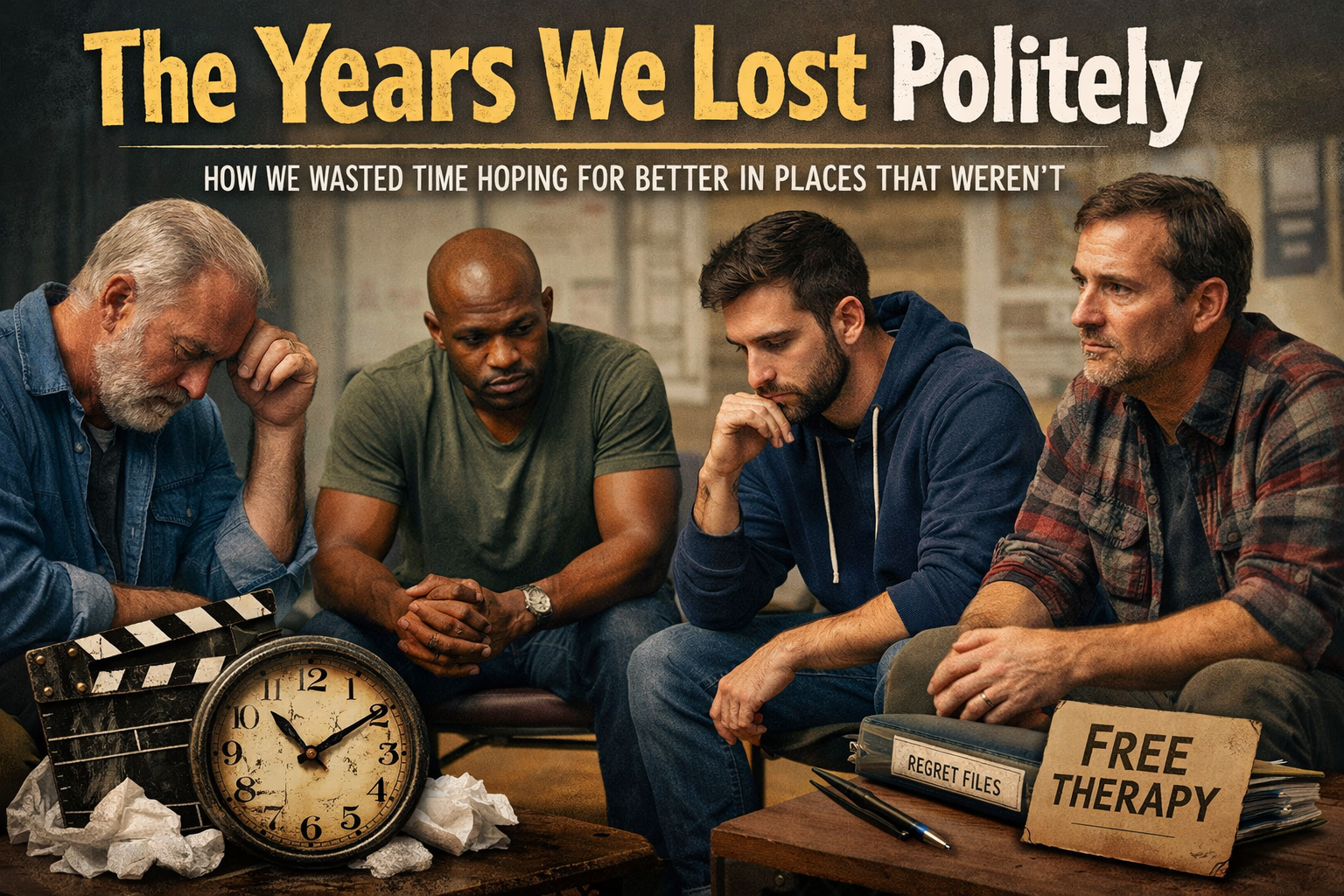
There are questions that arrive like small talk and then immediately turn into spiritual burglary. They walk into the room dressed like they just want conversation, maybe a little bonding, maybe a touch of harmless reflection, and then before you know it they have kicked the door off your emotional storage unit and started pulling unlabeled boxes into the light.
That is exactly what happened the other day during a weekly men’s support group when somebody asked, “If you could change anything in the past, what would it be?”
Now that is not an ordinary question. That is not a question you answer while casually reaching for a cookie and pretending your life has been one long sequence of healthy boundaries and emotionally informed decision making. That is a question with weight on it. A question that does not merely invite memory. It subpoenas it. It is the kind of question that makes grown men sit up straighter, then somehow collapse inward at the exact same time, as if their bodies are trying to file an internal incident report.
You could feel it in the room. The shift. The silence. The collective stare into middle distance. Suddenly every man in there looked like he was being haunted by a version of himself wearing an old outfit and making a terrible choice with full confidence. Because once you reach a certain age, the past is no longer just the past. It becomes a streaming service with too many unwanted reboots. It becomes a collection of moments that your brain insists on remastering at the most disrespectful hours possible. You are brushing your teeth, driving to work, heating up leftovers, and out of nowhere your mind says, “Would you like to revisit that time you accepted nonsense with a smile because you wanted to be mature?”
No. No, I would not. And yet there it is.
That is the strange cruelty of regret. It is rarely loud at first. It does not always enter your life with thunder and dramatic music and one catastrophic event that changed everything in a blaze of obvious destruction. Sometimes regret is quiet. Sometimes it wears good manners. Sometimes it shows up as the years you spent explaining away what should have sent you running. Sometimes it looks like staying longer than you should have, giving more than you had, and calling your own slow emotional depletion “growth” because that sounded nobler than saying, “I kept abandoning myself in installments.”
And that is where the humor sneaks in, because if you do not laugh at some of it, you may have to stand up in public and accuse your younger self of criminal levels of optimism. There is something almost impressive about the human ability to stand inside a burning situation, inhale smoke, and tell ourselves it is probably just a complicated season that will make sense later. We are capable of looking directly at patterns, red flags, mixed signals, obvious disrespect, dead end jobs, one sided relationships, and chronic disappointment and saying, “Well, nobody’s perfect.” Which is true. Nobody is perfect. But some people, places, and situations are not imperfect. They are actively terrible, and many of us stayed there anyway because we confused endurance with wisdom.
That support group question stayed with me for exactly that reason. Because the older I get, the less I think I would change one dramatic moment and the more I think I would change the way I kept waiting for things to become what they had already proven they were not. I would change how long I negotiated with what hurt. I would change how often I mistook self-betrayal for patience. I would change the amount of time I spent trying to win love, peace, belonging, understanding, and respect from people and places that had already made their final decision about what they were willing to give me, which, in many cases, was not much.
And when you realize that, really realize it, you begin to understand something painful and almost funny in its accuracy: some of us did not lose years all at once. We lost them politely. One compromise. One rationalization. One extra chance. One final conversation that should have been the last one three conversations ago. One more job where loyalty was rewarded with more work and less money. One more relationship where your empathy was treated like an unlimited resource. One more room where you kept shrinking yourself and calling it maturity.
That is not just sad. That is absurd. That is tragedy wearing office casual and smiling through a migraine.
So this article is for everyone who has ever looked back and realized the deepest wound was not always what happened, but how long it took to admit that you deserved better than what was happening. It is for the people who stayed too long because they were trying to be good. The people who kept hope alive long after hope should have been escorted from the building. The people who turned survival into a personality trait and called it strength because saying “I was exhausted and scared and wanted to be loved” felt too vulnerable.
Let us talk about that. Let us talk about the years we lost politely. Let us talk about the comedy, the grief, the self-respect we put on layaway, and the moment many of us finally realized that healing is not always about rewriting history. Sometimes it is about telling the truth about it.
The Fine Art of Abandoning Yourself Respectfully
Nobody teaches you how easy it is to disappear from your own life without ever physically leaving the room.
That is one of adulthood’s nastiest little surprises. You expect danger to look dramatic. You expect it to announce itself with chaos, slammed doors, public humiliation, fireworks, betrayal so obvious that even strangers in the next parking lot can tell something has gone wrong. But often the real damage happens quietly. It happens while you are being understanding. It happens while you are trying not to overreact. It happens while you are giving grace to people who would not give you the Wi-Fi password if your life depended on it.
That is how self-abandonment gets you. Not with a villain speech. With reasonable little lies.
Maybe they are going through something. Maybe work is just stressful right now. Maybe this is a rough patch. Maybe I need to communicate better. Maybe I need to be more patient. Maybe if I stay calm enough, helpful enough, loyal enough, spiritual enough, forgiving enough, low maintenance enough, this situation will become what it keeps promising to become.
And because the human heart has a dangerous amount of optimism in it, we believe these things longer than we should. We hand out extensions on our own suffering like we work in customer service for disappointment. We keep renewing contracts with pain that should have been canceled three seasons ago. We keep telling ourselves we are being strong, when in reality we are just becoming emotionally available to nonsense.
The wild part is that many of us were not weak when we did this. We were sincere. That is what makes it sting. We were trying to do life the right way. We were trying not to be selfish. We were trying to love well. We were trying to be dependable, graceful, mature. We were trying not to become bitter, reactive, cynical, cold. So we swung too far in the other direction and became historians of our own mistreatment. We documented it. We explained it. We contextualized it. We gave footnotes to every injury like graduate students writing a dissertation called Why This Is Probably My Fault Somehow.
There is dark comedy in that.
Because tell me why so many grown adults have stood in emotional catastrophe wearing the facial expression of a hotel manager apologizing for a missing towel. Tell me why we have looked at chronic disappointment and said, “I just want to handle this with dignity,” as if dignity requires remaining in environments that are spiritually repossessing your furniture.
There were jobs like that.
Jobs where the pay was bad, the culture was toxic, the leadership was allergic to accountability, and somehow you still kept showing up with your best attitude because you wanted to be professional. Jobs that asked for your creativity, your loyalty, your weekends, your energy, your emotional regulation, your problem solving, and your soul, then offered you a pizza party and a speech about teamwork like that was a fair exchange. Jobs where burnout was treated like a scheduling issue instead of a moral indictment of the whole operation. Jobs where you kept thinking, one more quarter, one more manager, one more reorg, one more chance, one more proof of my value, and then maybe this place will finally see me correctly.
Then there were relationships like that.
Relationships where you learned how to make yourself smaller in elegant ways. You became easier to deal with. Easier to dismiss. Easier to postpone. Easier to misunderstand. You turned your needs into little folded notes and slid them under the door of somebody emotionally unavailable, then waited there like customer support for your own heart. You kept trying to be fair to people who were perfectly comfortable being unfair to you. You kept giving context to behavior that did not need context. It needed consequences.
And for a while, that can even feel noble.
That is the trick. Self-abandonment rarely advertises itself as self-abandonment. It markets itself as loyalty, resilience, compassion, faith, patience, and depth. It tells you that you are doing the mature thing. It tells you this is what good people do. It tells you leaving is rash, speaking up is selfish, asking for more is demanding, drawing a line is unkind. So you stand there, emotionally underpaid, spiritually overworked, trying to earn peace from people and places that do not even stock it.
Then one day you wake up tired in a way sleep cannot fix, and that is when the truth starts walking toward you.
The Director’s Cut of Regret
Regret is a strange creature because it is not always loud. Sometimes it is cinematic.
It shows up years later with better lighting, sharper dialogue, and a brutal level of clarity your younger self absolutely did not have access to at the time. It reruns the scene, but now you can see everything. You can see the moment the conversation changed. You can see the red flag you called stress. You can see the mismatch you called potential. You can see yourself trying so hard to preserve something that was never trying equally hard to preserve you.
That is the real violence of hindsight. It does not just show you what happened. It shows you what was happening while you were busy interpreting it through hope.
And hope, while beautiful, has been the co-defendant in a lot of our worst decisions.
Because hope makes you say things like, this person has good intentions. This company means well. This friendship just needs time. This season is temporary. This opportunity will open up. This apology means change. This inconsistency is not a pattern. This confusion is not the answer. This ache is not the message.
Meanwhile your nervous system is filing complaints in triplicate.
That is what nobody really explains when they talk about “learning from the past.” They make it sound very clean and inspirational, like you will look back, smile softly, absorb the lesson, and move on with a richer understanding of life. No. Sometimes learning from the past feels like watching yourself ignore your own instincts for six consecutive episodes with no commercial break.
Sometimes it feels ridiculous.
You look back and think, I really stayed there for that long? I really explained that behavior away? I really believed effort was the same thing as mutuality? I really treated mixed signals like a scavenger hunt? I really kept trying to prove my worth in rooms that had already mistaken my silence for consent?
Yes. Yes, you did.
And because the human brain enjoys humiliation as a hobby, it never replays these memories in a dignified setting. It does not wait until you are seated comfortably with a journal and soothing music. No, it hits while you are standing in the grocery store comparing pasta sauce. Suddenly you are in aisle seven staring at marinara while remembering a version of yourself who accepted crumbs and called it spiritual fasting.
That is why regret can feel both devastating and almost laughable. Not because the pain was fake, but because the logic was so bad in retrospect that you want to sit your younger self down with a PowerPoint presentation titled Please Stand Up. Slide one: this is not normal. Slide two: this is not love. Slide three: this is not loyalty. Slide four: this is a hostage situation with softer language.
And still, I think we have to be careful with how we talk to our former selves. Because mockery is easy. Mercy is harder.
Yes, we stayed too long. Yes, we tolerated too much. Yes, we mistook endurance for meaning. Yes, we overextended grace to people who treated our hearts like a free trial. But we were also trying to survive with the tools we had. We were trying to keep relationships intact. Trying to keep jobs. Trying to keep families together. Trying to keep faith. Trying to keep from becoming the kind of people we had already been wounded by.
That matters.
It matters because regret without compassion can turn into self-contempt, and self-contempt is just another way of remaining stuck in the same story. You do not heal by becoming crueler to yourself than the world already was. You heal by telling the truth with tenderness. By admitting, yes, I knew some things. Yes, I ignored some things. Yes, I was afraid. Yes, I hoped too long. Yes, I confused being needed with being valued. Yes, I thought if I just loved harder, worked better, forgave deeper, stayed steadier, the outcome would change.
But also: I was human.
And humans are heartbreakingly talented at trying to build homes out of maybe.
The Day You Finally Believe Yourself
For a lot of people, transformation is sold as a dramatic event.
A breakthrough. A rock bottom moment. A single grand decision where the clouds part, violins swell, and you finally announce to the universe that from this day forward you will never again accept less than you deserve. It makes for great storytelling. It sounds powerful. It sounds clean. It sounds like personal growth wearing a tailored suit.
That is not usually how it happens.
Usually, the turning point is much quieter than that. Usually, it is exhaustion. Usually, it is the day you realize you cannot continue explaining your own pain to yourself like a defense attorney for the very things that keep harming you. Usually, it is the moment your body, your heart, your spirit, your common sense, and your last functioning nerve all gather in a conference room and say, this meeting could have been an email, but enough is enough.
The shift often begins not when everything gets worse, but when your ability to pretend it is acceptable finally collapses.
That is a sacred moment, even if it feels ugly.
Because that is the day you start believing yourself.
You believe the part of you that said this is draining me. You believe the part of you that said this is not love. You believe the part of you that said this job is costing too much. You believe the part of you that said these people do not celebrate me, they tolerate me. You believe the part of you that said I am not asking for too much, I am asking the wrong room.
That last one will change your life.
So many of us wasted years trying to become acceptable in spaces designed to keep us uncertain. We worked harder, explained more, shrank smaller, smiled wider, forgave faster, overperformed, overfunctioned, overdelivered, and still ended up empty. Not because we were not enough, but because the system, the relationship, the environment, the dynamic, the story itself was built to keep us earning what should have been given freely: respect, reciprocity, safety, dignity.
And when you finally understand that, something in you begins to return.
Not all at once. Not theatrically. But steadily.
You start leaving conversations earlier. You start noticing when your peace disappears around certain people. You stop translating disrespect into potential. You stop calling inconsistency “complicated.” You stop auditioning for places that already failed your spirit on the first read through.
And yes, it can be funny in a bruised sort of way, because once your vision clears, you begin to see how absurd some of it really was. You think, I really begged for clearer communication from somebody who treated honesty like an optional app update? I really stayed loyal to an employer who would replace me before my coffee cooled? I really bent over backward for people who would not lean forward an inch?
The answer is yes. We did. Many of us did.
But the deeper truth is this: the moment you believe yourself, the past stops owning you the way it used to. It does not disappear. It does not become beautiful overnight. But it loses its authority. It stops being the place where your value was determined and becomes the place where your standards were born.
That is what healing looks like more often than not. Not perfection. Not memory loss. Not pretending it did not hurt. Healing is when the lesson becomes stronger than the longing. Healing is when your compassion for others finally makes room for your loyalty to yourself. Healing is when you stop trying to earn belonging in places where you have to betray yourself to keep it.
And there is a kind of holy comedy in that too, because one day you look around and realize you are no longer volunteering to be the emotional intern in everybody else’s unfinished business.
What a miracle. What a scandal. What a relief.
Final Thoughts: We Did Not Need More Time, We Needed More Truth
If I could say one thing to the version of myself who stayed too long, tolerated too much, and kept dressing up survival as virtue, it would not be an insult. It would not be a lecture. It would not be some dramatic speech about being stronger, smarter, sharper, less naive.
It would be simpler than that.
I would say: you were allowed to leave sooner.
You were allowed to tell the truth sooner. You were allowed to disappoint people who were comfortable disappointing you. You were allowed to stop explaining what your soul had already made clear. You were allowed to want more than endurance. You were allowed to call things what they were. You were allowed to believe your own pain before it turned into your whole personality.
Because that is the part so many of us get wrong. We think healing means going back and changing the event. But sometimes the event was only part of the story. Sometimes the real grief is realizing how long it took us to stop negotiating against ourselves. How long it took us to stop trying to make peace with what was never peaceful. How long it took us to stop calling neglect a misunderstanding and imbalance a test of character.
The truth is, many people are not broken because life hit them once. They are tired because life kept hitting them in small, respectable, socially acceptable ways that were easy to normalize and hard to name. A draining job. A one sided relationship. A friendship built on convenience. A family dynamic where your role was to absorb everything and call it love. A season where you were so busy surviving that you did not realize survival had become the only standard.
And yet, even in that, there is grace.
Not the kind of grace that tells you to keep suffering elegantly. Not the kind of grace that asks you to remain available to what is harming you. I mean the real kind. The kind that meets you in hindsight and says, yes, you lost time, but you are still here. Yes, you were late to your own rescue, but you arrived. Yes, you abandoned yourself in pieces, but now you know how to come back.
That matters more than we admit.
So if that question ever finds you too, if somebody asks what you would change in the past, maybe the answer is not one giant event. Maybe the answer is the amount of time you spent trying to turn almost into enough. Maybe the answer is how long you doubted what your spirit already knew. Maybe the answer is every extra year you offered to things that had already taken enough.
And maybe the victory is this: you know now.
You know what peace costs when you ignore it. You know what your silence buys other people. You know that loyalty without reciprocity becomes self-erasure. You know that maturity is not endless tolerance. You know that being the bigger person is admirable right up until it becomes a full time job with no benefits and terrible management.
Most of all, you know this: deserving better is not arrogance. It is alignment. It is clarity. It is the moment you stop asking broken rooms to confirm your value and start living like your worth was never up for committee review in the first place.
That is not just healing.
That is getting your life back.






https://shorturl.fm/GOv67