
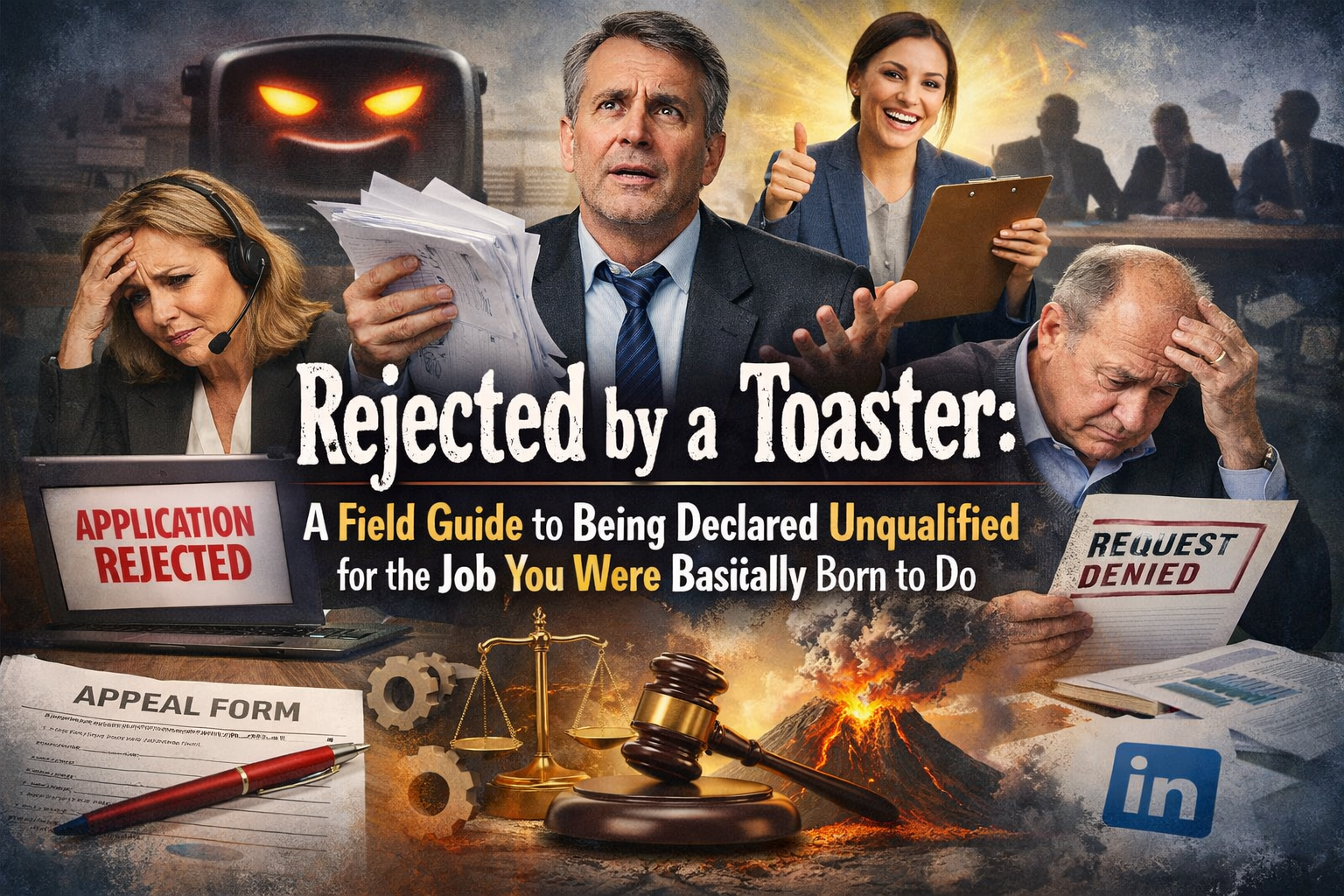
There is a very specific kind of insult that only modern hiring can deliver, and it is not the loud, dramatic kind. It is not someone slamming a door in your face or standing up in a meeting and announcing that you are a fraud in front of twelve confused coworkers and a tray of room-temperature pastries. No, this insult arrives in the smooth, bloodless language of process. It arrives by email. It arrives wearing “professionalism” like a hospital bracelet. It arrives with phrases like minimum qualifications and application package review and thank you for your interest, as if what is happening is not absurdity in broad daylight but a reasonable administrative exchange between adults.
And that is what makes it so funny. Also what makes it so spiritually exhausting.
Because nothing captures the full pageantry of the current job market quite like watching a person with twenty-six years of experience be informed by a digital gatekeeper that their background does not sufficiently suggest they are capable of doing the exact work they have already been doing since flip phones were considered advanced technology. This was not a moonshot. This was not someone applying to captain a submarine because they once won a fishing trophy at summer camp. This was a trainer position. A trainer position. And the candidate in question had not merely “done some training.” They had served as a Director of Training for a BPO call center, which feels, to the average person still in possession of basic pattern recognition, like a strong clue that they may understand the general mechanics of training human beings.
But the machine, that majestic and mysterious woodland creature of modern employment, looked at all of that and apparently whispered to itself, “The evidence is inconclusive.”
That phrase alone should be bronze-plated and mounted in every HR office in America. Did not indicate minimum qualifications. There is something so spectacularly detached about it. It has the energy of a butler announcing that the castle is on fire in a tone usually reserved for tea service. It turns obvious competence into a philosophical debate. It suggests that twenty-six years of relevant experience might simply be an elaborate misunderstanding, perhaps a clerical illusion, perhaps a coincidence, perhaps a long and complicated hobby.
And then, in a twist so perfect it should be scored with dramatic violin music, the email graciously offered the candidate a chance to request a review. Which is one of the funniest things modern hiring has ever produced, because it means the applicant must now appeal to the very system that just misread reality. It is like being told by airport security that your shoes have failed the vetting process and may petition for reinstatement. It is like being denied water by a vending machine and then invited to file a rebuttal.
So the review was requested, because what else is there to do now. You do not merely apply for jobs anymore. You litigate your own résumé. You become both candidate and defense attorney. You gather your facts, steady your breathing, and enter the courtroom of bureaucratic delirium where some invisible force has accused you of not being enough on a technicality it cannot explain.
Then came the glorious sequel. The next day, a human being entered the scene. Suddenly there was joy. Warmth. Exclamation points. Smiling emoji energy. They were thrilled the candidate had requested a review. Delighted, even, to share that the application had been reactivated and forwarded to the hiring manager. Which is astonishing, because the emotional translation of that email is essentially, “Whoops. The haunted bread machine almost threw away a perfectly qualified adult, but good news, Brenda from HR noticed the smoke.”
This is where hiring lives now. Not in judgment, not in discernment, not even in chaos exactly, but in a strange ritualized incompetence where software makes a ridiculous call, a human later reverses it, and everyone is expected to applaud the process as though a miracle has occurred. We are all supposed to stand there nodding while the same people who built the maze congratulate themselves for occasionally pointing toward the exit.
And somewhere inside all of this, the hiring manager waits for candidates the system nearly sacrificed to the volcano. Somewhere a recruiter insists the process is streamlined. Somewhere a corporate presentation is being given about innovation. Somewhere a panel of leaders is discussing talent shortages while their software is rejecting talent like a Victorian aunt turning away callers at the door.
So let us discuss this whole performance properly, because it deserves more than a casual laugh. It deserves an article. It deserves chapters. It deserves the kind of long, dramatic treatment usually reserved for war documentaries and prestige television, because modern hiring has become both a comedy and a survival genre.
The Sacred Phrase “Minimum Qualifications” and Other Works of Fiction
There are few phrases in the English language more slippery, theatrical, and aggressively unserious than “minimum qualifications.” On the surface it sounds objective, sturdy, trustworthy even. It has the clean lines of a ruler. It implies standards, careful review, a thoughtful process shaped by sober professionals wearing cardigans and considering merit with great care. But in practice, “minimum qualifications” often means whatever a software filter, a template, or an inattentive first pass happened to interpret at 9:14 a.m. before someone wandered off to microwave oatmeal.
That is the first joke. The phrase sounds precise while functioning like weather. It drifts. It changes shape. It depends on whether the title on the résumé perfectly matches the title in the posting, whether the right keyword appeared in the right sequence, whether the applicant phrased reality in the exact dialect required by the machine gods. You can have done the work, led the work, taught the work, improved the work, written the manual for the work, and still find yourself told that your materials did not sufficiently suggest familiarity with the work, because apparently “Director of Training” was too subtle a clue.
This is one of the great hidden talents of modern hiring technology. It can take a living, breathing professional history and reduce it to a game of résumé Mad Libs. It does not ask, “Can this person do the job?” It asks, “Did this person chant the approved vocabulary in the correct order while uploading a PDF that our software could digest without becoming emotionally overwhelmed?” It is less a hiring process than a séance performed inside a spreadsheet.
And what makes it even funnier is that this all gets sold to candidates as fairness. Efficiency. Consistency. Meritocracy with better fonts. Everyone is treated equally, they say, which in practice often means everyone is equally at risk of being rejected for deeply stupid reasons. The algorithm cannot be biased, they imply, while the algorithm is sitting in the corner rejecting people because their experience was described like a human wrote it instead of like a haunted chatbot assembled it from conference brochures.
The person in this story was not missing qualifications. They were missing a successful translation into Robot. There is a difference. A large one. A ridiculous one. One that says more about the system than it does about the candidate. Yet the burden falls, as always, on the applicant to absorb the absurdity politely. To remain calm. To not write back, “I am sorry, but if twenty-six years of training leadership does not indicate training qualifications, then perhaps the issue is not my background but your cursed software.”
Because that is the expectation now. You are not allowed to respond to nonsense as if it is nonsense. You are expected to honor it. Respect it. Engage it with good posture. The machine may insult your competence, but you must appeal with gratitude. You must behave as though the process is fundamentally wise and any error is a rare cosmic hiccup rather than a weekly ritual repeated across thousands of inboxes.
And I think that is what makes these moments feel so especially deranged. It is not merely that the wrong decision got made. Human beings make mistakes. That part is old news. It is that the mistake arrives wrapped in official confidence, as if the system has conducted a serious inquiry and reached a solemn conclusion, when in reality it appears to have glanced at a decades-long career and gone, “Unclear. Next.”
The old hiring world had its flaws, certainly, but at least its nonsense often wore a human face. A manager could be unreasonable. A recruiter could miss something. A panel could ask questions so irrelevant they seemed to have been generated by a bingo tumbler. But now the nonsense has been industrialized. It scales. It auto-sends. It rejects with speed and certainty. And because it wears the costume of technology, people are pressured to treat its errors as legitimate events rather than what they often are: administrative hallucinations.
So when someone with a quarter century of directly relevant experience is told they do not meet the minimum qualifications, it is not just frustrating. It is performance art. It is absurdist theater. It is Kafka with a password reset link. It is the hiring process looking directly at competence and asking it to provide additional documentation.
The Appeal Process, or How Job Applications Quietly Became Legal Proceedings
There was a time, long ago, when applying for a job meant sending your information and waiting to hear back. Maybe someone called. Maybe they did not. Maybe the process was imperfect, unfair, chaotic, or full of human weirdness, but it still generally recognized one important truth: this was employment, not federal litigation.
Those days are gone.
Now, apparently, you can be rejected by an invisible process and then invited to request a review, as though what just occurred was not a software blunder but a judicial decision rendered by the Ninth Circuit Court of Talent Acquisition. And I want to linger here, because this detail deserves the full respect due to a truly elite absurdity. The candidate was not simply turned down. They were informed they had the right to challenge the denial. Not because they had committed some offense, not because there had been a dispute over facts, but because the system had incorrectly assessed their qualifications and everyone involved had simply decided that the appropriate next step was to make the applicant do more work.
This is one of the most reliable features of modern hiring. When the system fails, the candidate inherits the cleanup.
You uploaded the résumé? Wonderful. Now re-enter every detail manually into forty-seven separate fields. The portal crashed? Refresh and start over. The file parser converted your leadership experience into what looks like the biography of a confused forklift? Please correct that. The software misread your qualifications and rejected you? You may request reconsideration like a peasant seeking mercy from the kingdom.
And all of this gets framed as opportunity. You have the opportunity to appeal. You have the opportunity to provide more information. You have the opportunity to remain in consideration. How generous. How kind. How delightfully medieval. It is the same energy as being told by a bouncer that your name was accidentally removed from the guest list and you are welcome to make a case for your own existence if you can do so respectfully.
What is especially beautiful, in the bleakest possible way, is how much emotional discipline this requires from applicants. You must be disappointed, but not bitter. Clarifying, but not confrontational. Persistent, but not pushy. You must submit your appeal in exactly the tone of someone requesting a small administrative correction rather than someone who has just been professionally misidentified by an expensive digital sorting hat.
Because let us be honest. Most people know exactly what they want to say in that moment. They want to say, “Are you out of your mind?” They want to say, “If directing training for a call center does not count as evidence of training ability, then perhaps your hiring process was assembled by raccoons in neckties.” They want to say, “I should not need to file a polite legal brief to convince you that decades of relevant experience are, in fact, relevant.”
But modern hiring has a very specific emotional dress code. Candidates must be gracious while being inconvenienced, calm while being insulted, and thankful while being forced to re-prove things that should have been obvious from the beginning. The process can be absurd, but your reaction must be immaculate. The process may treat your professional history like a suspicious package, but you must continue speaking in the warm tones of a person thrilled to be considered.
And sometimes, to make the comedy even richer, the appeal works immediately. Which is exactly what happened here. One review. One human glance. One apparent moment of clarity from someone not actively powered by keyword voodoo. And suddenly the application was back from the dead, cheerfully reactivated, and sent along to the hiring manager as though the prior rejection had been nothing more than a brief misunderstanding between friends.
That immediate reversal is the part that really should alarm everyone, because it confirms what candidates already know deep in their bones: many of these decisions are not close calls. They are not nuanced judgments. They are not the result of a rigorous evaluation that merely landed on the wrong side. They are often just bad screenings. Glitches with manners. Administrative pratfalls dressed up in neutral language.
And yet the story gets told as a success. See, the system worked. The review option exists. The human stepped in. The application was restored. But that is like praising a fire alarm for eventually noticing the building it helped set on fire. The existence of a fix does not erase the absurdity of the problem. It simply reveals how common and expected the problem has become.
So yes, the candidate requested the review. Yes, the application moved forward. Yes, somewhere an HR representative likely felt helpful and relieved. But none of that changes the deeper truth: the applicant should never have been in the position of needing to appeal something so obviously ridiculous in the first place.
A normal process would have recognized the qualifications and proceeded. A broken process rejects first, apologizes later, and then expects applause because it briefly remembered how to read.
Human Intervention as Heroism, and the Corporate Myth of the Daring Rescue
Once the human enters the story, the tone always changes. That is another one of the strange rituals of hiring. The machine rejects you in cold procedural language, but the human arrives like a camp counselor at the end of a thunderstorm, full of enthusiasm, punctuation, and emotional recovery. Suddenly there are exclamation points. Suddenly there is warmth. Suddenly the same organization that nearly tossed your candidacy into a wood chipper wants credit for discovering that you are, after all, a viable member of the species.
This is where the comedy becomes almost cinematic.
Because the HR follow-up, with its delight and smiley energy, creates the bizarre impression that a noble rescue has occurred. We did it. We saved your application. We are so glad you reached out. We are happy to let you know your materials have been reactivated and shared with the hiring manager. Which, stripped of its cheerful wrapping, basically translates to: “Our process made a foolish mistake, but great news, a person with working eyes was eventually introduced.”
And that is the corporate myth at the center of so many hiring interactions now. Organizations want candidates to experience human correction as kindness rather than as proof of preventable failure. They want the reactivation to feel like grace. Like benevolence. Like your file was trapped under rubble and Sharon rappelled in from a helicopter with a flashlight and a clipboard. In reality, Sharon probably just clicked the thing the toaster should have clicked yesterday.
No disrespect to Sharon. She may be lovely. She may be overworked. She may be the only functioning bridge between actual humans and the software labyrinth. But we have got to stop pretending that basic correction is heroism. It is not a rescue mission to reverse a dumb automated decision. It is maintenance. It is housekeeping. It is one more adult quietly mopping up behind a system that keeps spilling itself all over the floor.
And perhaps that is why people are so exhausted by hiring even before the first interview starts. The emotional labor begins long before anyone asks about strengths, weaknesses, or where you see yourself in five years. It begins the moment you must navigate the unstable terrain between automation and human involvement. First you must survive the software. Then you must charm the human. Then you must act grateful that the human corrected the software. Then you must continue through the rest of the process as though none of this has already warned you exactly how the organization handles obvious problems.
Because that is another uncomfortable truth hiding under the humor. Hiring processes tell on organizations. Loudly. If a company cannot build a sane path for obviously qualified candidates to enter the funnel without filing procedural appeals, what exactly does that suggest about their internal operations, their decision-making, their workflow discipline, their respect for time, or their relationship to common sense? If the first interaction is needless friction followed by cheerful cleanup, it is hard not to suspect that the culture behind the curtain may also enjoy creating avoidable messes and then celebrating whoever stayed late to fix them.
Still, the pageant continues. The hiring manager now receives the reinstated application. The candidate proceeds. The process marches on. And everyone pretends this is normal, because it is normal now, which is perhaps the bleakest joke of all. We have become so accustomed to these miniature absurdities that they barely register as scandals. Candidates compare them like weather stories. Recruiters shrug because the systems are what they are. HR representatives learn to sound delighted when restoring the obviously qualified. Leaders complain about talent shortages while their digital moat keeps drowning the villagers.
Somewhere, surely, a PowerPoint exists praising the efficiency of this arrangement.
And the haunted toaster remains at the center of it all, humming softly, rejecting with confidence, mistaking pattern matching for judgment and keyword presence for human capability. It has no intuition. No context. No sense of proportion. It cannot recognize irony, nuance, transferable skill, or the fact that someone with twenty-six years of experience in training might, against all odds, be an interesting candidate for a training role. It can only do what it was built to do, which is reduce human complexity into neat little fragments and occasionally light a perfectly good application on fire.
Then the humans arrive with smiles and say everything is back on track.
Back on track is such a funny phrase for something that never needed to derail in the first place.
Final Thoughts: The Real Qualification Is Surviving the Ritual Without Throwing Your Laptop Through a Window
At some point, I think we need to stop calling this efficiency and start calling it what it is: a bizarre endurance sport for adults with bills. The modern hiring process no longer seems primarily designed to identify capability. It seems designed to test patience, obedience, formatting discipline, and the willingness to calmly participate in rituals that make less sense the longer you stare at them. And that, more than any buzzword-filled press release about innovation, is what people are reacting to when they say the system feels broken. It is not merely that hiring is hard. Hiring has always been hard. It is that the nonsense is now so layered, so polished, and so smugly procedural that people are expected to endure it without ever naming it.
But the truth is, a person with twenty-six years of relevant experience should not need an appeal to convince a system they exist in the correct professional category. A hiring process should not need a dramatic human intervention scene to correct a problem a reasonably attentive workflow could have prevented. And candidates should not have to experience every small administrative error as a test of emotional maturity. Yet that is exactly what happens every day, in every industry, across every platform that claims to be streamlining access to opportunity while quietly building obstacle courses out of forms, filters, portals, and automated confidence.
What makes this story especially perfect is the speed of the reversal. The machine rejected. The human restored. Which means the difference between “not qualified” and “absolutely qualified” was not new information, not a deeper investigation, not a life-changing revelation. It was one actual person taking one actual look. That should concern more people than it does. It means the gate is not just strict. It is sloppy. It means the process is not merely selective. It is frequently unserious. It means entire professional futures can wobble on whether a system recognized a phrase, parsed a title correctly, or had a good day with PDF formatting.
And somehow, after all of that, the candidate is still expected to step into the next stage smiling, prepared to discuss leadership style and communication strengths with people who may never fully appreciate that the hardest part of the process so far was surviving the organization’s own intake confusion.
That is the real comedy of modern hiring. The résumé is not enough. The experience is not enough. The title is not enough. The decades are not enough. You must also possess the stamina to appeal errors, the tact to phrase your frustration like gratitude, the resilience to keep moving after a software-driven insult, and the psychological flexibility to accept that your candidacy may depend less on what you have done than on whether the haunted toaster believed your verbs.
So when people say candidates should be more strategic, more polished, more prepared, I think we should be honest about what they are really being asked to prepare for. Not just interviews. Not just competition. Not just the ordinary vulnerability of wanting a role and hoping to be chosen. They are being asked to navigate an elaborate bureaucratic funhouse in which competence must be translated, defended, resubmitted, reactivated, and occasionally rescued from systems that treat obvious facts like rumors.
At this point, the true minimum qualification for most jobs is not leadership, communication, technical skill, or industry knowledge. It is the ability to maintain your composure while a badly configured process briefly questions your entire professional existence and then sends you a smiley face when someone finally notices the mistake.
And honestly, if you can survive that without laughing, screaming, or composing a small opera about workplace delusion, you may already be overqualified.






https://shorturl.fm/twisN