
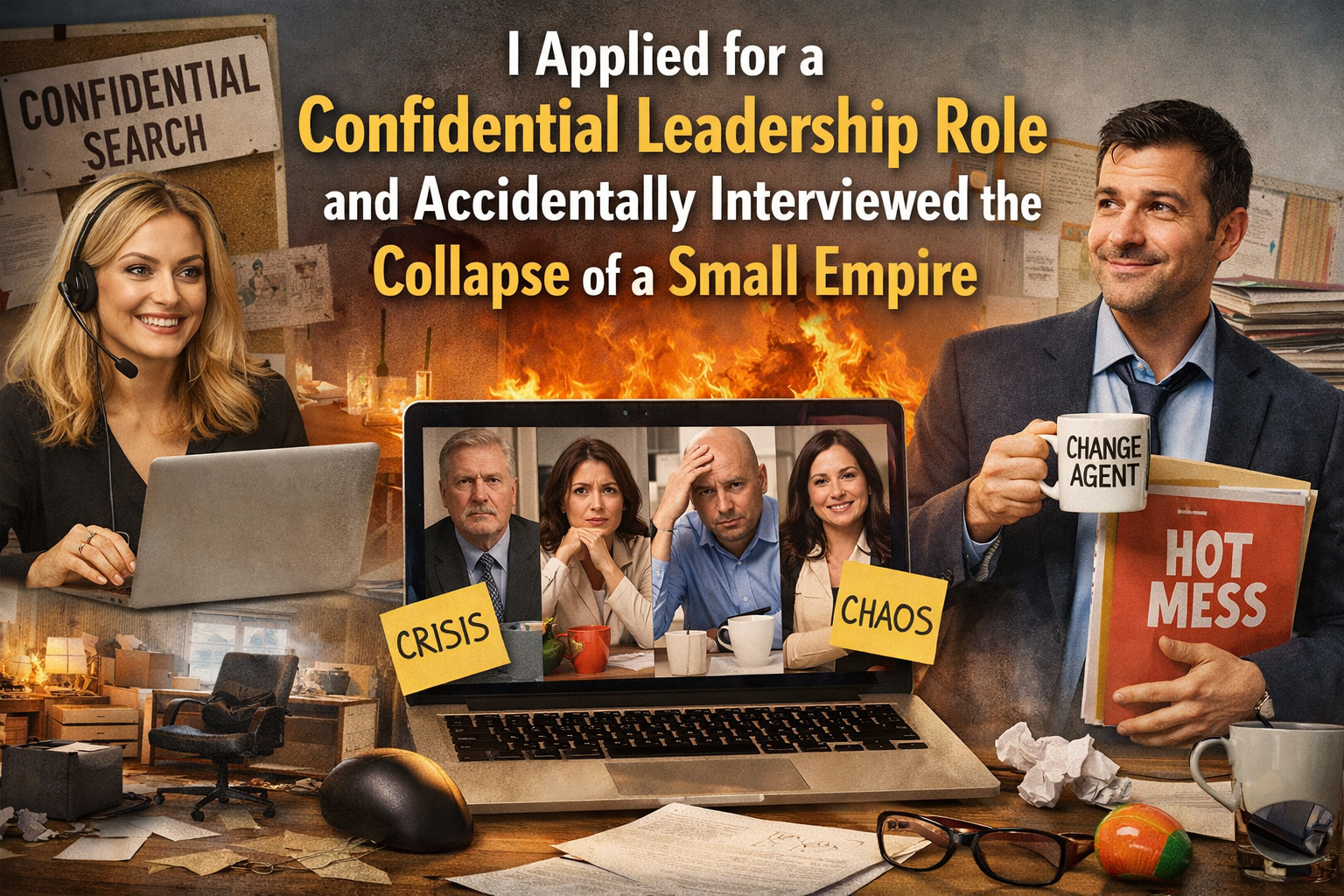
There is a very specific kind of optimism required to apply for a leadership role labeled confidential, because that word does not create mystery so much as it creates the sort of corporate suspense usually reserved for whistleblower documentaries and internal investigations. A confidential posting is never just a job. It is a puzzle wrapped in anxiety, dipped in polite deception, and mailed out to the public with a subject line that says exciting opportunity even though the subtext is often something has gone terribly wrong in a building with frosted glass conference rooms.
And yet, like every seasoned professional who has survived enough executive interviews to recognize the smell of dysfunction through Wi-Fi, I was intrigued.
Because confidential can mean many things, but in the modern hiring economy it usually means one of two options. Either they are replacing someone who is still very much employed and would likely be devastated to discover their succession plan has already been uploaded to LinkedIn, or the company has become so operationally chaotic that attaching its actual name to the search would feel less like recruitment and more like evidence. There is no middle ground. Nobody hides a healthy job. Nobody whispers about a well-functioning division. Apple does not post under a fake mustache. Stable organizations do not lurk in the shadows like embarrassed landlords.
But this posting had all the classic signs of premium corporate intrigue. No company name. No leader names. No real location beyond the wonderfully vague phrase major market, which is the geographic equivalent of telling someone you live “near emotions.” There were glowing references to transformation, growth, visibility, strategic partnership, and the chance to make an immediate impact, which is corporate language for the previous person may have escaped through a window and the furniture has not emotionally recovered.
The description read like it had been written by three consultants, a frightened HR director, and one executive who kept insisting the role needed “someone dynamic” while refusing to explain what, exactly, had exploded. They wanted a visionary. A builder. A culture shaper. A collaborative disruptor. A leader who could drive change, inspire teams, optimize performance, stabilize operations, and partner cross-functionally. In other words, they needed one person to serve as therapist, firefighter, diplomat, mechanic, priest, substitute parent, and occasional exorcist.
Naturally, I applied.
Not because I believed it would be normal. That would be insulting to my experience. I applied because there is something irresistibly funny about secretive leadership searches. They carry the same energy as a Craigslist post for a used boat that says minor cosmetic wear even though the vessel is clearly haunted and half underwater. A confidential executive role is the professional world’s way of saying, “We cannot tell you who we are, but we can promise you the chance to inherit a highly paid emergency.”
And honestly, that is how hope works in the modern job market. Not as joy. Not as possibility. More as a slightly deranged curiosity mixed with caffeine and enough self-belief to say, “You know what, maybe I am exactly the kind of emotionally overqualified adult this flaming circus deserves.”
So I stepped forward, resume polished, leadership stories loaded, ready to meet the mystery.
What I did not realize was that I was not entering a hiring process.
I was entering a beautifully staged workplace séance where every interview question would summon another ghost of organizational failure, and by the end I would not be evaluating an opportunity so much as touring a crime scene with benefits.
The Recruiter and the Gospel of Vague Excellence
The first interview was with a recruiter, which is always a fascinating ritual because recruiters are asked to sell possibility with the confidence of televangelists and the information access of interns trapped outside the executive meeting. She arrived with the bright, practiced energy of someone narrating a luxury cruise even though the role itself sounded less like leadership and more like being air-dropped into a regional emotional uprising with a laptop and a badge.
From the first moment, her tone suggested she was unveiling something extraordinary. This was a rare role. A pivotal role. A highly visible role. A chance to shape the future of an organization undergoing meaningful transformation. That phrase alone deserves prison time. Meaningful transformation is corporate code for a situation so unstable that even the walls have started updating their resumes.
She spoke of innovation. Momentum. Vision. Cross-functional alignment. Executive partnership. High impact. Strong stakeholder visibility. She made it sound as though I was being considered for the kind of role that changes industries, bends strategy, and possibly receives its own Harvard Business Review case study. Meanwhile, every practical detail remained shrouded in such severe ambiguity that I started to suspect the company itself might not know who it was anymore.
I asked a few reasonable questions and received the kind of elegant, well-moisturized answers that contain syllables but not information. What is the current structure? Evolving. Why is the role open? Opportunity-driven. What are the biggest challenges? Complexity, growth, and change management. What kind of support exists? Strong partnership across the business. That last one in particular is always spectacular, because “strong partnership” is often what people say right before revealing that half the organization communicates through passive aggression and forwarded emails.
Then came the attributes they wanted.
They did not want experience. Experience was implied. They wanted a visionary. A builder. A strategic operator. A culture carrier. A trusted partner. A collaborative disruptor. A hands-on leader who could also stay at thirty thousand feet. A person capable of both empowering teams and creating accountability. Someone who could move fast, influence broadly, drive sustainable outcomes, and navigate ambiguity with grace.
At some point, I was no longer sure whether they were describing a candidate or designing a corporate centaur.
It was magnificent.
Because once a job description starts demanding contradictory virtues in a single human body, you know you are no longer in the realm of staffing. You are in mythology. They did not want a leader. They wanted a unicorn with turnaround experience and strong Excel skills. They wanted a battlefield medic who could also facilitate a trust exercise. They wanted someone decisive but gentle, transformative but stabilizing, disruptive but deeply collaborative, strategic but operational, and above all, available immediately.
That last detail told me everything.
Companies only demand immediate impact when something is already smoking.
Still, I played along. I gave polished answers. I told stories about leading teams, navigating complexity, building systems, creating accountability, and moving through ambiguity without setting my own hair on fire. She loved it. I could hear her enthusiasm rise each time I translated years of experience into the professional dialect of people who enjoy saying things like “lean in” without physical shame.
By the end of the call, she sounded thrilled. The team was excited. They thought my background was compelling. I would be moving to the next round.
Of course I would.
Nothing attracts a struggling organization more than a calm, competent adult who appears capable of entering a messy room without screaming.
The Panel Interview, or Four People Quietly Describing a Disaster
The second round was a panel, because modern hiring has decided that if one conversation is useful, four simultaneous conversations conducted under fluorescent emotional tension must be excellence.
I logged in early, as one does when raised by consequences. Then the faces began to appear. One by one, like a Brady Bunch grid designed by anxiety. Four people. Four titles. Four identical expressions suggesting they had all recently attended a meeting called “How to Look Open to Change While Internally Dissociating.”
There is something uniquely revealing about executive panels. Individual interviews allow people to maintain fiction. Panels weaken the mask. Because once multiple stakeholders gather in one digital square, the dysfunction starts leaking through body language before anyone even asks the first question. You notice the stiffness. The over-rehearsed smiles. The subtle reluctance. The way one person becomes very interested in their mug whenever something sensitive comes near the conversation.
It started politely enough. Tell us about your background. What attracted you to the role? How do you approach leadership? All standard. All survivable. I responded with warmth, clarity, and the practiced composure of a man who has sat through enough interviews to know that confidence is just controlled skepticism wearing a nice shirt.
Then the questions shifted.
How do you handle difficult personalities?
How do you lead through ambiguity?
How do you build trust during times of change?
How do you create alignment when stakeholders have competing priorities?
How do you hold teams accountable without damaging morale?
How do you rebuild culture after disruption?
Now, in theory, those are all reasonable leadership questions. In theory. In practice, stacked together in that particular order, they do not sound like curiosity. They sound like a cry for help typed into Outlook.
And that was the moment the whole thing opened up like a trapdoor.
These were not interview questions.
These were witness statements.
Nobody on that panel was trying to assess whether I understood leadership. They were describing their environment in fragments and hoping I might be willing to walk into it voluntarily. Each question was less a prompt than a confession wrapped in HR-approved syntax. Difficult personalities meant someone tyrannical was still employed. Ambiguity meant decisions were either nonexistent or delivered by horoscope. Competing priorities meant leadership alignment had all the structural integrity of wet toast. Rebuilding culture after disruption meant the place had recently survived either a reorg, a purge, a scandal, or all three before lunch.
Once I saw it, I could not unsee it.
The interview transformed instantly from evaluation to theater.
So I adjusted.
I stopped answering as a candidate trying to impress them and started answering like a calm veterinarian being shown a very aggressive horse. I nodded slowly. I used language like sustainable structure, transparent accountability, healthy operating rhythm, and leadership consistency. I spoke the soft, steady dialect professionals use when they are trying to reassure frightened adults that yes, it is technically possible to run a department without emotional whiplash and surprise trauma.
And every time I answered, their faces did something fascinating.
They relaxed.
Not fully. Not joyfully. More in the way hostages might relax upon noticing the negotiator has arrived with water and a functioning pulse.
That was the funniest part. The better my answers were, the less this felt like an interview and the more it felt like I was being previewed as a relief package.
One person asked how I manage resistance to change. Another asked how I establish credibility quickly. Another asked how I navigate environments where trust has eroded. By then I was no longer speaking to executives. I was listening to survivors of a conference-room landslide.
It is amazing how much organizational pain people will reveal when they think they are being subtle.
And the panel kept performing this strange, elegant dance in which nobody said anything directly, but everyone said everything. Their phrasing was careful. Their tone was polished. Their smiles were professional. Yet beneath it all was the unmistakable energy of a team that had seen things. The kind of people who no longer ask for a leader because they are ambitious. They ask for a leader because the last three captains steered directly into weather.
By the end, I was not intimidated.
I was entertained.
Not cruelly. Not cynically. Just with the deep internal amusement that comes from realizing you are watching a group of adults attempt to disguise a workplace exorcism as a strategic hiring conversation.
One Question, One Silence, and the Entire Building Spiritually Coughing
After nearly an hour of this beautifully restrained corporate distress, the panel arrived at the ceremonial final moment.
“Do you have any questions for us?”
Now, this is where candidates are expected to perform enthusiasm. This is the portion of the interview where everyone pretends the process is neutral and the organization is not visibly sweating through its own brand. You are supposed to ask charming, upward-looking questions about success metrics, vision, collaboration, and what excites them most about the future. In other words, you are invited to decorate the lie.
But by then I had heard enough.
So I asked the only question that mattered.
“How long has this role been open?”
Reader, the silence was unbelievable.
Not normal silence. Not reflective silence. This was a silence with architecture. A silence you could furnish. It entered the room, took off its coat, and sat down between us with the grim authority of public records.
One person blinked twice, which is the human body’s way of filing an internal incident report. Another reached for water with the concentration of someone attempting to buy time through hydration. A third smiled that careful corporate smile people use when the truth is both terrible and not technically illegal. The fourth developed a sudden relationship with nodding, as though head movement alone might carry them safely through the moment.
Nobody answered immediately, which of course was the answer.
Because healthy roles do not produce textured silence. Healthy roles produce numbers. “Three months.” “Since January.” “About six weeks.” Clean, normal, adult answers. They do not create the atmospheric pressure of a submarine documentary.
Finally, someone offered a version of the truth so delicately edited it barely qualified as language. The role had been open “for a bit.” There had been “some evolution.” They wanted to “get it right.” The scope had “shifted.” There had been “changes in leadership priorities.”
Beautiful.
Absolutely breathtaking.
That answer contained every red flag in the republic without technically unfolding a single one. Open for a bit meant far too long. Some evolution meant repeated failure. Scope had shifted meant nobody agreed what the job was. Changes in leadership priorities meant somebody powerful had panicked and started moving furniture in their head.
And there it was. The whole story. Not in the words, but in the choreography around them.
I could practically hear turnover breathing through someone’s headset.
At that moment, the mystery of the confidential search resolved itself completely. This was not a hidden gem. This was not a strategic opportunity in stealth mode. This was an organization standing ankle-deep in the consequences of its own decisions, whispering for help through a recruiter with good lighting.
Which, to be fair, is still a form of leadership opportunity. Just not the glamorous kind. More the kind where they bring you in to “transform culture” after several years of executives using morale as a decorative suggestion.
And suddenly I understood the entire posting retroactively. The secrecy. The buzzwords. The heroic profile they wanted. The urgency. The panel. The confessional questions. The evasiveness around tenure and timing. They were not searching for a leader because they had an inspiring future to build. They were searching for one because the present had become too awkward to describe honestly.
When the interview ended, everyone was gracious. Warm smiles. Thank you for your time. Great conversation. We appreciate your insights. Professional closing rituals performed over the smoldering remains of transparency.
I logged off with the strange peace that comes from recognizing a disaster early enough to avoid putting your name on the investigation.
And when I eventually did not get the job, I felt something rare and beautiful.
Relief.
Not bitter rejection. Not disappointment. Relief.
Because I had not lost an opportunity.
I had narrowly missed becoming the designated adult in a workplace that appeared to be held together by strategic language, bottled water, and one increasingly tired HR business partner.
Final Thought: Some Jobs Are Not Open Positions, They Are Publicly Posted Consequences
There comes a point in professional life when experience stops making you more impressed by senior roles and starts making you better at identifying when a title is just expensive camouflage draped over preventable chaos. That is one of the few real gifts age and mileage offer in the working world. You stop reacting to prestige words like transformation, visibility, scale, complexity, and change leadership as though they are inherently exciting, and you begin examining them the way a bomb squad examines a backpack left in the middle of a train station.
Because sometimes a role is truly a chance to build something meaningful.
And sometimes a role is what happens when a company spends three years ignoring every obvious problem, burns through several semi-qualified optimists, terrifies the remaining staff into panel interviews, and then writes a confidential posting in the tone of a luxury brochure for an active volcano.
That is the dark comedy of leadership recruiting. The bigger the promises, the more likely you are not being invited into a future but into an aftermath. The more insistently they say visionary, the more likely they mean someone before you already tried operational competence and was spiritually eaten alive. The more they speak of ambiguity, resilience, transformation, and rebuilding trust, the more likely they are not offering a seat at the table so much as asking whether you would be willing to rebuild the table while everyone else continues slapping it with their unresolved trauma.
And what makes it all so perversely funny is that corporate America still expects candidates to respond with gratitude. To beam. To nod. To call this exciting. To pretend there is something noble about being invited to inherit a room full of invisible fires just because the salary includes an annual bonus and dental.
But here is the truth nobody puts in the posting.
A lot of leadership roles are not opportunities.
They are apologies with stock options.
They are organizations trying to outsource the consequences of cowardice, inconsistency, ego, poor succession planning, avoidance, political infighting, emotional immaturity, and years of calling systemic dysfunction “growing pains.” They want one polished adult to walk in, absorb the history, calm the frightened horses, align the brittle stakeholders, restore morale, improve performance, stop turnover, rebuild trust, increase accountability, retain the team, please the board, and somehow do it all with executive presence and a positive attitude.
Which is incredible, really, when you consider that half the people asking for this miracle are the ones who created the conditions requiring it.
That is why the silence after my question told me more than the rest of the interview combined. Because companies can rehearse language. They can polish narratives. They can hire recruiters to perfume the wreckage and attach words like dynamic and transformational to jobs that should really just be labeled bring gloves. But silence still tells the truth. Silence is where the body confesses what the mouth has been trained to hide.
And that is what I walked away with.
Not bitterness. Not outrage. Just the quiet, satisfying clarity of knowing the process had accidentally revealed itself. I had entered expecting a search. What I found was a beautifully managed admission that something inside that organization had been broken for longer than anyone wanted to say out loud.
So no, I did not get the job.
Thankfully.
Because I was never interviewing for a leadership role.
I was being asked, very politely, whether I would like to become the next well-dressed adult standing in the middle of a corporate sinkhole, smiling bravely while the ground continued to move beneath my shoes.
And while that may be many things, it is not an opportunity.
It is a crime scene with dental insurance.