
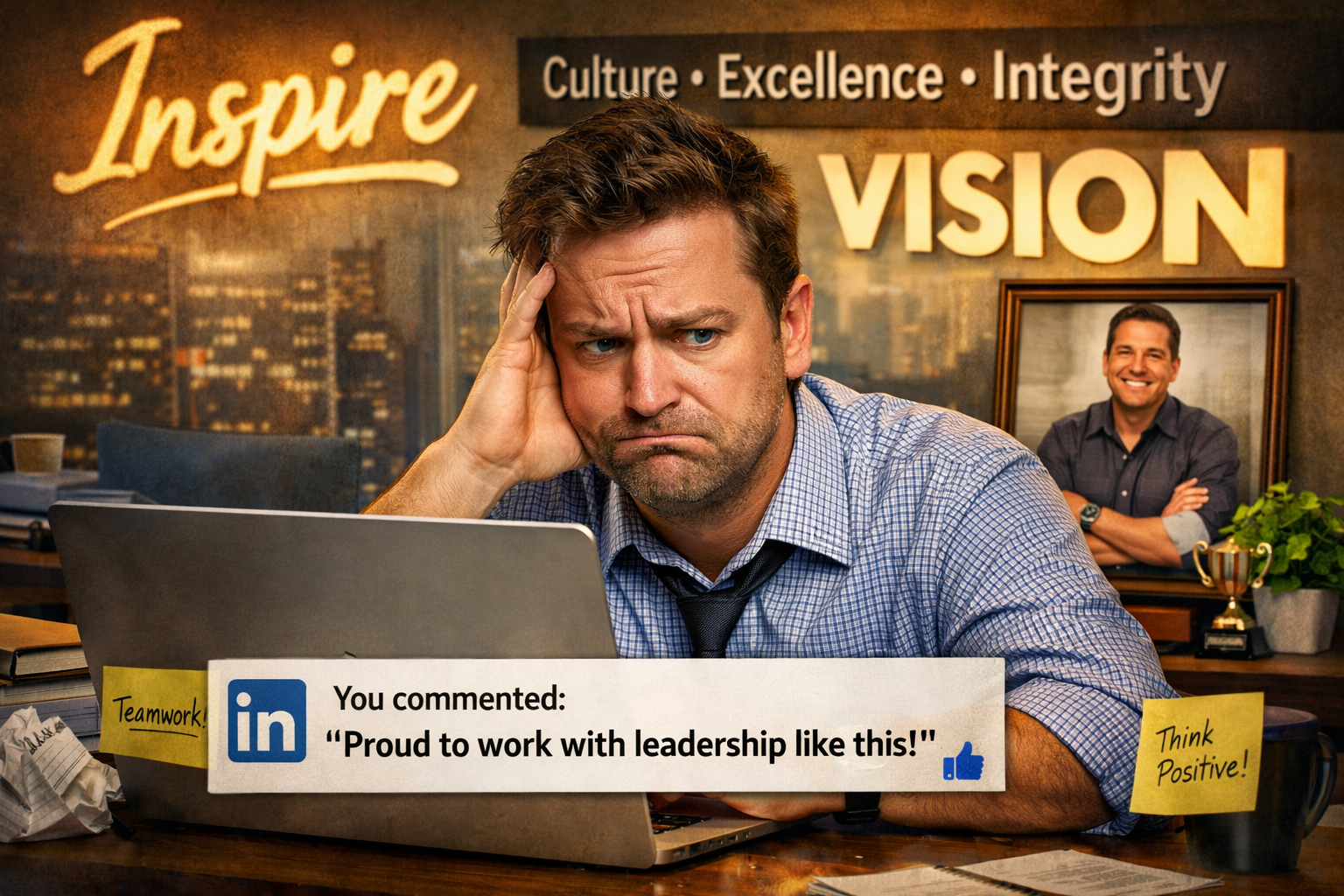
There are very few moments in adult life more humbling than discovering that your own public enthusiasm has aged into evidence, and yet somehow one of the worst of them is not bankruptcy, not accidentally replying-all, not being seen running for a closing elevator with your laptop bag bouncing against your side like a panicked toddler, but realizing that months ago, in a fit of sincerity so reckless it now feels almost criminal, you publicly supported an executive on LinkedIn and must now return to the internet like a disgraced museum curator to remove proof that you once mistook branding for character.
This is the part of corporate life nobody prepares you for. People warn you about layoffs, restructures, surprise calendar invites, vague feedback, and the kind of one-on-one meetings where the phrase “just wanted to chat” arrives wearing the smile of a man holding a folding chair behind his back. But nobody sits you down and says, “One day, you may have to perform a full-scale digital recovery operation because a leader you once publicly praised turned out to be less ‘visionary steward of people’ and more ‘high-budget wallpaper with authority.’” Nobody tells you that one of the hidden costs of trying to be supportive in a company culture is that your support may later boomerang back into your life like a cursed artifact that has been waiting patiently in the ruins for the exact right moment to humiliate you.
At the time, of course, it all felt reasonable. It always does. That is how these things happen. You see a polished post from someone important. The lighting is excellent. The sleeves are rolled. The caption has the emotional density of a TED Talk written inside a candle store. There is talk of culture, purpose, excellence, servant leadership, bold vision, the power of people, and a future so inspiring you almost forget Kevin from operations is still waiting three weeks for approval to replace a chair that leans like it survived a maritime accident. The executive is standing there in a photo with the exact expression all leaders use when they want to look both decisive and approachable, as if they personally made coffee for the entire organization at 5:00 a.m. and then stayed late to comfort the copier.
And you, because you are employed and therefore biologically susceptible to optimism under direct deposit, interact with it.
Maybe you click Like. Maybe you add the clap emoji, which in hindsight is always the confetti of future regret. Maybe, God forbid, you comment. Something warm. Something supportive. Something with the moral texture of public trust. You type words like proud, inspired, grateful, honored, excited to be part of this journey, because at that point in the story you still believe that leadership language and leadership behavior might one day be introduced to each other. You do not yet know that many executive posts are less an expression of values and more a decorative placemat placed over a table full of nonsense.
Then time passes, because that is what time does when it is gathering evidence.
Then things happen. Information leaks in through the walls. Patterns emerge. The curtain slips. The mythology cracks. The noble architect of culture begins to look suspiciously like a man who outsourced his conscience to a communications team. Suddenly, the post you once engaged with does not feel like a harmless moment of encouragement. It feels like a sworn statement given under emotional duress. You are no longer browsing your history. You are investigating the scene of your own misplaced loyalty.
And that is how an ordinary professional ends up late at night, lit only by the cold glow of a laptop, scrolling through months of activity with the haunted concentration of a person trying to locate one specific bad decision in a museum of lesser ones. Not because the world demanded it. Not because anyone forced you. But because your soul can no longer coexist with the sentence “So proud to work with leadership like this” floating around publicly like a decorative flag over a building that later caught fire.
The Day I Mistook Leadership Content for Leadership
The modern executive post is one of the great theatrical forms of our time. It has everything. Lighting. branding. conviction. selective vulnerability. It is corporate opera for people who believe bullet points can save them. Somewhere along the way, senior leadership figured out that if you stand in front of a branded wall, mention “our people,” and attach a photograph where you appear to be mid-laugh with a frontline employee you have almost certainly never met outside this specific photo opportunity, the internet will briefly allow you to cosplay as a philosopher king of workplace decency.
And to be fair, the format is powerful. That is what makes it dangerous. It is not just a post. It is a performance calibrated to activate every exhausted employee’s deepest need to believe that the adults upstairs are not improvising with a flamethrower. It arrives polished, composed, and marinated in the language of care. You read it during work hours while recovering from an email that began with “As discussed” and ended with your remaining serotonin. So when this elegant public sermon appears about people-first culture, compassion, accountability, and excellence, some primitive part of your spirit sits up and says, perhaps foolishly, perhaps beautifully, perhaps with the judgment of a raccoon eating vitamins out of a dumpster, “At last. A leader.”
That is how it begins. Not with stupidity, but with hope wearing a tie.
I remember the emotion well. It was not fake then. That is the most offensive part in hindsight. I was sincere. I was not trying to flatter anyone. I was not angling for visibility or auditioning for a role in the executive choir. I genuinely thought I was witnessing something admirable. I saw a polished declaration about values and thought, this is good. This is what leadership should sound like. This is worth affirming. So I did what emotionally well-meaning employees have done since the invention of professional networking platforms and self-betrayal: I publicly engaged.
I clicked the like button with all the innocence of a man signing a document without reading the fine print.
Then I commented, which is the professional equivalent of taking your regular mistake and engraving it into marble.
The comment itself was supportive in the way these things always are. Warm. Respectful. Slightly polished, because LinkedIn is the only place where fully grown adults write like they are trying to be accepted into a very boring monastery. I said I was proud. Proud to work with leadership like this. Proud to be part of the vision. Proud in a manner so sincere that reading it now feels like finding a diary entry from an earlier civilization.
And for a while, that comment just sat there, harmlessly. A little digital thumbs-up from a man who thought he understood the building he was standing in. A tiny public offering laid at the feet of professional belief. I forgot about it, because that is what you do with comments made during the period of your life historians later call Before the Plot Twist.
But the internet does not forget. It keeps receipts with the patience of a courthouse.
Meanwhile the real story unfolded, as real stories often do, not in captions but in behavior. That is always where the truth lives. Not in the post. Not in the quote graphic. Not in the sleeve roll. Not in the “honored to lead such an incredible team” language that sounds like it was assembled by a machine trained on scented candles and annual reports. The truth arrives later, in private interactions, hidden patterns, decisions made under pressure, and those exquisite little moments where the public prophet of people-first leadership suddenly behaves like a substitute principal who just got promoted by accident.
That is when the nausea starts. Not because the post was fake in some dramatic movie-villain way, but because it was worse: it was professionally decorative. It was corporate garnish. It was moral parsley laid over a plate of nonsense and served with enough confidence to briefly convince the rest of us that flavor had occurred.
And once you see that, you cannot unsee it. The whole memory curdles. Your own comment, once just a passing gesture of support, becomes unbearable. It is no longer a comment. It is an artifact from the era when you still believed the menu.
Returning to the Scene of My Own Enthusiasm
There should be a special branch of therapy devoted entirely to the emotional conditions created by having to search for your own old LinkedIn comment with the intention of withdrawing it like contaminated blood. Because there is humiliation, and then there is sitting in silence, scrolling through your own professional activity from six months ago, watching evidence of your optimism surface one item at a time like bloated luggage after a plane crash.
The search itself is devastatingly intimate. You are not just looking for a post. You are confronting a previous version of yourself, one engagement at a time. There is your old support for other people’s promotions. There is your cheerful reaction to a team award. There is a thoughtful comment under some article about resilience that now reads like a hostage note written in a hallway outside HR. There you are being gracious, collegial, publicly normal, all while the future sits somewhere offstage sharpening its knives.
I do not think people appreciate the psychological violence involved in digital backtracking. The body knows. The body understands before the mind does. Your shoulders tense. Your breathing changes. Your jaw locks. You are no longer casually browsing. You are excavating. This is no longer social media. This is a forensic dig through layers of professional sediment, each scroll revealing another fossilized fragment of who you were before the gods of corporate realism slapped the flute out of your hands.
And all the while LinkedIn watches with that smug little interface, silently offering no mercy.
There is something especially accusatory about the platform when you are revisiting your own misjudgment. Every button feels sentient. Every old interaction looks back at you with the quiet pity of a bartender who remembers what you said in confidence three drinks ago. The feed is no longer a feed. It is a hallway of portraits, and every portrait is whispering, “Look who has returned to amend the historical record.”
I went looking for that executive post the way people in legal dramas go looking for surveillance footage. Focused. Embarrassed. Slightly sweaty. And the deeper I got, the more absurd the mission became. Because what was I really doing? I was attempting to reverse an emotional transaction after new information had downgraded the asset. I was trying to perform a tiny reputational bankruptcy on myself. I wanted to repossess my own respect before it appreciated further in the wrong direction.
And then I found it.
There it was.
The post, preserved in all its original glory, still standing there like a bronze statue erected to a version of events that no longer had my support. The photo was still polished. The caption was still glossy and overfed. And beneath it, my comment. My own cheerful endorsement. Bright, visible, and horrifying. It looked less like a spontaneous show of support and more like a testimonial collected at gunpoint during a corporate retreat.
I stared at it for a long time, the way people stare at old tattoos from relationships that ended with the police being conceptually nearby.
It is difficult to explain the emotional complexity of seeing your own sincerity after it has expired. On one hand, you want to defend yourself. You made sense at the time. You did not know. You were operating under the available facts, standard payroll conditions, and the natural human desire to believe that somebody in authority might actually mean the things they print under professional photographs. On the other hand, there it is: the sentence, in your name, glowing publicly like a decorative plaque mounted outside the museum of your bad instincts.
So I did what had to be done. First the like. The like is easy. Quiet. Clean. The digital equivalent of removing your fingerprints from a glass. No drama. No splash. Just a discreet little reversal, a tiny bureaucratic exorcism conducted under cover of night.
But the comment. Ah yes, the comment.
Removing a comment is different. That is not a simple gesture. That is a confession. That is going back into the public square and unringing a bell you personally rang with both hands. That is me stepping forward and saying, respectfully, I would now like to rescind this endorsement due to updates in the internal weather report. It is a visible correction to an invisible emotional error. It feels like peeling your own campaign poster off a wall after the candidate turns out to be made entirely of PowerPoint transitions and selective empathy.
I deleted it, of course. I had to. But I did not feel victorious. I felt like a man who had successfully removed a cursed painting from his house only to realize he had once framed it himself.
Why Executive Posts Now Feel Like Wildlife Encounters
Since that day, I have changed. Not in a dramatic way. I still function. I still log in. I still maintain public professionalism. But something in me hardened into wisdom, or maybe just better instincts wrapped in sarcasm. I no longer approach executive LinkedIn posts with openhearted professional curiosity. I approach them the way a park ranger approaches rustling in tall grass. Calmly. From a distance. With respect for the possibility that what looks majestic from afar may still absolutely ruin your afternoon if you get too close.
This is not cynicism. Cynicism is cheap and lazy. This is pattern recognition with scar tissue.
Because once you have had to physically retract your own praise from the internet, you learn things. You learn that polished leadership content is often less a reflection of character than a form of digital landscaping. You learn that “people are our greatest asset” is not a value statement so much as a corporate hymn, sung reliably and often regardless of whether anybody backstage is actually feeding the choir. You learn that some leaders are not communicating values; they are staging weather. They want the atmosphere of trust, the lighting of conviction, the architecture of care. Whether the plumbing underneath works is apparently a detail for peasants.
And most importantly, you learn that public support should be handed out like rare blood, not cocktail napkins.
I now read executive posts the way medieval villagers probably read signs of plague. Carefully. From a distance. Looking for hidden indicators. Are the comments full of actual employees speaking like humans, or is everyone writing in that unnerving tone of ceremonial gratitude usually reserved for donor walls and military funerals? Does the post mention specific behavior, or just abstract nouns floating around in expensive shoes? Are we getting values with evidence, or values with photography? Is this leadership, or merely leadership-adjacent décor?
These are important questions.
Because the modern workplace has created an entire ecosystem where image can survive long after integrity has left through a side door carrying office supplies. The post remains pristine. The logo remains centered. The caption still glows. Meanwhile the actual employee experience may be downstairs eating crackers in the dark and wondering why “human-centered leadership” keeps arriving in the form of policies written by people who clap during layoffs.
And the cruel genius of it all is that the public theater works best on decent people. The manipulative, the performative, and the deeply synthetic rely on the fact that normal employees are wired to respond to signs of care. We want to believe. We want the values to be real. We want the people in charge to have interior lives. We want the public statement and the private behavior to be distant cousins at minimum. So when an executive posts something elegant and affirming, good people feel pulled toward affirmation. They want to reinforce what they hope is true.
That is how trust gets harvested.
Which is why I now maintain a healthier professional doctrine. I do not rush to praise. I do not publicly kneel at the altar of strategic sincerity just because someone paired a leadership quote with flattering daylight. I observe. I wait. I let actions marinate. I allow time to do what branding cannot. If the values are real, they will survive contact with reality. If they are fake, reality will eventually remove the wig.
And let me say this clearly for the record: the embarrassment is not that I supported someone once. The embarrassment is how aggressively sincere I was about it. There is a difference between tapping Like because your thumb slipped and composing a comment that reads like a campaign endorsement from a man who still thinks morale is handcrafted by leadership rather than briefly rented for use in photographs.
I know better now. I know that not every polished message deserves a witness. I know that admiration should require receipts. I know that some posts are not invitations to engage but traps baited with purpose, culture, and rolled sleeves. Most of all, I know that nothing ages worse than a public declaration of trust in a workplace ecosystem where the truth travels slower than the content team.
Final Thoughts: Some Things Should Never Be Left in the Wild
There is something almost spiritual about discovering the difference between who a leader says they are in public and who they turn out to be when the music stops, because it changes not only how you see them, but how you see your own participation in the machinery of professional belief. You realize that part of the modern job is not merely doing the work, but constantly navigating an environment flooded with symbols, gestures, slogans, and carefully packaged scenes designed to make institutions feel warmer than they are. You are not just asked to perform your role. You are invited, subtly and repeatedly, to co-sign the mythology.
That is what the like was. That is what the comment was. Not just engagement, but minor citizenship in the republic of image.
And once that republic falls, you feel ridiculous for ever having waved the flag.
Still, there is mercy in hindsight. The old comment embarrasses me now, yes, but it also reminds me that sincerity is not stupidity, even when it leaves ugly records. Believing the best of people is not a character flaw. Taking language at face value is not a moral failure. The real offense belongs to those who treat trust as a branding resource, who use public declarations of humanity as decorative fencing around private behavior that cannot survive daylight. If anything, my old comment is less a monument to gullibility than a record of the fact that I approached the world in good faith before the world handed me a magnifying glass and said, maybe stop doing that near executives with ring lights.
So I do not hate the old version of myself. I pity him a little. I want to sit him down, hand him a beverage, and explain that some leadership posts are just corporate bird calls designed to lure decent people into the brush. I want to tell him that words like purpose, culture, and excellence are not proof of anything except access to a keyboard. I want to tell him that the internet is a poor place to store trust because trust decays slower there and smells worse when you finally have to dig it up. I want to tell him that one day he will become the kind of man who sees a polished executive post and reacts the way seasoned sailors react to unnaturally calm water.
But perhaps the real lesson is simpler than that.
Do not leave behind a version of your respect that you may later have to hunt down.
Do not donate your public admiration to leadership branding before leadership behavior has passed inspection.
Do not carve loyalty into the wall while the building is still being tested for structural integrity.
Because deleting a like is housekeeping. Deleting a comment is a séance.
And nobody should have to perform digital exorcisms on a Tuesday night because they once believed a caption written under a photograph of rolled sleeves and borrowed humanity.
Now, when I see those posts, I nod politely the way one acknowledges danger at a safe distance. I do not engage impulsively. I do not clap for the scenery. I do not set down any emotional luggage where it might later be tagged as evidence. I have become careful, almost elegant in my restraint, a man who has learned through shame that the workplace is full of motivational screensavers in human form and that some of them are very, very good at posing near words they have never personally met.
And that, more than any leadership seminar, has taught me professionalism.