
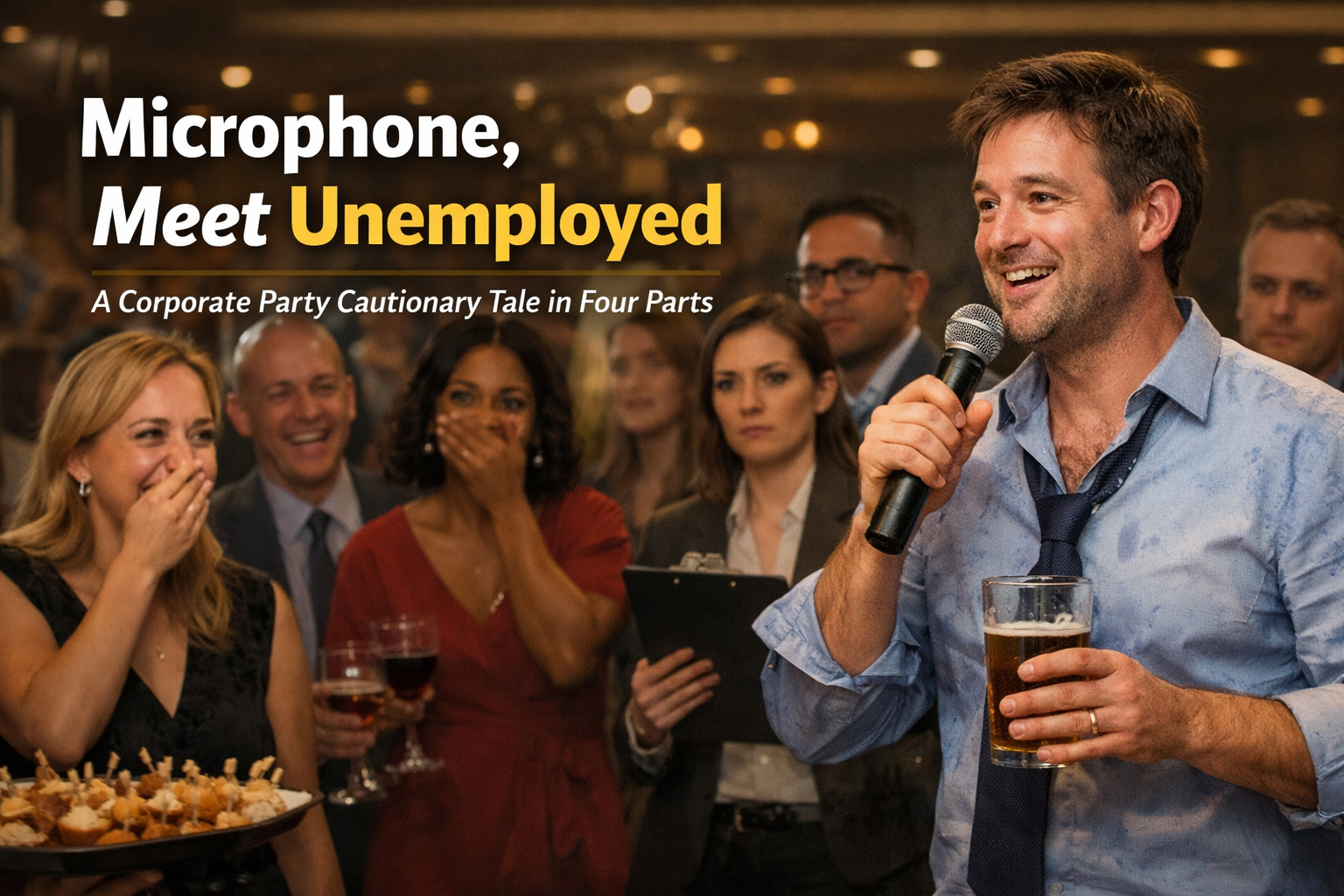
I was invited to my friend’s corporate party this evening, which sounded harmless on paper, the way “quick call” sounds harmless on a calendar invite until you realize it has an attachment labeled “Talking Points” and a surprise attendee named Human Resources.
I almost didn’t go. Not because I’m antisocial, or because I’m allergic to small talk, or because I’ve developed the kind of job-hunt paranoia where I assume any gathering of more than six employed people is technically a networking event and therefore a threat. I almost didn’t go because I’ve been unemployed long enough that a tray of miniature crab cakes now registers in my brain as a benefits package. I don’t see hors d’oeuvres anymore. I see compensation. I see a signing bonus. I see a future where I can stop doing math in the grocery store like I’m trying to solve world hunger with a coupon.
But I went anyway, because I’ve learned something in this era of rejection emails that never arrive and “we’ll circle back” that never circles back: sometimes you need to physically enter a room where people exist, just to remind your nervous system that you are still a member of the species and not a ghost haunting job boards at 2:13 a.m.
I walked in with my best imitation of confidence, which is easy when no one can verify your employment status without opening LinkedIn and scrolling past your most recent “Open to Work” post like it’s a public confession. The lighting was flattering in that corporate way where everyone looks successful as long as they don’t move too quickly. There were name tags, which is always a red flag because it means introductions will be forced, and forced introductions mean job titles, and job titles mean we are about to watch grown adults describe their worth using nouns they did not choose.
Everything was going fine. I was doing the polite nod. The smile that says I’m listening while my brain quietly counts how many shrimp are left on the tray and calculates whether it’s morally acceptable to hover. I was hearing phrases like “synergizing cross-functional deliverables” and “leveraging strategic alignment,” which is corporate language for “I am paid to attend meetings where nothing is decided, but we all pretend something happened because the invite had a Zoom link.”
I was blending in so well that for a brief moment I forgot I was unemployed. I felt like I belonged. I felt like I had an inbox. I felt like I had a printer somewhere that didn’t work. I felt like I could say “touch base” without throwing up.
And then someone made the most dangerous decision of the night.
They handed me a microphone.
Not for karaoke. Not for announcements. Not for the safe and noble purpose of directing people toward the dessert table. For “a few words.”
That phrase has ended more careers than layoffs.
The room went quiet in that way rooms only go quiet when people are expecting either inspiration or a lawsuit. The lights got brighter. Somewhere behind me, HR began assembling like a Marvel post-credit scene. You couldn’t see them yet, but you could feel them, like a faint breeze of policy language drifting in from the hallway.
I started safe. Thanked everyone. Complimented the energy. Said it was great to be in person. The verbal equivalent of stretching before disaster.
Then the job hunt reflex kicked in.
Because once you’ve been ghosted enough times, you stop fearing judgment. You start craving it. Preferably live. Preferably with witnesses. Preferably in a room full of people who still have dental insurance.
And that, unfortunately, is how a corporate party becomes a sermon.
The Microphone Is a Trap and I Walked Into It Like a Proud Animal
There is a specific kind of confidence you get when you’ve been told “we went with other candidates” so many times that it no longer hurts, it just becomes weather. You stop flinching at rejection. You stop personalizing silence. You stop reading tea leaves in the punctuation of recruiter emails because the truth is, there are no tea leaves. There is only a system, and the system is powered by templates and fear.
That confidence is not the glamorous kind. It’s not TED Talk confidence. It’s not “I’ve got this” confidence. It’s the confidence of someone who has already been embarrassed in every possible way and now has nothing left to protect except their sense of humor and whatever dignity they can carry in a reusable tote bag.
So when they handed me the microphone, something in me stood up like it had been waiting for this moment.
I told them how refreshing it was to be in a room where people physically existed. Where calendars weren’t the primary relationship. Where conversations didn’t begin with “sorry I’m double booked” like we’re all running trauma units instead of spreadsheets. I said it with warmth. I said it like a compliment. Which is the most dangerous way to say a truth in corporate America: lovingly, with eye contact, and without a slide deck to soften the blow.
They laughed. Carefully. The kind of laugh that checks for legal exposure. The kind of laugh that says, “This is funny,” and also, “If this gets weird, I am going to look at my phone and pretend I got an urgent message from my child’s school.”
I kept going because the laughter gave me permission and also because the microphone was warm now, like it had chosen me.
I talked about meetings that should’ve been emails, emails that should’ve been thoughts, and thoughts that never should’ve left my head. I talked about job titles so long they need line breaks, and how at a certain point you’re not a person anymore, you’re a paragraph. You’re “Senior Vice President of Global Strategic Partnerships and Operational Excellence,” which is just a complicated way of saying, “I have 47 meetings a week and none of them make me feel alive.”
I said every company says “we’re like a family,” but it’s always the kind of family that communicates exclusively through passive aggressive Slack messages and surprise “quick chats,” the kind where someone says, “Do you have a minute?” and what they mean is, “Do you have the emotional stability to be blamed for something you didn’t know existed?”
Heads started nodding. Real nodding. The kind that says, “This man has seen Outlook at its worst.” The kind that says, “I too have been attacked by a calendar invite titled Catch Up.”
And that was the moment I realized something both empowering and deeply unfortunate: corporate people are starving. Not for food. For honesty. For someone to say the quiet part out loud without immediately adding, “but of course we’re grateful for the opportunity.”
I had accidentally become a spokesperson for everyone’s internal monologue.
And now I was holding a microphone, which meant I was technically amplified.
This is how disasters start.
Corporate Life Is Performance Art and We Are All Understudies in a Show We Hate
Corporate life is fascinating because it teaches you how to look busy while nothing is happening. It teaches you how to fill time with urgency. It teaches you how to respond instantly to messages that do not matter while ignoring the things that do, like your health, your family, your joy, your will to live.
It teaches you how to keep your face neutral while your brain is actively Googling, “Can you cry in a bathroom stall without it echoing?” and “Is it normal to feel like your soul is buffering?”
I said that out loud, because once you’ve said it once, you cannot stop. It’s like opening a window in a room that’s been sealed for years. Suddenly the air is moving. Suddenly people can breathe. Suddenly you’re speaking a language everyone understands but no one is allowed to use at work.
Someone whispered “oh my god,” which is never feedback you want mid speech unless you’re doing magic, and I was not doing magic. I was doing truth. Which is the opposite of magic, because truth doesn’t make problems disappear, it just makes them visible.
I talked about the weird rituals we’ve normalized. The way we schedule meetings to prepare for meetings, then hold meetings to recap meetings, then send follow-up emails summarizing the meeting so everyone can pretend the meeting accomplished something. I talked about how we’ve developed an entire culture around the illusion of productivity, like a theater troupe putting on a show called Work, starring people who are exhausted and underpaid and pretending their inbox is a meaningful legacy.
I said we have made busyness a moral virtue. If you’re overwhelmed, you’re important. If you’re behind, you’re committed. If you’re burned out, you’re loyal. If you’re calm, people assume you’re not trying hard enough, which is insane, because calm is what humans are supposed to be when they are not being chased by predators or deadlines.
And then, because I am unemployed and therefore no longer protected by the polite fear of performance reviews, I talked about job hunting.
I said the job hunt is like dating, but with more rejection and less closure. At least in dating, someone might ghost you because they’re emotionally unavailable. In job hunting, you get ghosted because the applicant tracking system ate your resume like it was a sacrificial offering and no one wants to admit they built a process that can’t recognize the word “experience” unless it’s written in the correct font.
I said the cruelest part is not being rejected. The cruelest part is being ignored with professionalism. Being treated like a problem that can be solved with silence. Being given hope in the form of “we’ll be in touch” and then watching that hope evaporate while you refresh your email like it’s a life support machine.
The room got quieter, but not uncomfortable quiet. It was the kind of quiet you get when people recognize themselves in what you’re saying and for a second they stop pretending they’re fine.
That’s the thing about corporate life. Everyone is pretending. Even the people who look like they’re winning are pretending. Especially the people who look like they’re winning. The higher you go, the more you have to act like the chaos is normal, like it’s reasonable to be permanently reachable, like it’s healthy to measure your worth in deliverables.
I looked out at them and saw it. The exhaustion behind the smiles. The practiced resilience. The way people carry their job titles like armor.
And I thought, maybe this is why they gave me the microphone. Maybe they sensed I was already on fire and decided to use me as a controlled burn.
My Friend’s Bonus Was Hovering Over a Volcano and I Was Holding the Match
By this point my friend was doing that smile that says support while their eyes begged me to stop. It’s a unique facial expression, the corporate-host version of “I love you and also I will never forgive you.”
Their eyes were saying, “This is funny,” and their jaw was saying, “This could be career-ending.”
I could feel the room splitting into two groups. One group was fully with me, laughing with the relief of people who’ve been waiting years for someone to say it. The other group was doing mental math, calculating the risk, wondering whether humor is covered under the company’s code of conduct or if it falls under “reputation management.”
Somewhere near the back, someone in leadership was holding a drink like it was a shield. Somewhere near the side, someone from HR was nodding politely, which is the same as watching politely. HR does not laugh freely. HR laughs the way a lawyer laughs: strategically, with an exit plan.
I realized I had reached a point in the speech where I could either land the plane or attempt a barrel roll.
I chose landing, because even in my chaos I have some respect for my friend’s mortgage.
So I wrapped it up. I thanked them. I handed back the mic. I reminded everyone to enjoy the night, hydrate responsibly, and never, under any circumstances, give the unemployed friend a microphone after two free drinks.
The applause came fast and slightly panicked, like people clapping to end a situation before it becomes a learning module. The kind of applause that says, “We support this,” and also, “Please stop talking before Legal hears about it and turns this into mandatory training with a quiz at the end.”
And then it was over. Just like that. The lights softened. The music came back. People resumed their corporate postures, like actors returning to their marks.
But something had shifted.
People came up to me afterward with that hushed urgency corporate people use when they want to be honest but still feel like honesty should be whispered. They said things like, “I needed that,” and “How did you say that out loud,” and “Please never do that again in front of my boss,” which is the corporate equivalent of a standing ovation.
I didn’t get a job offer. I didn’t get a recruiter sliding into my DMs like, “We love your microphone presence, can you join our team and also solve our culture?” I didn’t get a miracle.
But I did get something I hadn’t realized I missed.
I got to be judged by humans again.
Not by an automated email signed “The Hiring Team.” Not by a rejection template that treats your effort like a spam folder inconvenience. Not by a silent system that never confirms you existed.
By people. In a room. With faces. With reactions. With laughter that sounded like recognition.
And honestly, after months of being reduced to a submission number in a portal, that felt almost holy.
Final Thoughts: Sometimes the Microphone Is a Mirror
Here is the uncomfortable truth I learned tonight, standing under corporate lighting with a microphone that was absolutely not meant for me: people are not craving motivation. They are craving reality. They are craving someone to acknowledge what we all pretend isn’t happening.
The employed people in that room laughed because it was funny, yes, but also because it was familiar. Because every one of them has sat through a meeting that could’ve been a sentence. Every one of them has typed “per my last email” like a prayer. Every one of them has stared at their calendar and felt their stomach drop because they realized their day belonged to other people.
And me, the unemployed friend with nothing left to lose, accidentally gave them permission to admit it. For a few minutes, we were not job titles. We were humans who have survived the modern workplace and lived to tell the story, even if the story is told in whispers and jokes and careful laughter that checks for legal exposure.
I’m not saying you should give the unemployed friend a microphone.
I’m saying if you do, understand what you’re doing.
You’re not handing them an accessory.
You’re handing them a truth serum with amplification.
And if you’re lucky, the room won’t just laugh.
The room will exhale.
Because sometimes the most dangerous person at a corporate party isn’t the one who’s drunk.
It’s the one who’s free.