
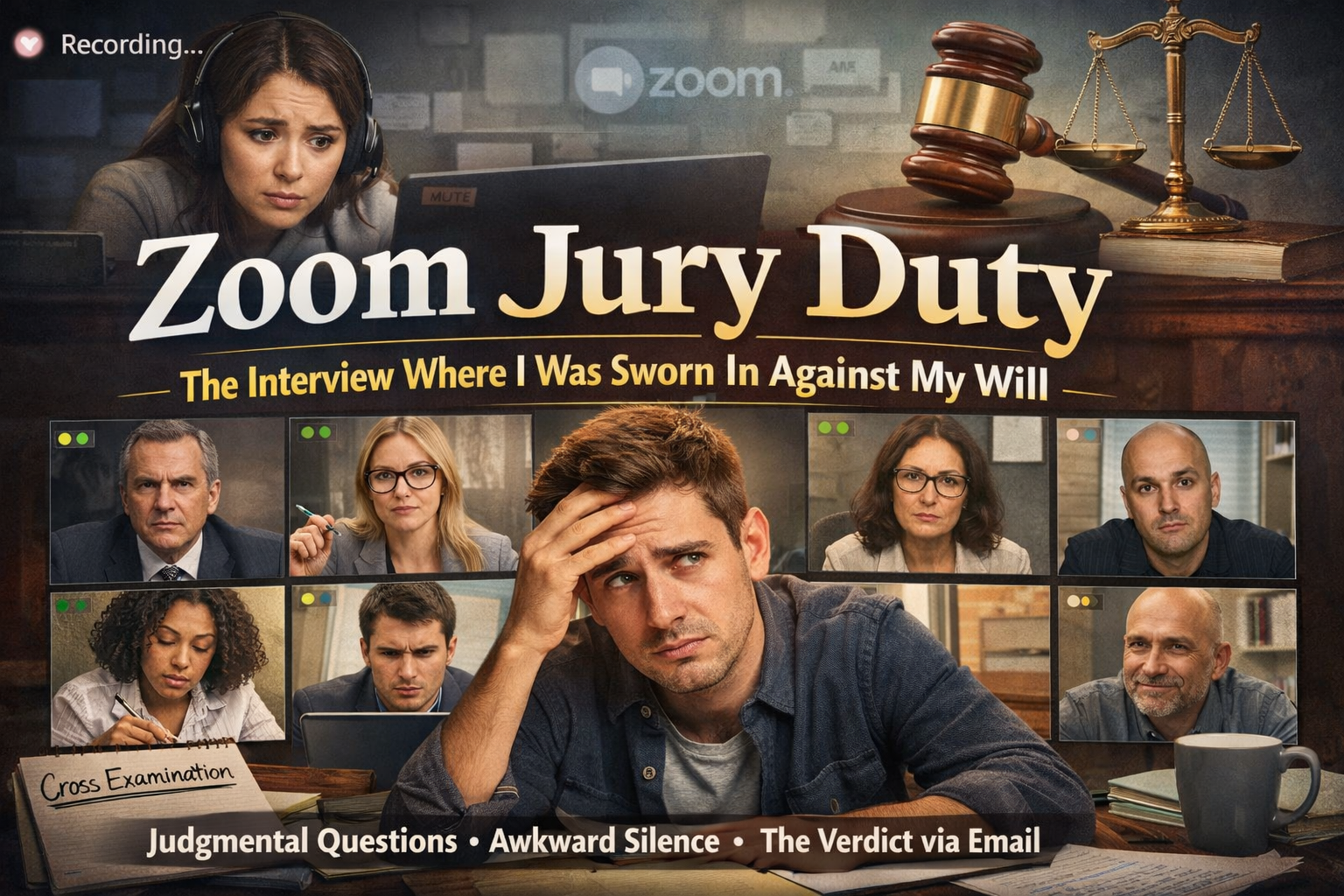
The year is 2026, and interviews have stopped pretending they’re conversations. They are no longer a mutual exchange of information between two adults exploring alignment, expectations, and whether the role involves actual work or just attending meetings about work until your personality becomes a calendar invite. No. Interviews are now proceedings. Formal. Ominous. Filled with sudden summons, vague charges, and a panel of strangers who stare at you like you’re the reason the Q4 forecast needs therapy.
It starts the way all modern professional nightmares start: with a buzz. A cheerful little notification that says something like “Quick recruiter call?”—and you, naive citizen that you are, believe it. Because the word “quick” still means something to you. Because you still live in a world where a “friendly chat” is a “friendly chat,” and not a Trojan horse containing eight executives and a shared Google Doc titled “Reasons We Don’t Like This Person.”
So you show up. You hydrate. You sit in your most responsible chair. You angle the camera so it looks like you have a home office and not a corner of your living room you’ve renamed “Career Hope.” You take the call expecting a vibe check—something casual where the recruiter asks what you’re looking for and you both pretend the salary range hasn’t been hidden like contraband.
And then, five minutes in, she drops it. The sentence that should come with sirens, flashing lights, and a waiver: “Would you mind hopping on a quick Zoom with the team?”
Quick is doing an aggressive amount of lying in that sentence.
Because you click the link expecting maybe one person. Possibly two. A manager. A witness. Someone who, at minimum, will say their name before asking you to explain your deepest professional trauma. But instead, eight faces appear—eight rectangles, eight silent observers, eight people who look like they were teleported into the meeting from eight different levels of corporate purgatory.
No one introduces themselves. They just stare. Muted. Cameras on, souls off. It’s less “interview” and more “corporate parole hearing,” like you’ve been accused of stealing a stapler in 2013 and this is finally your day in court.
Someone eventually says, “So… tell us about yourself.”
Which is incredible, because you don’t know who any of them are.
And now you’re giving your life story to strangers arranged like a judgmental Brady Bunch, trying to sound confident while your laptop fan starts working overtime like it knows something you don’t. Every answer feels like testimony. Every nod feels like evidence. One person is taking notes like you just confessed to a crime.
And you realize, in that moment, the interview isn’t an interview.
It’s jury duty.
And you didn’t even get the little badge.
The Summons (Or, How “Quick Call” Became a Court Date)
The recruiter call is the new envelope from the courthouse. It arrives with deceptive friendliness, written in a font designed to lower your defenses, and it carries the same underlying message: you are required to appear, and no, you cannot reschedule without being judged.
You’re told it’ll be “just a few questions.” You’re told they want to “learn more about your background.” You’re told it’s “informal.” Informal is the word they use right before they ask you to explain how you would handle conflict with a coworker who is actively on fire while also meeting deadlines and maintaining cultural alignment.
The first red flag is how quickly the casual tone evaporates. One minute you’re discussing your experience like a normal person. The next minute you’re being escorted into a Zoom room with more faces than a high school yearbook.
And everyone has a different expression that somehow communicates the exact same thing: “We are not here to enjoy ourselves.”
You can tell who’s who by the energy alone. There’s the person who is clearly the designated skeptic, brought in specifically to find the flaw in your story. There’s the person who looks kind but won’t speak, because kindness is not an approved function in this meeting. There’s the one who smiles too long, like they’re trying to remember how humans do that. And there’s always one person who joins late, says nothing, and makes you wonder if they are a real employee or a corporate hallucination.
The recruiter disappears into the background, because her job is done. She has delivered you to the room. You are now the subject. The case file. The human document they will review and mark up with comments like “seems confident” and “said ‘we’ too much” and “did not sufficiently grovel.”
And then comes the opening statement: “Tell us about yourself.”
This question is always framed like a warm invitation, but it is actually the beginning of your cross-examination. Because what they’re really asking is: “Which version of you should we judge today? The competent one? The humble one? The passionate one? The one who’s grateful to be considered for the privilege of being tired?”
You start talking, but you can feel the room listening the way a courtroom listens. Not with curiosity. With evaluation. With measurement. With the quiet intensity of people deciding whether you’re “leadership material” based on how often you blink.
And while you speak, they nod. They take notes. They exchange glances. You watch your own face on the screen and realize you’re doing that interview smile—the one that tries to look confident while internally screaming, “I DIDN’T STUDY FOR THIS.”
Because that’s the thing about the summons: you didn’t know you were being called to court. You thought it was a chat. You thought you were safe.
You were not safe.
The Cross-Examination (In a Hypothetical Scenario Where We Absolutely Judge You)
Once you’re in the room, the questions begin the way all modern interview questions begin: like a trap disguised as professionalism.
“In a hypothetical scenario…”
That phrase alone should require legal counsel. Because there is no hypothetical scenario. It is always their scenario. Something happened. Someone didn’t handle it well. They are still mad about it. And now you are being asked to answer for the sins of the employee who broke them.
“In a hypothetical scenario, what would you do if you had to manage a team through conflict while also delivering a project under tight deadlines with limited resources and a stakeholder who refuses to give requirements?”
So, in a hypothetical scenario, you mean… this job.
Then comes conflict. Leadership. Five-year plan. The questions stack up like charges, and each one demands that you be simultaneously confident and humble, experienced and curious, decisive but collaborative, assertive but not “too much,” passionate but not “intense,” ambitious but not “a flight risk.”
Someone asks how you define leadership. You say something sensible. Seven people nod. One person types aggressively like you just admitted to tax fraud.
Another person asks how you handle feedback. You say you welcome it. They nod, but their eyes say, “You will not.”
Another asks for a time you failed. This is always fascinating because they want vulnerability, but only the approved kind—the kind that ends with you saving the company, the team, the timeline, and somehow also your childhood dog.
So you craft the story. You choose a failure that sounds like a failure but isn’t one. You fail at being too dedicated. You fail at being too hardworking. You fail at caring too much, which is basically the professional version of saying your flaw is “being gorgeous.”
And while you answer, you can feel your vocabulary becoming legal. You start saying things like “in that situation” and “based on the information available” and “I would align with stakeholders” like you’re building a defense case.
Because you are.
At some point, two people ask the same question in different words. That’s not redundancy. That’s cross-examination. They are testing consistency. They want to see if you contradict yourself. They want to see if you’ll panic. They want to see if you can remember what you said three minutes ago while maintaining eye contact with a person named “iPad (2).”
Then there’s the silence. The note-taking silence. The silence where everyone looks down at their keyboards and you’re left alone with your own breathing, suddenly convinced that inhaling too loudly might be interpreted as poor communication skills.
This is the part where you start wondering what the criteria actually are. Is it the answers? Is it the tone? Is it whether your background looks professional enough to convince them you have a stable life and not three laundry baskets behind the camera?
And because you’re human, you try to read their faces. But their faces are corporate faces. Neutral. Controlled. They give you “great answer” with no emotion, which is Zoom code for “we have acknowledged that sound came out of your mouth.”
And then you realize the most unsettling truth about 2026 interviews:
It doesn’t matter what you say.
It matters how well you can perform calm under observation.
This is not a conversation.
This is an endurance test.
The Closing Argument (Do You Have Any Questions For Us?)
After an hour that felt like an entire fiscal year, they arrive at the question that pretends to be polite but is actually the final trap door.
“Do you have any questions for us?”
This is the part where your brain becomes a courtroom drama. Because every possible question has consequences.
Ask too many questions and you’re intense. Ask none and you’re disengaged. Ask about culture and they all answer differently, which means you now have to pretend you understood the contradictions. Ask about growth and someone says “it depends,” which is corporate for “we don’t know what we’re doing but we’d like you to be optimistic about it.” Ask about workload and everyone suddenly looks at their desk like they’ve just been asked to identify a ghost.
You consider asking about the team structure, but you fear it will reveal you don’t already know it. You consider asking about success metrics, but you worry they’ll think you’re obsessed with performance. You consider asking what they enjoy about the company, but that question sometimes creates the kind of silence that makes you feel like you just asked everyone to share their deepest feelings in a spreadsheet.
So you ask something safe. Something neutral. Something that sounds curious but not curious enough to trigger suspicion.
They respond in vague, confident statements. They mention collaboration. Innovation. Fast-paced environment. They say “we wear a lot of hats,” which is corporate for “we are understaffed and also proud of it.” They say “we move quickly,” which is corporate for “everything is on fire but the meeting schedule is immaculate.”
Then someone looks at the clock and says, “Well, we’re at time.”
Which is corporate for: your fate will now be discussed without you.
Cameras shut off mid-wave. One disappears early. Another freezes in a permanent smile like a haunted corporate portrait. The meeting ends abruptly, like a courtroom recess where the jury is dismissed and the defendant is left alone with the echo of their own uncertainty.
And then you sit there. Staring at your reflection. In the glow of your laptop. Feeling like you’ve just been evaluated for character flaws you didn’t know you had.
Somewhere, a verdict will be reached.
You will not be present for it.
And in two weeks, you may receive an email that begins with “Thank you for your time,” which is modern society’s most polite way of saying the jury has decided and you may now return to your life.
Final Thoughts: The Verdict Will Be Delivered Via Automated Email
The cruelest part of interviews in 2026 isn’t the panel. It isn’t the hypothetical scenarios. It isn’t even the fact that you’re expected to present your entire personality in a polished, camera-ready format while pretending you don’t have bills.
It’s the aftermath.
It’s the limbo where you replay every sentence like evidence. It’s the way “great answer” can mean nothing, and silence can mean anything. It’s how the process is designed to make you feel like you are constantly one wrong word away from disqualification, while the company gets to be vague, inconsistent, and emotionally unavailable with zero consequences.
But here’s the thing that no one tells you: if you walk out of those rooms feeling like you were on trial, it’s not because you’re broken. It’s because the process is.
A conversation should feel like mutual discovery. If it feels like jury duty, it’s because somewhere along the way, hiring stopped being human and started being liability management wrapped in buzzwords.
So if you ever leave a Zoom panel and think, “Was I interviewed or prosecuted?” just remember: you didn’t fail. You survived an institution.
Now go drink water, close your laptop gently like you’re ending a court session, and return to your life.
The jury will email you when they feel like it.