
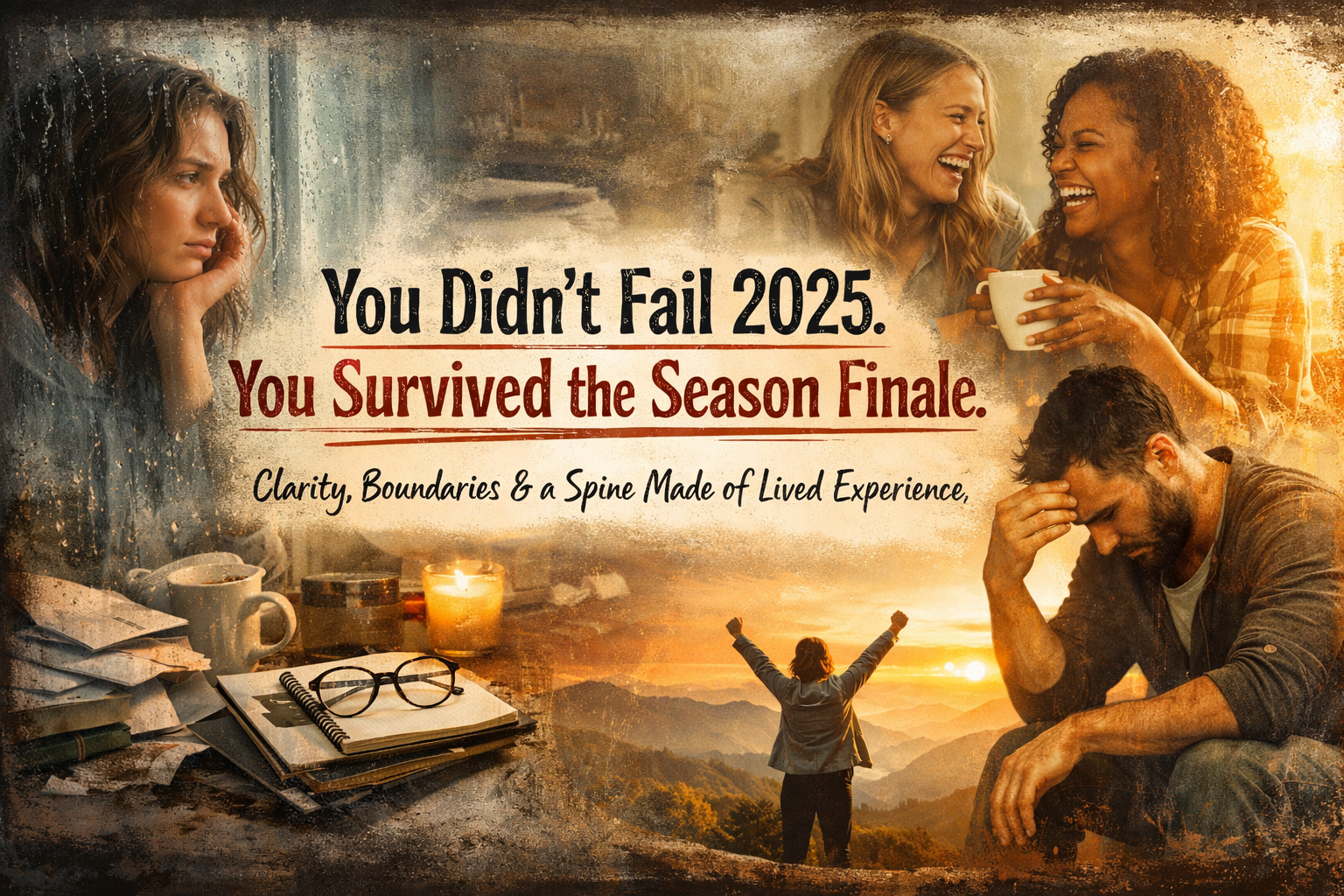
There’s a specific kind of exhaustion that doesn’t come from being “busy” in the cute, planner sticker, color coded way people brag about in January. It’s the kind that settles into your bones like wet laundry you forgot in the washer, the kind that makes you stare at a wall for ten minutes and then feel guilty because the wall didn’t even ask for that level of emotional intimacy.
And the worst part is how quietly it happens.
You don’t wake up one day and announce, “Hello, I’d like to enter my endurance era.” It’s more like a series of small things that stack up until your nervous system is living in a studio apartment with no windows, surviving off cold coffee, and flinching every time your phone lights up like it’s a subpoena.
2025 wasn’t a year. It was a group project with no instructions, no leader, and at least one person actively sabotaging the Google Doc.
And yet… you’re here.
Which is not a small thing.
Because “didn’t fail” is not the same as “didn’t struggle.” “Still standing” is not the same as “never fell.” People hear survival stories and sometimes they want them to sound inspirational in a tidy way, like you tripped, learned a lesson, and landed gracefully in a sunbeam with perfect hair and a journal entry that ends in “I’m grateful.”
But most real endurance looks messier than that.
It looks like getting through a week by sheer muscle memory and spite. It looks like crying at a commercial because someone in it got a text back. It looks like laughing at the wrong moment because if you don’t laugh, you might start screaming, and screaming feels like a bigger commitment.
So if you’re looking at 2025 like it was a personal indictment, like it proved something about you—your worth, your capability, your strength—let’s rewrite the story. Not with fake positivity. Not with a motivational quote slapped on a wound like a sticker on a cracked windshield.
With truth.
You didn’t fail 2025.
You endured it.
And the fact that you came out the other side with clarity, boundaries, and a spine made of lived experience means something. It means you didn’t just survive the plot. You learned the script. You took notes. You started recognizing patterns. You saw who showed up. You saw who didn’t. You saw what you kept excusing. You saw what you kept carrying. And you finally, bravely, quietly started setting it down.
That’s not failure.
That’s evolution.
The Year You Became a Human Stress Test
At some point in 2025, you stopped feeling like a person and started feeling like a case study.
Not because you wanted to be dramatic, but because life kept running experiments on you like it was trying to discover the exact dosage of disappointment you could tolerate before you snapped and moved into the woods to become a cryptid.
You weren’t weak. You were overloaded.
And overload is sneaky because it doesn’t come with an alarm. It comes with “just one more thing.” One more issue. One more unexpected bill. One more relationship that required you to be the therapist, the fixer, the adult, the forgiving one, the flexible one. One more situation where you had to be the bigger person, which is a polite way of saying you had to swallow your feelings so someone else could stay comfortable.
You kept pushing because that’s what you do. You keep it together. You show up. You keep moving. You find a way. You handle it. You don’t fall apart in public because you have developed a premium subscription to emotional containment.
But the body keeps records. The mind keeps receipts. The heart keeps score, even when you pretend you aren’t playing.
So you started noticing little things.
The way your chest tightened when someone said “Can we talk?” as if “talk” was now code for “surprise emotional ambush.”
The way you couldn’t fully relax even during “rest,” because rest felt unsafe, like the moment you stopped moving something bad would find you and file a complaint.
The way you became fluent in strategic coping. Not healthy coping. Strategic coping. The kind where you pick which breakdown you can afford based on your schedule.
And still, you kept going.
Because survival doesn’t always look like courage. Sometimes it looks like autopilot with mascara on. Sometimes it looks like you making dinner with one hand while googling “why am I like this” with the other.
And here’s what I need you to understand: if 2025 made you feel fragile, it wasn’t because you were fragile. It’s because you were holding too much.
People don’t crack because they’re weak.
They crack because they’ve been strong for too long without support.
And if you made it through that year, then you didn’t fail anything. You passed a test you never signed up to take.
Boundaries, AKA the Season Where You Stopped Being Free Labor
There comes a moment in adulthood where you realize you have been operating like a public resource.
Emotionally. Mentally. Spiritually. Sometimes financially. Like a helpful community water fountain, available to everyone, constantly running, never asking for anything back except the occasional “thank you” that arrives late and feels more like a courtesy than gratitude.
You were the one who answered.
The one who fixed.
The one who understood.
The one who didn’t take things personally.
The one who forgave quickly.
The one who stayed kind even when people made it difficult.
And listen—kindness is beautiful.
But kindness without boundaries becomes self-abandonment in a nicer outfit.
In 2025, something shifted. Maybe slowly. Maybe violently. Maybe you hit a breaking point so specific it deserves its own documentary title: “The Day I Realized I Was the Only One Trying.”
That’s usually when boundaries start forming.
Not as a trendy self-care concept, but as a survival mechanism.
You stopped explaining yourself to people who were committed to misunderstanding you. You stopped negotiating with the version of someone who only showed up when it benefited them. You stopped responding immediately just because someone had access to you. You started recognizing that urgency in someone else does not automatically become your emergency.
And at first, it felt wrong.
Because when you’ve been the reliable one, setting boundaries feels like betrayal. You start hearing the old scripts in your head:
“Am I being selfish?”
“Am I overreacting?”
“Am I being too sensitive?”
“Should I just let it go?”
But here’s the thing: the people who benefit from your lack of boundaries will always call your boundaries “too much.”
That doesn’t make them too much.
It makes them inconvenient for someone who liked you better when you were exhausted and accessible.
Boundaries are not walls to punish people.
They’re doors with locks so you can decide who gets access to you and when.
And the fact that you left 2025 with more boundaries means you didn’t just make it through. You learned how to protect what made it through.
You stopped treating your peace like a group chat.
You stopped handing out emotional discounts to people who always paid you back in disappointment.
You started choosing yourself without apologizing like you were committing a crime.
That’s not a personality change.
That’s you finally coming home to yourself.
The Quiet Triumph of Still Being Here (With a Sense of Humor)
People talk about resilience like it’s always loud.
Like it’s someone climbing a mountain with dramatic music playing, sweat glistening heroically, arms raised at the summit.
But real resilience is often small.
It’s unglamorous.
It’s you waking up and doing the day again, even when your heart is tired and your optimism has been missing since March.
It’s you finding one tiny thing to look forward to, even if that thing is just a drive with good music and no one asking you to be emotionally available.
It’s you laughing.
And not because everything is fine, but because humor is how you keep your spirit from drowning.
There’s a sacred kind of comedy that comes from pain, the kind that doesn’t minimize what you went through—it translates it into something you can carry without breaking.
Sometimes the funniest people are the ones who have had to learn how to be their own light in rooms that kept going dark.
And if you’ve ever cracked a joke in the middle of a hard season, that’s not denial. That’s defiance.
That’s you saying, “You don’t get to take my entire personality.”
2025 may have taken your energy.
It may have taken your innocence.
It may have taken your patience for nonsense, which honestly is a gift.
But it didn’t take your ability to feel.
It didn’t take your ability to learn.
It didn’t take your ability to grow.
It didn’t take your ability to show up again, wiser.
And most importantly, it didn’t take your story.
Because here’s the truth people don’t say out loud enough: your survival is someone else’s permission.
Someone is reading your honesty and thinking, “Oh. So I’m not the only one.”
Someone is quietly holding it together and your words are a hand on their shoulder.
Not because you’re perfect.
Not because you did everything right.
But because you kept going.
And that kind of endurance is not invisible, even if no one threw you a parade.
Final Thoughts: You’re Not Behind. You’re Becoming.
If you went into 2025 hoping it would be your year and it turned into your hardest year, that doesn’t mean you failed. It means life handed you lessons disguised as losses and you still made it out with more of yourself intact than you realize.
You didn’t come out unchanged.
You came out clearer.
You came out with boundaries that actually mean something.
With standards that protect you.
With a spine made of lived experience.
With a heart that still feels, even after everything tried to harden it.
And if you’re still haunted by the idea that you should’ve done more, achieved more, been more—let this be the moment you stop measuring your worth by your output during a survival season.
You were not made to “perform” through pain.
You were made to heal.
So no, it wasn’t just you.
It never was.
And if you needed proof that you’re stronger than you think, look at the fact that you’re here—still laughing, still learning, still building, still breathing, still becoming.
That’s not failing.
That’s winning in a way people don’t always know how to celebrate.
But I do.