There is a very specific kind of chaos that only corporate life can deliver, and it never kicks the door down like a normal villain. It doesn’t show up with a dramatic soundtrack or a fog machine. It arrives quietly, politely, in your inbox at 9:07 a.m., wearing a subject line like “Quick Note” and the same energy as a dentist who says, “This won’t hurt,” while reaching for tools that look like they were designed by a medieval blacksmith.
And the wildest part is it never shows up while you’re in the moment. Corporate chaos has manners. It waits until you’ve emotionally moved on, healed, unfollowed the entire cast, deleted the interview prep notes, recycled the blazer you wore on Zoom like it was ceremonial armor, and rebranded your trauma as “a season of growth” for the benefit of future cocktail conversations and LinkedIn captions.
Then, once you’re stable again—once you’ve rebuilt your nervous system and stopped flinching every time you hear the words “touch base”—it returns. Not to apologize. Not to clarify. Not to acknowledge that they ghosted you for a full year like you were a Victorian orphan in the rain. No. It returns with Legal.
Because corporate life is the only place where a company can ignore your existence for twelve months, then suddenly remember you’re alive when they want to lightly threaten you about a story you told that made them look… uncomposed.
And that’s the core of the modern job market, really. Companies are too busy to reply to applications, too busy to send updates, too busy to treat candidates like human beings, but somehow, miraculously, they have unlimited energy to defend the honor of a VP who fell asleep on camera. That’s not operational excellence. That’s a priority list written by insecurity, laminated by branding, and enforced by someone who owns three suits and zero joy.
So let’s talk about the love letter from Legal. The one that arrived like a ghost from a year ago, floating into your inbox with the delicate message: You violated our NDA.
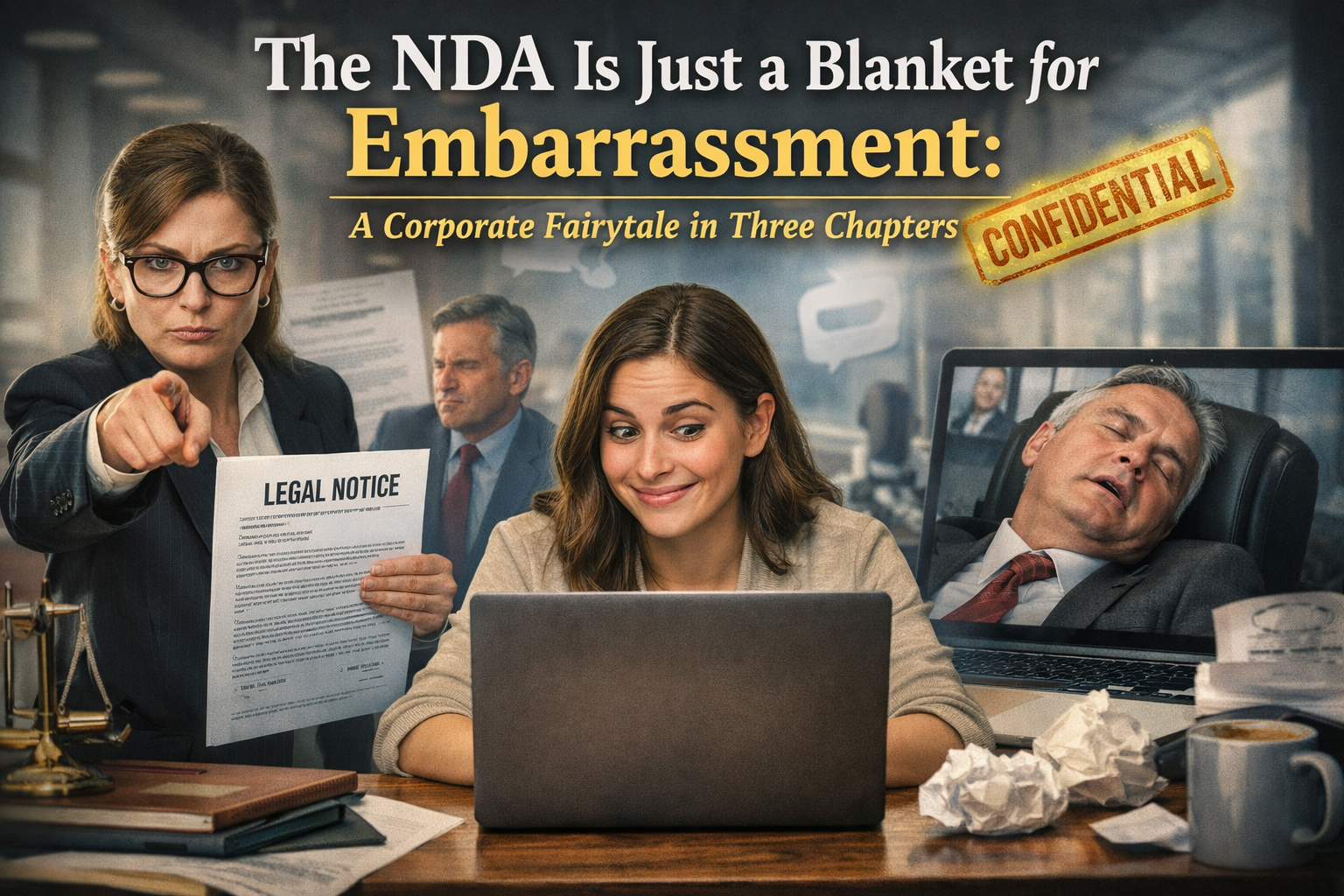
Yes. Over a Zoom interview where a VP fell asleep.
Which is an impressive accusation, because it implies there’s proprietary intellectual property involved in a grown adult nodding off mid-panel like a baby in a car seat. Apparently, the nap was classified.
Welcome to corporate America, where your “candidate experience” is silence, but your “storytelling experience” comes with consequences.
The Year-Long Ghosting, Now With Bonus Threats
Let’s start with the timeline, because timelines matter when you’re being scolded by people who discovered time travel.
You applied a year ago. A year. Twelve months. Four seasons. At least one holiday where you pretended you weren’t checking your email. And during that entire span, the company’s communication strategy was what I like to call “aggressively absent.”
No check-in.
No update.
No rejection.
No “we went with another candidate.”
Not even a courtesy “thank you for your interest,” which is corporate for “we noticed you exist, briefly, and we will now return to our natural habitat of ignoring you.”
You were ghosted so thoroughly that if you’d walked into a room with this company, they would’ve walked through you like you were a polite haunting.
And then—after a year of silence—they rise up from the legal shrubbery like a startled deer wearing a tie and announce:
“We noticed you told a story.”
It’s the most corporate thing imaginable: they couldn’t circle back when it mattered, but now they’ve circled back like a boomerang filled with legal vocabulary.
This is why job searching breaks people. Not because rejection is hard (it is), but because the whole system is built on a weird imbalance of power where companies can do anything—delay, ignore, vanish, forget you—and then still act offended when you mention something that happened publicly, on camera, in front of multiple witnesses, including the man’s own webcam.
And if you think about that for more than ten seconds, you realize the job market isn’t a market. It’s a haunted house where the ghosts sometimes send certified letters.
The NDA That’s Actually Just a Feelings Agreement
Now, let’s address the alleged crime: violating an NDA by telling a story.
Not naming the company.
Not naming the VP.
Not naming anyone.
Not sharing trade secrets, financials, client lists, proprietary strategy decks, or the sacred internal language that turns “we’re disorganized” into “we’re moving fast.”
You described an experience: a Zoom panel interview where one of the leaders fell asleep.
And what’s fascinating is how quickly that turns into a “confidentiality breach” the moment it becomes… unflattering.
Because here’s the part they don’t want to say out loud: the problem isn’t that the information was confidential. The problem is that the information was accurate.
If a vague internet story makes you instantly think, “Oh no, that’s us,” that’s not proof of an NDA violation. That’s proof your company has a signature move, and unfortunately, that move is “executive narcolepsy during recruiting.”
The letter always uses the same flavor of language, too. It’s never direct. It’s theatrical. It’s corporate Shakespeare with bullet points. Heavy on words like obligations, confidential, and consequences, as if you stole the nuclear codes instead of describing a moment that was visible to everyone on the call, including the VP’s own camera, which was faithfully documenting the slow descent into sleep like National Geographic.
An NDA is supposed to protect intellectual property.
What you received was a reminder that some companies use NDAs to protect embarrassment.
It’s basically a feelings agreement with teeth.
A contract that says, “You may not describe our behavior if it makes us look like we are exactly who we are.”
And if that’s what your NDA is for, congratulations: you don’t have a confidentiality policy. You have a brand management panic button.
Employer Branding vs. Reality, Featuring Gravity as the Villain
The true conflict here isn’t legal. It’s marketing.
Because in the employer brand deck, everyone is engaged. Everyone is energized. Everyone is leaning slightly forward at all times, as if curiosity is their core competency and caffeine is running through their veins like corporate coolant.
In real life, sometimes a VP is exhausted. Sometimes they’re burnt out. Sometimes they’re overbooked. Sometimes they’ve been in six meetings and shouldn’t have been on a panel interview in the first place.
But corporate culture doesn’t like reality. Corporate culture likes the appearance of excellence. The optics. The “high-performance environment.” The carefully curated illusion that leadership is always present, always sharp, always inspiring, always awake.
So when someone tells a story that reveals the gap between the brand and the actual human behavior, it hits a nerve. Not because it’s confidential. Because it’s inconvenient.
And that’s why the letter didn’t show up last year.
It didn’t show up when you were a candidate.
Because candidates don’t trigger urgency. Candidates trigger silence.
It showed up when you became a narrator.
Companies can ignore your application indefinitely, but they will sprint like Olympic athletes when you threaten the most valuable asset they own: the illusion that they’re put together.
And the most absurd part is that the story didn’t even attack them. It wasn’t a whistleblower exposé. It was an anecdote—one of those modern career stories we all collect like emotional receipts.
But corporate life can’t tolerate being seen in unflattering lighting. It requires flattering angles. Soft focus. A professional filter. The kind that smooths out the reality that sometimes leadership is just as tired, distracted, and human as everyone else… except they have Legal on speed dial.
Final Thoughts: Congratulations on Proving My Point
So yes, thank you. Truly.
Thank you for confirming I was right not to work there.
Thank you for reminding me that some companies are more responsive to stories than candidates.
Thank you for proving that your sense of urgency activates only when your image is involved.
And thank you for the most poetic irony of all: after a year of silence, you finally managed to wake someone up.
Just not the person on the panel interview.
Because the funniest part of corporate culture is that it can tolerate dysfunction for years, but it cannot tolerate someone describing dysfunction with a punchline.
If your NDA can be violated by someone accurately describing something that happened in plain view, then your NDA isn’t about protecting information. It’s about protecting feelings. It’s a legal document written to preserve the employer-brand fantasy that everyone is alert, engaged, and leaning forward, even when gravity is doing what gravity does.
And I don’t know what’s more embarrassing—having a VP fall asleep on camera, or having a Legal team spend a year building a case against… a nap.
Either way, I’m grateful for the clarity.
Because nothing says “dodged a bullet” like getting threatened by a company you don’t even work for, about an interview you didn’t even get hired from, over a story that didn’t even name them.
That’s not a warning.
That’s a testimonial.