There are two kinds of messages that arrive in your inbox and immediately change the trajectory of your day.
One is: “Hey, are you free for a quick call?”
The other is: “Curious what you think about this.”
The second one is the more dangerous species, because it doesn’t come with a calendar invite you can decline. It comes with an open door, a blank canvas, and a person voluntarily handing you a match and saying, “Here, feel free to explore this gasoline, intellectually.”
So yes, someone sent me an article about women posing as men on LinkedIn and watching their reach explode—same posts, same words, same experience, same brain, same exact Wi-Fi connection—and then suddenly the algorithm starts acting like it just discovered the next great philosopher of our time.
Only difference?
A name that sounds like it was born holding a Bluetooth headset.
And let me tell you, I didn’t gasp. I didn’t clutch my chest. I didn’t whisper “no way” like this was a twist ending in a courtroom drama. Because if you’ve spent more than five minutes on LinkedIn, you already know it’s not a platform, it’s a stage. And the stage has a lighting preference.
LinkedIn doesn’t just reward content.
It rewards tone.
And the favored tone is: “I am absolutely correct and I have never once questioned myself, even briefly, while writing this post in a hotel lobby while my assistant books my third speaking engagement of the week.”
The algorithm loves certainty the way corporate America loves a man who says “Let’s circle back” with his full chest, like he invented time itself.
So when women change their names and suddenly the same content gets treated like gospel, it’s not shocking. It’s… scientifically satisfying. Because nothing exposes bias faster than keeping everything identical and changing one variable: perceived authority.
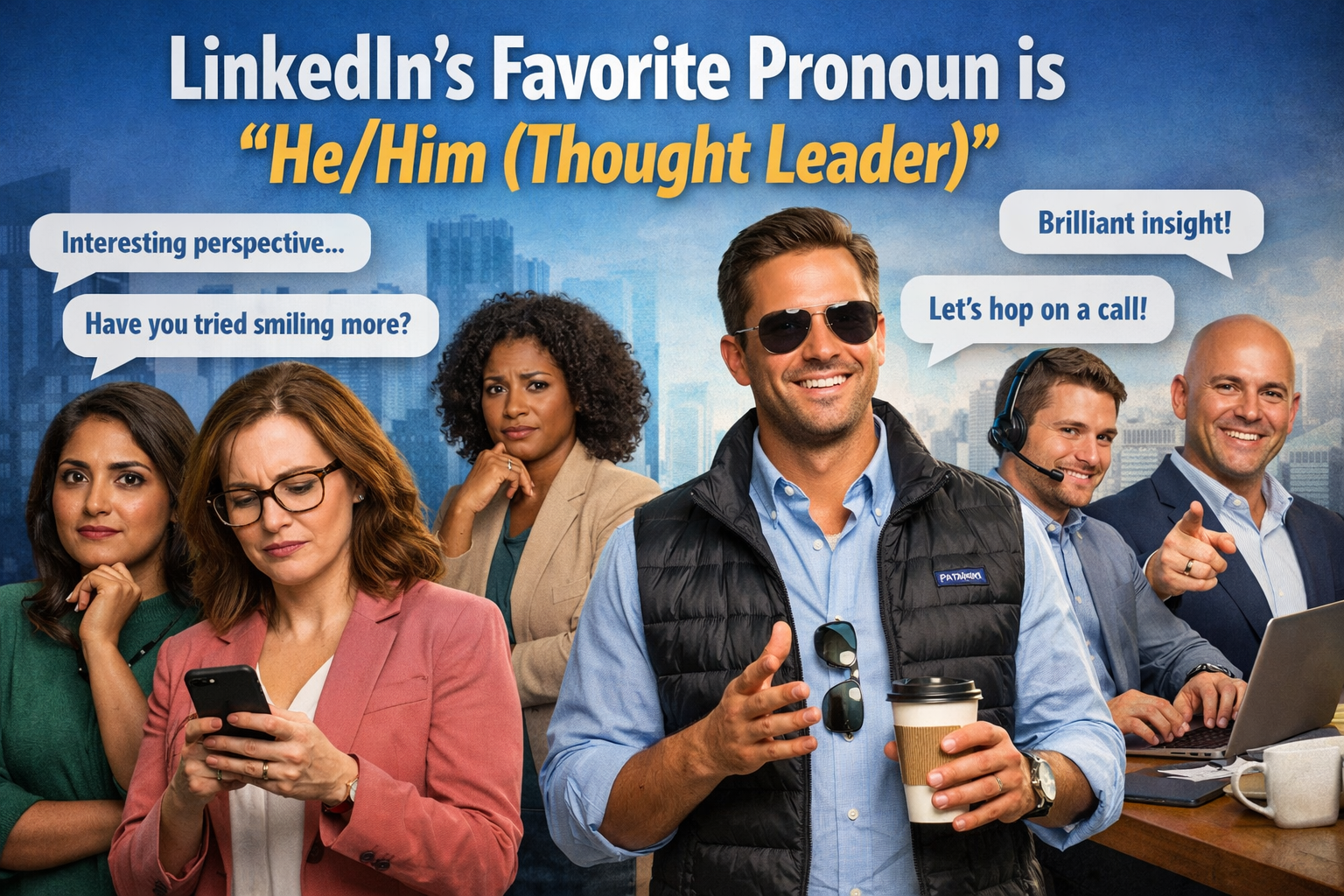
Same post from a woman?
“Interesting perspective.”
“Thanks for sharing.”
“Have you considered softening your tone?”
“Love this—just curious, can you quantify it using a spreadsheet, three peer-reviewed studies, and a blood sample?”
Same post from a man?
“Incredible insight.”
“So well said.”
“Brilliant.”
“Would love to hop on a call.”
“Have you ever considered being CEO of the internet?”
Now, let’s talk about what’s actually happening here—because this isn’t about men being villains. This is about systems being lazy. Algorithms don’t create bias out of thin air. They learn patterns from human behavior, then amplify those patterns like an over-caffeinated hype man who was hired to clap, not to think.
If engagement historically favored male voices, the algorithm doesn’t analyze that morally. It doesn’t reflect. It doesn’t pause for growth.
It shrugs and says, “Cool. I’ll keep doing that forever.”
And that, my friends, is how you get a “neutral platform” that mysteriously behaves like it’s allergic to anyone who doesn’t sound like they own a Patagonia vest and have opinions about golf.
Welcome to LinkedIn: the meritocracy where the best ideas rise to the top—unless the best ideas arrive wearing a name the platform doesn’t automatically associate with authority, leadership, or “someone who definitely has a podcast.”
The Algorithm Loves Confidence, Especially When It’s Wearing Cargo Shorts
Let’s start with a foundational truth:
LinkedIn is not a professional networking site.
It is a confidence Olympics.
And the gold medal doesn’t go to the person with the best point. It goes to the person who delivers a mediocre point as if it were carved into stone tablets and handed down from Mount Quarterly Earnings.
The algorithm is a mirror. It watches what humans reward and then it aggressively copies that behavior. That’s why it boosts content that sounds like it was written by a man who has never been told “no” without immediately requesting to speak to a manager.
Because historically, loud certainty has been interpreted as leadership.
Not competence. Not accuracy. Not insight.
Just volume with formatting.
And women already know this. Women have been learning the difference between being “confident” and being “too confident” since the first time they were called “intimidating” for saying a complete sentence without apologizing for it.
If a man writes:
“Here’s what’s wrong with hiring today.”
He’s a thought leader.
If a woman writes the same sentence:
She’s “negative.”
She’s “bitter.”
She’s “not a culture fit.”
She’s “bringing the wrong energy to the conversation,” which is corporate code for: “We can’t argue with what you said, but we don’t enjoy hearing it from you.”
So when women change their name to something like “Matt” or “Ryan” or “Josh” and suddenly the exact same thoughts get a standing ovation, it’s not because the content got better.
It’s because the platform sees a name and thinks: “Ah yes. Authority has entered the chat.”
Because we’ve trained each other to listen differently.
We’ve trained each other to interpret the same confidence as “assertive” in one person and “aggressive” in another, based on nothing but assumption and centuries of social conditioning wearing a blazer.
LinkedIn didn’t invent that bias.
LinkedIn just monetized it.
How the Same Post Becomes “Inspiring” the Moment It Gains a Fake Beard
There is something deeply comedic about the idea that you can take a post, change the name, and watch LinkedIn treat it like it just emerged from a retreat in the Swiss Alps where it meditated on leadership while sipping artisanal water.
Like imagine posting:
“I set boundaries at work.”
Under a woman’s name, it’s:
“Interesting. But boundaries can be tricky.”
“Are you sure this is professional?”
“Not everyone has the luxury to set boundaries.”
“Boundaries are fine, but let’s consider the business needs.”
Under a man’s name, it becomes:
“This is leadership.”
“This is vision.”
“This is what high performers do.”
“Would love to feature you in my newsletter called The Boundary Blueprint.”
The post did not change.
Only the audience’s willingness to accept it as credible did.
And we need to talk about that “would love to hop on a call” phenomenon, because it’s not just about likes and reach. It’s about access.
LinkedIn’s engagement economy doesn’t just reward content; it rewards the perception of leadership with opportunities: speaking gigs, podcasts, “founder chats,” panels, advisory roles, and invitations to join communities that mostly exist to share screenshots of each other’s posts.
So when a woman posts something insightful and gets a few polite comments, it’s not just a difference in dopamine.
It’s a difference in what doors open.
It’s the difference between being “seen” and being “validated.”
Between being “heard” and being “trusted.”
And trust is the real currency here.
Trust is why mediocre advice can go viral if it’s wrapped in the right voice.
Trust is why the same recycled quote can get 8,000 likes if it’s posted by someone whose headshot looks like a keynote speaker—even if the quote is attributed to Abraham Lincoln and Abraham Lincoln never once said it, because Abraham Lincoln was busy doing historical things, not posting “Thoughts?” under a Canva infographic.
LinkedIn will still insist it’s a meritocracy, which is precious. It’s like watching someone claim the casino is a fair system because the slot machines technically don’t physically stop you from winning.
“Everyone can play,” they say.
Yes.
But some people are allowed to cash out faster.
The Corporate Fairytale Where the Best Ideas Win and Everyone Gets a Trophy and a Promotion
This is the part where LinkedIn gets very earnest and tells us it’s a neutral platform, like it’s a Switzerland made of engagement metrics.
“The best ideas rise,” it says, smiling gently, as if it’s never once boosted a post that said, “I made coffee today and it reminded me of leadership.”
The truth is, LinkedIn is not a pure marketplace of ideas.
It’s an arena of perception.
And perception is not a straight line. It is a messy, biased, human thing.
The algorithm learns what gets engagement, but engagement is not always intelligence. Engagement is emotion. Engagement is familiarity. Engagement is authority signals. Engagement is the comfort of hearing something from a voice you’ve already been trained to accept as credible.
So when women “become men” on LinkedIn and suddenly their posts take off, that’s not a gimmick.
That’s an audit.
It’s someone running a controlled experiment on a platform that insists it doesn’t have a bias problem, and the results come back like:
“Yes, hello, your system has been marinating in the same cultural soup as everyone else.”
And what’s the solution?
It’s not telling women to be louder.
Women are already loud when they need to be. Women are already bold. Women already write thoughtful posts, share expertise, tell stories, provide value, teach lessons, lead teams, build businesses, and survive workplaces that treat them like emotional support staff.
The issue is not their content.
The issue is the filter the world puts on their content.
The issue is who we assume is the expert before we even read the words.
Because the uncomfortable truth is this: the playing field isn’t level just because everyone has the same “Post” button.
Everyone has access to the microphone.
But not everyone gets the same sound system.
Final Thoughts: Same Words, Different Name, Different World
If changing your name unlocks the algorithm, that’s not a quirky LinkedIn hack.
That’s a confession.
It’s the system quietly admitting it has been trained to recognize authority through a specific kind of packaging, and it will keep rewarding that packaging until enough people force it to do otherwise.
So no, the takeaway isn’t that women need to write differently.
The takeaway is that we need to read differently.
We need to interrogate our own reflexes.
We need to notice who we instinctively trust, who we question, who we “challenge” in the comments, and who we immediately call “brilliant” for saying something that would’ve been labeled “complaining” if it came from someone else.
Because this isn’t just a LinkedIn problem.
LinkedIn is just the place where the bias gets a dashboard.
And honestly, I’m grateful for the experiment—not because it’s funny (it is), not because it’s satisfying (it is), but because it proves something so many people have felt for so long and struggled to articulate without sounding like they’re “making it about gender.”
It is about gender.
It’s about perception.
It’s about the invisible weight some voices carry just by showing up.
The ideas didn’t evolve.
The skills didn’t improve.
Only the assumed credibility changed.
And if that’s not worth examining, then congratulations: you might be exactly who the algorithm was designed to believe.
If you want, I can also write a shorter LinkedIn-post version of this (tight punchlines, scroll-stopping opener, and a closing line that baits the comments without sounding like engagement farming).