
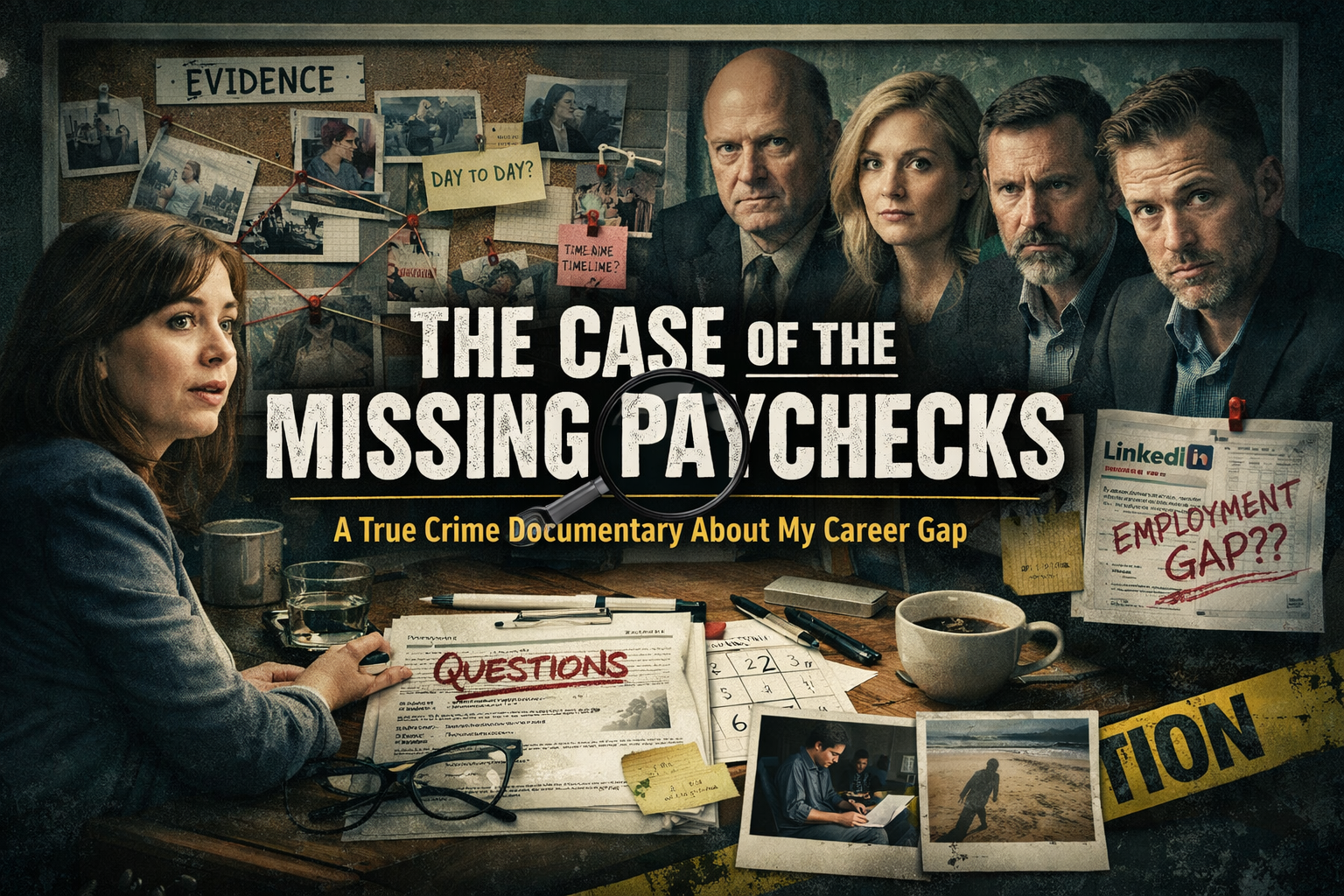
You ever had to explain a career gap like you’re the subject of a true crime documentary?
And the panel interview is the investigative team that already assumes something suspicious happened, they just need you to crack?
Because the other day, I was sitting in a panel interview—five faces, five serious expressions, five slightly different camera angles—when one person leaned forward and said, very carefully, “So… can you walk us through this gap on your resume?”
Not a gap.
This gap.
The way you say “this” when you’re pointing at blurry security footage and circling it with a red marker like you’re about to unveil a shocking twist no one asked for.
My brain immediately switched into documentary mode.
Dramatic pause. Lowered voice. The soft sound of ominous piano keys. A narrator with a voice like gravel and disappointment whispers, “It was during this time… that the candidate disappeared from traditional employment. What happened next would raise questions.”
I explained that during the gap I was laid off, consulting, freelancing, learning new skills, reassessing my career, and briefly remembering what daylight looks like. They nodded politely—the kind of nod detectives give when they don’t believe you, but they’re willing to let you keep talking because they want to see if you accidentally say something incriminating like “and that’s when I joined a traveling circus.”
“Interesting,” one said, writing absolutely nothing.
“And what were you doing… day to day?” another asked, like I’d been hiding under an assumed identity in a remote cabin made entirely of rejection emails.
Day to day?
Applying for jobs. Rewriting my resume like it was a personality flaw. Refreshing my inbox with the hope of someone who still believes effort matters.
They wanted timelines. Months. Specifics. Evidence.
One asked, “And why did you leave your previous role?” in a tone that suggested “left” was generous and “escaped” was more accurate.
I explained the restructuring. The budget cuts. The decision made by someone who has never attended a meeting without scheduling another meeting.
More nodding. More silence. The shared look that said, Let’s see if this story holds up.
At this point I expected someone to slide a printed LinkedIn screenshot across the table and ask me to explain myself, while another person dramatically announced, “We found your endorsement for Microsoft Excel… but you haven’t used pivot tables in six months.”
What’s wild is no one interrogates the working years like this.
No one asks, “During this role, were you exhausted? Burned out? Quietly questioning your life choices after calendar invite number thirty-seven?”
No one pulls up a timeline of late nights, skipped lunches, or the slow realization that productivity and peace were never invited to the same meeting.
But step away for a few months to survive, recalibrate, or be human, and suddenly it’s Dateline: Career Edition.
And the thing is… I can play this game. I’m adaptable. I can narrate my own life with suspenseful background music. I can provide an itemized list of emotional damages and screenshots of my job applications as supporting evidence.
But the longer you sit in that chair, answering perfectly normal life questions like they’re felony charges, the more you start to realize something uncomfortable:
If explaining a career gap requires a narrative arc, character witnesses, and a closing statement… maybe the gap isn’t the problem.
Maybe it’s the assumption that being human needs justification.
The Investigative Team Asks for “The Timeline”
There is nothing panel interviewers love more than a timeline.
Not because it helps them understand you.
Because timelines make them feel like they’re controlling chaos.
They ask for months and dates like they’re building a case file:
“Okay… and when exactly did the layoff happen?”
“And when did you start consulting?”
“And how long did you do that?”
“And at what point did you begin… upskilling?”
Upskilling. A word that sounds like a corporate-approved hobby, like scrapbooking but sadder.
They want you to describe the gap the way you’d describe an internship:
“I woke up at 6 a.m. to optimize my keyword density. Then I attended a webinar called ‘How to Network Without Needing Therapy.’ After lunch, I submitted thirty applications into the void, where they were immediately shredded by an ATS robot with the personality of an expired parking ticket.”
But if you say it like that, they get nervous.
So you sanitize it.
You say, “I spent that time pursuing professional development and consulting opportunities.”
Which is true.
But it’s also the PG version of, “I fought for my life.”
Because here’s the part they don’t like to acknowledge:
Job searching isn’t unemployment.
It’s emotional cardio.
It’s waking up each day and volunteering to be evaluated by strangers with vague job descriptions, inconsistent pay ranges, and a suspicious attachment to the phrase “fast-paced environment,” which is just corporate for “we are understaffed and we want you to be grateful about it.”
And when they ask, “What were you doing day to day?” what they really mean is:
“Prove you were suffering productively.”
Which is such a fascinating requirement.
Because nobody has ever asked a fully employed person to justify a random Tuesday.
No one in a panel interview has ever said, “So during your time at Company X… what were you doing on April 14th? Specifically between 2:00 and 4:00 p.m.? And please don’t say ‘meetings.’ We’ll need something verifiable.”
But if you had a gap?
Now we’re dusting for fingerprints.
Now we need receipts.
Now we need you to swear under oath that you were not, at any point, enjoying your life.
The “Day-to-Day” Question, AKA “Were You Being Human?”
There is a specific kind of suspicion reserved for anyone who has ever existed outside of payroll.
It’s not even openly hostile. It’s worse.
It’s confused.
Like your unemployment broke their spreadsheet.
When they ask “day to day,” what they’re really searching for is a familiar routine—something they can label, file, and forget.
Because if your explanation is too human, it threatens the whole system.
Imagine telling the truth:
“Day to day I was processing the shock of getting laid off while still being expected to act like a cheerful professional on LinkedIn. I was managing fear, bills, rejection, and the fact that every job posting wanted fifteen years of experience in software that was invented last Tuesday. I was also trying to not let the job search turn me into a person who flinches when Outlook pings.”
See? Too real.
They don’t want real.
They want a productivity narrative.
They want to hear that you were a responsible adult who spent your gap building a tech stack and not, say, rebuilding your nervous system.
So you give them a version they can digest:
“Yes, I was actively applying, networking, taking courses, and consulting.”
Again: all true.
But what they miss is that “networking” during a career gap often looks like smiling politely while you ask people if they know anyone hiring, and your soul quietly whispers, I hate it here.
And “courses” during a career gap often looks like trying to convince yourself that one more certificate will finally unlock the magical door where hiring managers stop treating you like a suspicious character in a crime reenactment.
And “consulting” during a career gap sometimes means taking whatever work you can because the bills don’t accept vibes as payment.
Yet somehow, society treats that as suspicious too.
Which is impressive, honestly.
Work full time and you’re “stable.”
Work freelance and you’re “in between.”
Stop working temporarily and you’re “a risk.”
At what point do we admit the system doesn’t actually care what you did—it cares that you stayed visible in capitalism’s attendance sheet?
Because the unspoken rule is:
You can suffer.
You can burn out.
You can drown in meetings.
You can answer emails from a hospital bed as long as your Slack status is green.
But take time away?
Now you have to prove you didn’t become a feral woodland creature who forgot how to open Excel.
The Real Crime Is the Assumption
Here’s the twist ending no one wants:
Most career gaps are boring.
Painful, yes.
Stressful, absolutely.
But scandalous?
No.
There is no car chase. No dramatic reveal. No secret second family.
Most people don’t leave the workforce to commit crimes.
They leave because life committed crimes against them.
Layoffs.
Restructuring.
Family emergencies.
Health issues.
Burnout so deep it needs a search party.
Or sometimes—brace yourself—they leave because they looked around and realized they were living in a constant state of “Monday,” and they wanted to remember what it felt like to breathe without a performance review attached.
And yet interviews treat gaps like evidence of instability.
As if employment is the only marker of trustworthiness.
As if being constantly available to a corporation is the same thing as being capable, reliable, and skilled.
Which is such a weird conclusion when you consider how many employed people are currently doing the absolute least.
I have met people with uninterrupted employment histories who cannot attach a PDF.
I have met people who haven’t had a gap in twenty years and still panic when they have to lead a meeting longer than eight minutes.
I have met people who have been continuously employed since 1997 and emotionally, spiritually, professionally… they left in 2008.
But no one interrogates them.
Because they stayed on the payroll, and in the eyes of the system, payroll is purity.
Meanwhile, you can lose your job for reasons outside your control and suddenly you’re in a conference room being asked to prove you weren’t doing something suspicious like… recovering.
The real issue isn’t the gap.
It’s the belief that a human life must look like a straight line.
That anything resembling pause, recovery, transition, or re-evaluation is automatically a red flag.
Because if we normalize gaps, we have to normalize humanity.
And if we normalize humanity, we have to admit that the workplace is not built for it.
So instead, we label gaps as suspicious.
We make people narrate their survival like they’re on trial.
We force them to package their hardship into bullet points.
We ask them for “day-to-day” explanations as if being alive requires documentation.
And then we call it professionalism.
Final Thoughts: Closing Statements from the Defendant
I wrapped up that interview politely. I thanked them for their time. I smiled, because professionalism is pretending this is normal, even as you quietly marvel at how much justification basic humanity apparently requires.
But here’s my final statement for the court:
If explaining a career gap requires a documentary narrator, a timeline board, and character witnesses, the gap isn’t the problem.
The problem is the assumption that a person must constantly be producing to be trusted.
That rest must be defended.
That recovery must be proven.
That survival must be explained.
Because a career gap is not a crime scene.
It’s a chapter.
And if the system can’t handle the idea that a human life includes pauses—then the system isn’t hiring for talent.
It’s hiring for obedience.
So yes, I can walk you through the gap.
But maybe the better question is:
Why does being human still need an alibi?