
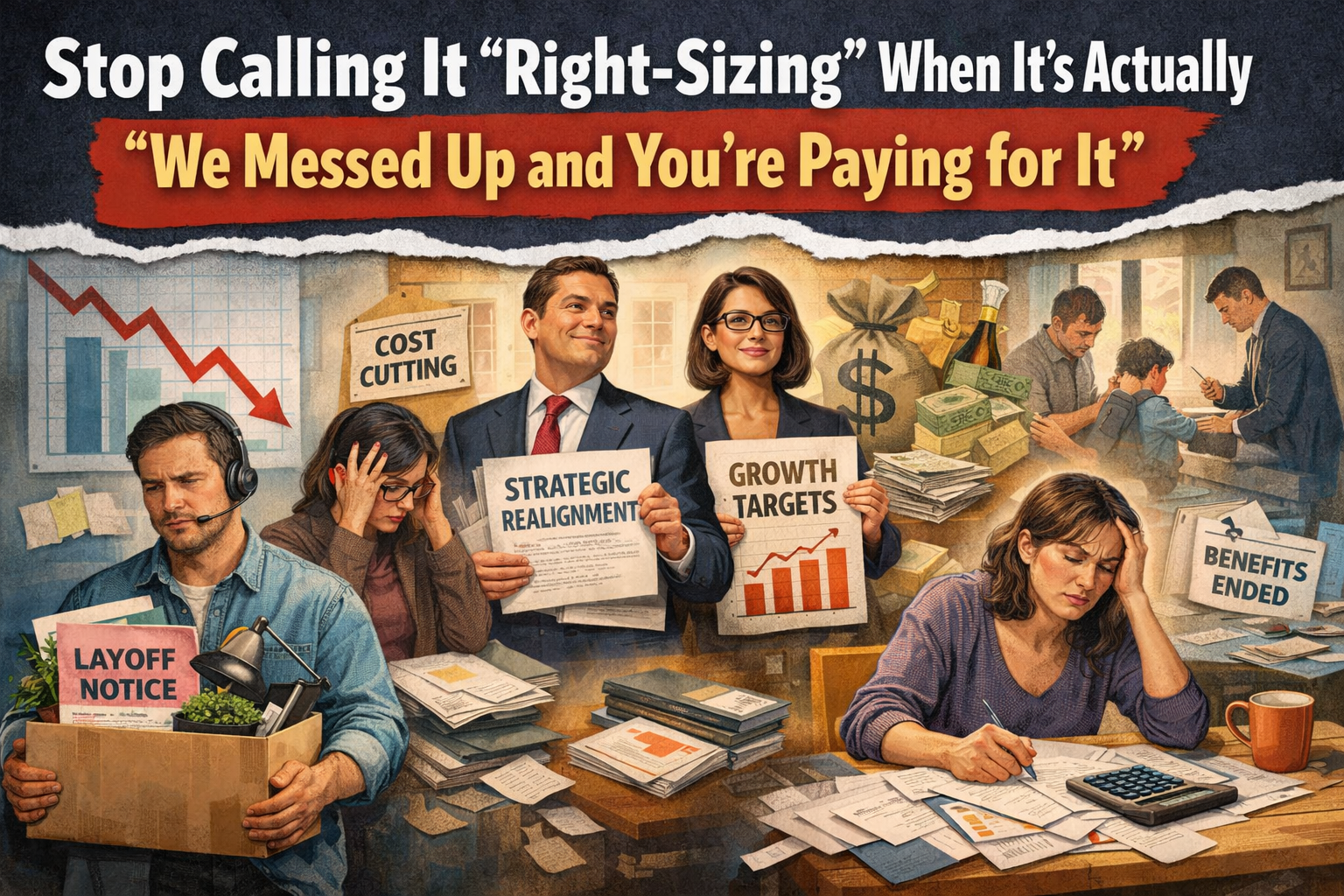
There’s a very specific sound a layoff announcement makes, and it’s not the dramatic drumroll leadership imagines when they hit “Send” on the All-Hands invite titled Business Update—it’s the quiet, stomach-dropping thunk of your personal life being treated like a spreadsheet cell that can be deleted without affecting the “integrity of the workbook,” as if the people inside the company are just optional plug-ins you can uninstall to improve performance, like the only thing standing between a “strong future” and financial ruin was Melissa from Accounting taking a lunch break longer than twelve minutes.
Because somehow, in the modern workplace, we have collectively agreed to speak about layoffs the way a realtor speaks about a basement with mold—“It has character,” “It’s an opportunity,” “This is a strategic reset”—and we say it with straight faces, as if the word choice is what determines whether someone’s rent gets paid next month, as if the phrase right-sizing is going to walk into your kitchen, open the fridge, and gently whisper, “Don’t worry, I’m a euphemism, so groceries are free now.”
And the part that makes people feel like they’re losing their minds is not just the layoff itself, but the way it’s presented: the corporate voice that arrives like a priest of capitalism, draped in beige optimism, explaining that this is not about performance, and yet somehow you are still the one who is no longer employed, which is a fun little logic trick where they manage to blame nobody while consequences mysteriously find the same people every single time.
We are asked to accept layoffs as normal, natural, even healthy—like the company is just “shedding winter weight,” like human beings are seasonal décor—and the more often it happens, the more we’re pressured to treat it like weather: unfortunate, inconvenient, but ultimately nobody’s fault. Except it is somebody’s fault. The sky didn’t miscalculate revenue projections. The moon didn’t over-hire. Mercury retrograde did not approve a growth plan that required perfection, endless demand, and the emotional endurance of a labradoodle at a fireworks show.
So no, we don’t need to normalize layoffs.
We need to normalize calling them what they usually are: a leadership mistake with a PR budget.
The Euphemism Olympics (Featuring “Strategic Realignment” as a Gold Medalist in Avoiding Accountability)
Let’s start with the language, because corporations treat vocabulary like a legal force field—if they call it something gentle enough, they can convince themselves they’re still the good guys.
Restructuring.
Right-sizing.
Rebalancing.
Streamlining.
Organizational optimization.
Strategic shift.
All of these phrases have the same energy as a restaurant owner saying, “We are not closing, we are simply pivoting away from serving food.”
Because “layoffs” is too human a word. It implies bodies, families, routines, identities, and the mildly horrifying reality that someone is going to go home today and have to explain to their partner, their kids, their landlord, their nervous system, and their bank account why the future just got replaced with a question mark.
So they don’t say layoffs.
They say “We’re making difficult decisions.”
Which is adorable, because the decision was not difficult for the people who made it. It was difficult for the people who now have to update their resume, cancel their gym membership, and pretend they’re “excited for new opportunities” while staring at their health insurance portal like it’s a ticking bomb.
Then comes the part where leadership tries to mop up the emotional spill with corporate spirituality.
“We value our people.”
You value your people the way a toddler values a toy: intensely, until a shinier one shows up or until you’re asked to clean up after it, and then suddenly you’re ready to toss it into the donation bin with a sticky note that says “still works.”
And what really fries the circuits is how often the public story is some version of strategy, while the private truth is much messier: leadership guessed wrong, promised growth like it was a product feature, and treated cost control like something they’d “get to later” after the celebration champagne had stopped fizzing.
It’s not strategy. Strategy is choosing a direction.
This is the corporate equivalent of driving at 90 miles an hour because you assumed the road would stay straight forever, and then acting shocked—shocked—when there’s a curve and the passengers are the ones who fly through the windshield.
“It’s Not Performance” (A Statement That Somehow Still Ends With You Packing a Box)
Here’s the cruelest part of most layoffs: the cognitive whiplash.
Most people who get laid off did nothing wrong. They showed up. They delivered. They hit goals that were constantly moving anyway. They navigated half-baked priorities, weird org charts, leadership “vision” decks that contradicted last week’s leadership “vision” decks, and a parade of new initiatives that arrived with confetti and died quietly in the corner like a forgotten office plant.
And then, one morning, they’re told this is “no reflection” on their work.
Which is the corporate version of being told, “You’re amazing, I just don’t want you to exist here anymore.”
Because layoffs aren’t typically about individual failure. They’re about a model failing—usually a model built on assumptions that everyone pretended were facts because optimism is contagious and skepticism is frowned upon when the stock price looks cute.
So you have this bizarre moment where the same company that trusted you to handle customers, budgets, product decisions, people management, compliance, or literally the brand’s reputation on the internet, suddenly treats you like a removable expense line, a disposable layer of paint that can be scraped off without changing the structure underneath.
Except the structure does change.
Every layoff leaves scars—on the people who leave, and the people who stay. The “survivors” don’t feel lucky; they feel watched, like the office has turned into a reality show where the prize is continued access to direct deposit.
Morale doesn’t “dip.” Trust doesn’t “wobble.” It ruptures.
And while leadership is out here saying, “We need to move forward,” the employees left behind are learning a very specific lesson that will follow them forever: your loyalty is sentimental, but the company’s loyalty is conditional.
Then everyone pretends to be okay, because we’ve also normalized the performance of okay.
The LinkedIn posts arrive like clockwork.
“So grateful for my time at—”
“Excited to announce I’m open to work—”
“Taking time to reset and reflect—”
And maybe they are reflecting, but a lot of the time they’re also quietly thinking, “If I don’t sound upbeat, people will assume I’m difficult, and I cannot afford to be difficult while I’m trying to keep my lights on.”
So we sugarcoat, we polish, we brand our pain like it’s a product launch, because that’s the price of being employable in a world that keeps firing people and then telling them to be resilient about it.
The Real Cause of Layoffs (Spoiler: It’s Usually Not the People Who Get Laid Off)
Let’s just say the quiet part out loud, since corporations refuse to.
Most layoffs happen because leadership miscalculated.
Not because the employees suddenly became less capable.
Not because the work disappeared overnight.
Not because “the market” woke up and chose violence for fun.
Layoffs happen because leadership guessed wrong about growth. Leadership over-promised to investors. Leadership hired like demand was guaranteed. Leadership waited too long to control costs because cost control is unpopular until it becomes necessary, and by then the only “fast” lever left is people.
It’s often a timeline of very normal bad decisions dressed up as bravery:
- Hype becomes a plan.
The company starts believing its own pitch deck like it’s prophecy, and nobody wants to be the person who raises their hand and says, “What if we’re not a unicorn and we’re actually just a horse wearing a party hat.” - Headcount becomes a flex.
Hiring is treated like proof of success rather than a responsibility, and teams balloon because nobody gets promoted for saying, “Let’s go slower and make sure this is sustainable.” - Costs quietly metastasize.
Tools, consultants, reorgs, executive layers, office expansions, pet projects—money leaks everywhere, but it’s ignored because growth is supposed to cover the mess like a rising tide. - Reality arrives.
Demand cools, rates change, competition bites, the product isn’t ready, sales cycles drag, or the “next quarter” miracle doesn’t happen. - The company panics.
And instead of admitting the model was flawed, they present it as an intentional choice: We are proactively aligning resources with strategic priorities.
Translation: We drove too fast, and now we’re throwing people out of the car to make it lighter.
And here’s the part we should not gloss over: people pay for these mistakes in deeply personal ways.
They lose benefits. They lose routine. They lose the stability that allowed them to plan their lives. They lose the identity that comes from contributing to something bigger than themselves. They lose time—time spent interviewing, time spent recovering, time spent trying to stitch their confidence back together after being told they’re “valued” and “not needed” in the same sentence.
And the worst part is how common it’s become to treat that as collateral damage, like it’s unfortunate but necessary, like we’re all supposed to nod and say, “That’s business,” while someone is doing math at their kitchen table trying to figure out how long they can keep their family afloat.
People aren’t disposable.
They are the entire point of the company.
And when you treat them like a cost problem, you’re not doing strategy—you’re doing damage control with better fonts.
Final Thoughts: If It Was a “Strategic Reset,” Start Resetting at the Top
We can be compassionate to the complexity of running a business without turning layoffs into a cultural ritual we accept as inevitable, and we can acknowledge economic reality without worshipping it like a god who demands human sacrifice every time the quarterly numbers feel insecure.
But we should stop pretending layoffs are neutral.
Stop treating them like weather.
Stop dressing them up like “optimization,” as if the issue was that the company had too much humanity and needed to reduce it to improve margins.
If a company truly wants to be ethical, then it starts by telling the truth: this wasn’t about your performance—this was about our forecasting, our risk tolerance, our leadership choices, and our refusal to plan for anything except best-case scenarios.
And if leadership wants to keep using words like accountability, values, and people-first, then we should normalize the uncomfortable follow-up question:
If it’s really about strategy… why does the strategy always seem to cost the people who had the least power to make the mistakes in the first place?