
There are certain sounds your body recognizes before your brain catches up.
A smoke alarm at 3 a.m.
A tire blowout on the expressway.
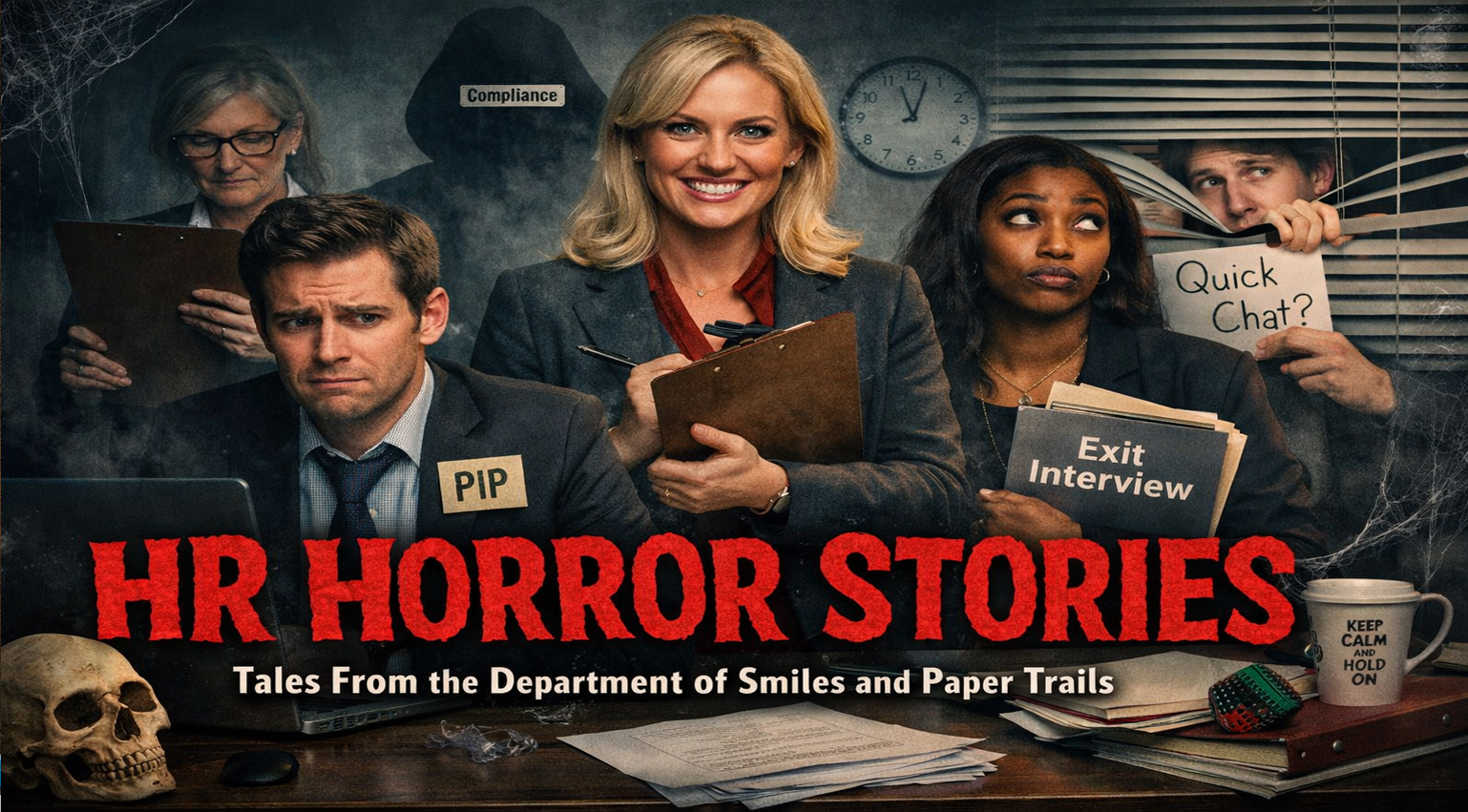
And the Outlook calendar notification that says, “Quick Chat (15 minutes)” with an invite list that looks like the cast of a courtroom drama: your manager, an HR business partner you’ve never met, and someone named “Compliance” who has no first name because apparently they ascended beyond humanity.
That’s when your nervous system does what it was built to do. It begins preparing for war.
Not the dramatic kind with swords and banners. The modern kind with bullet points, vague phrasing, and a PDF that will be used against you in a meeting you weren’t allowed to record. You’ll sit there, nodding like a reasonable adult, while HR speaks in the ancient dialect of Corporate Comfort: a language designed to sound warm while legally insulating everyone within a ten-mile radius of accountability.
Because HR is never just a department. It’s a vibe. It’s a scented candle that smells like “transparency,” burning on top of a locked filing cabinet. It’s a professional smile that says, “We’re here for you,” while the subtext says, “Unless you’re inconvenient.”
And to be clear: HR is not always evil. Sometimes HR is helpful. Sometimes HR is the last remaining adult in a building full of chaos. But other times?
Other times HR becomes a haunted house built entirely out of policies, where every door leads to a form, every hallway echoes with the phrase “per my last email,” and the exit sign is just a printed sign that reads: EMPLOYEE EXPERIENCE.
These are the stories people don’t tell in onboarding. Not because they’re rare. But because they’re too common to be interesting until they happen to you.
So dim the lights. Close Slack. Silence your phone. And join me for three chapters of HR horror—where the monsters aren’t under the bed.
They’re in your calendar.
The “Quick Chat” That Lasts Forever
It starts innocently.
You’re having a normal day. You’re answering emails. You’re contributing. You’re doing the thing people claim they want when they say they want “team players.” You’re living, laughing, billing hours.
Then the invite arrives:
Subject: Quick Chat
Duration: 15 minutes
Location: Teams / Zoom
Agenda: (blank)
No context. No notes. No hint. Just a tidy little meeting invitation tossed into your day like a live grenade wrapped in professionalism.
You message your manager:
“Hey! What’s this about?”
They respond with the corporate equivalent of a haunting whisper:
“Nothing bad. Just a check-in.”
And that’s when your soul exits your body and goes to update its resume.
Because nothing in the history of employment has ever been “just a check-in.” “Just a check-in” is what people say before they tell you your job is changing, your role is shifting, your performance is “being monitored,” or your desk plant is about to become the most stable thing in your life.
You join the call early, like a person who still believes professionalism will protect them.
Your manager is there. HR is there. HR is smiling. HR always smiles, because HR smiles the way sharks swim: not because they’re happy, but because it is happening.
HR begins with a sentence you will never forget:
“First, I just want to acknowledge your feelings.”
Now listen. Nobody acknowledges your feelings when something good is happening.
No one has ever said, “I want to acknowledge your feelings” and then followed it with “Surprise! Here’s a raise and a four-day workweek.” The feelings being acknowledged are always the feelings you are about to have, whether you consent or not.
Then the script begins.
The tone is gentle. The words are soft. The meaning is sharp.
“Concerns have been raised.”
“Perception is reality.”
“We’ve noticed a pattern.”
“We’re going to document this for clarity.”
And suddenly your “quick chat” becomes an hour-long paranormal investigation where you’re the haunted object, and the evidence is a single Slack message from three months ago where you used a period instead of an exclamation point.
You leave the meeting with nothing concrete—just a vague, floating dread and a promise that “we’ll circle back.”
Which, as you know, is corporate for: We’re not done with you yet.
The Performance Improvement Plan, Featuring Glitter and a Knife
A Performance Improvement Plan sounds like something designed to help.
It is not.
A Performance Improvement Plan is what happens when your job tries to turn into a documentary about itself. It’s a narrative device. A plot structure. A way of making an ending look like a process.
It arrives with formatting so clean it feels personal.
Bullet points. Categories. Timelines. Deliverables. Milestones. Words like “proactive” and “ownership” and “demonstrate consistency” sprinkled on top like HR confetti.
The goals will be things like:
- “Improve communication.”
- “Enhance collaboration.”
- “Demonstrate leadership presence.”
Which is fascinating because none of those things are measurable unless your company recently installed a device that can scan your aura.
A PIP is essentially the workplace saying:
“We have decided you are not doing well, but we’d like to give you the opportunity to prove you are doing well by doing better, in a way we will decide later, with expectations that can be adjusted depending on how tired we are of you.”
You’ll be asked to sign it, of course. And if you hesitate, HR will say the most haunted sentence of all time:
“This is not punitive.”
Right. And haunted houses are not spooky. They’re just old homes with unexpected sounds and occasional screams.
If you accept the plan, you enter a strange new era where your manager becomes a daily narrator of your life. Every task you complete is now “progress.” Every question you ask is now “resistance.” Every day you survive is now “an opportunity.”
You begin working like a person being chased. You over-deliver. You document everything. You turn into a spreadsheet with a pulse. You become so responsive that your email signature should say: Sent before you finished thinking.
And if you succeed—if you hit every vague milestone and exceed every unclear expectation—you might earn the great prize HR offers at the end of a PIP:
The privilege of not being fired… yet.
Because the PIP doesn’t end the horror story. It just gives it a second season.
The Exit Interview, Where the Ghost Writes the Notes
Eventually, you leave. You resign. You’re laid off. You’re “separated.” You are “transitioned.” You are “realigned with future opportunities.” You are gently removed from the narrative like a character who knew too much.
And then—like a final jump scare—HR emails you:
“Hi! We’d love to schedule a quick exit interview.”
This is a fascinating tradition, because it happens at the exact moment you have the least reason to protect anyone’s feelings, and yet somehow you still do.
You show up. You’re polite. You’re calm. You speak in measured tones. You do not mention the things you screamed into a pillow for the last six months.
HR asks questions like:
“What could we have done better?”
“Did you feel supported?”
“Would you recommend this company to others?”
And you want to respond with:
“I wouldn’t recommend this company to my enemies, and I have enemies.”
But you don’t. Because you’ve been conditioned. You’ve been trained. You’ve spent years learning how to translate pain into professionalism.
So instead you say things like:
“I think there’s an opportunity to improve communication.”
“I’d love to see more clarity around expectations.”
“Sometimes the workload felt… ambitious.”
HR nods thoughtfully and types notes that will never be read by anyone with the power to change anything.
Because the exit interview isn’t for improvement. It’s for closure. Not your closure.
The company’s closure.
It’s the final ritual where they get to frame the story the way they want to remember it. You were grateful. You learned a lot. You’re pursuing new challenges. Everyone wishes everyone the best. The end.
And just like that, your time there becomes a neat, sanitized paragraph—stripped of the sleepless nights, the anxiety spirals, the “quick chats,” the PIP energy, the reality that you were slowly being turned into a compliance-friendly cautionary tale.
You leave the call and stare at your laptop like it’s a portal to an alternate universe you barely survived.
Final Thoughts: Surviving the Haunted Office
Here’s the thing about HR horror stories: they aren’t scary because they’re dramatic.
They’re scary because they’re quiet.
They happen in polite voices. In clean documents. In meetings with friendly smiles and phrases that sound supportive while the actual message slips past your defenses like fog under a door.
And if you’ve lived through it, you know the truth: the real terror isn’t the moment something goes wrong.
It’s the moment you realize you’re the only one reacting like a human.
So if you’ve ever gotten the “quick chat.”
If you’ve ever watched your job turn into a paper trail.
If you’ve ever smiled through a meeting while your brain whispered, This is not safe.
You’re not dramatic. You’re not sensitive. You’re not imagining it.
You’re just fluent in the language of modern work—where the monsters don’t jump out in the dark.
They send calendar invites.