
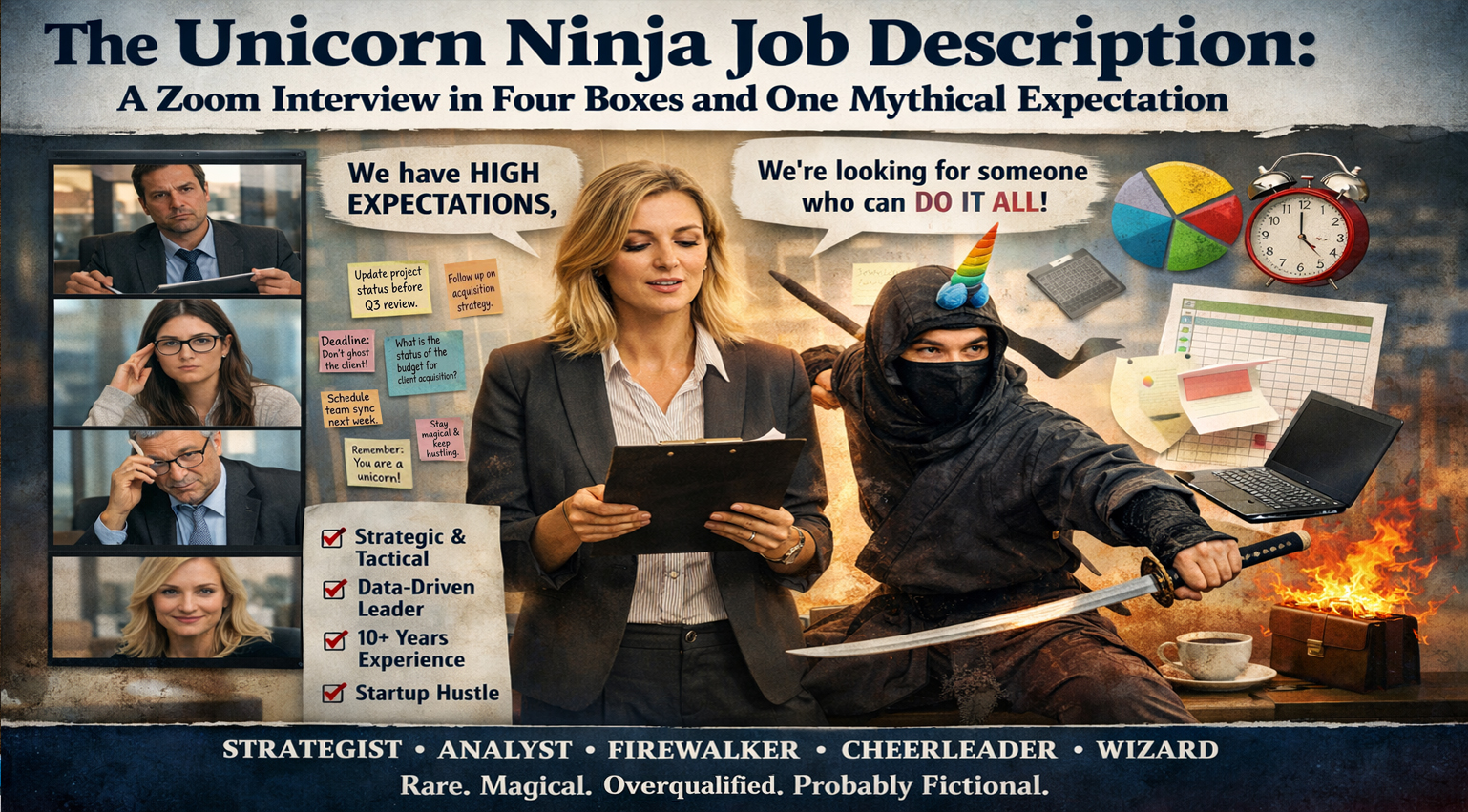
The other day I was on a Zoom interview with four people, which is already a strong signal that whatever is about to happen will be slightly unhinged but presented as “very standard,” like we’re all pretending it’s normal to be evaluated by a tiny grid of silent faces who look like they’ve been trained to nod professionally while internally calculating whether your personality is “collaborative” or “a future risk.”
Everyone was muted except the HR manager, who had that calm, soothing cadence reserved for two types of moments: guided meditations and legal disclaimers. She spoke like a person who has never once typed a job description, but has absolutely forwarded eighteen versions of one to leadership, compliance, and a mysterious individual named “Culture,” who apparently lives inside a PowerPoint deck and survives exclusively on buzzwords.
And she starts walking through the job description. Not summarizing it. Not highlighting it. Reading it. Line by line. Like an audiobook. Like she was narrating the terms and conditions for my future burnout.
At first I’m polite. I’m nodding. I’m smiling. I’m doing that thing where you make your eyes look like they respect authority. But then the requirements start stacking up like Jenga blocks made of corporate ambition.
They needed someone who could lead cross-functional teams but also execute independently. Someone strategic but tactical. Visionary but detail-oriented. Calm under pressure but endlessly passionate. A self-starter who thrives on collaboration. A data-driven storyteller. A hands-on leader who never needs direction but loves feedback. Available across time zones. Deep expertise in five systems that barely talk to each other. Ten years of experience. Entry-level energy. Startup hustle. Enterprise polish. Minimal ego. Maximum output.
It was less “job description” and more “we built a person in a lab but the lab ran out of ethics.”
At one point she said, completely seriously, “We’re looking for someone who can do it all.”
And that’s when my mouth—my chaotic little mouth—decided it would like to participate.
“So,” I said, smiling politely into the camera like a man who still thought he had a chance, “it sounds like you’re looking for a unicorn ninja.”
Silence.
Not awkward silence. Sacred silence. The kind where time slows and you can hear the hum of the Wi-Fi. One interviewer blinked slowly like they were buffering. Another looked down, possibly to write “culture mismatch” or “dangerously self-aware.” The HR manager tilted her head like I’d just introduced an exotic concept such as boundaries.
I clarified, because apparently I enjoy consequences.
“You know,” I said. “Rare. Magical. Highly trained. Appears when needed. Works nonstop. No visible weaknesses. Possibly fictional.”
A nervous laugh escaped someone. It might have been me. To her credit, the HR manager smiled and said, “We just have high expectations.”
Of course you do.
Every company does. No one ever says, “We’re looking for a competent human who does good work, asks reasonable questions, and logs off occasionally without guilt.” No, no. We aim higher. Mythical. Agile. Slightly caffeinated. Emotionally resilient but not emotional. Independent but loyal. Replaceable but irreplaceable.
The modern job market isn’t hiring people. It’s assembling a Marvel character using a spreadsheet.
And look, I get it. Everyone wants excellence. But when the role requires one person to be a strategist, operator, therapist, analyst, cheerleader, firefighter, and occasional wizard, maybe the issue isn’t talent availability.
Maybe the issue is the job description was written by four departments who never spoke to each other but all wanted to feel seen.
I didn’t get the job.
Which is fine. Because somewhere out there, a unicorn ninja is late for standup, exhausted, underpaid, and quietly updating their LinkedIn headline to “Open to Work.”
The Job Description as a Fantasy Novel
Job descriptions used to be simple. They were like: Answer phones. Do reports. Occasionally attend meetings where nothing happens. Very straightforward. Manageable. Human.
Now they read like the origin story of a tragic superhero.
“We want someone who can build strategy and execute the strategy and measure the strategy and present the strategy and emotionally support the team while the strategy is being ignored.”
They want a person who can do high-level visionary leadership, but also personally reformat the spreadsheet when the CFO “doesn’t like the font.” They want someone who thrives in ambiguity but also follows process. Someone who’s innovative but also never changes anything without approval from three committees and a Slack thread that started in 2021.
And the best part? They always say it with confidence. Like this makes sense. Like it’s completely reasonable to want a single human being who has the energy of a golden retriever, the discipline of a Navy SEAL, the emotional intelligence of a therapist, the analytical skills of a data scientist, and the patience of a kindergarten teacher in a room full of adults who still don’t know how to mute themselves.
Then they’ll add the line that really seals the deal:
“Must be able to work independently.”
Which is corporate for: We will not train you, but we will judge you for not already knowing how we do things here, even though we also can’t explain how we do things here.
“High Expectations” and Other Threats Disguised as Values
When the HR manager says, “We just have high expectations,” what she means is:
“We have decided the workload of three roles will be carried by one person, and we’d like that person to feel inspired about it.”
High expectations is the corporate equivalent of telling someone, “This relationship will be difficult, but in a character-building way,” while handing them a calendar invite titled Weekly Alignment that lasts ninety minutes and solves nothing.
High expectations is how companies explain why they’re asking for:
- senior-level expertise
- junior-level salary
- executive-level accountability
- intern-level gratitude
They don’t want someone who’s good at the job. They want someone who is psychologically compatible with being exploited, but in a positive attitude way.
Because the “unicorn ninja” isn’t just about skills.
It’s about temperament.
They want a person who never says, “That’s too much.” A person who never says, “That’s unrealistic.” A person who never says, “Can we hire one more person so I can sleep?”
They want someone who hears “we’re moving fast” and doesn’t ask, “Fast toward what?” They want someone who hears “wear many hats” and doesn’t ask, “Are any of these hats paid?” They want someone who hears “scrappy” and doesn’t immediately picture a budget held together with motivational quotes and panic.
The Interview Panel as a Group Project You Didn’t Consent To
Four person panel interviews are fascinating because they create the illusion of fairness while actually maximizing confusion.
You’re talking, but you don’t know who you’re talking to.
One person is evaluating your technical skills. One person is evaluating whether you’re “a culture fit,” which is code for “Would I hate you if we got stuck together in an airport?” One person is evaluating how you answer pressure questions, even though they themselves look like they’re under pressure just existing. And one person is just there because they were invited and now they have to justify their presence by asking you something like, “If you were a kitchen appliance, what would you be and why?”
Meanwhile, you’re trying to perform competence in a tiny rectangle while your brain is also doing the math of survival:
Am I making enough eye contact? Am I talking too fast? Why is that guy staring like I just insulted his pet KPI? Is my smile normal or is it giving “hostage video”?
And then you make one joke. One small, harmless joke. A little human moment. A crack in the corporate veneer.
And suddenly the whole panel reacts like you brought a live raccoon into a funeral.
Because interviews aren’t about finding the best candidate anymore.
They’re about finding the candidate who can pretend the job description is normal, accept “high expectations” as a personality trait, and nod along like, “Yes, I too am a magical creature who thrives in chaos and finds deep fulfillment in being under-resourced.”
Final Thoughts: Somewhere, the Unicorn Ninja Is Logging Off (and So Should We)
Here’s the truth: the unicorn ninja doesn’t exist.
And if they did exist, they would quit.
Because nobody can be strategic and tactical and visionary and detail-oriented and calm under pressure and endlessly passionate while also being available across time zones, maintaining “startup hustle,” and somehow staying grateful for the opportunity to slowly disintegrate.
The real problem isn’t candidates.
The real problem is companies keep writing job descriptions like they’re ordering a custom-built hero from the Avengers catalog, and then acting shocked when actual humans show up with normal human limitations like sleep, sanity, and a desire to not be on Slack at 9:47 PM answering a question that could’ve been an email that could’ve been resolved by hiring enough people.
So no, I didn’t get the job.
But I did get something else: clarity.
Because if a company is looking for a unicorn ninja, what they’re really saying is they’re not hiring a person.
They’re hiring a fantasy.
And I’m done auditioning for roles that require fiction to function.
Somewhere out there, the unicorn ninja is late for standup, exhausted, underpaid, and quietly updating their LinkedIn headline to “Open to Work,” while whispering into the void:
“I can do it all.”
Sure.
But I shouldn’t have to.