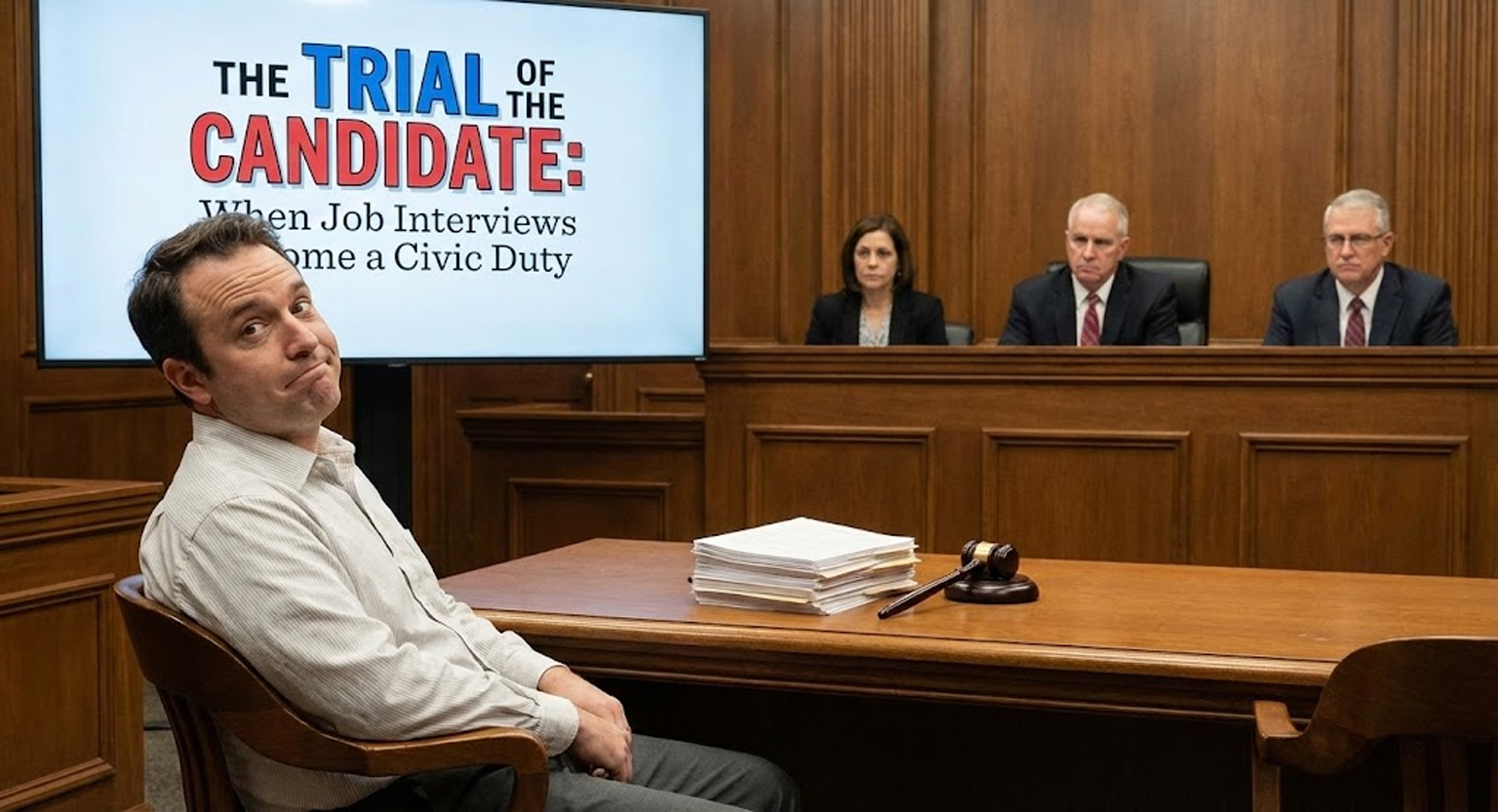
You ever go through so many interviews that you stop calling it a hiring process and start referring to it as a civic obligation? Somewhere between the third calendar invite and the seventh “quick chat,” you realize you are no longer a candidate. You are a participant in a system. A volunteer, technically. An unpaid one. At that point, you’re not job hunting anymore, you’re reporting for duty, mentally preparing yourself the way people do when they’re summoned for jury duty, except instead of being asked to judge someone else’s fate, you’re quietly begging strangers to decide yours.
That was me recently, sitting at my desk, staring at yet another confirmation email, realizing I had survived a five-panel Zoom interview followed by six in-person interviews, and at no point had I been offered water, clarity, or compensation for emotional labor. No snacks. No timeline. No reassurance that this was normal. It didn’t feel like professional progress anymore. It felt like a procedural drama with bad pacing and no clear ending.
It started innocently, as these things always do. One interview. Then another. Fine. Reasonable. Expected. I prepared. I smiled. I perfected the nod that says, “That’s a great question,” even when the question is the same one I’ve answered repeatedly for different people using slightly different corporate fonts. I told my stories. I used my examples. I made sure my background was neutral, my lighting forgiving, and my personality appropriately enthusiastic but not alarming.
And then the process kept going.
At some point, the tone shifted. This was no longer about qualifications. This was about endurance. This was about how long a human being could remain polite, articulate, and hopeful while being evaluated by an ever-rotating cast of decision makers who all seemed very serious about alignment but deeply unclear on authority.
By the time I hit interview number eight, I wasn’t sure if I was being hired or inducted.
The Five-Panel Zoom Interview, Also Known as Digital Courtroom A
The five-panel Zoom interview is not an interview. It is a virtual courtroom where the laws of time, logic, and basic social comfort no longer apply. You log in early, camera on, posture alert, coffee carefully placed just out of frame, and immediately realize you are the only person fully visible, fully exposed, and fully aware of how strange this all is.
There are faces. So many faces. Each one representing a different department, perspective, or unresolved corporate trauma. One person nods constantly, like a dashboard bobblehead set to “encouraging.” One person never blinks, maintaining eye contact with the intensity of someone trying to win a staring contest with your soul. One person stares slightly off camera, as if reconsidering every life choice that led them to this meeting. I am convinced one panelist existed solely to observe my posture and see how I handle silence.
And the questions. Not difficult questions. Just repetitive ones. “Tell us about a challenge.” “Tell us about a conflict.” “Tell us about a time you disagreed.” At some point, I wanted to gently point out that I was living the challenge in real time, navigating the emotional obstacle course of answering the same question five times while pretending it was new and exciting every single time.
Each answer required careful calibration. Honest but not too honest. Confident but not threatening. Experienced but still “coachable.” Somewhere around minute forty-five, I stopped hearing my own voice and began answering purely on muscle memory, like a corporate improv exercise I did not consent to.
When the call finally ended, no one said what came next. Just polite smiles, vague appreciation, and the familiar phrase that now haunts my dreams: “We’ll be in touch.”
The In-Person Interviews Where I Accidentally Became Staff
Just when I thought the Zoom ordeal was the final hurdle, they invited me in person. Once. Then again. Then again. By the third visit, the receptionist greeted me by name. By the fourth, security waved at me like I worked there. By the sixth, I knew where the bathrooms were, which conference room had the best chairs, and which hallway had the strongest Wi-Fi.
At no point did anyone acknowledge that this might be excessive.
Each in-person interview felt less like evaluation and more like stress testing. How long will this person remain polite? Will they crack? Will they still sound enthusiastic on interview number eleven? It was like they weren’t hiring anymore. They were observing. Studying. Seeing how a human behaves when placed in a professional pressure cooker with no clear end date.
The conversations blurred together. Same questions. Same stories. Same carefully measured enthusiasm. I shook hands with people who shook hands like they were evaluating grip strength as a leadership trait. I nodded thoughtfully while internally calculating how many unpaid hours of my life had been donated to this process.
At some point, I half expected someone to hand me a badge and ask if I could cover a shift.
The Verdict That Never Comes
By the end of it all, I wasn’t trying to impress anyone anymore. I was just trying to survive. Sitting upright. Smiling responsibly. Answering questions while quietly tallying the emotional invoice I would never be able to submit.
Jury duty, at least, tells you when it’s over. Jury duty lets you bring a book. Jury duty does not ask you where you see yourself in five years or how you handle ambiguity while actively creating it.
And the wildest part? After everything, after panels and hallways and handshakes and carefully rehearsed enthusiasm, they still said, “We’re reviewing next steps.”
Next steps.
I have walked a marathon. I have testified before the council. I have earned a certificate I will never receive.
At this point, I don’t even want the job. I just want a verdict.
Final Thoughts: Please Decide or Release Me Back Into Society
Somewhere along the way, modern hiring forgot that interviews are meant to assess capability, not endurance. They are supposed to be conversations, not trials. Decisions, not sagas.
If a candidate has shown up this many times, answered this many questions, and remained professional through this much ambiguity, you already have your answer. The only thing left is whether the organization can meet the same standard of decisiveness it expects from the people it’s evaluating.
Because at a certain point, it stops being about fit.
And starts feeling like community service.