Listen to the audio version of this article (generated by AI).
The other day, I logged into a Zoom interview five minutes early because deep down, I still subscribe to the delusional idea that punctuality is a brand—like it says something profound about my character rather than just broadcasting that I’m anxious and have no chill. I was ready. Camera on. Posture poised. Background expertly curated to scream “I’m professional,” while whispering “I don’t live in chaos.” I had coffee, I had notes, I had three backup pens for a digital meeting—because that’s the level of trauma we’re working with.
Then I joined the call.
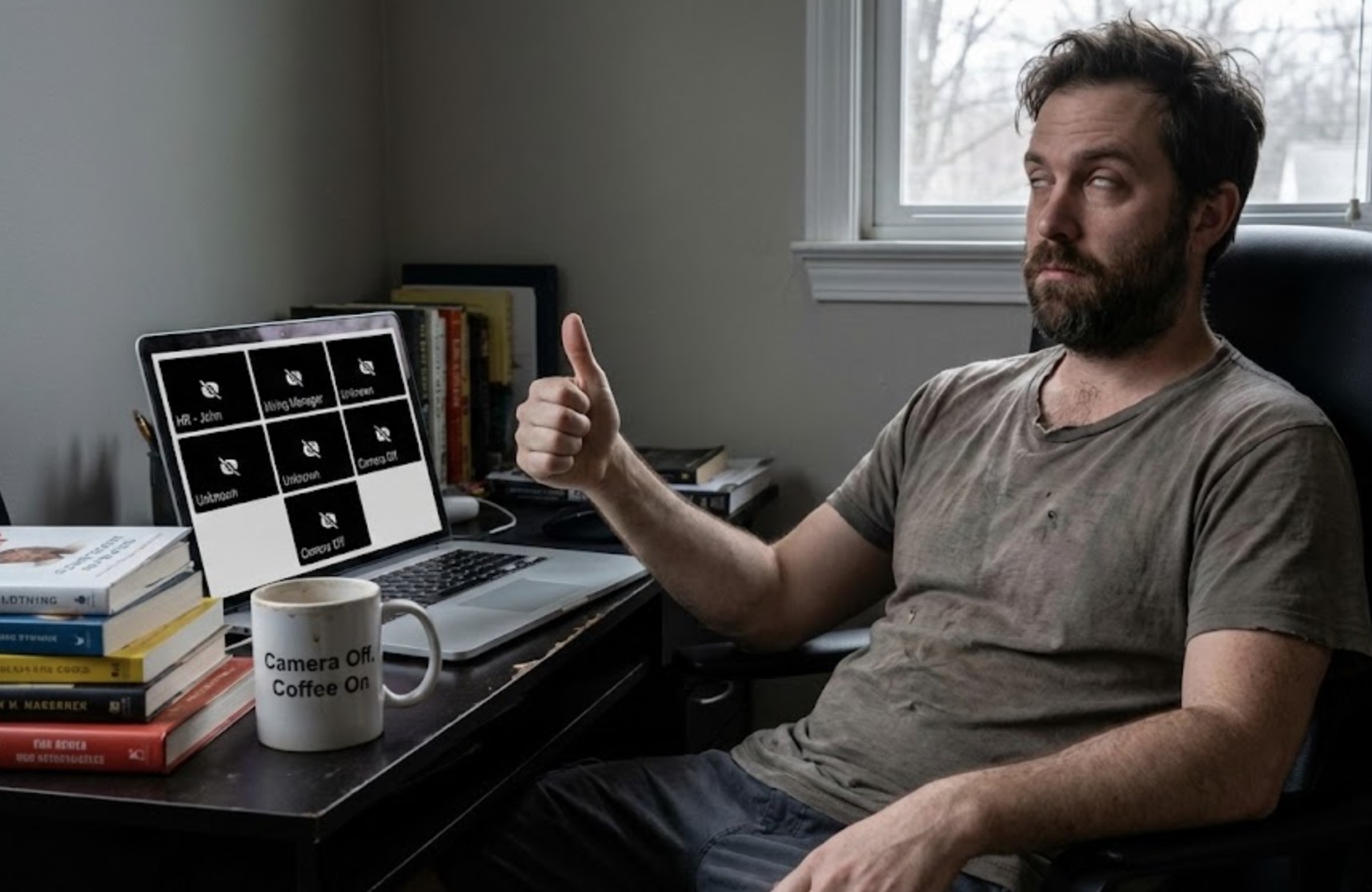
Three black boxes. No faces. Just names. And one of them was misspelled so badly I wasn’t sure if it was a typo or a threat.
“Hi! Can you hear us?” said a voice that sounded like it was being broadcast from the bottom of a canyon inside a broom closet.
“Yes! I can hear you,” I chirped back, overly cheerful and wildly aware I was now smiling directly into my own reflection like a motivational hostage.
“Great,” said another disembodied entity. “We’ll be keeping cameras off today.”
Of course you will.
Because why show your face when you can preserve the sacred mystery of corporate anonymity? This is the modern Zoom interview: you, fully visible, sweating through your most presentable shirt, talking to what feels like a séance hosted by LinkedIn Premium. Somewhere, maybe in a conference room or maybe in someone’s garage, actual people are evaluating your voice, your tone, your essence—all while remaining visually unavailable, like emotionally distant exes who now work in recruiting.
Welcome to the Age of Cameras Off: where you bring your whole self, and they bring… initials.
Performing Confidence for a Wall of Eternal Darkness
There is a special kind of existential chaos that descends when you’re speaking enthusiastically into what appears to be an emotionally unavailable laptop screen. It’s one thing to be nervous during an interview. It’s another to give a TED Talk to three faceless rectangles named “JSmith_Lead,” “HR_2024,” and “Guest.”
You start strong. You smile. You nod, even though you’re essentially nodding to your own nervous energy bouncing off your webcam. You answer with the exact balance of polish and humility that career coaches swear by—and it lands with the emotional resonance of a LinkedIn poll about pineapple on pizza.
And then… silence.
Are they engaged? Are they writing something kind or damning? Are they even still there or did they mute themselves to yell at their kids, microwave salmon, or emotionally process your salary expectations?
You’ll never know.
So you keep going. You laugh softly at your own joke, just in case one of them smirked. You give a thoughtful answer, then immediately overthink it. You maintain unwavering eye contact with the camera lens like it’s the final boss in a video game about corporate approval.
Meanwhile, they are existing in a blissful state of camera-off freedom: sipping from mugs the size of small planets, rocking pajama bottoms that haven’t seen sunlight since 2020, and quite possibly pacing their kitchen while deciding if you’re a “culture fit” or just another human being with a Wi-Fi connection and a resume full of dreams.
This is not an interview. This is emotional performance art, curated live for a panel of silent avatars. And the only thing being evaluated more than your answers is your Wi-Fi stability.
The Tyranny of the Invisible Interviewer
Let’s address the unspoken truth here: in every Zoom interview, whoever has their camera off holds the power. It’s subtle, yes. But it’s also aggressively real.
You are visible. You are vulnerable. You are dressed like a functioning adult. They are faceless fonts floating in the digital void, sipping coffee and judging your pronunciation of “synergy” without the burden of pants.
It’s the ultimate corporate power move.
They can observe your microexpressions while keeping theirs in the witness protection program. They can write notes, side-chat, or deep-dive into your LinkedIn activity from 2017 without you having a clue. Meanwhile, you’re sitting there trying to smile naturally while wondering if your nostrils look aggressive in this lighting.
And the best part? These are often the same companies that boldly claim “We’re big on culture” and “We really value human connection.” Oh, really? Then why does this feel like a hostage negotiation where I’m not allowed to see the hostage takers?
Occasionally, one will say, “Apologies, my camera isn’t working today.” Sure. Sure it’s not. And I’m Batman.
At some point, you give up trying to imagine what they look like and instead start assigning them personalities based solely on their voices:
- One sounds like they’ve been burned out since Q3 of 2022
- One has big “uses a standing desk for identity purposes” energy
- And one is so upbeat it’s borderline threatening
You are no longer interviewing for a job. You are auditioning for an unseen jury in a dramatic Zoom reboot of The Voice, except no one’s turning their chair around.
When “Cameras Off” Becomes a Lifestyle Choice
By the third interview, it dawns on you: this isn’t situational. This isn’t a technical issue. This is who they are. This company has fully leaned into the shadow realm. Cameras are not just off—they are philosophically off. And so is their enthusiasm.
The process is slow. The feedback is vague. The tone is somewhere between “We’re still evaluating” and “We forgot this position was even open.” Emails are laced with phrases like “still aligning,” “syncing internally,” and “looping in leadership”—which roughly translates to: someone is on PTO and nobody wants to make a decision until they come back or get replaced.
At this point, you’ve invested hours into preparing, showing up, bringing your full professional self to a webcam—and you’re not even sure these people would recognize you in daylight.
But you keep showing up. Because hope is irrational. And so is capitalism.
You log in early. You turn your camera on. You fake a good lighting setup. You tilt your head at a flattering angle. You ignore the fact that your soul is slowly being eaten by the faint echo of your own voice bouncing off a wall of indifference.
Because you still believe. You believe there are real people behind those black boxes. People who want to hire you. People who mean well. People who are probably just too emotionally exhausted to click “Start Video.”
Final Thoughts: Turn the Camera Back On (Or At Least Make Eye Contact With My Soul)
Let’s be clear—Zoom interviews with cameras off aren’t some unforgivable corporate crime. They’re just… deeply weird. They’re like showing up to a party where everyone else is invisible but still judging your dance moves. They remove the human from human resources. They suck the vibe out of vibing. They make you question if the entire job search is just a social experiment being run by the ghost of Blockbuster.
But until we, as a society, collectively decide that turning on your camera is the new handshake, we adapt.
We put on our best shirt. We talk to our own reflections. We smile into the void with the quiet confidence of someone who once memorized the STAR method and never got to use it.
All I ask is this:
If you’re going to assess my professionalism, evaluate my communication, and determine if I’m a good cultural fit—at least have the courage to let me see your face while you do it.
Because fair is fair. And at this point, I’ve earned the right to know if you’re wearing pants.