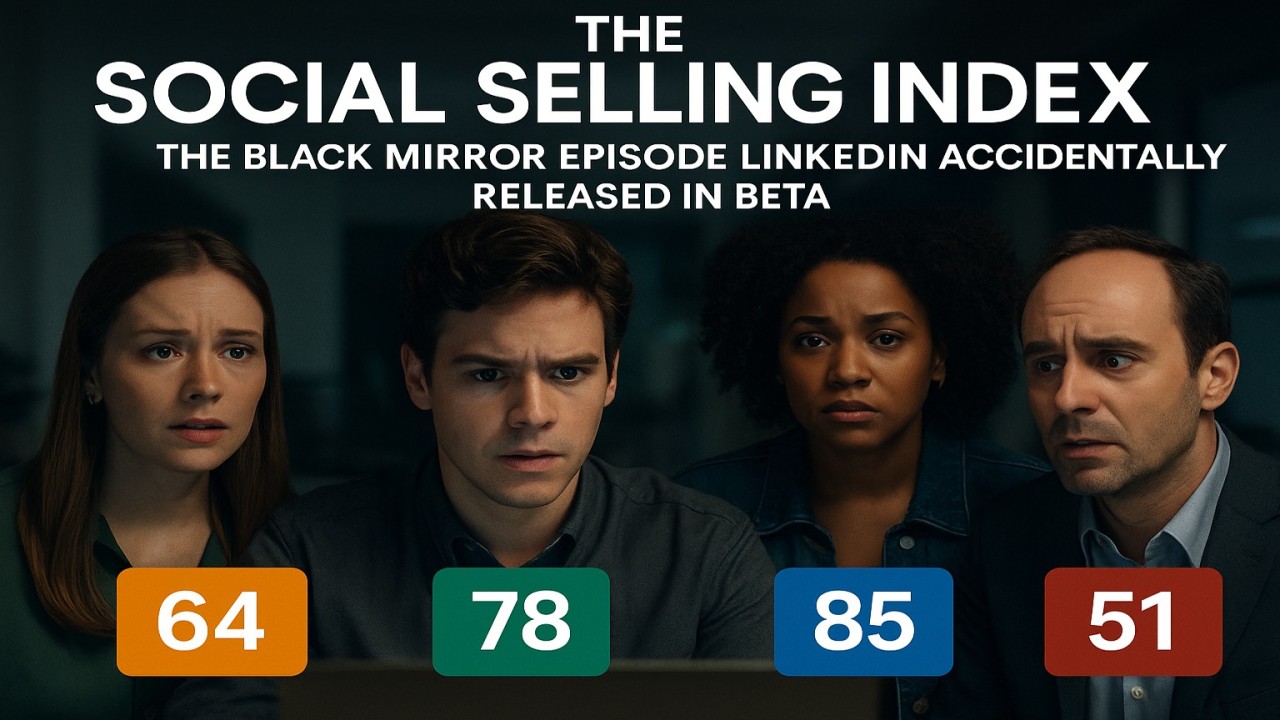
The other day, someone asked, “What if LinkedIn made everyone’s SSI score public, right there on your profile for the world to see?”
And I swear, that single sentence felt less like a question and more like the trailer for the next Black Mirror episode none of us asked for.
Picture it. You log into LinkedIn on a Monday morning, still clutching your coffee and whatever’s left of your dignity, only to see a shiny new metric next to your name:
Alex Pyatkovsky: President of Vibes (SSI: 72).
You stare at the number, wondering how it’s possible that your self worth has now been color coded and converted into a score. Recruiters start ghosting anyone under 70. Executives begin bragging about hitting 90 like it’s their cholesterol level. The rest of us sit there, blinking at our profiles, trying to figure out how to raise our number without selling our souls or posting about “resilience through vulnerability.”
And just like that, the professional world implodes. LinkedIn becomes less “networking platform” and more “corporate Hunger Games.” People are posting three times a day just to keep their engagement rates alive. Comment sections turn into chaotic barter markets:
“I’ll like yours if you like mine.” “I’ll endorse your leadership if you endorse my authenticity.”
It’s the digital equivalent of trading soup cans after the apocalypse, polite, desperate, and deeply absurd.
Soon, secret Slack groups emerge with code names like Operation Thought Leadership and The Authenticity Cartel. Recruiters begin saying things like, “We were impressed with your background, but your SSI doesn’t demonstrate true influence.”
Performance reviews follow suit. Managers start showing slides titled:
“Tom exceeded his project goals, but his engagement dropped eight points this month. Clearly not living our values of ‘Authentic Networking at Scale.’”
Even the content spirals into philosophical madness. Every professional becomes a poet overnight:
“This morning, I spilled coffee on my laptop. But isn’t that just like leadership — messy, unpredictable, and full of lessons?”
1,200 reactions. 83 comments. Four connection requests.
Somehow, this all feels terrifyingly believable. Because LinkedIn was already halfway there, half networking, half performance art. Making SSI public would just make the simulation official.
Welcome to the Scoreboard of Souls
By Tuesday morning, humanity has fully lost it.
LinkedIn’s homepage looks like Wall Street met a group therapy session. Notifications are exploding: “Congrats on your new SSI milestone!” “You’ve dropped three points, time to engage more!” “Your authenticity index is trending downward!”
Workplaces descend into chaos. Departments are divided into SSI tiers. The 80+ club gets priority in meetings. The 60s get quiet pity. The 40s are told to “focus on internal reflection and external posting.”
Performance reviews now sound like Olympic commentary:
“Mark’s teamwork is exceptional, but his engagement curve has plateaued since Q2. We’ll need him to show more thought leadership if he wants that bonus.”
Executives treat SSI like Fitbit for ambition. “I hit 86 today after a humblebrag about my morning run and a vulnerable post about imposter syndrome,” one says proudly. “Feeling aligned.”
Then there’s that one coworker treating SSI like CrossFit:
“Morning reflections: up to 85 today! Two posts, three comments, and one story about failure that definitely didn’t happen.”
By noon, productivity across corporate America has flatlined. No one’s working. Everyone’s posting. The company Wi-Fi is choking under the weight of authenticity.
It’s only Day 2.
The Rise of the Engagement Underground
But where there’s desperation, there’s innovation.
Enter the Engagement Underground, a sprawling black market of digital validation. Secret pods with names like Operation Empathy Surge and The Thought Leader Collective form on Slack, Discord, and WhatsApp. Membership is by referral only, and every morning begins with the sacred ritual:
“Drop your link. Minimum five word comment. ‘Love this insight’ still counts.”
Corporate directors, recruiters, and consultants moonlight as pod moderators. They enforce the rules like cult leaders.
- No ghost likes.
- No skipped posts.
- No fake vulnerability unless it’s algorithm approved.
The feed becomes a barter economy for visibility. You can practically hear the whispered deals:
“I’ll share your leadership story if you boost my post about authenticity.” “I’ll react to your burnout reflection if you comment on my post about resilience.”
Alliances form like warring tribes. “The Empaths” refuse to engage with “The Hustle Bros.” “The Storytellers” blacklist anyone caught using stock photos. “The Recruiter Realists” refuse to comment unless it’s ironic.
Then, out of the digital chaos, the first SSI celebrity rises.
His name is Trent.
Trent posts a 10 slide carousel titled “10 Lessons I Learned From Crying in My Car After a Layoff.”
It’s perfect. The lighting. The vulnerability. The relatability. Every slide feels like a TED Talk narrated by soft piano music.
Thirty thousand reactions. Twelve thousand comments. A CNBC feature titled “The Man Who Made Corporate Emotion Cool.”
Trent’s SSI skyrockets to 94.
He becomes a god. A philosopher. The Car Crying Messiah.
And just like that, the “Crying in Your Car” genre is born.
“This morning, I sat in my Toyota and realized rejection is just redirection.” “I spilled coffee on my dashboard and learned that leadership is messy.” “I hit a red light, but maybe that’s just life’s way of saying pause.”
Auto dealerships start offering LinkedIn Creator Packages: tinted windows, ring lights, and a free box of tissues.
Trent launches an online course: “SSI Mastery: From Breakdown to Brand Equity.” Price: $499. Includes a crying guide and a free Canva template.
Everyone hates him. Everyone copies him.
The Collapse of Credibility
By year three, the world is unrecognizable.
SSI has consumed everything. Promotions, partnerships, even friendships are decided by score. Job applications now include a new requirement:
“Seeking dynamic professional with strong communication skills, collaborative mindset, and SSI of 80+.”
Recruiters start filtering resumes by “Authenticity Density.” Leadership panels are hosted exclusively by people with verified empathy metrics.
Then come the scandals.
A whistleblower reveals that Trent’s viral post wasn’t even written by him, it was ghostwritten by a marketing intern named Claire and tested across sixteen versions for “optimal relatability.”
The internet explodes. Articles, op eds, podcasts, all analyzing the authenticity crisis. But instead of destroying him, the scandal makes Trent stronger. He posts a tearful video titled “Owning My Imperfection.” It racks up millions of views. His SSI hits 96.
Authenticity becomes the ultimate performance. Vulnerability becomes a strategy. Consultants roll out new workshops like “Sincerity Optimization” and “Strategic Humility in Content.”
Before long, people aren’t living their lives, they’re scripting them. Every failure is a post in progress. Every emotion, a monetizable asset.
Eventually, the system collapses. Too many posts start with “I wasn’t going to share this, but…” The algorithm implodes under the sheer weight of synthetic sincerity. SSI scores reset to zero.
For the first time in years, notifications fall silent. The blue glow fades from office windows. People look up from their screens, disoriented, as if waking from a collective dream.
And somewhere, in a quiet corner office, someone whispers, “Maybe we should post about this.”
The Mirror and the Machine
The algorithm didn’t kill authenticity. We did.
LinkedIn didn’t invent the performance, it just handed us the stage, dimmed the lights, gave us a captive audience, and said, “Now tell us about the time you overcame adversity… in 1,200 characters or less.”
We were already performing professionalism long before the SSI arrived. We just used to do it quietly, at team meetings, in carefully worded emails, during those moments when someone asked “how are you?” and we replied “busy, but great!” instead of “spiritually bankrupt.” The only thing the algorithm did was slap a score on it and call it data driven growth.
The truth is, we were born for this theater. We’ve spent decades rehearsing our “I’m thrilled to announce” face, our “honored and humbled” tone, and our ability to type “I’m so proud of this team” without ever remembering what the project actually was.
We were already addicted to approval, the SSI just made it a leaderboard.
We curate our “authentic selves” with the precision of museum curators, polishing every flaw into something inspirational. We call it vulnerability, but it’s really marketing with better lighting. You’re not being authentic; you’re A/B testing your personality.
The SSI didn’t corrupt us. It merely quantified the performative self we’ve been nurturing since the first person said “circle back.”
So if the day ever comes when your score flashes beside your name, don’t panic. Don’t chase it. Don’t cry in your car, unless, of course, you’re planning to post about it later. Then make sure you get the lighting right. No one wants to empathize with a grainy breakdown.
Because that’s the future: people adjusting their ring lights to look “unfiltered.” Tears rehearsed. Pauses intentional. Every tragedy ending with “and that’s when I realized…”
Still, the algorithm didn’t force us to do it. It just gave us the perfect incentive to keep pretending.
So remember: the only way to win this game is to stop playing. Log off. Touch grass. Maybe even talk to a human being in person, though be warned, they won’t clap or react with “Insightful.”
Until then, post wisely, comment ironically, and if you must, share strategically. Because in this professional dystopia, sincerity isn’t dead, it’s just been optimized, formatted, and scheduled for 9:00 a.m. Central Standard Time.
And the scariest part? It’s performing better than ever.






Can you be more specific about the content of your article? After reading it, I still have some doubts. Hope you can help me.
Thanks for sharing. I read many of your blog posts, cool, your blog is very good. https://www.binance.com/register?ref=IHJUI7TF
Your article helped me a lot, is there any more related content? Thanks! https://accounts.binance.bh/ru-UA/register-person?ref=JVDCDCK4
Your article helped me a lot, is there any more related content? Thanks!