
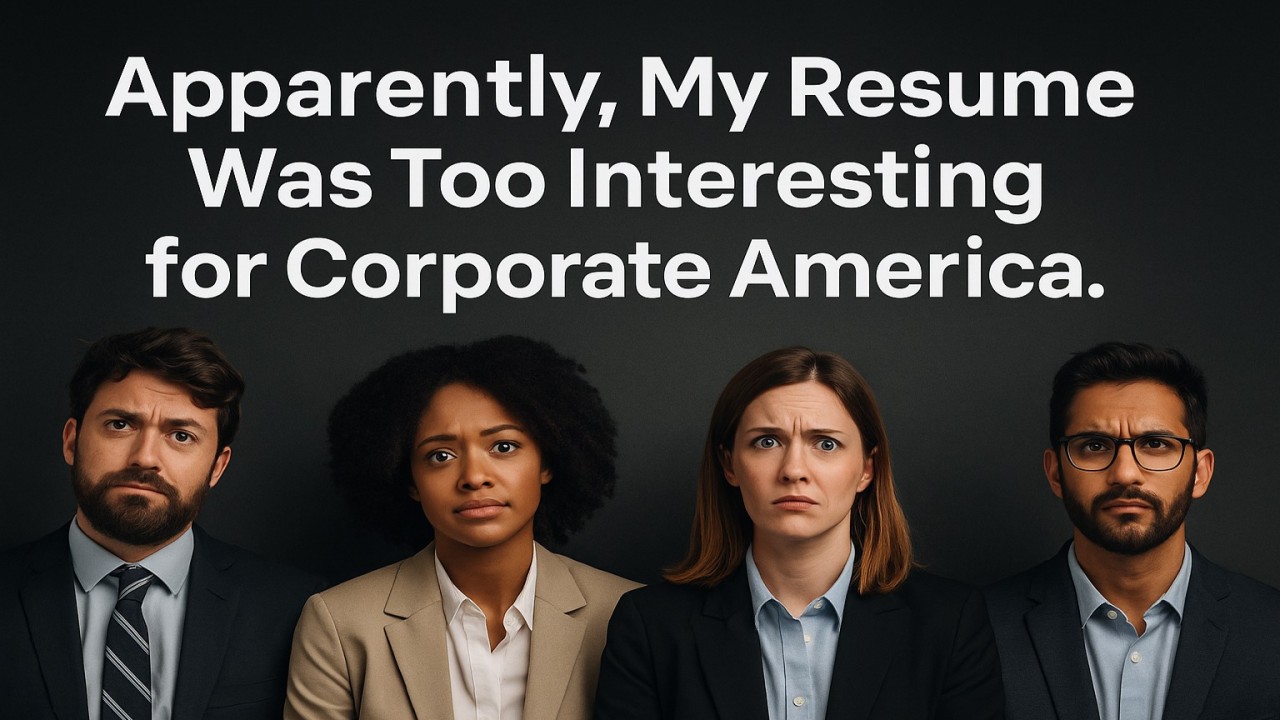
Somewhere between “dynamic self starter” and “motivated team player,” the modern resume lost its soul.
It used to be a summary of your professional journey, a curated glimpse of who you were, what you’d done, and where you hoped to go. It was a story. A handshake on paper. A promise that said, Here’s what I’ve built, and here’s what I can build for you.
Now it’s a landmine. One wrong word, one too personal detail, one extra line spacing, and your career aspirations are obliterated by a recruiter’s 4 second glance and a quiet click of “Move to Rejected.”
I know this because I’ve read the new commandments — those impassioned recruiter sermons circulating across LinkedIn. They come in all caps, framed by red stop signs, and usually begin with something like, “YOUR RESUME IS NOT A DATING PROFILE.”
Apparently, joy is unprofessional now. So is personality. So is anything that makes you look remotely human.
We’ve entered an age where job hunting has become a personality erasure exercise. Recruiters preach efficiency, companies glorify minimalism, and applicants are expected to compress their entire existence into a single grayscale page that says nothing too boldly, explains nothing too honestly, and dares to offend no one.
We are told: no hobbies, no creativity, no gaps, no colors, no fancy fonts, no soul.
What remains is not a resume, it’s a corporate eulogy. A document announcing that you once lived, worked, and achieved things, but have since been formatted into compliance.
This is the new professional paradox: They ask us to “stand out” while demanding we all look the same. They encourage “authenticity” while punishing individuality. They want passion, as long as it comes in Times New Roman.
And so, in the name of employability, we strip away the pieces that make us interesting, likable, and real.
This is not a career guide. It’s a eulogy for personality, written in a clean, one page format, of course.
Thou Shalt Not Have Hobbies — The Criminalization of Being Human
Let’s begin with the first corporate sin: hobbies.
“Do not include hobbies,” the experts warn. “Your resume is not a dating profile.”
A statement that implies two things: one, recruiters are apparently one bad bullet point away from falling in love with us; and two, admitting that we do anything besides work is now considered unprofessional.
I get the logic, in theory. They say hiring managers want focus. They want to know about your experience, not your love for marathon running, cooking, or rescuing cats. But let’s be honest, the argument falls apart quickly when you consider that the same companies demanding passionless resumes post job listings filled with phrases like “seeking energetic self starter,” “team oriented go getter,” and “someone who brings their whole self to work.”
Which self, exactly? The sanitized one you’ve trained to speak in bullet points and performance metrics? The version that has deleted every trace of joy and replaced it with “cross functional collaboration experience”?
The irony is that hobbies do tell you something valuable. Someone who builds furniture, runs half marathons, or teaches kids how to play piano isn’t just indulging a pastime, they’re showing focus, commitment, and patience. But somewhere in HR canon law, that became “too personal.”
So we’re left with resumes that sound like they were written by an emotionally restrained AI trained on corporate jargon:
“Strategic professional leveraging cross-departmental synergies to achieve operational optimization.”
Which, translated into human language, means: “I once talked to another department and didn’t start a fire.”
Recruiters say, “Less is more.” But less of what? Less humanity? Less curiosity? Less evidence that you might actually enjoy being alive?
At this rate, the perfect resume will soon be just a blank sheet of paper with the words “Hire Me, I Promise I Won’t Have Interests.”
The Cult of Formatting — When Fonts Become Moral Judgments
The next sin, according to the new prophets of professionalism, is daring to have aesthetic preferences.
Color? Sinful. Graphics? Unforgivable. Modern fonts? Blasphemy.
We’ve created an entire industry of resume absolutists who treat Arial 12pt like holy scripture. One career coach even said, “If it’s not in Times New Roman, I don’t read it.” As if the font choice determines your competence.
Imagine being disqualified from employment because your resume used Calibri.
But this isn’t just about design, it’s about control. The war on formatting is the corporate world’s way of ensuring no one stands out too much. Because standing out requires someone to make a decision. And decision making is terrifying when your job is to screen 500 applicants before lunch.
Then comes the one page rule, that eternal corporate obsession. You can lead teams, manage budgets, develop strategies, and solve complex problems, but you must summarize it all into exactly one page. Because apparently, if you can’t describe 15 years of professional experience in under 500 words, you’re inefficient.
It’s absurd. We live in an era where companies brag about “storytelling” as a marketing superpower, yet punish candidates for telling theirs.
Then there’s the fetishization of metrics, the obsession with numbers to prove worth.
You can’t say “Improved customer experience.” You must say, “Increased multi channel engagement satisfaction rates by 14.2% quarter-over-quarter while reducing escalations by 3.8%.”
This is the resume industrial complex: where humanity is replaced by quantification. Where “Led a project that mattered” must become “Drove cross functional KPIs resulting in scalable revenue pathways.”
It’s a language that sounds impressive but communicates absolutely nothing.
And the worst part? It works. Because the people reading it have been trained to value formatting and formula over meaning.
If Shakespeare applied for a corporate role today, he’d be told his resume “lacked measurable outcomes” and his summary section was “too poetic.”
The Great Erasure — How We Became Professional Ghosts
By the time you’ve followed all the advice, removed hobbies, deleted color, condensed experience, and swapped humanity for percentages, your resume doesn’t represent you anymore. It represents compliance.
It’s no longer a map of your career. It’s a passport stamped “corporate safe.”
The process is so stripped of life that it’s almost philosophical. Recruiters tell you not to “overshare,” not to “stand out too much,” not to “include unnecessary context.” They call it streamlining. But what it really is — is erasure.
You become an outline of yourself: just enough detail to prove you exist, not enough to make anyone curious.
We’ve built a hiring process designed for efficiency but not connection. Recruiters brag about spending four seconds per resume, as if attention deficit is a badge of honor. Four seconds to judge an entire career. Four seconds to decide whether your existence continues to the next round.
And then, when you inevitably get rejected, they tell you it was about “fit.”
The problem with “fit,” of course, is that it rewards sameness. The less you stand out, the more “fit” you appear. The more compliant, colorless, and interchangeable your resume becomes, the more professional you look.
That’s not selection, that’s cloning.
We’ve created an ecosystem that punishes individuality and rewards invisibility. Companies beg for innovation but hire for obedience. They want “culture add,” but only if you don’t change the temperature.
The resume, once a proud snapshot of someone’s story, has now become a manual on how to be forgettable.
The Elegance of Erasure
In a world obsessed with metrics, algorithms, and optimization, we’ve optimized ourselves into oblivion.
We’ve mistaken polish for professionalism, compliance for competence, sameness for safety. And in doing so, we’ve drained every drop of authenticity from the hiring process.
It’s not that people are submitting bad resumes, it’s that they’re submitting good ones to bad systems. Systems that equate formatting with merit, efficiency with intelligence, and blandness with trustworthiness.
Recruiters tell us to be concise, but what they really mean is: “Be quiet.” They tell us to stand out, but what they really mean is: “Don’t make me think.” They tell us to be ourselves, just not too much.
And so, we comply. We erase our hobbies, our stories, our quirks, our color, our voice. We make ourselves smaller, plainer, and easier to skim.
Maybe one day, the professional world will realize that the best hires aren’t the safest choices, they’re the most honest ones. The ones who dare to sound human in a sea of bullet points. The ones who include a line about the guitar they play, the marathon they ran, or the community they serve, because those details say what metrics never can: that they’re alive.
Until then, keep your resume clean, your font approved, and your personality off the page.
Because in the corporate machine, invisibility is the new professionalism and apparently, being interesting is still the biggest career risk of all.






Thanks for sharing. I read many of your blog posts, cool, your blog is very good. https://www.binance.info/kz/register?ref=K8NFKJBQ
Thank you for your sharing. I am worried that I lack creative ideas. It is your article that makes me full of hope. Thank you. But, I have a question, can you help me?