
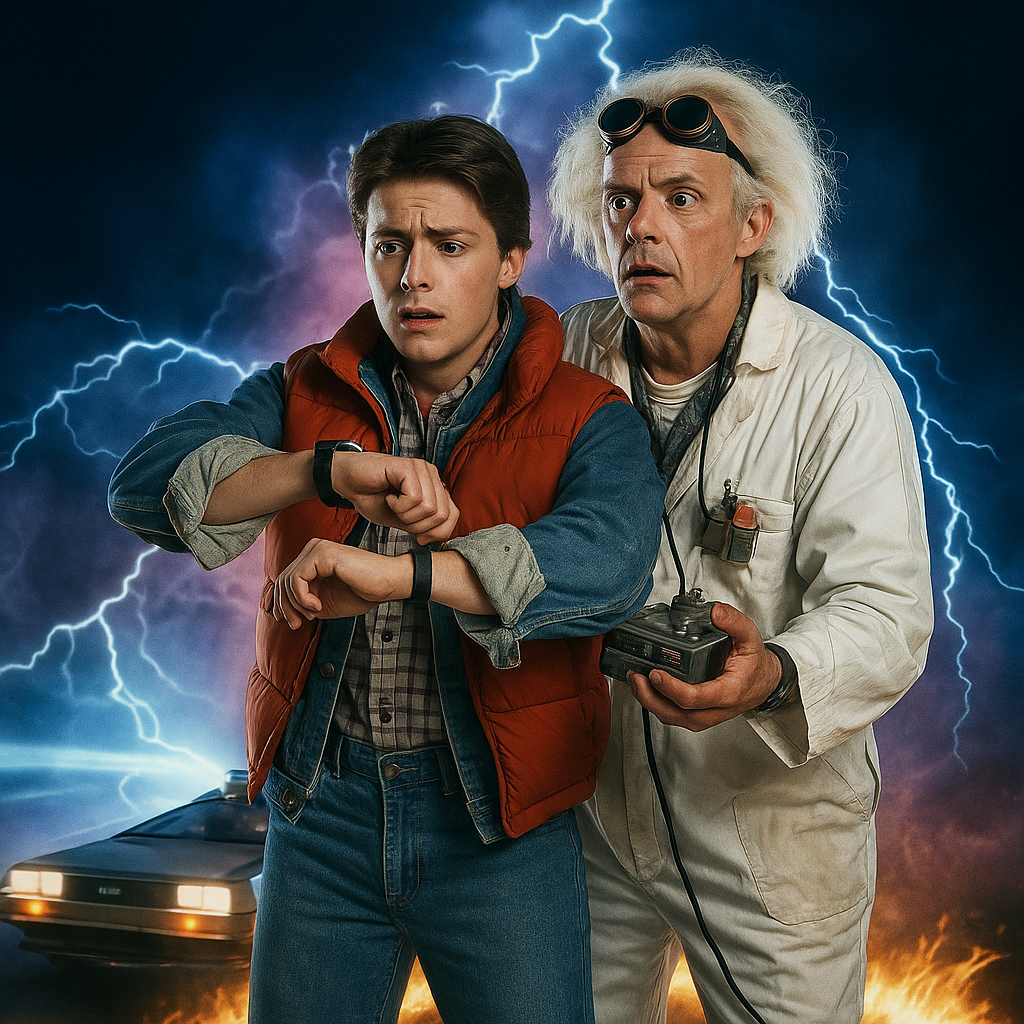
There’s something oddly comforting about imagining a time machine. Not because it’s practical — most of us can barely afford gas, let alone plutonium — but because it gives us the illusion of control. The idea that, with just enough speed and a little lightning, we could fix the moments that still echo when we’re trying to sleep.
Think about it: the missed chances, the wrong words, the job you took for “experience” that turned out to be unpaid trauma. We all have a list, whether we admit it or not. A secret archive of “if onlys” we revisit when the present feels a little too heavy and the future feels a little too blurry. Maybe you’d go back to tell your younger self to take that trip, to say no to that relationship, or to stop trusting people who use “synergy” unironically.
Back to the Future made it look simple — a car, a crazy scientist, and a dashboard of choices. You hit 88 miles per hour, and poof — your regrets vanish in a puff of cinematic smoke. But real life doesn’t come with orchestral background music or clear moral lessons. It comes with bills, burnout, and the constant fear that you might be one more bad decision away from becoming the villain in your own story.
Still, the fantasy lingers: what if we could undo the email we shouldn’t have sent, or the silence we wish we’d broken? What if we could prevent ourselves from trusting the wrong people or losing faith in the right ones?
We imagine we’d fix everything. But what if changing one small thing meant unraveling the very fabric of who we’ve become — sarcasm, scars, awkward laughter and all?
The Butterfly Effect and the Art of Messing Up Gracefully
If time travel were real, I’d probably start small. Maybe I’d go back to 2012 and stop myself from buying those neon jeans. Or to 2016 and whisper, “Don’t send that text. It’s not vulnerability; it’s caffeine and poor judgment.” But that’s the problem with hindsight — it gives you perfect clarity with zero mercy.
The Butterfly Effect isn’t just about physics or chaos theory. It’s about realizing that everything — everything — you’ve done has led to the ridiculous, complicated, semi-functional masterpiece that is you. That missed bus? It introduced you to someone. That breakup? It forced you to find your own identity. That job you hated? It taught you how to endure conference calls that should’ve been written apologies.
If you could go back and change one “mistake,” would you still end up here — wiser, sarcastic, and strangely good at pretending to have it all together on Mondays? Probably not. Because for all the pain those moments caused, they also built your sense of humor, your resilience, and your ability to spot red flags from a mile away.
You can’t step on a butterfly without changing the weather — and you can’t delete your past without erasing your depth. Your screw-ups are not stains on your story; they’re plot twists. They’re the moments that made you interesting, human, and just the right amount of unhinged to survive adulthood.
So maybe, just maybe, the goal isn’t to avoid the storm — it’s to dance through it, get soaked, and then use the experience to make better jokes later.
The Myth of “Better Choices” and the Paradox of You
People love to romanticize the version of themselves who “could’ve been.” You know, the one who didn’t settle, didn’t procrastinate, didn’t fall for the same type of emotionally unavailable person three times in a row. That version of you has better skin, perfect timing, and probably owns real silverware instead of plastic forks from takeout.
But here’s the truth: that version of you doesn’t exist. They’re a mirage — a fantasy projection of who you think you could’ve been if life were fair and your Wi-Fi always worked.
We cling to this illusion because it’s easier than forgiving ourselves. It’s easier to imagine a “better” us than to accept that the current one, with all their chaos and coffee stains, might actually be doing okay. Because “better” isn’t always happier. Sometimes the polished version of you — the one who didn’t screw up — never learned empathy, or humor, or how to find beauty in the absurdity of failing publicly and surviving it.
Changing your past means changing your perspective, and perspective is what makes pain bearable. It’s what turns embarrassment into a story, heartbreak into art, and failure into fuel. The paradox is this: you can only imagine “better” because you already know worse.
So if you had the power to go back, maybe you wouldn’t fix your choices. Maybe you’d just sit next to your younger self — that confused, hopeful, terrified version of you — and say, “You’re going to make a lot of mistakes. But they’ll make sense someday. Keep going.”
Reruns, Reboots, and the Emotional Time Machine We Already Own
Let’s be honest — we’re all time travelers, just without the DeLorean. We don’t need flux capacitors; we have memories, nostalgia, and an overactive imagination. We time travel in the shower, reliving that one argument where we finally came up with the perfect comeback — five years too late. We time travel through old texts, social media posts, playlists that smell like heartbreak and bad decisions.
We think about who we were, who we are, and who we might’ve been — like we’re flipping through channels of a show that’s still being written. And sometimes, we wish we could change the script. But here’s the twist: we already can. Not by rewriting the past, but by editing how we remember it.
Your past doesn’t change, but your interpretation does. What once felt like failure can become a setup for redemption. What once felt like rejection can look like redirection. And what once felt like chaos can, in hindsight, look like the necessary destruction before rebuilding.
The irony of time travel is that we crave the ability to return to moments we didn’t fully appreciate when they happened. But maybe that’s the whole point — to finally learn to be present enough now that we won’t need to fantasize about going back later.
Because every day you wake up, choose differently, forgive yourself, or just try again — that’s time travel. The emotional kind. The one without paradoxes or lightning bolts, just quiet, stubborn growth.
Final Thought: No Roads Needed, Just Courage
Doc Brown was right: “Where we’re going, we don’t need roads.” What he didn’t say is that where we’re going, we’ll probably still get lost — and that’s okay. Life was never meant to be navigated perfectly. It’s meant to be lived awkwardly, bravely, and with the occasional mental breakdown over your career trajectory at 2 a.m.
If you could go back, you’d realize that most of what you wanted to fix didn’t actually need fixing. It just needed time, perspective, and the kind of self-awareness that only comes from surviving your own chaos.
You can’t change your past, but you can change how you carry it. You can turn guilt into gratitude, regret into lessons, and fear into fuel. You can forgive the version of yourself who didn’t know better — and thank them for trying anyway.
Because maybe the real point of “Back to the Future” isn’t that we can rewrite history. It’s that we can keep moving forward, knowing that the past — no matter how messy — got us here.
And here, despite everything, is still a pretty good place to be.






Your article helped me a lot, is there any more related content? Thanks! https://accounts.binance.com/register-person?ref=IHJUI7TF
Your point of view caught my eye and was very interesting. Thanks. I have a question for you. https://accounts.binance.com/id/register-person?ref=UM6SMJM3