There was a time when coffee was sacred. You’d stumble into your local café, half-awake, clutching your wallet like a lifeline, and exchange a few honest dollars for a hot cup of motivation. Maybe you’d toss a coin into the tip jar — not because you had to, but because you felt like being a decent human. There was no audience, no glowing touchscreen judging the depth of your soul. Just the quiet ritual of caffeine and survival.
But then, the world decided that even coffee needed Wi-Fi, and tipping became digital — a public performance disguised as gratitude. The moment the tablet swivels toward you, the transaction transforms into a personality test. “Would you like to tip?” isn’t a question anymore; it’s a moral riddle, a flashing screen that says, we’ll know what kind of person you are in three seconds or less.
This morning, I faced that digital demon again. Same Starbucks. Same black coffee. Same fragile faith in humanity. I approached the counter like a veteran returning to battle. I didn’t even need to speak; the barista already knew my order: “One black coffee, no sugar, no foam, no hope.” It’s the drink of someone who’s seen corporate PowerPoints too early in the morning and survived multiple “quick sync” meetings that were neither quick nor synchronized.
I just wanted my liquid motivation — caffeine before chaos, the calm before the inbox storm. But fate had other plans.
The coffee tasted like disappointment mixed with regret and a hint of burnt ambition. One sip, and I thought, Did they brew this using printer toner and despair? I looked down into the cup like it was a metaphor for my life — bitter, lukewarm, and somehow still overpriced.
And then it happened.
The screen appeared. The touchscreen. Glowing. Waiting. Judging.
The Silent Standoff
There are moments in life when time slows down — when you realize you’re about to make a decision that will define your character. For some people, that moment happens in job interviews or marriage proposals. For me, it happened at Starbucks, 7:48 a.m., holding a credit card like it was a moral compass.
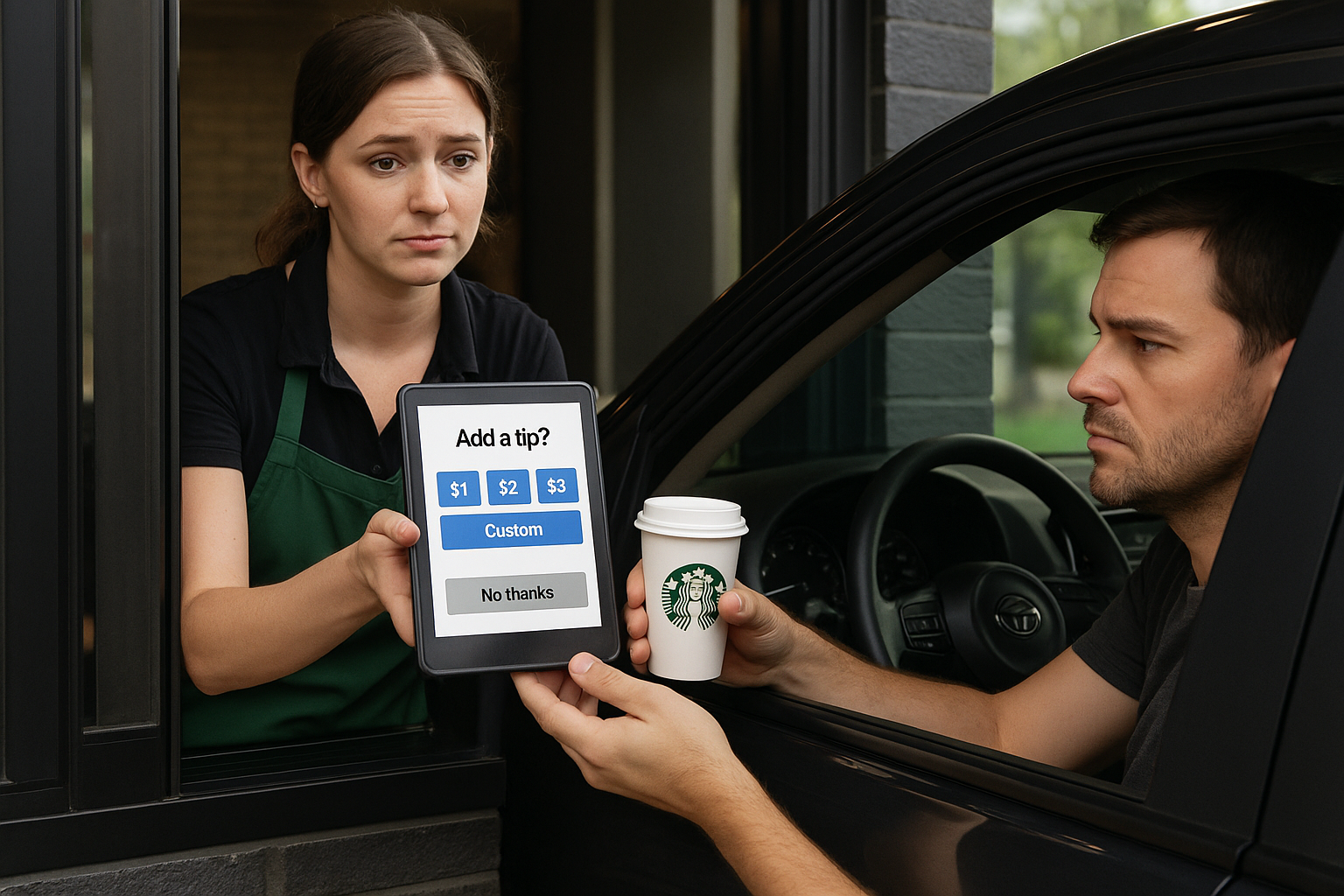
The barista turned the screen toward me, that bright little rectangle of guilt.
Add tip:
$1 | $2 | $3 | Custom | No thanks (you monster)
I froze. The air got thick. Somewhere in the distance, a cappuccino machine hissed in judgment. The barista watched, pretending not to watch. Behind me, I could feel the impatient sighs of people who clearly had better moral clarity than I did.
I stared at the options, weighing my soul like I was on trial. I wasn’t even against tipping — I’d worked in customer service. I’d faced the public before 9 a.m., smiled through pain, and faked enthusiasm for people who thought “venti” was Italian for “bring me your manager.” But this felt different. This wasn’t appreciation — this was surveillance.
When I finally tapped “No tip” — by accident, or destiny, I’ll never know — I swear the room temperature dropped five degrees. The barista’s smile disappeared faster than my 401(k) during inflation. She handed me the cup with a tone that could curdle milk.
“Have a nice day,” she said. But it wasn’t a wish. It was a curse.
I walked out with my dignity in one hand and my disappointment in the other, feeling like I’d just failed an unspoken exam in basic humanity.
The Performance of Generosity
We live in the age of performative generosity — where kindness has to be visible, recorded, and preferably shared on social media for it to count. The digital tip screen isn’t a request; it’s a mirror, reflecting back your moral anxiety with impeccable clarity.
Once upon a time, you tipped quietly. Maybe you left a few singles and went on with your life. Now, every interaction is a theater production — starring you, the reluctant protagonist, and them, the weary barista playing the role of passive observer-slash-judge. The supporting cast includes the people behind you, silently assessing whether you’re a saint or a sociopath.
I once saw a guy tip 50% just because the girl behind the counter had a nose ring and he panicked. Another man pretended to take a phone call mid-transaction just to avoid the entire moral confrontation. I’ve seen it all — fake button presses, awkward jokes, and the classic “Oh, I think it didn’t go through” act of self-deception.
The truth is, we’re no longer tipping for service. We’re tipping to prove that we’re not villains. That we care. That we have empathy, even if our bank accounts don’t. And while that might sound noble, it’s exhausting. We’ve turned small acts of appreciation into televised confessions.
I remember once ordering takeout online from a restaurant that forgot my order, burned my food, and sent me an automated text asking for a 25% tip “to support the team.” The team that forgot I existed. I stared at that message for five minutes like it was a philosophy exam: If a restaurant forgets your order but still asks for a tip, is it wrong to say no? Or is the real sin overthinking it?
This is where we are now — trapped in a moral matrix run by tablets and tip prompts, where the only true crime is hesitation.
The Caffeine Confessional
By the time I got back to my car, the coffee was cold — which felt symbolic. I took a sip anyway, because caffeine dependency doesn’t care about temperature or pride. As I stared out the window, I realized the tip screen wasn’t really the problem. It was just a reflection of everything else in modern life: too connected, too performative, and too guilt-ridden for its own good.
We’ve all become actors in a never-ending play called “Appear Good in Public.” We curate kindness like it’s content. We broadcast empathy like it’s branding. And somewhere along the way, we forgot what genuine appreciation feels like.
But here’s the truth — I’ll still go back tomorrow. Because caffeine wins over pride every single time. Even if it tastes like burnt Wi-Fi and regret, I’ll sip it anyway. I’ll smile. I’ll nod. And maybe, just maybe, I’ll drop a dollar in the tip jar — not for show, not for guilt, but as a peace offering to the caffeinated gods.
Or maybe I’ll bring cash, just to confuse the system. I’ll hand the barista a five, look her dead in the eye, and say, “This is for the emotional damage caused by your touchscreen.”
Because at the end of the day, we’re all just trying to survive — one awkward touchscreen interaction at a time. Some with caffeine, some with sarcasm, and some with a faint hope that tomorrow’s brew will taste a little less like existential dread.
So here’s to all of us — the tired, the under-caffeinated, the accidentally rude, the socially anxious, the “no tip” survivors, and the brave souls who keep showing up anyway. You’re doing your best. You’re human. You’re awake.
And in this economy? That’s more than enough.