
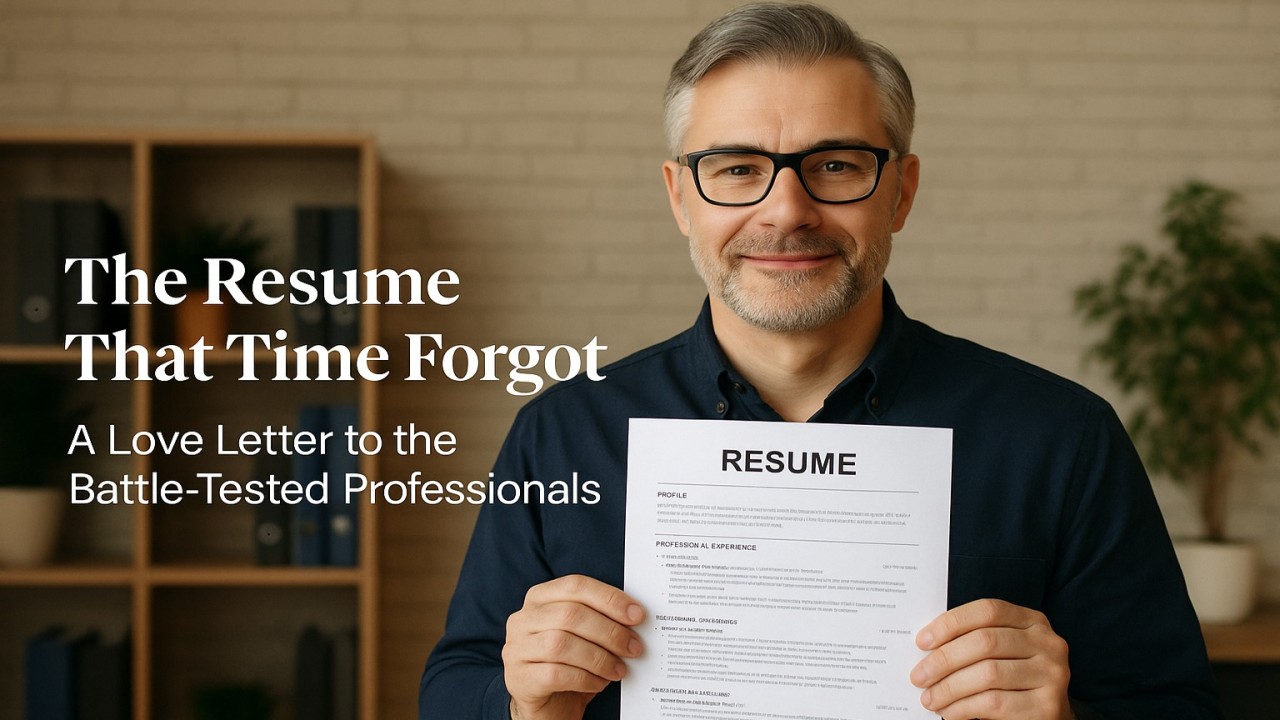
You ever notice how some companies look at a resume and react like they’ve just unearthed a fossil from the Cretaceous period? The recruiter squints, the hiring manager gasps, and someone whispers, “Twenty… years?” like they’ve just found a VHS tape in a Netflix world. Somewhere in the back, someone nervously clicks “Next Candidate,” as if decades of experience might crawl out of the document and demand a pension.
They don’t see the decades of earned wisdom, caffeine powered determination, and survival skills honed in cubicles long before beanbags and kombucha stations existed. No, they see age, which in corporate language apparently translates to “overqualified,” “set in their ways,” or the dreaded “might not fit our fast paced, dynamic environment.” Translation: you’ve been through too much to be fooled by ping pong tables, inspirational quotes on walls, and “unlimited PTO” that mysteriously disappears when requested.
Let’s get one thing straight, you’re not expired milk. You’re vintage resilience with a Wi-Fi upgrade. You’ve outlasted every management fad, every buzzword, and every software “revolution” that was just Excel with a different color scheme. You’ve seen companies rise, fall, rebrand, merge, split, get acquired, go bankrupt, and still somehow find a way to schedule a “mandatory fun” meeting at 4:55 p.m. on a Friday.
You’re the kind of professional who knows that “synergy” means “we’re doing two people’s jobs now” and that “team building retreat” is corporate for “bring sneakers, we’re climbing trust ropes again.” You’ve watched generations of leaders reinvent the same wheel, slap a new buzzword on it, and call it innovation. And yet, through it all, you’ve kept your humor, your work ethic, and your unmatched ability to fix both the office printer and the office morale in under five minutes.
If experience had a smell, yours would be freshly brewed coffee and printer ink, with a faint note of “I told you so.” You’ve earned those wrinkles, those LinkedIn endorsements, and that uncanny ability to survive a 2 hour Zoom call that could’ve been an email.
And yet, somehow, corporate recruiters treat your resume like it’s an antique, something to admire from afar but never plug in. The irony? You probably built half the systems their company still relies on. The ones they call “legacy software”? Yeah, that’s your code.
This is the story of those who built the workplace, survived it, and somehow kept their sanity through fax machines, floppy disks, open offices, and four CEOs named Jeff. You are not a relic, you are the backbone. The proof that wisdom doesn’t expire. And this? This is your comeback tour.
The Jurassic Park of Job Applications
Picture this: a hiring manager scrolling through resumes like they’re flipping through ancient scrolls. They see yours, filled with achievements, leadership, and skills that kept entire departments afloat before “cloud” meant storage and not weather. Their face twists. “Twenty years of experience? Hmm… do you think they’ll adapt?”
Adapt? Friend, this is someone who survived dial-up internet, paper timesheets, and the Great Printer Jam of 2003. They don’t adapt, they upgrade. This is the professional who conquered Windows 95, survived the Y2K panic, and learned to copy paste in the trenches of corporate evolution.
These are the veterans of the workforce, people who used to send reports through fax machines that screamed like tortured spirits. They learned PowerPoint when clip art was considered graphic design and presentations required a projector the size of a small refrigerator. They worked in offices before “remote work” meant your boss called your landline at 8 p.m. because they “just had a quick question.”
They were coding in HTML before “influencer” became a career path. They built empires on Lotus Notes and Outlook calendars while today’s startups are out here reinventing “shared folders” like they just discovered fire.
Meanwhile, companies chase “digital natives” like Pokemon, convinced youth automatically equals innovation. Sure, the new hires know how to make a killer TikTok, but hand them a broken copier, and suddenly they’re googling “how to fix the scary beeping box” like it’s an unsolved mystery.
But the seasoned pros? They’ve been troubleshooting since troubleshooting required a screwdriver. They don’t panic when Wi-Fi drops, they pivot. When Teams crashes, they don’t freeze, they restart. When the CRM stops syncing, they mutter “figures” and open Excel like a surgeon reaching for a scalpel.
And let’s talk about crisis management. When Wi-Fi goes down, younger teams spiral into panic, hissing, “How will we work?” Meanwhile, Janet from Accounting calmly pulls out a legal pad and says, “Honey, this isn’t my first blackout.” She starts running manual calculations with a pen that’s older than the intern.
Janet doesn’t need a cloud backup, she is the backup. She’s been through every system migration, survived five CFOs, and knows exactly where every file is, both digital and physical. She’s the workplace equivalent of a Navy SEAL: trained for chaos, fueled by coffee, and immune to panic. When the server goes down, everyone looks to her, and she just sighs and says, “Give me five minutes.”
These aren’t outdated employees, they’re field tested professionals. They can navigate an office meltdown faster than most people can find their Wi-Fi password. They’re not afraid of “change”; they’re just tired of rebranding common sense as “innovation.”
So the next time a hiring manager asks, “Can they adapt?” remember this: they’ve been adapting since your company logo was Comic Sans. They’re not relics, they’re the reason the lights are still on.
The Evolution of Office Survival
If you’ve been working long enough to remember the screeching symphony of a dial-up modem connecting, you’ve also survived every corporate mutation imaginable. Cubicles. Open offices. Hybrid models. Standing desks. Remote work. Return to office “initiatives.” And the ultimate insult, being told to “embrace agility” by someone who can’t even attach a file to an email.
You’ve seen it all and somehow, you’ve stayed sane. Mostly.
Back then, “multi tasking” wasn’t a buzzword; it was a lifestyle. You’d answer phones while fixing the copier, calm down a client having an existential crisis, and train your replacement, all before lunch and without a single “productivity app.” There were no Slack channels or daily standups. You just got things done. Deadlines were met, customers were happy, and no one needed a push notification to remind them to “breathe mindfully” or “hydrate.”
You didn’t need words like “synergy,” “alignment,” or “bandwidth” because you were too busy actually working. If someone said “let’s take this offline,” it meant a real conversation, not a calendar invite for next Thursday.
And don’t even get started on “work life balance.” You didn’t need a policy, you invented it. Through sheer willpower, caffeine, and muttering “just five more minutes” until your kids had graduated college. You didn’t have burnout webinars. You had coffee pots that looked like they’d been through a war.
Today’s corporate culture romanticizes “resilience” as if it’s some newly discovered superpower. The truth? The veterans created it. They didn’t just roll with the punches, they reorganized the boxing ring, wrote the post fight analysis, and still had time to fix the printer jam on their way out. They’re the ones who turned chaos into process, panic into planning, and “we’ll figure it out” into a meeting agenda.
They’re the Swiss Army knives of the workplace, adaptable, durable, and somehow still sharp despite years of misuse. They can rebuild a spreadsheet from scratch, mediate a department feud, and troubleshoot a malfunctioning projector using nothing but a binder clip and righteous indignation. They’ve seen technology evolve from floppy disks to “the cloud,” and yet, when a system crashes, they’re the first to say, “Did you try turning it off and back on again?” because deep down, they know it still works.
They’re also part time therapists, unofficial mentors, and the moral compass of every organization too young to know what “dress for success” used to mean. When the Wi-Fi dies or the office group chat implodes, they’re the calm in the storm, sipping coffee from a chipped mug older than the intern who just said “Let’s pivot our strategy.”
Corporate veterans don’t chase trends; they outlast them. They’ve survived every new “revolutionary” management philosophy from Lean to Agile to “Radical Transparency,” all of which are just recycled versions of “Please communicate better.” They’ve been told to “embrace change” so many times they could start charging rent for it.
And here’s the best part, they’re still standing. Still hitting deadlines. Still mentoring, managing, and occasionally saving the company from itself. Because when you’ve seen the rise and fall of four CEOs, three office moves, two rebrands, and one ill-fated motivational speaker named Brad, you develop a sixth sense for nonsense and the uncanny ability to keep things running anyway.
They’re not “set in their ways.” They invented the ways. And somehow, through it all, they still show up, coffee in hand, sarcasm in reserve, ready to fix whatever crisis today’s “fast-paced, innovative environment” managed to create overnight.
The Age of Unreason (and Unread Resumes)
Somewhere along the line, companies started treating experience like a liability instead of an asset. “We’re looking for someone with fresh ideas,” they say, while ignoring the people who’ve already seen every “fresh idea” before it was repackaged, renamed, and presented as the next big thing in innovation.
It’s the era of buzzwords over balance sheets, where “disruption” is treated like a business plan and “youthful energy” is somehow considered more valuable than institutional knowledge. Ironically, the same people they’re overlooking are the ones who built the systems everyone else is now trying to “streamline.” They don’t need a workshop on collaboration tools, they beta tested them when floppy disks were currency and saving files meant holding your breath for thirty seconds.
But here’s the real kicker: they don’t just bring experience, they bring calm. They’ve seen every crisis play out before, from server meltdowns to economic downturns, and they know the secret that every startup eventually learns the hard way, panic solves nothing. When the interns are spinning in circles and management’s hosting “alignment meetings” about the Wi-Fi outage, they’re the ones sipping coffee and saying, “Relax. We’ll fix it.”
They are the steady heartbeat of every organization pretending to “move fast.” They’re the backbone holding together the “agile transformations” that collapse the second Slack goes down. While everyone else is panicking about their Jira boards and “deliverables,” they’re the ones with a legal pad, a plan, and a quiet kind of confidence that can’t be taught in any onboarding module.
They don’t make a big deal about it, they just get it done. They’re the silent translators between executive vision and operational reality. They’ve seen PowerPoints come and go, CEOs rebrand mediocrity as “momentum,” and consultants sell the same advice in new fonts. And through it all, they’ve stayed, working, adapting, surviving.
When management declares a “new direction,” these are the people who quietly adjust the workflow so things still function. When leadership rolls out a half-baked “efficiency initiative,” they’re the ones who make it actually efficient. They’ve learned that the real secret to productivity isn’t a tool, it’s patience, perspective, and a well-timed sigh.
They’ve seen recessions, rebrands, mergers, layoffs, system crashes, and every version of Windows known to humankind and they’re still here. Not bitter, not broken, just battle tested. The unshakable calm in the chaos.
So the next time someone scoffs at a resume that lists experience older than some of your employees, take a second look. That person isn’t outdated, they’re unstoppable. They’re the reason your company has a history at all. Because when the Wi-Fi fails, the market dips, or the new “AI solution” crashes the system, it won’t be the interns who save you. It’ll be Janet from Accounting, calmly whispering, “I’ve seen worse.”
Because experience doesn’t age, it endures. And in a world obsessed with being “new,” the ones who’ve seen it all are the only ones who truly know what’s worth keeping.
The Vintage Revolution
Someday, the same hiring managers who once overlooked the “experienced” candidates will find themselves on the other side of the Zoom call, grayer, wiser, clutching decades of lessons learned and a LinkedIn profile full of hard won endorsements. And when a recruiter squints at their resume and says, “Hmm… 25 years, huh?” they’ll feel it. That quiet sting of being mistaken for obsolete when, in truth, they’re irreplaceable.
It’s poetic justice, really. The cycle comes full circle. The same people who once filtered out resumes for being “too senior” will one day watch theirs drift into the same pile, ignored, misjudged, undervalued. They’ll realize that experience isn’t a burden to carry; it’s the proof that you’ve weathered the storms others are still learning to predict.
The truth is, wisdom doesn’t expire, it compounds. The veterans of the workplace aren’t relics; they’re living archives of solutions, strategy, and quiet heroics. They’ve navigated chaos before there were hashtags for it. They’ve adapted through every reorg, every crisis, every “urgent pivot” that management swore was temporary (spoiler: it never was). They’ve stayed calm through financial crashes, server meltdowns, and enough “strategic realignments” to fill a documentary.
And yet, they’re still here, still showing up early, still mentoring, still proving that competence doesn’t trend, it endures. They don’t need another seminar on “change management”; they could teach it blindfolded. They don’t panic when new tech rolls out; they take a breath, read the manual, and quietly fix it while everyone else debates it in Slack.
So yes, respect your elders. Especially the ones who can out type you on a Blackberry, troubleshoot your Wi-Fi blindfolded, and still beat you to inbox zero before 9 a.m. They’re the reason the office coffee pot works, the reason your processes make sense, and the reason the new intern didn’t set the copier on fire.
They’re not what’s left over from the past, they are the bridge to the future. The ones who built it, reinforced it, and now hold it steady while everyone else tries to sprint across it in dress shoes.
Because someday, when the next wave of fresh faces calls you “old school,” you’ll smile, take a sip of coffee, and think, Ah, so this is how Janet felt.
And somewhere, probably right now, Janet from Accounting just fixed the printer again. She’s been doing it since 1998, and she’ll still be doing it when your cloud server inevitably crashes.
Because in every office, through every era, there’s always a Janet. And thank goodness for that.