There is a special kind of optimism that only exists in people who apply for jobs in the year of our corporate overlords two-thousand-and-whatever, the kind of optimism where you upload your resume into a portal that was clearly designed during the dial-up era, watch it aggressively erase your formatting like it’s performing an exorcism, then politely retype your entire work history into seventeen mandatory boxes, including one labeled “Describe your responsibilities” which is a fascinating request considering you just gave them a resume, which is literally a document whose entire purpose is to describe your responsibilities, but sure, let’s do interpretive dance for the Applicant Tracking System, the mechanical beast that lives beneath the HR building like a sewer alligator that demands offerings and occasionally grants mercy.
And this is where the raccoons come in.
Because the modern job search is not a process, it is an ecosystem, and within that ecosystem there are many species: the hiring manager who “really wants to move quickly,” the recruiter who speaks exclusively in soft promises and calendar invites that never arrive, the panel interview that appears on your schedule like a surprise subpoena, and you—standing there in your best shirt, rehearsing your answers, trying to pretend you are not an exhausted nocturnal creature with tiny hands digging for meaning and stability in the glowing dumpster behind Corporate HQ.
Job seekers are raccoons, not because we are chaotic (although yes), but because we are resourceful, overlooked, slightly sleep-deprived, and weirdly good at surviving in places that were not built for us, while being judged by people who have never had to fill out a “culture add” questionnaire that asks, with full sincerity, whether we have ever disagreed with a coworker and how that made us feel in our soul.
We do what we must.
We forage.
We adapt.
We get ghosted anyway.
Ghosting Is Not a Hiring Strategy, It’s a Haunted House With Wi-Fi
Ghosting in recruiting is one of those behaviors everyone acts like is normal, even though it is objectively insane, like if you walked into a restaurant, ordered dinner, watched the server nod thoughtfully, and then three weeks later you received an email saying, “We have decided to move forward with other diners,” even though you were still sitting there, quietly drinking water and trying not to make eye contact with the host.
Ghosting happens because somewhere along the way, employers collectively decided that candidates are not people, they are tabs, and tabs can be closed without explanation, like “Oh, this one isn’t loading,” as if the candidate is a buffering video and not a human adult who has organized their life around the possibility of employment, rescheduled dentist appointments, rehearsed responses in the mirror, and told their friends, “I think it went really well,” like a brave little raccoon holding a piece of pizza he found under a bench.
The worst part isn’t even the silence, because silence is at least honest in a bleak, post-apocalyptic way, like a sign that says “NO HELP HERE,” and you can move on; the worst part is the cheerful language that precedes it, the warm verbal head pats, the corporate lullaby that whispers, “We’ll be in touch soon,” which is the recruiter equivalent of saying, “Don’t worry, I’m definitely not about to disappear into the mist,” while you can literally hear the fog machine turning on behind them.
If you’ve been ghosted, you know the phases.
First, you refresh your inbox like it owes you money.
Then you refresh LinkedIn, because maybe they messaged you there, because surely no one would disappear across platforms like a magician escaping accountability.
Then you check your spam folder, because it’s possible the email got lost among the Nigerian princes and the “urgent invoice” scams, and honestly at this point, being offered a small fortune by a stranger sounds more stable than the hiring pipeline.
Then, eventually, you accept the truth: they are gone, and you were left holding a polite follow-up email like a raccoon holding a leaf, trying to pretend it is a meal.
So you do what raccoons do best: you keep moving, you keep foraging, and you learn to treat “We’ll be in touch” as a weather forecast—possible, not promised, and definitely not something to plan your entire week around.
The Panel Interview, or “Survivor: Conference Room Edition”
Somewhere in the distant past, an interview used to be a conversation between two humans, like “Tell me about yourself,” and “Sure,” and then maybe a second interview, and then—if the stars aligned—an offer, which is how civilized societies should function when exchanging labor for money.
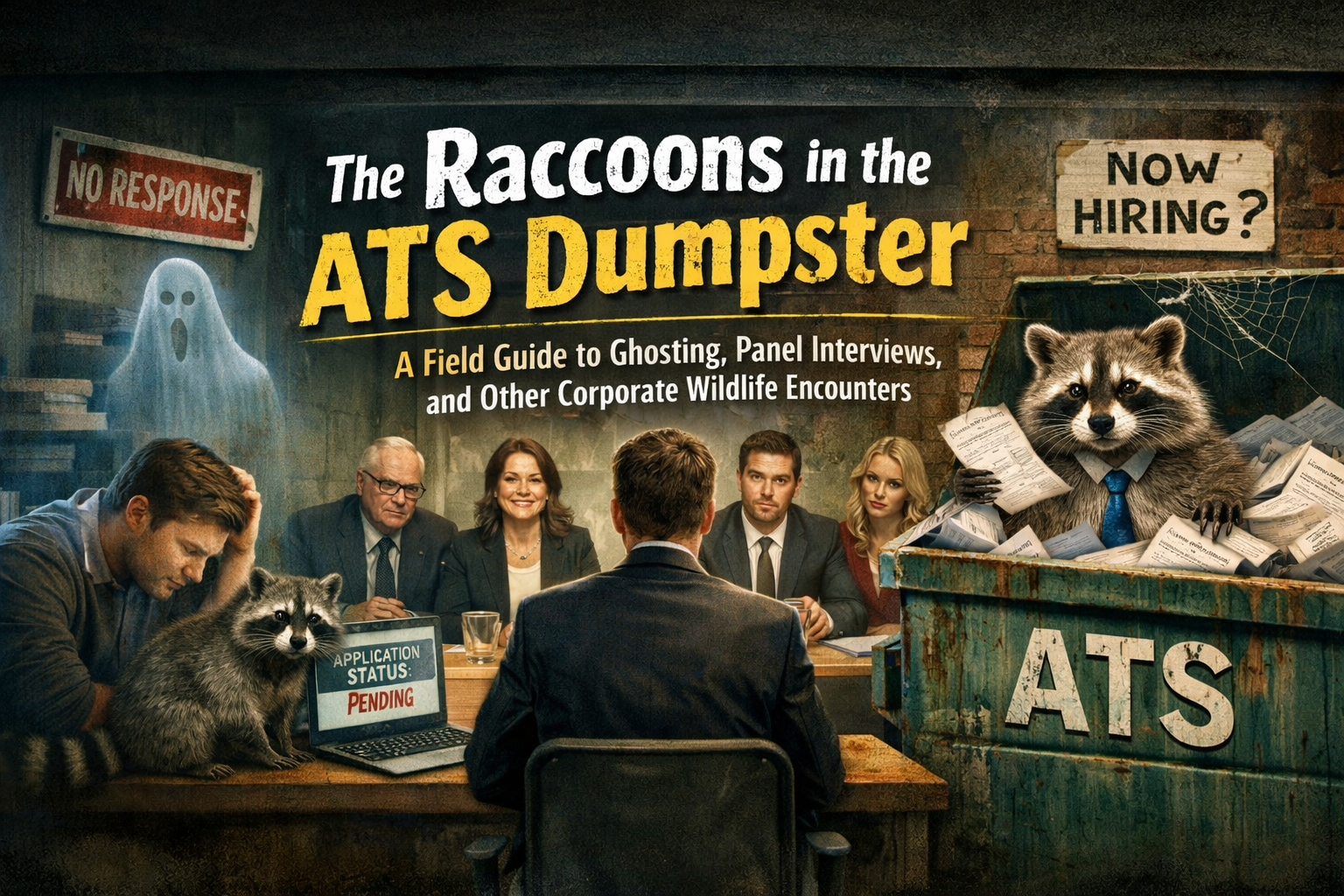
Now, however, we live in the Era of The Panel, which is not an interview so much as an ambush with name tags, where you log into a video call and discover eight faces arranged in little squares like a corporate Brady Bunch, all of them staring at you with the calm confidence of people who have already been paid for this hour and are now here mainly to evaluate your ability to remain composed while being asked the same question in slightly different fonts.
Panel interviews are fascinating because they often contain one of each personality, like a job-search safari.
There’s the silent observer, who says nothing but takes notes like they are transcribing your spirit for legal purposes.
There’s the “culture” person, who smiles too warmly and asks what animal you would be, which is a trap question because if you answer honestly—raccoon—they will write “unfit” in their notebook and immediately alert HR.
There’s the technical person, who asks you to solve a problem that does not exist in the role you applied for, as if they are hoping you accidentally reveal you can also rebuild a carburetor while explaining stakeholder management.
There’s the future coworker, who looks like they’ve seen the inside of this company and are silently trying to warn you with their eyes, but the camera quality isn’t good enough to read the full message.
And then there’s the hiring manager, who begins with, “We’re really excited to meet you,” and ends with, “We have a few more candidates,” which is corporate for “Welcome to the Hunger Games, may the odds be ever in your emotional regulation.”
Panel interviews are not designed to understand you, they are designed to test your stamina, like a marathon, except instead of water stations you get asked, “Tell us about a time you dealt with conflict,” and you have to answer while your brain is also doing math, like: How many people are here? Who is actually making the decision? Which one will remember my name? Which one will ask me a follow-up that requires I be both confident and humble at the same time, like a motivational poster that also does your taxes?
The raccoon mindset is essential here, because raccoons are not intimidated by crowds; raccoons simply assess the situation, locate the food, and move with purpose, and in this case, the food is the one person on the panel whose approval matters most, and your job is to speak to them while also respecting the others, like a diplomatic mission in a room full of people who could either offer you a job or send you into the shadow realm with a “We’ll keep your resume on file.”
And when it ends, and they say, “We’ll be in touch,” you smile, thank them, close the laptop, and immediately stare into the middle distance like you just survived an emotional triathlon.
The ATS Dumpster and the Myth of “We’re Hiring”
Let’s talk about the ATS dumpster, because it is the central habitat of our raccoon society.
The ATS is the place where hope goes to be sorted, categorized, and occasionally rejected for containing the wrong synonyms, like “managed” instead of “led,” because apparently the system can detect your potential but only if you use the correct incantations.
Companies love to announce they are hiring in the way people love to announce they are “getting back into fitness,” which is to say: they like the idea of it, they enjoy the identity, they want the energy of it, but they are not necessarily going to do the part where they actually commit to it.
So the posting goes up.
The posting stays up.
The posting is reposted.
The posting becomes a permanent fixture of the landscape, like a billboard for a store that closed in 2009, and meanwhile candidates are lining up in the digital alley behind it, submitting applications into the void, like raccoons politely placing their offerings at the feet of the dumpster gods.
Sometimes the job is real.
Sometimes the job is a “pipeline role,” which is corporate for “We want to collect resumes like Pokémon cards.”
Sometimes the job is internal, but they post it anyway because policy demands that everyone be allowed to audition for a role they have already given to Steve, who is currently sitting at his desk pretending he doesn’t know he’s about to be promoted.
And sometimes the job is a ghost job—yes, ghosting has evolved, it has become a posting, it has become architecture, it has become an entire haunted building where the lights are on but no one is home.
This is why the raccoon job seeker learns to read the environment.
If the role has been reposted four times in two months, that’s not “growth,” that’s “indecision wearing a blazer.”
If the hiring timeline is vague, the salary is “competitive,” and the responsibilities include “other duties as assigned,” congratulations, you have found a listing that is basically a personality test for suffering.
If the recruiter says, “We’re moving fast,” but the interview process includes five rounds, a panel, an assignment, and a “meet the founder” call, what they mean is they are moving fast toward your burnout.
The raccoon doesn’t rage at the dumpster; the raccoon simply learns which dumpsters have edible options, which ones contain only disappointment, and which ones are guarded by a territorial cat named “Internal Candidate” who will swipe you the second you get close.
And yes, it is unfair that you have to develop survival skills to get a job, but here we are, living in a world where “Please attach your resume” is immediately followed by “Now manually type it again,” like the system is trying to make sure you want it badly enough to humiliate yourself a little.
Final Thoughts: Keep Your Little Hands Clean and Your Standards Sharp
If you are out there in the job market right now, you are not failing because you are unqualified, unworthy, or missing some secret charisma gene that everyone else got in the mail; you are navigating a chaotic ecosystem where signals are inconsistent, timelines are imaginary, and communication is treated like an optional feature.
Ghosting is not your fault, it is a reflection of a process that forgot candidates are people.
Panel interviews are not proof you are being “seriously considered,” they are proof the organization is afraid of making a decision without a committee, a subcommittee, and a ceremonial trial by PowerPoint.
And the ATS dumpster is not a measure of your value, it is simply a machine sorting language patterns, like a raccoon sniffing containers to see which one smells like dinner.
So keep going, but do it like a raccoon with boundaries.
Apply strategically, not desperately, because your time is also a resource, and you do not owe it to every posting that looks vaguely plausible.
Follow up once, because professionalism is not begging, and if they vanish after that, let them haunt someone else.
Prepare for panels like you’re walking into a wildlife documentary, calm and alert, ready to speak clearly and exit gracefully.
And most importantly, remember this: raccoons do not apologize for surviving.
They do not sit in the alley wondering if they were “too much.”
They do not rewrite their entire identity because a dumpster didn’t appreciate their sparkle.
They simply adjust, move forward, and keep looking for the places where they are wanted, valued, and properly fed.
Because somewhere out there is a role that won’t treat you like a tab to close, a process that won’t require you to perform for eight strangers at once, and a hiring team that understands a radical concept: if you invite someone into your process, you should probably talk to them like a human.
Until then, keep your resume sharp, your humor sharper, and your little raccoon hands ready—because this job market is messy, and you’re going to need something to hold onto besides false hope and “We’ll be in touch.”