There is a strange little moment that happens on LinkedIn now, and it deserves to be studied by scientists, therapists, labor attorneys, and at least one exhausted raccoon wearing reading glasses.
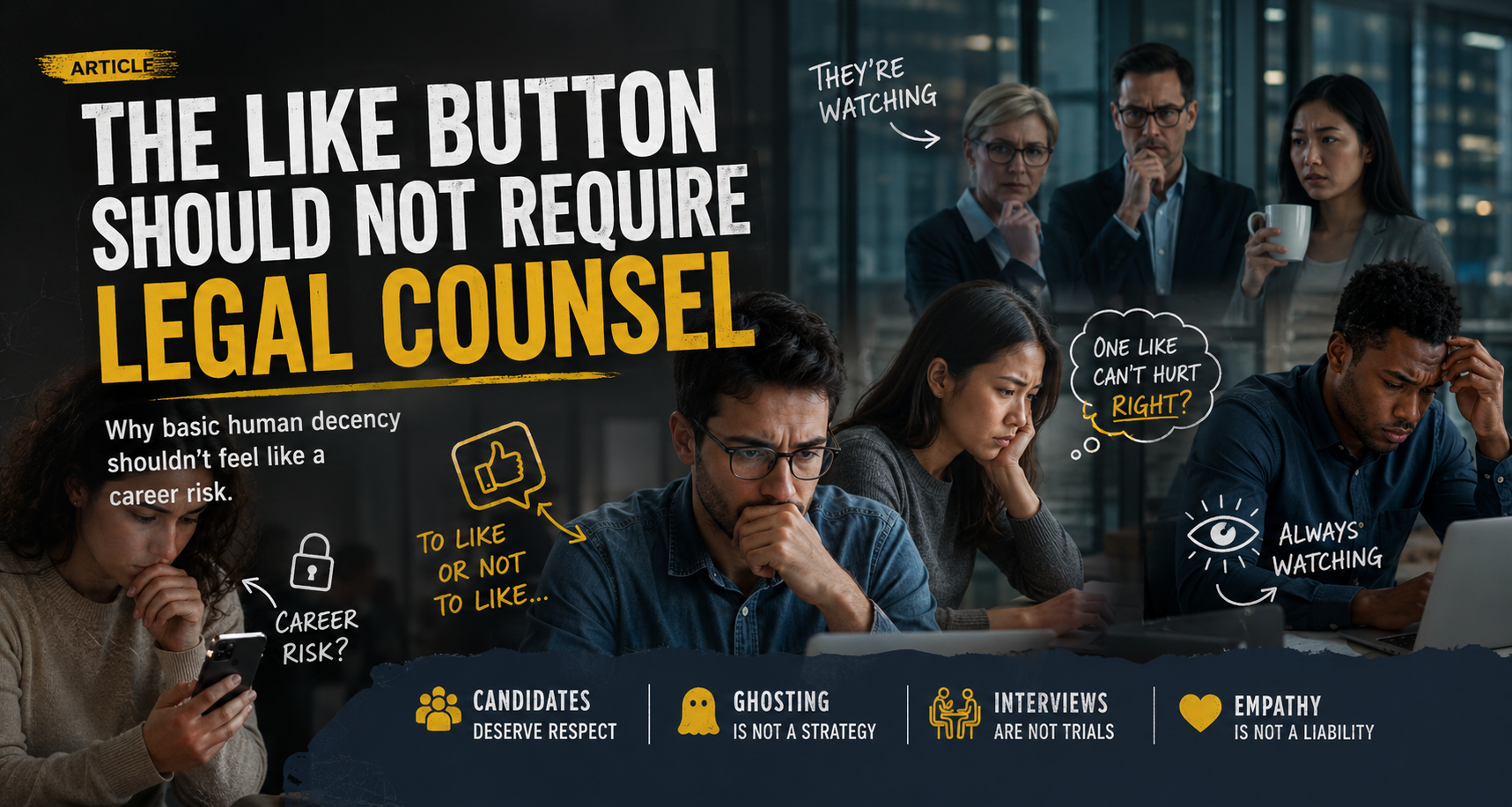
It is the moment when a normal adult human being sees a post that says something wildly controversial like, “Candidates should not be ghosted after six interviews,” or “People who get laid off deserve compassion,” or “Maybe job seekers should not have to complete a personality assessment, a typing test, a one way video audition, and a short pilgrimage through Workday just to be rejected by an automated email at 2:14 in the morning.”
And instead of simply clicking like, they freeze.
Their finger hovers.
Their breathing changes.
Somewhere in the distance, a printer jams.
They glance around their living room like the VP of Talent Acquisition is crouched behind the houseplant with binoculars and a copy of the employee handbook. They consider the consequences. They think about their current boss. Their former boss. Their recruiter connection from 2018. The HR business partner who once commented, “Great insight!” under a post about leadership but has not publicly experienced a human emotion since onboarding.
Then they make the bravest decision possible in modern corporate society.
They do nothing.
They read the post, emotionally agree with every sentence, whisper “absolutely” to themselves, maybe even send it privately to a friend with thirteen fire emojis, and then publicly disappear like a witness entering federal protection.
And honestly, I understand.
Because the weirdest part of this job market is not only the applications. It is not only the ghosting. It is not only the interviews where six people join a call, three are late, one has no camera, one asks a question already answered in round two, and one appears to be attending from inside a witness protection program sponsored by Microsoft Teams.
The weirdest part is the silence.
Not the quiet kind of silence where people are simply busy living their lives. I mean the silence people are trained into. The silence that comes from knowing someone is always watching. The silence that makes basic public kindness feel like a professional liability. The silence that turns “I agree candidates deserve respect” into a statement that requires risk management, three references, and possibly a neutral facial expression reviewed by legal.
We have reached the point where clicking like on decency feels like leaving fingerprints at a crime scene.
And that should concern everyone.
The Like Button Has Become a Career Casino
There was a time when a like button was innocent. You clicked it because something was funny, helpful, interesting, or because your friend posted a picture of soup and you wanted to support their emotional relationship with broth.
Now the like button has become a tiny corporate slot machine.
You pull it, and maybe nothing happens.
Or maybe someone from your company sees it and quietly adds your name to an invisible spreadsheet titled “People With Opinions.” Nobody tells you the spreadsheet exists, of course, because that would be too honest and honesty is apparently a premium subscription in the modern workplace.
So people hesitate.
They do not hesitate because they lack courage. They hesitate because they have bills. They have rent. They have kids. They have car payments. They have parents who need help, medical expenses, aging refrigerators, and managers who say “let’s connect offline” with the same emotional tone villains use before revealing the trapdoor.
People know how this works.
One innocent comment can become a screenshot. One screenshot can become a forwarded email. One forwarded email can become a meeting invite. One meeting invite can become a “quick sync.” And a quick sync, as we all know, is never quick and rarely a sync. It is usually a professionally lit ambush where someone named Brent from leadership says, “We just wanted to understand your perspective,” while HR sits there silently like a decorative witness.
This is why people watch quietly.
They hover over posts about layoffs, burnout, ghosting, ageism, bad leadership, toxic managers, broken hiring systems, and basic human dignity. They want to comment. They want to say, “This happened to me.” They want to say, “Thank you for saying this.” They want to say, “My company does this too, except worse and with more inspirational posters.”
But instead, they do the digital equivalent of looking both ways before crossing the street.
They check who already liked it.
They check if anyone from their company is connected to the author.
They check if the author has been legally threatened by a Fortune 500 company recently, because apparently that is now a meaningful part of content strategy.
Then they close the app and go back to being professionally silent.
And the sad part is that the post was probably not even radical. It was probably something like, “Please tell candidates when they are no longer being considered.”
That is not rebellion.
That is basic manners.
That is not storming the castle.
That is asking the castle to send a rejection email before lowering the drawbridge on someone’s self-esteem.
Corporate Fear Does Not Need to Shout
The most effective fear in corporate America does not arrive wearing a cape. It does not kick open the door and announce itself with dramatic music. It shows up politely. It says, “Just be mindful.” It says, “Remember your personal brand.” It says, “Everything you post reflects on you.” It says, “We encourage authenticity,” but only the kind that has been approved by communications, scrubbed by legal, and flattened into a beige pancake of leadership approved vulnerability.
Corporate fear is not always loud.
Sometimes it is a pause before commenting.
Sometimes it is deleting a post after writing it.
Sometimes it is changing “this is wrong” to “interesting perspective.”
Sometimes it is watching someone get mistreated and choosing silence because you have seen what happens to people who become inconveniently honest.
That is how the system works best.
It trains adults to police themselves. Nobody has to send the threatening email if everyone already imagines it. Nobody has to say, “Do not like that post about layoffs,” because people have already learned the rules without being handed the rulebook.
This is what fear does. It makes empathy feel dangerous.
It takes a normal human response like, “Wow, that person was treated badly,” and turns it into a strategic communication decision. Suddenly compassion needs a risk assessment. Suddenly decency needs plausible deniability. Suddenly liking a post becomes something you do at 11:47 p.m. and then unlike at 11:49 p.m. because your nervous system remembered that your director is also on LinkedIn and once reacted to a company anniversary post with “proud of our culture.”
That phrase alone should be studied.
“Proud of our culture.”
Which culture?
The one where everyone smiles on camera while updating their resume in another browser tab?
The one where people are told to bring their whole selves to work, then punished when their whole self has a question?
The one where leadership talks about transparency while employees learn major company changes from a calendar invite titled “Organizational Update”?
The one where managers say, “My door is always open,” but somehow every honest conversation becomes a performance review subplot?
People are not imagining this fear.
They are responding to patterns.
They have watched coworkers get labeled “negative” for asking reasonable questions. They have seen people treated differently after speaking up. They have seen companies celebrate courage in theory and punish it in practice. They have seen “we value feedback” turn into “why did you say that publicly?”
So yes, people are careful.
They use private messages instead of comments.
They say, “I wish I could say this.”
They say, “Thank you for speaking for so many of us.”
They say, “Please keep going.”
And underneath all of that is the same quiet truth.
A lot of people are not silent because they do not care.
They are silent because honesty has been made expensive.
The Background Audience Is Larger Than You Think
One of the strangest things about posting honestly is realizing how many people are reading from the shadows.
They may never like anything. They may never comment. They may never publicly agree. But they are there.
They are the quiet audience.
The people between jobs who are terrified of looking too frustrated. The employed people who are terrified of looking too sympathetic. The managers who know the system is broken but are trapped inside it wearing a branded polo and a smile that says, “Please do not ask me about headcount.” The recruiters who privately agree that the process is insane but publicly have to post things like, “Hiring is a two way street,” while standing in the middle of a twelve lane corporate traffic jam.
They are watching.
They are reading every word.
They are laughing at the raccoon jokes because sometimes humor is the only way to discuss professional absurdity without screaming into a decorative office plant.
They are nodding at posts about ghosting because they have been ghosted.
They are nodding at posts about layoffs because they have seen the badge posts, the grateful farewell posts, the “after careful consideration” emails, the sudden access removals, the awkward farewell comments from executives who somehow always find the comment section after the severance package has already found the printer.
They are nodding at posts about interviews because they have sat through panels where nobody knew who was supposed to ask the next question. They have been asked where they see themselves in five years by a company that cannot tell them where the role will be in five months. They have uploaded a resume, retyped the resume, summarized the resume, explained the resume, defended the resume, and then received a rejection addressed to “Dear Candidate” like they were a lost invoice.
But still, they stay quiet.
And that quiet should not be mistaken for agreement with the system.
Sometimes silence is survival.
Sometimes silence is strategy.
Sometimes silence is what people do when the rent is due and the job market has turned into a haunted carnival operated by applicant tracking systems and optimism consultants.
That is why I do not judge the quiet readers.
I see them.
I understand them.
Not everyone can be loud. Not everyone can afford to be visible. Not everyone can become a professional raccoon in a blazer, standing in the comments with a tiny briefcase full of receipts and emotional damage caused by corporate jargon.
Some people have to protect themselves.
But here is what should bother us.
People should not need protection from supporting decency.
Nobody should feel brave for liking a post that says, “Treat candidates with respect.”
Nobody should have to send support privately because public kindness might be misinterpreted by someone whose entire leadership philosophy was apparently downloaded from a compliance slideshow.
Nobody should feel like compassion is a suspicious activity.
And yet here we are, living in a world where people can post endless leadership quotes about courage, vulnerability, empathy, belonging, psychological safety, and bringing your whole self to work, but the second someone publicly agrees with a post about bad hiring practices, the air changes.
Suddenly everyone becomes a brand manager.
Suddenly everyone becomes careful.
Suddenly everyone remembers that professionalism often means pretending not to notice the obvious.
Final Thoughts: If Dignity Feels Threatening, That Is the Review
The problem is not that people are afraid to like posts.
The problem is that they have reasons to be afraid.
That is the part companies should sit with, preferably in a conference room without pastries and without turning it into a “learning opportunity” led by someone who uses the phrase “thought partnership” unironically.
Because when employees, candidates, and former employees are scared to publicly support basic dignity, that says more about the professional world than it says about them.
It says people have been trained to believe visibility is dangerous.
It says companies have confused loyalty with silence.
It says too many workplaces want engagement, but only the kind that claps politely, shares the quarterly update, and never asks why the person who did three jobs is suddenly posting a badge photo with the caption “after seven amazing years.”
It says the system is not just broken at the application stage.
It is broken at the human stage.
And maybe that is why so many people connect with honest posts about work, layoffs, ghosting, burnout, interviews, and fear. Not because everyone wants to be negative. Not because everyone wants to complain. Not because everyone woke up hoping to challenge corporate America before lunch.
But because people are exhausted from pretending the obvious is controversial.
They are tired of being told to network harder when hiring processes are broken.
They are tired of being told to stay positive when rejection emails arrive faster than human replies.
They are tired of being told to be authentic in a system that treats authenticity like an open container violation.
They are tired of watching companies post about values while candidates beg for closure, employees brace for layoffs, and everyone else wonders whether clicking like is going to summon a meeting invite called “Touch Base.”
So to the quiet readers, the private supporters, the people who almost comment and then decide not today, I get it.
Your silence does not mean you are weak.
Your caution does not mean you do not care.
Your fear does not mean you lack courage.
It means you are living in a professional world where honesty has been overpriced, decency has been overanalyzed, and the like button has somehow become a tiny unpaid internship in risk management.
And to the companies watching employee activity like someone liking a post about respect is a threat to national infrastructure, maybe ask a better question.
Why does dignity make you nervous?
Why does empathy feel disruptive?
Why does someone agreeing with “treat people better” register as a concern?
Because if a post about basic human respect feels dangerous to your culture, the problem is not the post.
The problem is the culture.
And honestly, that may be the real performance review.