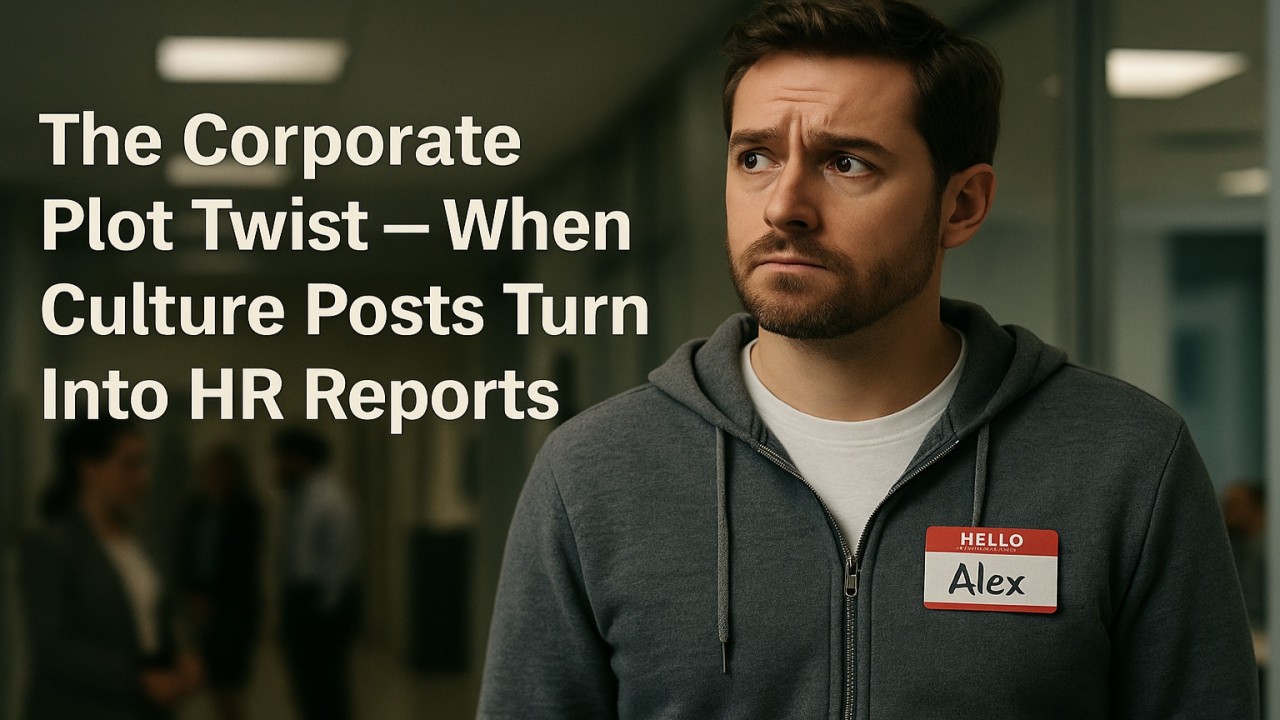
When I first stepped into corporate America, I didn’t walk in — I assimilated. Someone handed me a company badge, a free hoodie, and a motivational slogan disguised as onboarding. “Welcome to the team!” they said, and I believed it. Because back then, I thought culture meant cappuccino machines, company hashtags, and quarterly raffles for AirPods.
They told me, “You need to get on LinkedIn. Post about the company. Show people how great it is to work here.” So I did. Like a good employee, I took pictures at volunteer events, wrote emotional captions about “giving back,” and used every approved corporate buzzword like it was a loyalty test. I tagged the CEO. I thanked leadership. I crafted sentences that sounded authentic enough to pass the LinkedIn sincerity filter, but polished enough to survive internal PR.
And it worked. The executives noticed. HR commented. Someone from corporate marketing even reposted one of my “culture” pieces with the caption, “Love this energy!” I became that employee, the culture ambassador, the cheerleader, the one who was always smiling in every group photo, no matter how many layoffs happened the week before.
A few months later, I got a promotion. Not because I closed some major deal or improved processes, but because I understood the real modern skillset: knowing how to sound inspired while avoiding the truth. My performance review literally said, “A great representative of our company values.” I framed it. Then, six months later, I almost threw it out.
Because I started to notice something no one talks about in those glossy “best places to work” write-ups: culture isn’t what’s written in the handbook. It’s what happens between the meetings. It’s what’s whispered when the camera’s off. It’s the emotional tax people pay to survive the smile first, feedback later world of professional “positivity.”
So, one day, I decided to post something real. Not “branded real” but real real. And that’s when everything changed. The likes disappeared, HR appeared, and the plot as they say, twisted.
The Great Cultural Illusion
Corporate culture, I discovered, is a lot like Disneyland: magical from a distance, exhausting once you see the people behind the costumes. The free snacks, casual Fridays, “bring your whole self to work” emails, it all felt like a production. A well lit, carefully curated illusion designed to convince us we were part of something bigger, even when the only thing growing was the company’s LinkedIn following.
Behind the motivational posters and “culture first” town halls, people were quietly unraveling under deadlines, restructures, and “development conversations” that were really exit rehearsals in disguise. The smiling group photos on the intranet told one story, the Slack DMs at midnight told another.
The company prided itself on transparency, but only about things that didn’t matter. We got updates about new office plants, diversity committees, and record breaking sales quarters, but silence when someone vanished overnight. We knew the numbers, the slogans, the mission statements. What we didn’t know was why good people kept disappearing without notice, replaced by new faces with new badges and the same recycled optimism.
There was one Friday I’ll never forget. It was the grand finale of “Culture Week,” a five day celebration of “who we are.” There were cupcakes, company trivia, and a photo booth with branded props, tiny cardboard signs that said things like #WeBelongHere and #OneTeamOneDream. Everyone posted their pictures with polished captions about teamwork and gratitude.
That same afternoon, two people from my department were quietly called into “Check-In” meetings. No one saw them again. By Monday, their names were gone from the directory, their email auto-replies polite but final. The photo booth props were still sitting in the breakroom, sticky with frosting fingerprints, waiting for the next culture event to reuse them.
The following morning, leadership posted on LinkedIn: “Grateful for an amazing team that continues to inspire every day!” I stared at that post for a long time. The same hands that wrote it had signed the termination papers. That’s when it hit me, culture wasn’t a shared experience. It was a marketing strategy.
And once you see the illusion, you can’t unsee it. You start noticing the script, how people respond to questions with buzzwords instead of answers, how meetings about “innovation” are really about control, how “values” are repeated so often they start to lose all meaning. “Transparency” means filtered updates. “Accountability” means blame in a polo shirt. “Growth mindset” means working longer hours without asking why.
Still, I played along. We all did. Because pretending was part of survival. I smiled in team photos, said “great question!” in meetings, and used words like “alignment” and “impact” while secretly counting down the minutes until 5 p.m. I clapped for promotions I didn’t understand, congratulated leaders who hadn’t earned them, and laughed at jokes that didn’t land.
Every so often, I’d hear someone whisper in the hallway, “It’s just business,” as if that made it better. As if “business” was a shield that excused anything from favoritism to emotional exhaustion. But the truth was simpler and far sadder: the culture we praised wasn’t built on values, it was built on fear.
Fear of being labeled “negative.” Fear of speaking up and being “coached” for tone. Fear of becoming the next name erased from the directory.
And yet, somehow, we still called it “family.”
It took me years to understand that what most companies call culture isn’t a living thing. It’s a performance, a rehearsed script with interchangeable actors and endless costume changes. The hoodies, the slogans, the “we care” emails, they’re props. The real culture lives in the silences, the eye contact in hallways, the collective exhaustion that never makes it into the quarterly recap.
Because behind every “amazing team” post is a story that never got permission to be told.
The Plot Twist They Didn’t See Coming
It happened one random Tuesday, the kind of Tuesday that feels like a Monday in disguise. The coffee machine was broken again, the office air was a mix of recycled ambition and quiet despair, and the company Slack was buzzing with “Happy Tuesday, team!” messages no one meant. Somewhere between my third meeting and fifth “circle back,” I snapped.
Not in a dramatic way. Not with fireworks or rebellion. Just… with honesty.
I opened LinkedIn, that digital cathedral of corporate self promotion, and wrote a post, not about our mission, not about “how we’re all a family,” not about our “core values” laminated on every wall. I wrote about silence. The kind that fills meeting rooms after someone asks a real question. The kind that hums between teams when leadership says, “We’re being transparent,” but no one believes it.
I wrote about burnout, not the kind companies send mindfulness emails about, but the kind that slowly erodes your sense of self. The kind where you wake up exhausted, scroll through Slack, and realize you’ve become fluent in pretending.
I wrote about how pretending to love every initiative had become a survival skill. How “positive energy” had become code for “don’t question anything.” How the people who asked for clarity or accountability were quietly labeled as “difficult” or “not a team player.”
I didn’t name names. I didn’t break any confidentiality agreements. But I broke something much bigger: the illusion.
The illusion that “culture” and “honesty” could coexist without friction. The illusion that feedback was welcomed, when in reality, it was feared. The illusion that being real was rewarded, when in truth, it was seen as rebellion.
That post went viral, but not the way you hope when you hit “post.” It wasn’t executives applauding or recruiters sending connection requests. It was whispers. My coworkers sent private messages saying, “Thank you for saying this.” Managers liked it quietly, then unliked it two hours later. And leadership? Oh, they loved it — publicly. “This is such an important reminder about empathy and mental health!” they commented, trying to claim the narrative like a PR fire drill.
But HR… HR saw it differently. Within 24 hours, I got a calendar invite for a “quick sync.” That phrase “quick sync” should’ve been my warning. It’s never quick, and it’s never a sync.
The meeting started with smiles. Always smiles. “We really appreciate your passion,” one of them said, which is corporate for we’ve discussed this with Legal. Then came the follow-up: “We just wanted to better understand the intent behind your post.”
That’s the moment I realized authenticity is not a company value, it’s a liability.
Being honest in corporate America is like pulling a fire alarm: people don’t panic because something’s wrong. They panic because you noticed.
A week later, during my one on one, my manager brought it up again, casually, like we were discussing weekend plans. “So, I just want to make sure your personal brand aligns with our company values.”
Translation: You’re making us look bad for pretending everything’s good.
I remember sitting there, nodding like a well trained professional, but inside, something shifted. Because once you start telling the truth, pretending feels like suffocating in your own smile.
And that’s when the funniest thing happened, the same executives who had scrolled past every “culture” post I ever wrote suddenly knew my name. Suddenly, I was invited to “small group feedback sessions.” Suddenly, people who hadn’t acknowledged me in elevators were asking for “a few minutes to chat about my perspective.”
Apparently, honesty gets more attention than hashtags.
It was surreal, watching people simultaneously applaud my courage while building a strategy to contain it. One director even said, “We love your voice. Maybe next time, you could channel that energy into an internal blog instead.” Ah yes, the corporate translation of please keep the truth indoors where no one can see it.
That’s when I understood the real hierarchy of values: Innovation? Optional. Integrity? Negotiable. Image? Non-negotiable.
They didn’t care that I told the truth. They cared that I told it publicly.
Still, I couldn’t go back. Because once you’ve tasted honesty, the flavor of fake enthusiasm makes you sick. Once you’ve said something real and watched people wake up, you can’t unsee how deep the performance runs.
What started as a single Tuesday post became a quiet revolution, not a loud rebellion, but the kind that happens in DMs, lunch breaks, and knowing glances across cubicles. The kind where people start to realize that maybe the culture they were told to protect wasn’t culture at all.
It was choreography.
And I had just stopped dancing.
The Culture That Survived the Memo
Eventually, it all came to a head. Another “performance conversation.” Another room with two HR reps and a manager pretending to be calm, holding a printout of my post like it was classified material. They didn’t yell. They didn’t threaten. They didn’t even frown. They just smiled tightly and spoke in careful, measured tones — the corporate language of damage control.
They used words like alignment, optics, and tone. But what they were really saying was, “You broke the script.”
And that script had rules. Unwritten ones, but powerful nonetheless. Rule #1: Always smile when you talk about “change.” Rule #2: Never post anything that requires an uncomfortable follow-up meeting. Rule #3: If you must tell the truth, make sure it rhymes with the company slogan.
They wanted me to keep posting, just not that kind of post. They wanted the kind of authenticity that could fit into a PowerPoint slide. They wanted inspiration without introspection, positivity without accountability, applause without disruption.
One of the HR reps said, “We love your engagement online, it really shows leadership potential. But we just want to ensure your messaging aligns with the company narrative.” Ah yes. The narrative. The sacred corporate bedtime story told in every quarterly town hall, where everyone is thriving, all voices are heard, and “our people are our greatest asset” still means something.
But I’d stopped believing in bedtime stories.
That was the day I made peace with something important, maybe the most important realization of my entire career: company culture doesn’t belong to the company. It belongs to the people who live it, breathe it, and sometimes break under it.
Culture isn’t in the posters or the mission statements. It’s not in the coffee mugs with company values printed on them or the “Culture Committee” PowerPoint slides filled with stock photos of diverse strangers smiling at a laptop. It’s in the real moments that don’t make it to the annual report, the after hours Slack messages that start with “You okay?” and end with “Same here.” It’s in the quiet solidarity of coworkers who don’t have power, but who have each other. It’s in the shared glance across a conference room when someone says “restructure,” and everyone holds their breath.
That’s the real culture, the one that survives after the posters come down, after the executives move on, after the slogans fade. It’s the culture of human beings who keep showing up despite everything. The ones who carry the weight of what the company claims to be and what it really is.
And here’s the truth they’ll never print on the company banner: sometimes the healthiest thing you can do for a culture is stop protecting it. Because when you stop pretending, you make room for honesty and that’s where actual growth begins.
So yes, I lost some approval points along the way. I got “flagged for tone.” I was told to “consider how things might be perceived.” I was quietly removed from a few optional committees that suddenly weren’t so optional.
But for the first time, I didn’t care. Because I realized something that can’t be measured on a KPI dashboard or wrapped in a LinkedIn post: credibility.
Credibility isn’t built through praise. It’s built through consistency, through being the same person in meetings, in DMs, and on your worst day. And the more I told the truth, the lighter I felt. I stopped trying to be the company’s brand ambassador and became something better, a mirror.
Because mirrors don’t flatter. They reflect.
And that’s what real culture needs, not another campaign, but a reflection. The kind that forces everyone to ask, “Is this who we really are?”
Some people didn’t like it. Some distanced themselves. A few even warned me that “you’re getting a reputation.” But others, the quiet ones, the observers, the ones who’d been surviving in silence, started speaking up too.
It started with side conversations. Then with messages like, “I thought I was the only one.” And just like that, the illusion cracked a little more.
That’s how it spreads, not rebellion, but relief. The relief of realizing you’re not crazy, and you’re not alone. The relief of realizing that the culture you believed in doesn’t need permission to exist, it just needs people willing to keep it alive, one honest conversation at a time.
So yes, maybe I lost the favor of a few executives. Maybe my name got quietly added to some “monitor this person’s activity” list in HR. But I gained something far more valuable — peace. The kind that comes from knowing you no longer need to pretend to belong somewhere that requires pretending.
And maybe that’s the ultimate corporate plot twist, realizing that the most authentic culture you’ll ever find might not come from your company at all. It might come from the people brave enough to question it, to challenge it, and to build something better in the ruins of the slogans.
Because sometimes, the real culture isn’t written in the employee handbook. It’s whispered between survivors.






I don’t think the title of your article matches the content lol. Just kidding, mainly because I had some doubts after reading the article. https://accounts.binance.com/register-person?ref=IHJUI7TF
Thank you for your sharing. I am worried that I lack creative ideas. It is your article that makes me full of hope. Thank you. But, I have a question, can you help me?