
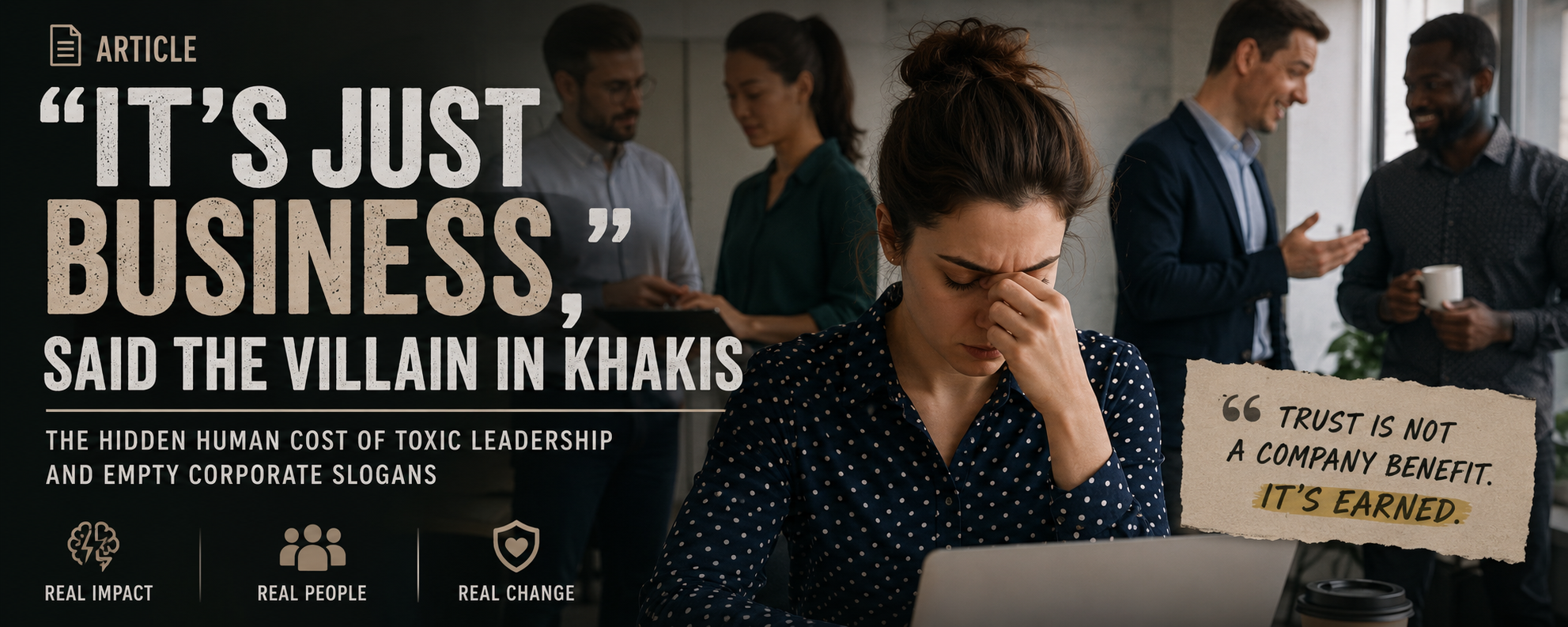
Some people say, “It’s just business,” with the calm confidence of someone who has never once considered that the phrase sounds less like strategy and more like something whispered by a haunted LinkedIn profile right before payroll deletes your badge access.
“It’s just business” is one of those corporate phrases that shows up dressed like professionalism but smells suspiciously like emotional damage with a quarterly forecast. It usually arrives after someone has done something deeply humanly questionable, like laying off a team over a video call, blaming burnout on “mindset,” turning feedback into a trap, or treating another person’s confidence like it was an optional line item on a budget spreadsheet.
And somehow, the phrase is supposed to end the conversation.
“It’s just business.”
Wonderful. Thank you, Brad. That clears everything up. I was starting to think this was a workplace filled with actual human beings, but thank you for reminding us that we are apparently all attachments in a budget email, floating through the inbox of capitalism until someone from finance decides our hopes and dental insurance are no longer aligned with shareholder expectations.
What fascinates me most is how often “it’s just business” is used immediately after someone has made a very personal mess. Because bad leadership is personal. Being ignored is personal. Being manipulated is personal. Being gaslit in meetings, punished for honesty, and slowly trained to distrust your own instincts is personal. The fact that it happened under fluorescent lighting near a coffee machine does not magically make it neutral.
A toxic leader does not just ruin your Wednesday. They can rewire how you walk into every room after that. They can make you read every email like evidence. They can make a simple “Can we talk?” message feel like your nervous system just received a calendar invite from Satan. They can make feedback feel less like coaching and more like someone quietly measuring the distance between you and unemployment.
Then, after months or years of doing that kind of damage, the company posts something online about psychological safety.
There is usually a stock photo involved. A diverse group of professionals laughing around a laptop, clearly looking at nothing, because no actual workplace laptop has ever inspired that level of joy unless someone just found out the CEO resigned.
The caption says, “We care about our people.”
Do you?
Because caring is not a Canva template. Caring is not a values poster above the microwave. Caring is not saying, “My door is always open,” when everyone knows that door leads directly to retaliation, character assassination, and a performance improvement plan written like a hostage note.
Caring means you do not collect people’s honesty and then use it later like you are building a legal scrapbook.
Caring means leadership does not get to borrow trust, spend it recklessly, overdraft the emotional account, and then act offended when employees stop making deposits.
And that is the part nobody wants to say out loud in the quarterly town hall while the executive team nods solemnly beside a slide titled “People First.”
Some leaders are not leaders.
They are emotional vandals with Outlook calendars.
The Quarter-Zip Philosophy of Emotional Damage
There is a very specific type of leader who says, “It’s just business,” and somehow believes that phrase gives them diplomatic immunity from being a menace in Dockers.
They usually have a voice that sounds calm in the way a locked door sounds calm. They have mastered the art of saying terrible things with the softness of a guided meditation. They can tell you your role has been eliminated with the same tone someone uses to describe oat milk options. They can destroy morale in a meeting and then end with, “Any questions?” like they did not just punt the entire team’s trust into traffic.
These people love phrases.
“Let’s circle back.”
“We’re creating alignment.”
“We need to be agile.”
“This is a business decision.”
That last one is especially dangerous because it usually means a room full of people made a decision that affects your rent, your health insurance, your confidence, your family, and your sense of stability, then placed it inside a phrase so sterile it could be used to disinfect a conference table.
A business decision.
That sounds so clean.
But people do not experience it cleanly. They experience it at kitchen tables, in cars, in bathrooms, in stunned silence after the call ends. They experience it while updating resumes, checking savings accounts, wondering how to explain it to their kids, and trying not to spiral while some executive posts about “navigating change with empathy.”
And when people get hurt by these decisions, they are told not to take it personally.
That is one of corporate America’s most impressive magic tricks: doing personal damage and then demanding impersonal reactions.
Do not be emotional.
Do not be bitter.
Do not burn bridges.
Do not speak negatively.
Do not tell the truth in a tone that makes leadership uncomfortable.
Meanwhile, the leader who created the mess is somewhere updating their LinkedIn headline to include “culture builder,” which is amazing because the only culture they built was fear with snacks.
Bad leaders love the aesthetics of leadership. They love the language. They love the title. They love the office. They love the authority. They love standing in front of people and saying things like, “I want everyone to feel empowered,” while quietly making sure nobody feels safe enough to actually be empowered.
They want open communication until communication opens.
They want feedback until feedback has names, dates, examples, and screenshots.
They want transparency until transparency starts looking back at them.
Then suddenly the employee is “not a team player.”
Suddenly they are “negative.”
Suddenly they are “struggling with change.”
No, Brad. They are struggling with you.
There is a difference.
Trust Is Not a Company Benefit
Companies talk about trust like it is something they can issue during onboarding, right after the laptop, badge, and water bottle nobody asked for.
“Welcome to the team. Here is your email login, your benefits packet, your branded hoodie, and three units of trust. Please use responsibly.”
But trust does not work like that.
Trust is not assigned by HR. Trust is not created because a leader said, “We are a family,” during a meeting where nobody’s camera was on because everyone knew it was a trap. Trust is not manufactured by forcing employees into a team-building exercise where adults are asked to share “one fun fact” while silently wondering if their department will survive the quarter.
Trust is built when people tell the truth and do not get punished for it.
Trust is built when leaders say what they mean instead of wrapping every sentence in bubble wrap and corporate fog.
Trust is built when someone raises a concern and leadership does not immediately treat them like they brought a raccoon into the boardroom.
Trust is built when feedback is not used as evidence, vulnerability is not turned into ammunition, and employees are not expected to smile while being slowly professionally dismantled.
Because once people learn that honesty is dangerous, they adjust.
They stop speaking freely.
They stop volunteering ideas.
They stop asking hard questions.
They stop telling you what is really happening.
They become polite, quiet, cautious, and extremely good at saying, “Sounds good,” while emotionally packing a go-bag.
Then leadership gets confused.
“Why is morale low?”
“Why is engagement down?”
“Why is everyone quiet in meetings?”
I do not know, Susan. Maybe because the last person who spoke honestly was treated like a security threat with a 401(k).
Maybe because employees watched someone raise a legitimate concern and then mysteriously get “restructured” into the parking lot.
Maybe because your open-door policy has the energy of a bear trap with a welcome mat.
This is where bad leaders reveal themselves. They think silence means agreement. It does not. Sometimes silence means people have learned the cost of honesty and decided the invoice is too high.
A quiet team is not always a loyal team.
Sometimes it is a team that has gone into emotional witness protection.
The Professional Aftermath Nobody Puts in the Handbook
Nobody talks enough about what happens after a toxic leader gets done with you.
You leave the job. Maybe you resign. Maybe you get pushed out. Maybe you are laid off in a meeting where someone from HR uses their soft voice like a pillow over the truth. Eventually, you move on physically.
But emotionally?
That is a whole different spreadsheet.
You start a new job, and everyone seems normal, but your nervous system does not trust normal yet. A manager says, “Let’s connect later,” and your brain immediately opens a courtroom. You reread Slack messages like they are ancient scrolls. You hear the phrase “quick chat” and suddenly your soul is putting on a helmet.
Someone gives you feedback, and even if it is kind, you brace for impact.
Someone says, “I appreciate your honesty,” and you wonder whether that appreciation has a shelf life.
Someone says, “We value transparency,” and you think, “Wonderful. I have seen this movie before, and in the third act someone from HR appears holding a folder.”
That is what toxic leadership does. It does not just create a bad work environment. It teaches people to expect danger in places that should be safe. It makes employees carry old rooms into new buildings. It makes people second-guess instincts that used to be sharp. It turns confidence into something they have to rebuild one careful interaction at a time.
And then, because the universe has jokes, those same people are often told they need to “show up with confidence” in interviews.
Fantastic.
So now the person who survived professional emotional vandalism has to sit across from a hiring manager and explain why they are excited about a new opportunity without accidentally sounding like someone who has seen behind the curtain and knows the wizard has an HR folder.
They have to be open, but not too open.
Honest, but not alarming.
Confident, but not intense.
Self-aware, but not visibly traumatized by the last leader who used “accountability” as a blunt object.
And the toxic leader?
They are fine.
They are posting about mentorship.
They are attending leadership conferences.
They are sharing articles about empathy.
They are commenting “So important” under posts about psychological safety with the confidence of a raccoon wearing a judge’s robe.
That is the part that makes people want to scream into a decorative office plant.
The person who caused the damage gets to rebrand.
The person who survived it has to recover.
Final Thoughts
So when someone says, “It’s just business,” listen carefully.
Because sometimes it is not an explanation.
Sometimes it is a confession wearing khakis.
It is the phrase people use when they want the benefit of power without the responsibility of impact. It is what they say when they want to make human decisions while pretending humans are not involved. It is how they ask you to accept damage quietly so they do not have to feel the weight of what they did.
But work is human because people are human.
Paychecks are human.
Confidence is human.
Trust is human.
Being treated with dignity is human.
And if your leadership style requires people to become smaller, quieter, more anxious, less trusting, and more afraid in order for you to feel in control, then you are not leading.
You are managing a crime scene with calendar invites.
The truth is, some people are not guarded because they are negative. They are guarded because they have been professionally taught that safety can be performative, kindness can be conditional, and “open communication” can become Exhibit A in a meeting they were not invited to.
So to anyone trying to trust again after a bad leader made work feel unsafe, you are not broken.
You are not difficult.
You are not bitter because you remember what happened.
You are recovering.
And recovery takes time, especially when the injury came from a place that kept calling itself a culture.
Let people earn access to your trust. Let consistency matter. Let actions speak louder than polished leadership vocabulary. Watch how people respond when you say no. Watch how they handle truth. Watch how they treat someone with less power when nobody important is watching.
Because leadership is not proven by how someone sounds on a stage.
It is proven by what people feel after leaving the room.
And if someone keeps saying, “It’s just business,” right after harming people, maybe the problem is not that employees are too emotional.
Maybe the problem is that too many leaders have mistaken emotional distance for professionalism, cruelty for decisiveness, silence for respect, and fear for culture.
That is not business.
That is damage with a badge.
And eventually, people stop clapping for it.