
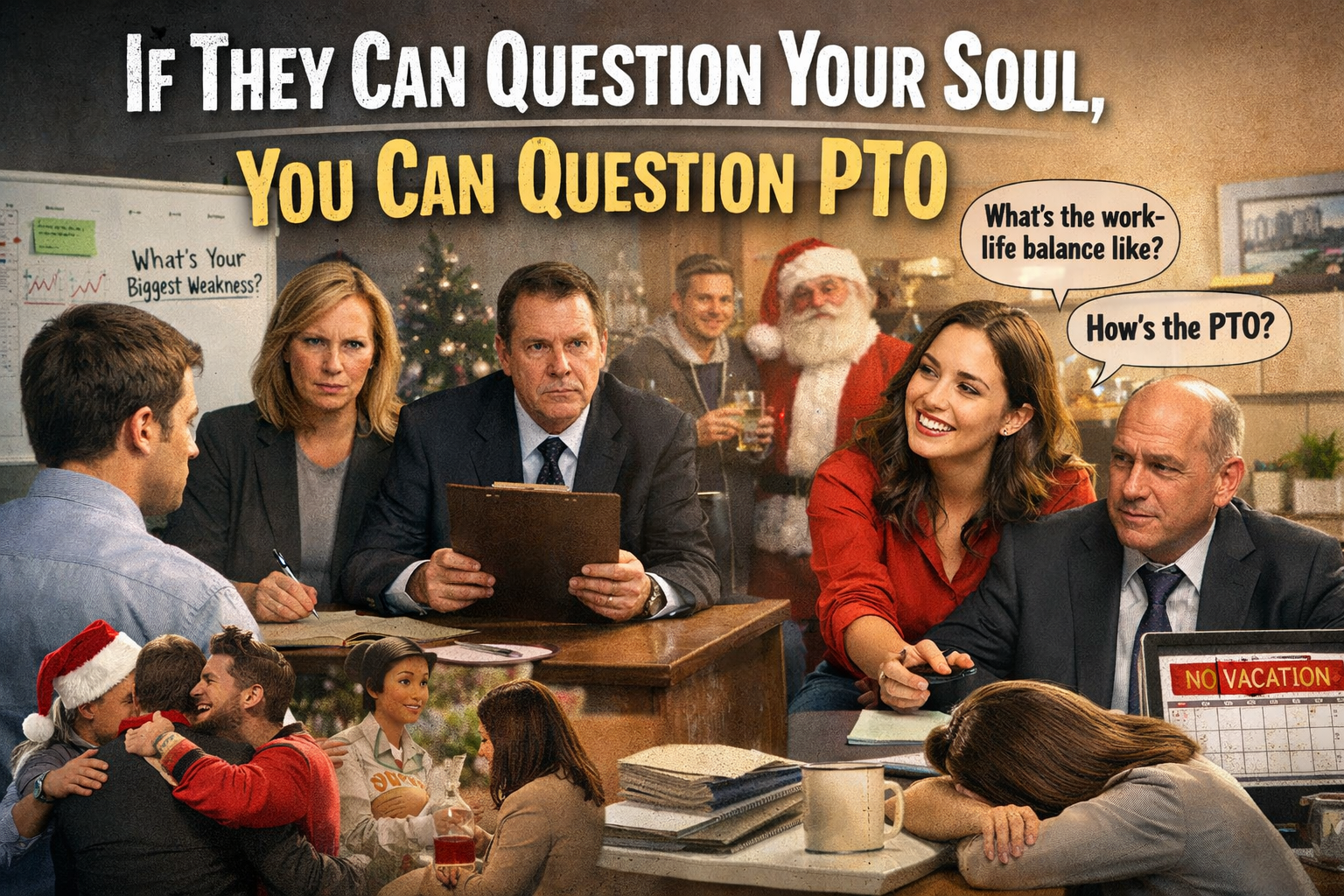
There is something almost majestic about the modern interview, and I mean majestic in the same way a falcon is majestic right before it steals a smaller animal off the ground. It is presented to us as a professional conversation between adults, a thoughtful exchange of information, a mutual exploration of fit, values, goals, and future collaboration, but the lived experience often feels less like a conversation and more like being called before a council of emotionally unavailable strangers who would like to know why you left your last job, what motivates you, how you handle conflict, whether you are resilient, whether you are strategic, whether you are passionate, whether you can perform under pressure, whether you can lead without authority, whether you can influence stakeholders, and whether your childhood trauma has made you a team player.
They say interviews are two-way streets, which is beautiful branding, because many of them are in fact one-way toll roads run by people in quarter-zips. For forty-five minutes, sometimes an hour, sometimes an amount of time that makes you feel like you should be allowed to claim witness protection afterward, you sit there under fluorescent lighting or in a Zoom rectangle trying to answer questions with the perfect blend of confidence, humility, ambition, warmth, competence, self-awareness, and carefully portioned humanity. You must appear driven, but not aggressive. Collaborative, but not weak. Accomplished, but not threatening. Honest, but not so honest that they accidentally learn something real about working there.
And the questions come with the intensity of a federal inquiry. What is your biggest weakness. Tell us about a conflict. Why did you leave your last role. How do you handle ambiguity. Describe a time you failed. Describe a time you succeeded. Describe a time you had to influence someone without authority, which always sounds less like business and more like a medieval political marriage. They ask about your five-year plan as if any adult with access to the internet and grocery prices still believes in five-year plans. They ask whether you thrive in fast-paced environments, which is corporate shorthand for, We have normalized chaos and would like to know whether you can smile while being hit with it.
And yet, the moment the candidate clears their throat and says something wildly inflammatory like, “How is success measured in this role?” the air shifts. Faces tighten. Eyes narrow. Someone takes a sip of water like they need time to recover from the audacity. The emotional weather changes so fast you would think you had asked for the CEO’s home address, tax returns, and a sworn statement from the last three people who quit in tears.
This is what makes interviews so fascinating. Not because they are wise or fair or particularly revealing, but because they are one of the last public rituals where grown adults are expected to perform gratitude while being lightly interrogated by people who occasionally seem offended that the furniture has become sentient. The candidate is supposed to show up prepared, polished, enthusiastic, insightful, strategic, grateful, humble, eager, and somehow curious without appearing too curious, because too much curiosity in the wrong room is treated like an attempted coup.
And to be fair, some candidate questions are so aggressively premature they deserve to be studied by behavioral scientists. There is a time and place for everything, and round one is not always the ideal setting to ask when you will be promoted, how much the raise will be next year, whether lunch can be skipped in exchange for early release, or whether your relationship structure entitles you to plus-twos at the company holiday party. Those are not questions. Those are flash grenades tossed directly into the recruiter’s frontal lobe. But the existence of terrible questions does not mean good questions are suspicious. It means adults remain unpredictable, which is one of the few stable truths left in the labor market.
The point is not that every candidate question is brilliant. The point is that the candidate should be allowed to ask them without being treated like a raccoon who found the emergency exit. Because if a company expects forty-plus hours a week of your one irreplaceable life, it is not unreasonable to inquire whether the manager is sane, whether training exists, whether success is measurable, whether support is real, and whether the culture is healthy or simply described that way in annual LinkedIn captions accompanied by black-and-white photos of people laughing at salads.
So let us talk about the interview, that sacred little theater of modern employment, where one party often arrives looking for talent and the other arrives looking for income, dignity, health insurance, and a reason not to scream in the parking lot. Let us discuss the questions, the performances, the bizarre emotional etiquette, and the deep institutional discomfort many employers feel when the candidate remembers that they are, in fact, an adult.
The Interview as a Beautifully Dressed Interrogation
An interview, in theory, is meant to determine mutual fit. That is the official language. Mutual fit. A phrase so polished it sounds like it was handcrafted by a committee that uses the word synergy with a straight face. What it often becomes, however, is a professionally decorated extraction event where the employer tries to pull as much value, personality, history, resilience, and emotional composure out of the candidate as possible while revealing almost nothing meaningful in return.
The hiring manager wants to know who you are under pressure, how you manage tension, how you react to failure, whether you can lead, whether you can follow, whether you can manage conflict, whether you can innovate, whether you can prioritize, whether you can multitask, whether you can collaborate cross-functionally, whether you are comfortable with ambiguity, and whether you remain pleasant when your laptop freezes during a meeting and someone says, “We lost your screen.”
What they rarely want, at least not with the same joy, is to answer parallel questions about themselves. They do not beam with delight when asked how turnover is trending, why the last person left, what support looks like in practice, how frequently priorities change, how performance reviews are handled, what training is actually provided, or whether the team’s current workload has pushed several employees into speaking exclusively in sighs. Somehow curiosity is considered a leadership trait when it belongs to them and an attitude problem when it belongs to you.
There is a deeply theatrical imbalance to the whole thing. They are allowed to ask about your scars, but you are supposed to phrase your questions like a Victorian child requesting soup. You cannot simply ask, “Why is this role open and should I be alarmed?” No, you must say something elegant like, “Could you share a bit about the context around this opportunity and how the team has evolved?” which is white-collar for, Tell me if I am walking into a burning house in business casual.
And then there is the strange moral performance expected of the candidate. You are supposed to radiate gratitude at all times, as if being considered for employment is a spiritual privilege bestowed by the gods of payroll. This is especially rich when the company has made you upload your resume, then retype the same information into fields that appear to have been designed by a committee hostile to joy. You have already completed six pages of application questions, agreed to a background check, taken a personality assessment that essentially asked whether you would betray your family for teamwork, and now you are in interview round two pretending it is charming that nobody can tell you the salary range without first consulting the moon.
Still, the expectation persists that you will smile softly and accept the asymmetry. You must answer everything. You must respond thoughtfully. You must remain composed even when the questions sound like they were borrowed from a hostage negotiator’s workbook. But when the tables turn even slightly, when you ask something direct and adult and sane, some interviewers behave as though you have failed the vibe check of the kingdom.
That reaction is often more revealing than anything they asked you. Because a mature employer understands that thoughtful candidates have thoughtful questions. A secure leader does not fear transparency. A healthy workplace does not panic when asked how success is measured. But an unhealthy one, a brittle one, a chaotic one held together by branding language and one emotionally exhausted operations manager, will sometimes flinch at the smallest signs that you are trying to make an informed decision.
And that is what makes the interview so unintentionally funny. It is framed as evaluation, but often it functions as confession, theater, and social experiment all at once. You arrive hoping to be assessed fairly and leave having learned that one of the most important skills in modern employment is not merely answering questions well, but noticing which people resent the fact that you have any of your own.
Questions Candidates Should Probably Keep in the Trunk Until Later
Now, in the interest of fairness, not every candidate question deserves applause. Some questions are excellent. Some are normal. Some are strategic and thoughtful and make you sound like a grounded adult with self-respect and functioning pattern recognition. And then there are the other questions, the ones that arrive too early, too loudly, or with the unmistakable energy of someone who has mistaken the first interview for a hostage negotiation where they somehow have leverage.
These are the questions that cause the recruiter to blink twice and stare into the middle distance like a veteran remembering the war. Not because the topics themselves are forbidden forever, but because timing is a real thing and there is a difference between due diligence and walking into the first round already trying to renegotiate the social contract.
Take the classic: “When will I be promoted?” A spectacular opening act. We have not verified your start date, your references, or whether you can find the office without divine intervention, but your soul is already leaning toward vice presidency. It is not that ambition is bad. Ambition is lovely. Ambition built civilization, personal branding, and those people who own ring lights specifically for LinkedIn. But there is a delicious boldness in demanding the map to the penthouse while you are still in the lobby proving you know how elevators work.
Then there is the financial cannonball: “Will there be a pay raise next year and how much?” Again, the issue is not that compensation is inappropriate to discuss. It absolutely should be discussed. Openly. Clearly. Without the elaborate coyness of a 19th-century courtship ritual. But there is something magnificently unhinged about asking for future raise projections before half the room has admitted what the current salary even is. That question does not so much open a conversation as kick down the drywall and ask where the vault is.
And who could forget the operational minimalist’s favorite: “If I do not take lunch, can I leave early?” There is something almost admirable about the efficiency. Why waste time building a reputation for reliability and excellence when you can begin by asking whether employment may be experienced in a condensed format. It has the energy of someone boarding a plane and immediately asking when they can get off again. Honest, yes. Strategic, maybe. Inspiring confidence in your long-term engagement, not exactly.
Then we arrive at the truly legendary questions, the ones that transcend business and enter folklore. “Can I bring two guests to the Christmas party? I am in a thruple.” Now listen, I respect audacity. Audacity built empires, launched startups, and convinced several people to put “thought leader” in their bios without losing consciousness. But there is a difference between authenticity and detonating a complexity grenade in the middle of round one. That is not a question about benefits. That is an unscheduled stress test for whoever from HR still believes this week can be normal.
The existence of these questions is often used by employers as evidence that candidate curiosity must be managed carefully, like a campfire near dry brush. But that is nonsense. The presence of a few chaotic questions does not invalidate the entire concept of candidate inquiry any more than one terrible manager invalidates the concept of management, though some departments are working overtime to test that theory.
The real distinction is not between questions and no questions. It is between unserious questions and useful ones. Between curiosity that helps both parties assess fit and curiosity that sounds like someone is already looking for loopholes in the attendance policy. Mature employers know the difference. They do not lump “How does your team define success?” together with “How quickly do you usually promote excellence like mine?” They understand that one is due diligence and the other is a peacock in a blazer.
And yet, the funniest part is that some interviewers react with the same discomfort to both. Ask a wild question and they panic. Ask a smart one and they still tense up, just in a more polished way. That is how you know the issue was never the quality of the question. The issue is that many organizations love the myth of mutual evaluation right up until the candidate begins evaluating.
Why Good Questions Are Not a Threat but a Survival Skill
Thoughtful questions are not a breach of etiquette. They are not arrogance. They are not signs that the candidate is difficult, skeptical, damaged, or improperly grateful. They are evidence that an adult human being is attempting to make an informed decision about where to spend a staggering amount of their finite existence.
That should not be controversial, and yet here we are.
A job is not a casual purchase. It is not choosing between throw pillows. It is a decision that affects your stress, your identity, your health, your household, your schedule, your confidence, your weekends, your sleep, and in many cases the exact tone of your inner monologue for the next one to three years. The manager matters. The training matters. The expectations matter. The pace matters. The support matters. The turnover matters. The difference between a good job and a destructive one is often not salary alone, but whether the people leading it are competent, honest, and emotionally housebroken.
That is why questions matter. Because candidates are not just asking for fun. They are trying to determine whether this is a place where they can do meaningful work or whether they are about to join a department held together by caffeine, denial, and one overachieving coordinator named Melissa. When a candidate asks how success is measured, they are really asking whether expectations are clear or weaponized. When they ask about training, they are asking whether they will be supported or simply blamed with structure. When they ask about leadership style, they are asking whether feedback is constructive or delivered like a knife in a conference room.
These are not rebellious questions. They are survival questions.
The healthiest companies understand this and welcome it. They answer openly. They appreciate seriousness. They know that a candidate who asks thoughtful questions is often exactly the kind of person they want: engaged, observant, intentional, and capable of seeing past slogans. Healthy employers do not need mystery to seem impressive. They do not rely on vagueness to protect weak management. They do not confuse opacity with authority.
The unhealthy ones, however, often react as though your curiosity has exposed a draft in the walls. Ask what support looks like and suddenly the answer becomes a cloud of soft nouns. Ask how the team is structured and someone begins speaking in decorative phrases that contain no blood. Ask why the role is open and you receive a smile so polished it should come with a warranty. That is when the interview stops being a discussion and becomes a wildlife documentary. You are no longer meeting a team. You are observing evasive behavior in a natural habitat.
And candidates notice. Or at least they should. Because an interviewer’s reaction to basic questions tells you more than many of their answers. A secure manager can handle scrutiny. A thoughtful leader expects it. A strong company knows that great candidates are not desperate to be chosen at any cost. They are discerning. They know their labor has value. They know a title is not therapy. They know free coffee is not culture. They know “fast-paced” is sometimes just a respectable way to describe recurring disorder with a Slack channel.
This is where candidates need to stop apologizing for sounding like adults. Ask about expectations. Ask how feedback is delivered. Ask what a successful first ninety days looks like. Ask how priorities are managed when everything becomes urgent. Ask how cross-functional tension is handled. Ask what support exists when workloads spike. Ask what happened to the last person in the role, preferably in language that sounds warmer and less like investigative journalism.
Because the interview is not supposed to be an elegant hostage situation where one side performs and the other side withholds. It is supposed to be a decision-making process. Mutual, real, and grounded in something sturdier than branding copy. And if the person across from you acts offended that you would like to understand the arrangement before signing over your calendar, your evenings, and part of your soul, that is not a sign you asked too much. That is a sign you may have just discovered the answer.
Final Thoughts: The Candidate Is Not an Extra in the Company’s Hero Story
Somewhere along the way, many organizations started behaving as though the job interview is a sacred ceremony in which the employer is the protagonist and the candidate is merely a guest star hoping not to be cut from the episode. The company asks. The candidate responds. The company evaluates. The candidate waits. The company deliberates. The candidate remains gracious. The entire structure is designed to imply that one side is making a serious decision while the other side should simply feel lucky to have been invited into the building or admitted into the Zoom.
But that framing is ridiculous.
The candidate is not a prop. Not a hopeful extra. Not a decorative participant in the company’s self-esteem ritual. They are an adult with bills, skills, limits, ambitions, and the basic right to understand what kind of arrangement they are entering. They are not required to donate curiosity at the door in exchange for a chance at direct deposit.
That is why this whole cultural discomfort around candidate questions is so absurd. Employers want initiative, judgment, critical thinking, strategic awareness, emotional intelligence, and ownership. They put all of these words in the job description. They ask about them during the interview. They claim to prize people who think deeply, act intentionally, and engage constructively. Then some of them become visibly unsettled the moment a candidate demonstrates those exact traits by asking how the role works, how the team is led, how success is evaluated, and whether support is real or just one of those words that appears on posters next to stock photos of people pointing at laptops.
You cannot say you want grown adults and then get nervous when one appears.
And yes, candidates should use judgment. There is such a thing as terrible timing, unnecessary chaos, and questions so strangely specific they deserve their own documentary series. Not every thought must be released into the room the moment it is born. Wisdom matters. Tone matters. Timing matters. But none of that changes the larger truth that thoughtful questions are part of thoughtful decision-making.
In fact, the candidate who asks good questions is often protecting both sides. They are trying to understand whether they can succeed there, whether the team can support them, whether the expectations are clear, whether the leadership is functional, whether the culture exists beyond newsletters, and whether the whole thing is a real opportunity or just a polished little carnival booth where everyone smiles until the second Tuesday.
So no, a job interview is not court. It is not Shark Tank. It is not a royal audience where the applicant should speak only when spoken to and accept mystery as a benefit package. It is a conversation about labor, trust, expectations, power, money, time, and the weird little reality that one group of adults would like another adult to give them most of their weekdays for the foreseeable future.
That arrangement deserves questions.
And if the interviewer can ask about your biggest failure, your professional regrets, your conflict style, your resilience, your adaptability, your employment gap, your greatest weakness, and that one awkward thing that happened in 2019 with a stakeholder named Brent, then yes, with full confidence and without shame, you are allowed to ask about PTO.
Because if they can question your soul, you can absolutely question the parking situation, the onboarding process, the team dynamic, the management style, and whether “fast-paced” means exciting or simply that everyone is one calendar invite away from collapse. And if they are rattled by that, then congratulations. The interview worked.