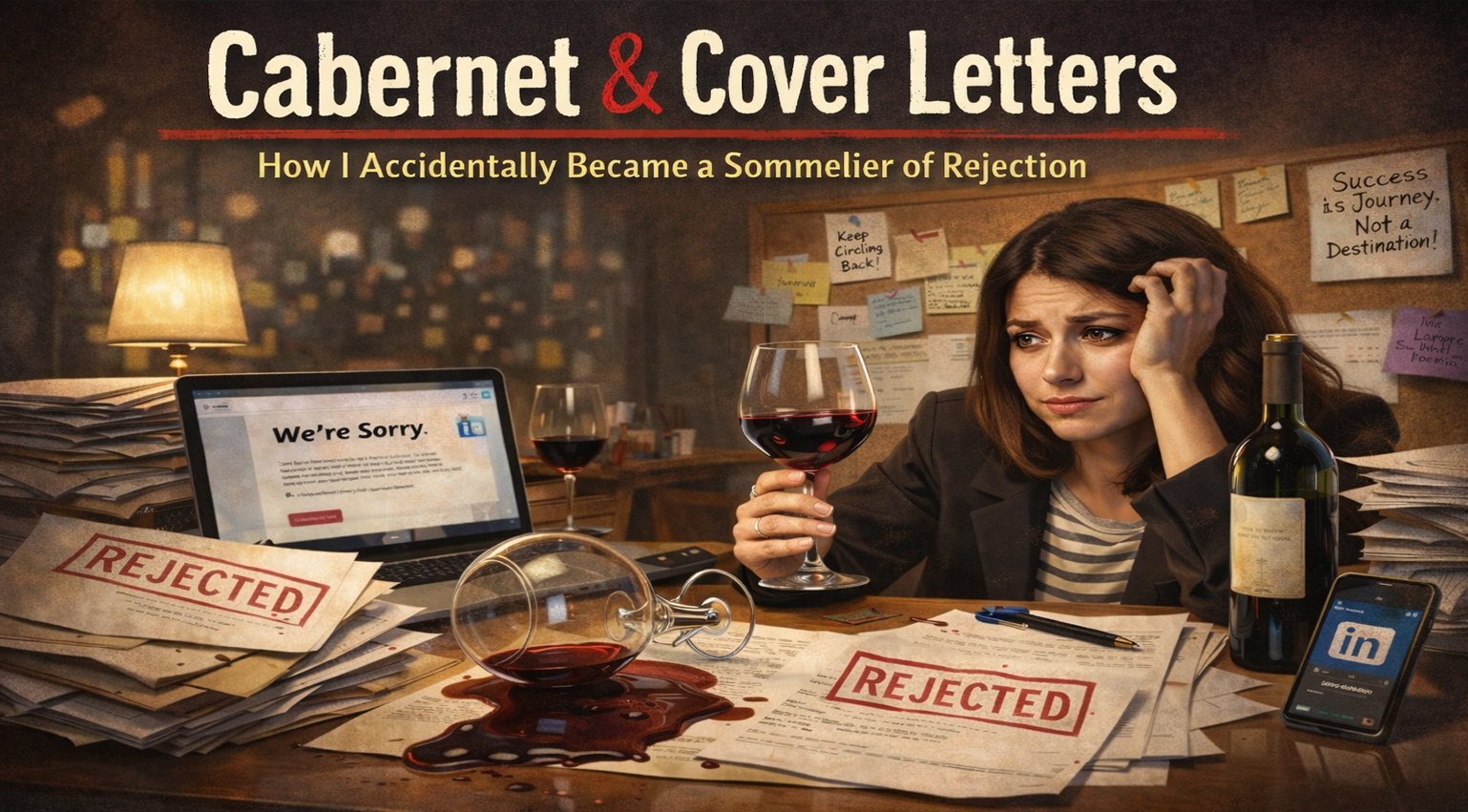
There’s a very specific kind of adulthood nobody warns you about, and it’s this: you are simultaneously trying to be a functional human being while job hunting, which is like attempting to assemble IKEA furniture during an earthquake while a stranger calmly reads you inspirational quotes from LinkedIn.
At first, you approach the process with hope. Optimism. The kind of wide-eyed belief that surely, in the year 2025, the systems are streamlined, the recruiters are responsive, and the phrase “we’ll circle back” has finally been outlawed by some international employment tribunal. You open your laptop with intention. You update your résumé with the seriousness of a surgeon washing their hands. You tailor your experience bullets until they sparkle. You add words like “stakeholder,” “cross-functional,” and “strategic” until you sound less like a person and more like a well-fed spreadsheet.
And then… the first rejection email arrives.
It’s polite. It’s sterile. It thanks you for your time the way a parking ticket thanks you for supporting city infrastructure. And you do the rational thing: you tell yourself it’s fine. You weren’t that excited anyway. The role wasn’t perfect. The salary was suspiciously described as “competitive,” which usually means it’s competing against your rent and losing.
So you apply again. And again. And again. You become a professional applier. A digital pilgrim. A person who can identify an ATS portal by the smell of its login screen. You start recognizing the same job posting reappearing every three weeks like a haunted house that refuses to be blessed. You begin to suspect some companies aren’t hiring so much as they’re collecting résumés like Pokémon cards, just to feel something.
This is where the wine enters the chat.
Not as a problem. As a coping strategy. As a warm little assistant who doesn’t ask you to “please upload your cover letter in PDF format,” but simply says, “Hey. You tried. Here’s a glass. Let’s pretend you’re not being judged by an algorithm that thinks ‘human’ is a soft skill.”
And slowly, over the course of one very long job-search season, you develop a ritual: apply, refresh, spiral, sip. You don’t drink because you’re dramatic. You drink because you’re practical. Because there’s only so many times you can describe yourself as “results-driven” before you need a beverage to rinse the taste of your own professional desperation out of your mouth.
Pairing Wine With Corporate Nonsense
There are wines you drink for celebration, and then there are wines you drink while staring at a job posting that requires ten years of experience in a software that launched eighteen months ago.
This is not a “notes of blackberry and oak” moment.
This is a “notes of burnout and disbelief” moment.
You start learning what pairs well with certain parts of the process. A crisp white with the initial optimism, when you still think tailoring your résumé will make a meaningful difference. A rosé for the delusional confidence of the first application, when you believe the hiring manager is going to read your cover letter and whisper, “Finally. A person.” A red blend for the second round interview, when you realize the team is nice but the role is shaped like three jobs wearing one trench coat.
And for the ATS portal?
That’s straight Cabernet.
Because nothing pairs with “Create an account to apply” like a drink that tastes like consequences.
The portal asks you to upload your résumé, then immediately asks you to manually retype everything you just uploaded, like a petty digital hazing ritual. It wants your education history dating back to the moment you learned to hold a pencil. It wants a reference list. It wants to know if you’ve ever been convicted of a crime, and at this point you’re tempted to answer, “Only emotionally, by recruiters.”
Then comes the personality assessment. The corporate tarot reading. Two hundred questions designed to determine whether you’re the kind of employee who “enjoys collaborating,” or the kind who secretly wants to flip a conference table when someone says, “Let’s take this offline.” You answer honestly, because you still have integrity, and then you wonder if honesty was the first disqualifier.
By the time you click “Submit,” you aren’t proud. You’re relieved. Like you just filed your taxes, except instead of a refund you get an auto-generated email that says, “Thank you for your interest,” which is the professional equivalent of, “We acknowledge you exist, but we will not be speaking further.”
So you take a sip. And you don’t even taste the wine. You taste the moment your soul whispered, “Maybe I should open a bakery instead.”
The Interview, Also Known As Emotional Speed Dating
Interviews in 2025 are not conversations. They are obstacle courses with ring lights.
You show up early. You test your microphone. You angle your camera so the background says, “I’m stable,” even though the unseen part of your room looks like a laundry-based crime scene. You smile the kind of smile that says, “I’m excited,” while your internal monologue says, “Please let this job include health insurance and a manager who doesn’t schedule 7 a.m. ‘quick syncs.’”
First interview: the recruiter screen.
They ask, “Tell me about yourself,” and you have to compress your entire professional identity into sixty seconds without sounding either desperate or homicidal. You talk about impact. You talk about leadership. You talk about how you “love solving complex problems,” even though the complex problem right now is keeping your face relaxed while someone evaluates your personality like they’re picking a dog at a shelter.
Then you get to the part where they say, “So, walk me through your résumé.”
Your résumé, which they theoretically already read.
But they didn’t. Of course they didn’t. Nobody reads. Reading is for poets and historians. Hiring is done by vibes and keywords.
Second interview: the hiring manager.
They ask, “Why do you want this role?” and you want to say, “Because I enjoy eating,” but instead you say something like, “I’m really drawn to the mission,” as if the mission is not primarily “paying my bills without developing stress-induced eye twitch.”
Third interview: the panel.
Four people. Sometimes six. Sometimes nine, if the company is truly committed to making you feel like you’re being tried for a crime you don’t remember committing. Everyone asks versions of the same question, phrased slightly differently, like they’re testing whether you can survive a loop in a video game.
“Tell us about a time you overcame conflict.”
“Tell us about a time you managed competing priorities.”
“Tell us about a time you dealt with ambiguity.”
Buddy, I am currently living in ambiguity. My entire life is a competing priority. The conflict is between my hope and my Wi-Fi.
And after every interview, you wait. You refresh your email. You refresh LinkedIn. You refresh your soul. You try to stay calm, but your brain starts negotiating.
If they don’t respond by Friday, I’ll follow up Monday.
If they don’t respond Monday, I’ll follow up Thursday.
If they don’t respond Thursday, I will assume I have been gently erased from corporate memory like an Etch A Sketch.
So you pour another glass, not because you’re spiraling, but because you’re preparing. Like a wartime general. Like someone who has learned that silence is not neutral. Silence is a decision. Silence is the “we went with someone else” email still sitting in Drafts.
Becoming a Full-Time Applicant With a Part-Time Personality
At some point, job hunting stops being something you’re doing and becomes something you are.
You don’t just “apply.” You enter portals. You translate your career into bullet points engineered to impress a machine. You start writing cover letters that feel like hostage notes, trying to sound eager without sounding insane.
You begin to develop Applicant Reflexes.
You see the phrase “fast-paced environment,” and you flinch.
You see “must be able to wear multiple hats,” and you imagine a clown car full of hats.
You see “unlimited PTO,” and you hear, “You will never use it without guilt.”
You get ghosted so many times you start wondering if you’re haunted. You begin to feel personally targeted by the sentence, “We’ll keep your résumé on file,” which is just corporate folklore for, “We have launched your hopes into a digital abyss where they will float forever, alongside a million other dreams in PDF form.”
And somehow, while all this is happening, you’re also expected to remain charming. Professional. Confident. Balanced.
You’re supposed to tell yourself you’re worthy while a system repeatedly implies you are not.
So you build small comforts. Small rituals. The little things that make you feel like a human being and not a data point.
One of those rituals is wine.
Not because wine solves the job market, but because wine doesn’t pretend. Wine doesn’t say, “We loved meeting you, but we’ve decided to move forward with other candidates.” Wine doesn’t give you feedback like, “We’re looking for someone with more experience,” when you’ve been working since printers were sentient.
Wine just shows up. Wine is honest. Wine says, “Yes, this is exhausting. Here is something warm. Here is something you didn’t have to earn through a three-step verification email.”
And when you’re deep in the process, wine becomes your tiny rebellion: a reminder that you are still allowed to have pleasure even when your inbox is a wasteland. A reminder that you’re still a person, not a project.
Final Thoughts: Cheers to the People Still Trying
If you’re applying for jobs right now, I need you to know something.
You are not failing because you haven’t found a role yet.
You are navigating a system that often confuses “hiring” with “auditioning,” that asks people to be simultaneously humble and extraordinary, confident and grateful, available and endlessly patient, all while being evaluated by software that would reject its own mother for not using the right keywords.
So yes—pour the wine if you want to.
Not as surrender, but as survival. As ceremony. As a small toast to your own endurance.
Raise a glass to every cover letter you wrote while questioning your existence. To every interview you showed up for with a brave face and a stressed-out browser tab collection. To every “unfortunately” email you opened and still kept going afterward.
Because you are doing something incredibly hard: you are continuing to hope in a world that keeps testing your patience.
And that deserves a drink.
Cheers.