
There comes a point in every job hunter’s life where “preparation” starts to feel like performance art. You’ve researched the company, rehearsed your answers, memorized your bullet points, and even practiced the perfect smile that says, I’m confident but not threatening. You’ve printed your resume on paper thick enough to double as armor and ironed a shirt that still smells faintly like anxiety and Febreze.
You walk into each interview telling yourself, This could be it. The one. The moment your career turns around, your LinkedIn headline evolves from “Open to Work” to “Thriving in My New Chapter,” and your parents finally stop asking if you’ve “heard anything back yet.”
But then it happens — again. The same sterile conference room. The same overly enthusiastic handshake from someone who read a leadership book once. The same HR coordinator asking if you “had any trouble finding the building” while sitting three feet from a massive sign that says the company name in 40 point font.
And always always the same question that has haunted every interview since the dawn of human resources:
“So, walk us through your resume.”
Every candidate knows that phrase by heart. It’s like the national anthem of unemployment. You nod, you smile, you start reciting your professional history as if reading an obituary for your former optimism. You summarize ten years of experience into neat, digestible chunks that make you sound competent but not too ambitious, accomplished but not intimidating, confident but not cocky. It’s a delicate, soul draining dance.
That day, I had reached my limit. Not because I wasn’t ready. But because I was tired of performing a version of myself that fit neatly between bullet points and buzzwords. I wanted to be honest, not in the polite, corporate approved way, but in the human way.
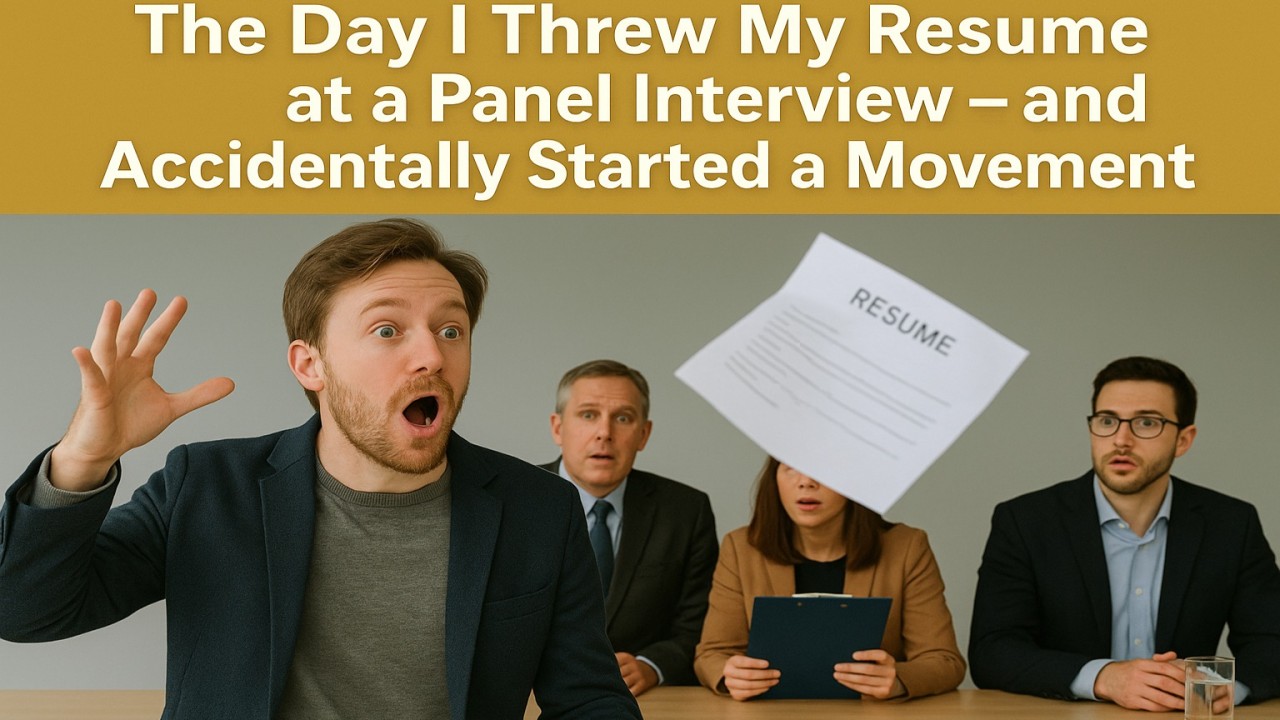
So when the question came, I didn’t walk through my resume. I threw it.
The Setup — The Conference Room Hunger Games
The interview was scheduled for 2:00 p.m. A panel interview, the worst kind. Multiple faces, multiple notepads, multiple people pretending not to judge your shoes.
There were five of them: HR, a department head, a senior manager, and two people whose titles were vague enough to sound made up. They were seated in a half circle like a tribunal, all sipping from identical bottles of water that had probably been placed there by some intern still recovering from their own interview trauma.
“Welcome,” said the HR rep, smiling with the kind of warmth that could only come from mandatory training. “We’re excited to get to know you.”
I smiled back. “Likewise.”
And then came the inevitable. “So,” she said, clicking her pen with authority, “why don’t you walk us through your resume?”
I looked down at the paper in front of me, that thin, trembling summary of my adult life. Every bullet point condensed to a few words: led, managed, improved, increased, implemented. I had spent hours formatting it. Choosing verbs that sounded powerful but not delusional. Removing personal pronouns to seem professional. Adding measurable metrics to make me sound robotic in the right way.
But as I looked at it now, something snapped. Not out of anger, out of exhaustion.
I picked it up, weighed it in my hands for a second, and then with the calm confidence of a man who had nothing left to lose, slid it across the table. It skidded halfway, made a satisfying thud, and landed squarely between the HR rep’s notebook and the senior manager’s coffee.
“There,” I said. “That’s me in twelve point font. But since you already have that, maybe I can tell you the version that doesn’t fit on paper.”
Silence. The kind of silence you only hear in two situations: funerals and corporate interviews.
The HR rep blinked twice, processing whether this was confidence or chaos. The senior manager raised an eyebrow, possibly impressed, possibly filing a mental HR incident report.
But I didn’t flinch. Because for once, I wasn’t interviewing for approval. I was interviewing for authenticity.
The Twist — From Interview to Intervention
Once you’ve thrown your resume, you can’t exactly go back to pretending this is a normal conversation. So I leaned in.
“Let me tell you something about that paper,” I began. “It’s technically accurate, but emotionally incomplete. It tells you what I’ve done, not what I’ve survived. It lists my positions, but not the lessons. It gives you titles, not context.”
Someone, I think the one with “strategy” in their title shifted in their seat, intrigued despite themselves.
I walked them through my story. Not in the robotic cadence of “accomplishment + metric + outcome,” but as a human who had actually lived it.
“That first role? That’s where I learned that ‘fast paced environment’ really means ‘no one has any idea what they’re doing, but we’re all too scared to say it out loud.’” They chuckled. I kept going.
“The promotion? That wasn’t ambition. That was survival. They laid off half the team, and I inherited their workload and a new title that came with no pay increase.” Someone nodded in quiet agreement. I could feel it, they’d all been there.
“The gap year you see? That’s not unemployment. That’s reinvention. That’s the year I freelanced, failed, rebuilt, and learned to make peace with rejection emails that start with ‘We were impressed by your background.’”
By then, the HR rep wasn’t taking notes anymore. She was just watching me, half horrified, half fascinated. I had turned a sterile Q&A into a TED Talk for the emotionally unemployed.
And once you’ve said too much, you might as well keep going. “I don’t have the perfect linear career story,” I told them. “But I’ve got something better: resilience that doesn’t need a team building workshop to prove itself.”
Silence again. But this time, it wasn’t awkward. It was electric.
When I finally sat back down, the lead interviewer smiled, the kind of smile that said, You just broke every rule, and I kind of respect it.
The Aftermath — Unhired, Unapologetic, Unforgettable
I didn’t get the job. Of course I didn’t.
Two weeks later, the inevitable arrived, the corporate breakup email. You know the one. The subject line pretending to be neutral, the opening line pretending to be kind, and the closing line pretending to care. It read: “After careful consideration, we’ve decided to move forward with candidates whose experience more closely aligns with the requirements of the role.”
Translation: We loved the show, but we’re not ready to air it.
And yet, I didn’t feel bad. Not this time. For once, I hadn’t left an interview feeling like I’d just emptied my soul into a beige conference room. I hadn’t walked out rehearsing what I should’ve said differently. I hadn’t rehearsed the same tired “Maybe next time” monologue in my head. Instead, I left that room feeling alive.
A few days later, my phone buzzed with a LinkedIn notification. One of the panelists had sent a message.
“I can’t officially endorse what you did,” she wrote, “but it was the first interview I’ve genuinely enjoyed in years. You reminded us there’s a person behind every resume.”
That message hit harder than any offer letter.
Because here’s the truth no one tells you: a resume isn’t your story. It’s your trailer. It gives the highlights, the structure, the runtime — but none of the heart. It’s a teaser for a film that no one can truly understand until they sit down and watch.
And sometimes, you have to stop explaining the plot and start showing who you are.
Since that day, I’ve sat through dozens of interviews. Some went great. Some didn’t. Some were as sterile as a hospital waiting room, others as chaotic as a family reunion. But I never went back to being that careful, overly rehearsed version of myself. I still bring a resume, sure — but I bring me too. The one with stories, with edges, with personality. The one who’s failed, rebuilt, laughed through awkward silences, and learned to answer “Tell me about a challenge” without sanitizing the pain out of it.
Every now and then, I find myself in front of another panel, bottled water perfectly aligned, smiles slightly too tight, the unspoken pressure of politeness filling the room. And I can feel it again. That spark. The same one from the day I let go of perfection and just showed up.
I see the resume gliding across the table in my mind, that little paper act of rebellion. I hear the silence that followed. I remember the rush of realizing I wasn’t auditioning anymore. I was existing.
Maybe I didn’t get the job that day. But I got something better, the kind of peace you can’t list under “Achievements.”
Because once you stop begging for validation, once you realize that rejection doesn’t define your worth, you start to see the whole game for what it is: performance art. Everyone’s improvising, pretending to be composed while silently Googling “what to say when asked about weaknesses.”
So if you ever find yourself sitting in that same chair, under the same fluorescent lights, hearing the same tired question “Walk us through your resume” take a breath. Smile. And remember: you don’t have to walk through it. You can throw it, too.
Because sometimes, professionalism is overrated. But authenticity? That’s the one thing that still lands, every single time.






Thanks for sharing. I read many of your blog posts, cool, your blog is very good. https://accounts.binance.info/si-LK/register?ref=LBF8F65G
Thank you for your sharing. I am worried that I lack creative ideas. It is your article that makes me full of hope. Thank you. But, I have a question, can you help me?
I don’t think the title of your article matches the content lol. Just kidding, mainly because I had some doubts after reading the article.