
Let’s talk about employment gaps, because apparently the moment some companies see a blank space on a resume, their imagination leaves the building, files a missing person report, and returns wearing a tiny detective hat.
They do not see a human being. They do not see context. They do not see life, responsibility, sacrifice, caregiving, parenting, grief, survival, or the kind of invisible labor that holds entire families together while the world continues pretending productivity only counts if someone had a company email address.
No.
They see dates.
They see a line that says someone stepped away from paid employment and immediately begin acting like the candidate spent five years wandering through the forest, trading Microsoft Excel skills for berries, communicating only with raccoons, and forgetting how calendars work.
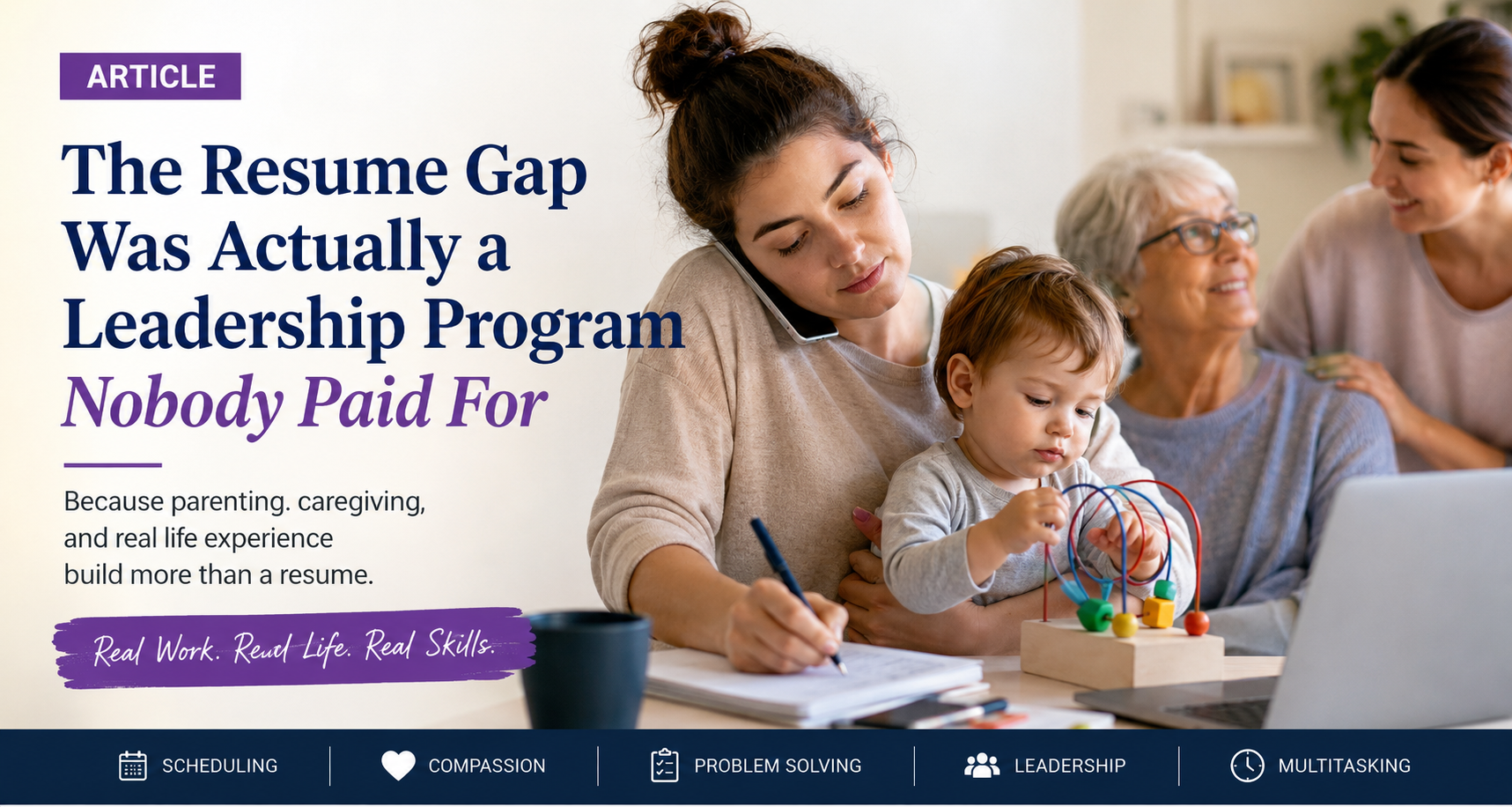
A woman stayed home for five years to raise her child and care for aging parents. She explained it clearly. She interviewed well. She had the experience, the skills, the maturity, the communication, and the kind of life-tested patience most corporate training programs could not manufacture if they locked twelve consultants in a conference room with a whiteboard and unlimited coffee.
And the company still said, “Five years off is a long time. We cannot take that risk.”
Risk?
That word deserves to be picked up gently, carried outside, and asked what it thinks adulthood is.
Because that was not “five years off.” That was five years of unpaid executive leadership inside the most unpredictable department on earth: family operations. There was no PTO. No wellness stipend. No quarterly bonus. No assistant. No polished job title. No badge that opened a glass door. No annual review where someone named Brad said, “You really showed ownership this year.”
There was just responsibility.
The kind that does not clock out.
The kind that does not pause because a meeting ran over.
The kind that does not allow you to say, “Let me circle back on that,” when a child is crying because the banana broke in half, your parent has a doctor appointment, the insurance company needs a form they already received twice, and dinner is somehow expected to exist by 6:00 p.m. like magic with a side salad.
That is not a resume gap.
That is a battlefield with laundry.
Apparently Parenting Does Not Count Unless There Is a Conference Room
A stay at home parent is not unemployed. A stay-at-home parent is running a full-scale operation without the luxury of pretending the printer is the biggest crisis in the building.
They are managing schedules, budgets, transportation, emotional support, medical appointments, school communications, grocery inventory, household maintenance, conflict resolution, behavioral negotiations, emergency response, time management, crisis prevention, and the daily miracle of keeping small humans alive while they actively attempt to injure themselves with furniture, snacks, and confidence.
That is not a gap.
That is operations management with tiny shoes in the hallway.
Corporate America loves operations when it involves dashboards, acronyms, and someone standing next to a PowerPoint slide saying, “We need to optimize workflow.” But when a parent does it in a kitchen while making lunch, answering a school email, checking medication instructions, and breaking up a sibling argument over a plastic cup that has somehow become a constitutional issue, suddenly it does not count because there was no LinkedIn badge attached.
That is the absurd part.
If someone says they managed a team of six adults at work, companies nod like they just met General Eisenhower. If someone says they managed children, aging parents, appointments, household finances, emotional storms, homework, meals, school deadlines, doctor visits, and the entire spiritual mystery of missing socks, the hiring panel leans back and says, “But have you used Outlook recently?”
Outlook?
She has been managing a calendar where one missed appointment can trigger a school call, a medical delay, a family emergency, or a toddler meltdown that makes a corporate escalation meeting look like a spa retreat.
She does not need to prove she can schedule a meeting. She has scheduled pediatric checkups, parent-teacher conferences, grocery runs, medication refills, family obligations, school events, doctor visits, and emergency trips to buy poster board at 8:47 p.m. because someone forgot to mention a project due tomorrow.
That is not rusty.
That is advanced-level logistics.
But some companies only recognize labor when it comes with a badge, a direct deposit, and a manager who uses the phrase “circle back” like incense. They cannot imagine that leadership happens outside a building with beige carpet and motivational posters about teamwork.
That is the imagination gap.
Not the employment gap.
The imagination gap.
The inability to understand that skills do not evaporate when someone prioritizes family. Communication does not disappear because someone stepped away from a payroll system. Judgment does not vanish because someone spent years caring for people instead of attending meetings about meetings.
If anything, that candidate probably developed more useful skills than half the people currently hiding behind corporate jargon and pretending “alignment” is a personality.
Caregiving Is Not a Career Pause. It Is Crisis Management With Fluorescent Pharmacy Lighting
Now let’s talk about caring for aging parents, because apparently some hiring managers hear that phrase and imagine someone simply sat peacefully in a recliner for five years, occasionally handing out soup and watching daytime television.
No.
Caring for aging parents is compassion with a calendar, patience with a phone charger, and crisis management performed while waiting on hold with an insurance company that has weaponized smooth jazz.
It is appointments. It is medication schedules. It is transportation. It is medical paperwork. It is pharmacy calls. It is hospital visits. It is explaining the same information to three departments that apparently live in separate emotional zip codes. It is advocating for someone who may be scared, tired, confused, stubborn, embarrassed, or all four before breakfast.
It is becoming the project manager for someone’s health while also being their emotional support, family translator, logistics coordinator, transportation department, appointment reminder, paperwork detective, and occasional motivational speaker.
And somehow hiring managers look at that and say, “We are concerned about the gap.”
Concerned?
You should be impressed.
That person has dealt with healthcare systems, insurance delays, family stress, emotional exhaustion, medical uncertainty, and the impossible balancing act of caring deeply while still trying to keep everything from falling apart. That is not a gap. That is leadership under pressure without a title, a team, or a laminated org chart.
Corporate leaders love to talk about resilience. They put it in job descriptions like seasoning. They want candidates who can “thrive in ambiguity,” “manage competing priorities,” and “operate in a fast-paced environment.”
Wonderful.
Try managing a parent’s medication change while a child needs help with homework, dinner has not been started, the pharmacy says the prescription is delayed, the doctor’s office says the insurance company needs approval, the insurance company says the doctor’s office needs to call, and everyone involved somehow believes you have a direct line to God and a printer that never jams.
That is ambiguity.
That is competing priorities.
That is fast-paced.
That is not a resume gap. That is a leadership academy with emotional damage and better real-world training than most corporate offsites where adults build towers out of marshmallows and call it teamwork.
And yet, the workplace often treats caregiving like suspicious behavior. Like stepping away from paid employment to care for people is evidence of professional decay. Like compassion is a liability. Like responsibility only matters when it reports to a vice president.
That is backwards.
Someone who cared for aging parents did not become less capable. They became more aware, more patient, more organized, more emotionally intelligent, more adaptable, and more familiar with the kind of real pressure that does not come with a calendar invite titled “Urgent Sync.”
They handled complexity without applause.
They handled responsibility without compensation.
They handled stress without a branded water bottle and a wellness webinar.
And then they came back to the workforce only to be told their lived experience is a risk by people who call themselves “people-first.”
The irony should require a hard hat.
Companies Say “Family First” Until Someone Actually Chooses Family
This is where the whole thing becomes comedy wearing a sad little tie.
Companies love saying they support family. They love it. They print it on career pages. They put it in recruiting videos with soft music and employees laughing near windows. They say, “We care about work-life balance.” They say, “We are like a family.” They say, “Bring your whole self to work,” which usually means bring the version of yourself that has no needs, no emergencies, no children, no parents, no grief, no medical appointments, and no life outside the company’s preferred schedule.
But the moment someone actually chooses family, the same companies act like they witnessed a felony.
A candidate says, “I stepped away to raise my child and care for aging parents,” and suddenly the panel becomes a courtroom.
“Can you explain this gap?”
She does explain it.
Then they ask again, but with more concern.
“So what have you been doing during that time?”
She just told you.
She was running a household and caring for multiple generations of human beings. She was doing invisible labor so essential that if nobody did it, society would collapse by Tuesday. But because nobody assigned it a salary band, some hiring systems treat it like a mysterious void.
Meanwhile, companies will hire someone who has had six jobs in seven months, says “synergy” like it was prescribed by a doctor, and describes themselves as a thought leader because they reposted a quote over a stock photo of a mountain.
That person is “dynamic.”
The woman who kept humans alive for five years is “concerning.”
We have lost the plot so badly the plot has updated its resume and left for a competitor.
The same hiring culture that worries about a parent returning to work will celebrate candidates who stayed in toxic jobs until their nervous system sounded like a printer jam. It calls burnout commitment. It calls overwork passion. It calls answering emails at midnight dedication. But caregiving? Parenting? Family responsibility? Suddenly everyone needs a risk assessment and a follow-up meeting.
That is not professionalism.
That is emotional illiteracy with a job requisition number.
The truth is, a five-year gap does not erase talent. It does not delete intelligence. It does not uninstall professionalism. It does not make someone forget how to use software, speak to people, solve problems, manage time, or show up when things get hard.
People do not become incapable because life happened.
They become layered.
They become tested.
They become more human.
And honestly, companies should want more humans in the room, because many of these hiring processes already feel like they were designed by a vending machine going through a divorce.
Final Thoughts: The Gap Was Never on Her Resume
The gap was never on her resume.
The gap was in their common sense.
Because when a company rejects a qualified candidate simply because she stepped away from paid employment to raise a child and care for aging parents, the company is not protecting itself from risk. It is revealing what it does not understand about work, life, responsibility, and transferable skills.
It is revealing that it only values labor when labor is easy to categorize.
It is revealing that it can recognize leadership in a spreadsheet but not in a home.
It is revealing that it can celebrate resilience in a corporate slogan but not in a woman who lived it every day without applause.
A five-year caregiving period is not a professional disappearance. It is not a suspicious blank space. It is not evidence that someone forgot how to contribute. It is evidence that someone carried responsibility most people would struggle to explain in a performance review because there are no neat bullet points for being needed by everyone at once.
How do you quantify the ability to stay calm while everything is urgent?
How do you measure patience when the job never ends?
How do you turn emotional labor into a keyword an applicant tracking system can understand?
How do you explain that keeping a family functioning through childhood, aging, illness, appointments, bills, meals, school demands, family stress, and daily unpredictability might actually prepare someone for work better than sitting in a cubicle pretending a weekly status meeting is combat?
You probably cannot explain it to a hiring process that has the emotional intelligence of a broken stapler.
But you can say the truth anyway.
That woman was not a risky hire.
She was a capable adult with experience most companies claim to value but fail to recognize when it arrives without a corporate title.
She knew how to manage pressure.
She knew how to prioritize.
She knew how to communicate.
She knew how to coordinate moving parts.
She knew how to handle people who were emotional, tired, confused, impatient, or refusing pants.
Honestly, after five years of parenting and elder care, your CRM should be afraid of her.
Because she can handle it.
She can handle the meetings, the follow-ups, the customers, the deadlines, the systems, the reports, the inbox, the phone calls, and the occasional coworker who replies all to say “Thanks.”
What she should not have to handle is a hiring culture that treats caregiving like a character flaw.
Employment gaps are often not gaps at all.
Sometimes they are chapters.
Sometimes they are survival seasons.
Sometimes they are proof that a person knows how to show up when life gets complicated, inconvenient, exhausting, and deeply human.
And maybe instead of asking candidates to defend the years they spent taking care of people, companies should start asking themselves why they are so bad at recognizing the value of people who know how to care.