
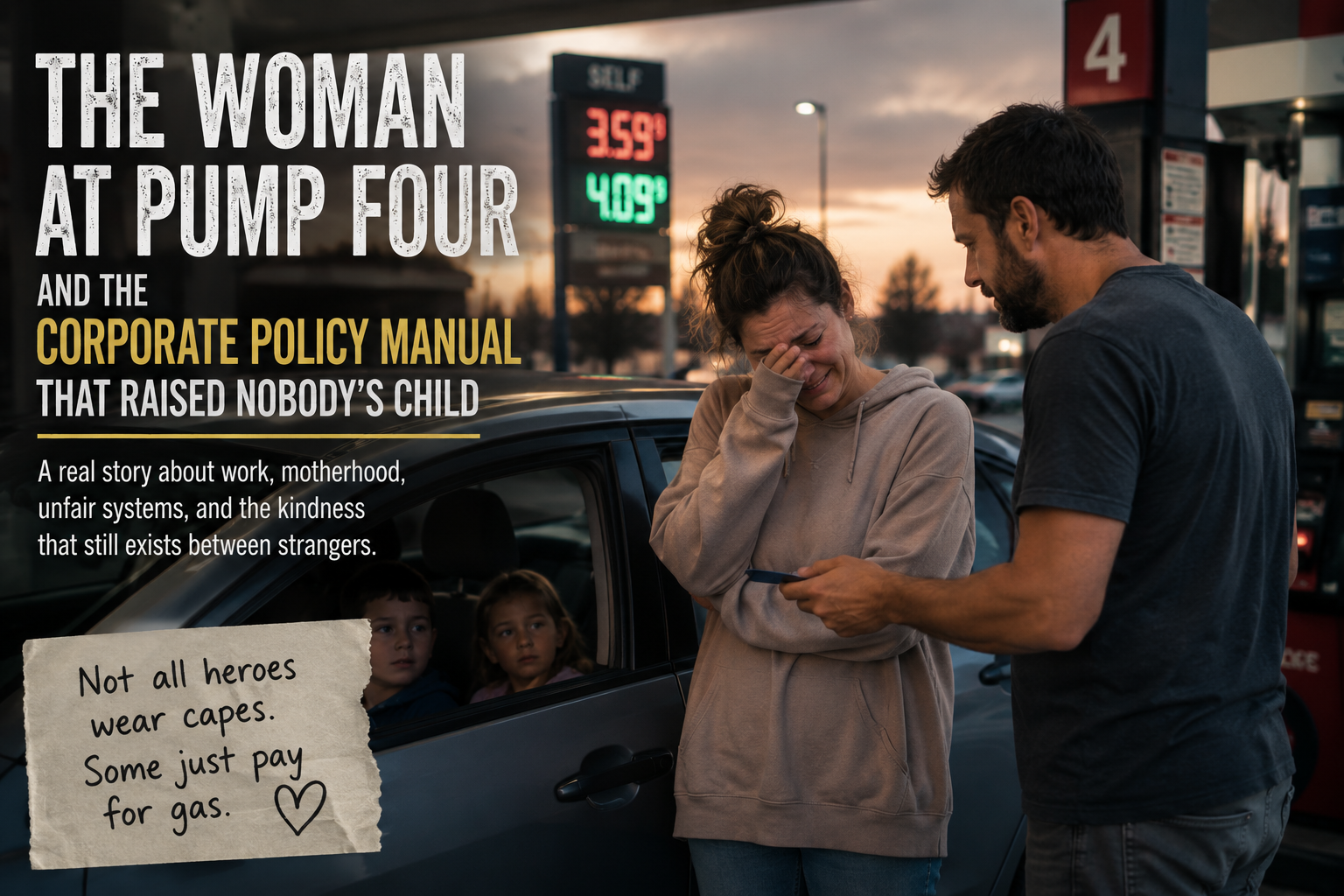
You ever pull into a gas station thinking the most emotional part of your day is going to be watching the pump casually remove money from your account like it has been granted temporary custody of your checking account, and then life decides to hand you an entire sermon between the windshield washer fluid, the broken receipt printer, and the one trash can that looks like it has survived three recessions and a family argument?
That was me.
I pulled in already annoyed, because buying gas now feels less like transportation and more like entering a financial escape room designed by oil executives and guarded by a screen that asks if you want a car wash while your bank account is actively crying for privacy. The pump asks if you want regular, plus, or premium, and every option feels personal. Regular feels like admitting you are doing your best. Premium feels like a luxury purchase with a nozzle. Plus feels like gasoline’s middle child, standing between the two hoping someone finally says, “You matter too.” I picked the option my budget allowed, which was basically “please give me enough fuel to get home and continue participating in society against my better judgment.”
I was standing there watching the numbers climb with the confidence of a slot machine possessed by a landlord when I noticed her.
A woman was sitting in her car a few feet away with kids packed inside like a tiny emotional committee that had already held three emergency meetings, filed a snack grievance, and was preparing to open a full congressional investigation into why they were not moving. She was not just sitting there. She was crying.
Not dramatic crying. Not attention crying. Not the kind of crying people perform when they know a camera is nearby and a sad piano song might be added later. This was real crying. Exhausted crying. The kind of crying that happens when someone has been holding up the ceiling of their life for too long, silently, politely, responsibly, and then one small thing finally taps them on the shoulder and says, “Good news, I am the collapse.”
And the small thing was her wallet.
She forgot it.
That was it.
Not a scandal. Not irresponsibility. Not some reckless decision requiring a TED Talk, a accountability coach, and a LinkedIn comment section full of people named Brad explaining personal finance. Just a wallet left behind in the tornado of being a parent, a human, a tired person, and someone trying to keep moving in a world that keeps asking people to juggle knives while smiling like the knives are a growth opportunity.
Forgetting your wallet is annoying when your life is stable. Forgetting your wallet when you are already unemployed, overwhelmed, carrying kids, running on fumes, and trying not to fall apart in public is not annoying. It becomes symbolic. It becomes the final brick. It becomes the tiny dumb detail that breaks the shelf because the shelf was never built to hold this much weight in the first place.
So we started talking.
And that is when she told me she had recently been fired because her younger son had been sick for a week, and she stayed home to take care of him.
Let that sit for a second.
A mother took care of her sick child, and the reward was unemployment.
That is not an attendance issue. That is not a staffing issue. That is not “a difficult but necessary business decision.” That is a moral failure wearing a company polo and holding a clipboard like it just discovered compassion was not in the quarterly budget.
Because this is where we are now. We have built a workplace culture that will spend all year posting about values, wellness, empathy, belonging, flexibility, mental health, and “bringing your whole self to work,” but the minute your whole self includes a feverish child in tiny pajamas coughing like an old Victorian chimney sweep, suddenly the empathy department is closed for inventory, leadership is in a meeting, and HR has transformed into a printer with benefits.
Companies love family until actual family shows up. They love parents in theory. They love children in holiday commercials. They love “work-life balance” in recruiting materials written by someone working at midnight. But when a parent has to choose between a paycheck and a sick child, suddenly the company becomes a courtroom with a time clock, and the sentence begins with “unfortunately.”
And that woman was sitting at a gas station, crying in front of her kids, because life had put her in the impossible position of doing the right thing and being punished for it.
The Family Company That Panics When You Have a Family
There is something deeply ridiculous about companies saying, “We are like a family,” because apparently the family they are referencing is the kind where everyone is expected to show up no matter what, nobody talks about their needs, and Uncle Brad from operations keeps saying, “We all have to make sacrifices,” while leaving early for golf because he has “an appointment.” Nobody knows what kind of appointment requires clubs, sunscreen, and a polo shirt tucked in with executive confidence, but apparently his personal matters are sacred and everyone else’s are attendance concerns.
“We are like a family” is one of those corporate phrases that sounds warm until you realize it usually means they want loyalty without obligation, sacrifice without protection, and emotional commitment without any actual responsibility back to the people giving it. It means they want you to care like family when the schedule is short, when sales are down, when someone quits, when customers are angry, when leadership needs a miracle by Friday, but the second your actual family needs you, the warmth leaves the room so fast it should be studied by climate scientists.
Because the moment your real family needs you, the corporate family suddenly gets very quiet.
Suddenly it is not “we are like a family.” Suddenly it is “per the attendance policy.” Suddenly it is “we understand this is a difficult time.” Suddenly it is “unfortunately, we have to be consistent.” Suddenly it is “we care deeply, but we are separating your employment.” Suddenly the family has bylaws, a witness, a documentation trail, and a manager using that soft voice people use when they are about to do something deeply unkind while hoping the tone will carry the body.
That word, unfortunately, has become the official perfume of corporate cruelty.
“I understand, but unfortunately.” “We value you, but unfortunately.” “This was not an easy decision, but unfortunately.” Unfortunately walks into rooms wearing sensible shoes, holding a folder, pretending it had no choice. It says the company cares while proving the company does not. It turns a human emergency into a documentation issue and then sends everyone home feeling professional about it.
This woman was not asking for luxury. She was not requesting a six-month paid sabbatical to heal spiritually in a mountain cabin while journaling about boundaries and drinking ethically sourced tea out of a mug that says “I choose peace.” She was taking care of her sick son.
A child.
A little boy who probably needed medicine, tissues, juice, comfort, cartoons, and someone to sit near him while he fought whatever tiny plague he brought home from the biological warfare facility known as school. Kids do not get sick politely. They become tiny dramatic nobles on a fainting couch. They cough once and look around to make sure everyone heard it. They ask for a blanket, then reject the blanket because it is “too blankety.” They want soup until the soup arrives. They want the blue cup, not the green cup, because apparently the green cup has committed crimes against the monarchy.
And parents handle all of that.
They check temperatures, call doctors, clean messes, miss sleep, lose money, panic quietly, and tell the child everything is going to be okay while privately wondering if anything is going to be okay. They sit on bathroom floors at 2:00 a.m. with a thermometer in one hand and a calculator in the other, trying to figure out medicine, rent, gas, groceries, and whether missing another shift will cause the entire fragile structure of survival to start making that cartoon wobble sound before it falls.
Then the workplace looks at that parent and says, “This absence has created concerns.”
Concerns.
As if the concern should not be that a working parent can lose her job for caring for a sick child. As if the concern should not be that people are expected to be employees like they do not have children and parents like they do not have jobs. As if the concern should not be that the entire system depends on pretending human beings arrive at work with no bodies, no children, no emergencies, no grief, no illness, no life, and no reality outside the schedule.
That is the impossible standard.
Be fully available at work and fully available at home. Be dependable, flexible, grateful, professional, patient, responsive, calm, productive, emotionally stable, financially resilient, and spiritually unbothered by the fact that one fever can turn your income into a rumor. Be a team player, caregiver, closer, scheduler, nurse, chauffeur, snack distributor, homework supervisor, household manager, and human calendar with debt.
And if any part of that machine breaks, someone in management starts talking about reliability like they have discovered a character flaw instead of a survival problem.
Parents are not failing. They are being asked to succeed inside an equation that was designed by people who have backup care, paid help, flexible schedules, and the kind of leadership title that turns their emergencies into “personal matters” instead of write-ups. There is a big difference between someone being unreliable and someone being unsupported, but too many workplaces blur that line because it is cheaper to blame the parent than to build a humane system.
The Gas Station Became a Tiny Courtroom for Modern Life
That gas station stopped being a gas station that day.
It became a courtroom, a confession booth, and one of those strange public places where real life suddenly rips the curtain open and says, “Here is what people are carrying while everyone else is busy pretending things are normal.” It became the kind of place where you remember that people are not just customers, drivers, employees, parents, strangers, or faces behind windshields. They are entire storms moving through public spaces, trying not to spill too much rain on anybody else.
She was sitting there with kids in the car, no wallet, no job, no space left in her body to absorb one more problem, and the kind of look people get when they are trying not to completely break down because breaking down in public still feels like you are inconveniencing everyone. That is one of the saddest things we teach people: even when you are falling apart, do it quietly, do it politely, do it in a way that does not make the line move slower.
And the kids were doing what kids do during serious adult moments.
They were being kids.
They were not in the back seat silently honoring the emotional gravity of unemployment, wage insecurity, and the collapse of social support systems. No. They were probably asking questions with the precision of federal investigators. “Why are we stopped?” “Are we out of gas?” “Why are you crying?” “Can I have chips?” “Are we still going?” “Did you bring my charger?” “Why is that man looking over here?” “Can we get a slushie?” “Is crying contagious?” “Can I have your phone?” “Did my brother breathe on my side?”
That is the thing about children. They can sense tension, but they do not always know what to do with it, so they turn it into a press conference about snacks, electronics, justice, and personal boundaries inside the back seat. A child can watch an adult having an emotional collapse and still calmly ask whether this will impact nugget access, because in their world, that is a legitimate policy concern.
And honestly, there was something painfully human about it.
A mother was carrying the full emotional weight of losing her job, forgetting her wallet, needing gas, and trying to keep her kids calm, while the kids were debating whether a bag of chips was still possible under the circumstances. That is life. It is heartbreaking and absurd at the same time. It is a woman crying at a gas station because the world has been too heavy, and a child in the back wondering if this affects juice box availability.
So I helped with gas.
Not because I am a hero.
Please.
I am not built for hero branding. I am a man who has argued with a self-checkout machine and lost. I have opened the refrigerator three separate times in ten minutes as if new food would appear because I showed commitment. I have walked into a room, forgotten why I went in, and stood there like my brain was buffering on hotel Wi-Fi. I have answered “you too” when a server told me to enjoy my meal, and I still think about it during moments of silence.
I helped because sometimes kindness is not complicated.
Sometimes you do not need a nonprofit, a committee, a slogan, a campaign, a company-wide initiative, matching T-shirts, a keynote speaker, or a branded hashtag that says something like #HumansFirst while three departments argue over the font. Sometimes you just need to notice that another human being is drowning in three feet of water and say, “Here, take my hand.”
Not fix everything. Not solve her employment situation. Not rewrite the entire American workplace beside pump four while the receipt printer wheezed in the distance like it had seen too much. Just help with gas. Just remove one problem from the pile. Just give her one less thing to cry about. Just be the person who does not make the hard moment harder.
And because I survive uncomfortable emotion with humor, I made a joke.
I told her, “At this point, parenting should come with hazard pay, roadside assistance, and one free nervous breakdown per quarter.”
She laughed.
Not the kind of laugh that means everything is fine. Everything was not fine. It was the kind of laugh that still had tears attached to it. The kind that comes out when someone has been underwater too long and finally gets one second of air. The kind of laugh that does not erase the pain, does not fix the job, does not refill the bank account, does not magically place the forgotten wallet into the cup holder, but does remind the person they are still here.
And sometimes that is enough for the moment.
Sometimes people do not need a speech. They do not need “stay strong.” They do not need “everything happens for a reason,” which is a phrase that should be sealed in a box, dropped into the ocean, and guarded by emotionally mature dolphins. They do not need someone explaining resilience like resilience is going to fill the tank.
Sometimes people need gas.
Sometimes they need dignity.
Sometimes they need one person to look at them and not treat their worst moment like proof they failed.
Behind Every Attendance Issue Is a Human Story
That woman stayed with me because she was not just one woman at one gas station.
She was every parent who has ever had to choose between showing up for work and showing up for their child. She was every exhausted person who has ever sat in a parking lot trying to collect themselves before walking into a building where nobody knows they cried in the car. She was every employee who has ever been called unreliable because life did not ask permission from the schedule. She was every mother and father trying to stretch one paycheck across too many emergencies while still being expected to smile, perform, produce, and act grateful for the opportunity to be one crisis away from collapse.
Behind every cold corporate phrase, there is usually a human being with a story nobody bothered to ask about.
“Attendance issue” might mean a parent was up all night with a sick child, measuring medicine, changing sheets, checking breathing, and watching the clock move closer to a shift they already knew they might not make. “Not dependable” might mean daycare fell through, the car would not start, the school nurse called, or the person who was supposed to help could not. “Poor fit” might mean the employee had a life that did not fit neatly inside a staffing model built by people who treat emergencies like scheduling defects. “Excessive absences” might mean someone chose a feverish child over a shift because that is what love required.
“Business decision” might mean compassion was available, but leadership decided not to use it.
That is what bothers me.
We use sanitized language to make painful decisions sound clean. Nobody says, “We fired a mother because her child was sick.” They say, “We had to make a difficult decision regarding attendance.” Nobody says, “We punished someone for caregiving.” They say, “We need consistency across the team.” Nobody says, “We chose policy over humanity.” They say, “Unfortunately, this is where we landed.”
Where we landed.
As if everyone floated gently down from the sky and nobody pushed.
Corporate language has become an industrial washing machine for responsibility. Put cruelty in, add a little “difficult decision,” a splash of “business needs,” some “we value your contributions,” and suddenly the harm comes out smelling like leadership. But the damage is still damage. The woman still lost her job. The child was still sick. The wallet was still forgotten. The tank was still empty. The tears were still real. And the kids were still sitting in the back seat watching their mother try to survive a day that should never have been that hard.
We need to stop pretending every workplace issue exists in isolation from real life.
People do not clock in as robots. They clock in as parents, caregivers, spouses, sons, daughters, people with bills, people with sick children, people with aging parents, people with broken cars, people with bodies that fail, people with lives that do not care about shift coverage. They clock in carrying invisible weight, and too often workplaces only notice the weight when it slows productivity.
And yes, businesses have needs.
Of course they do.
But people have needs too.
And when a business can only function by pretending employees are not human, maybe the problem is not the parent with the sick child. Maybe the problem is the system that was built so tightly, so cheaply, and so coldly that one child’s fever becomes a termination event. Maybe the problem is not that workers have emergencies. Maybe the problem is that too many workplaces have built no room for emergencies while still claiming to value people.
That is not strength.
That is fragility dressed up as policy.
A strong workplace can handle humanity.
A weak one punishes it.
Final Thoughts: Be the Person Who Holds the Umbrella
I keep thinking about that woman at the gas station because I know she is not rare.
She is everywhere.
She is in the grocery store counting items before she gets to the register, doing quiet math with a cart full of necessities and a face that says she is trying not to embarrass herself in front of strangers. She is in the school pickup line trying not to cry behind sunglasses. She is in the pharmacy asking if there is a cheaper version. She is in the break room pretending she is fine. She is in the car taking three deep breaths before walking into work because she cannot afford to bring her real face inside.
She is online applying for jobs that will make her upload a resume, retype the resume, answer questions already on the resume, take a personality test, prove she can identify shapes, explain why she is passionate about customer excellence, and then receive an automated rejection at 2:14 a.m. from a company that says they were impressed by her background. Impressed, apparently, but not enough to hire her, call her, explain anything, or acknowledge she is a person instead of a PDF trapped in a software maze.
She is not lazy.
She is not irresponsible.
She is not dramatic.
She is tired.
And tired people are everywhere right now.
People are carrying more than they admit. They are holding together families, bills, health problems, job searches, grief, fear, childcare, car repairs, rent, groceries, and the daily pressure to look normal while quietly wondering how much longer they can keep doing this. They are smiling in checkout lines, answering “good” when people ask how they are, replying to emails with exclamation points they do not emotionally possess, and surviving days that would make a motivational poster curl off the wall in shame.
And the scary part is how often we walk right past them.
We see someone crying and assume it is not our business. We see someone struggling and assume there is a reason. We see someone late, overwhelmed, forgetful, or frustrated, and we judge the one moment we can see without knowing the ten storms that came before it. We see the forgotten wallet, but not the week of sickness. We see the empty tank, but not the lost job. We see the tears, but not the policy that helped create them.
That is why kindness matters.
Not fake kindness. Not corporate kindness. Not the kind that comes in an email with a soft greeting, two paragraphs of legal fog, and a final line about wishing you the best in your future endeavors. Real kindness. Human kindness. The kind that does not need applause. The kind that does not need a post. The kind that does not need to solve the whole problem before it decides to help with one piece of it.
Sometimes kindness is paying for gas.
Sometimes kindness is giving someone patience.
Sometimes kindness is making a joke so they can breathe.
Sometimes kindness is not assuming the worst.
Sometimes kindness is letting the tired parent go ahead of you in line.
Sometimes kindness is saying, “You are doing better than you think,” because most parents never hear that while they are in the middle of surviving.
Especially parents.
Parents are out here doing impossible things every day with no parade, no manual, no backup orchestra, and no hazard pay. They are packing lunches, wiping noses, checking fevers, answering questions, finding shoes, losing sleep, stretching money, managing emotions, cleaning up disasters, and trying to raise decent humans while the world keeps acting like caregiving is a personal inconvenience instead of the foundation of everything.
Some parents are holding together an entire world with one hand and wiping a child’s nose with the other.
Some are one forgotten wallet away from breaking.
Some are one sick week away from losing income.
Some are one empty tank away from crying at pump four while their kids ask about snacks from the back seat.
So be kind to people.
Be kind to the parent who looks exhausted. Be kind to the employee who is trying. Be kind to the stranger having a hard moment in public. Be kind to the person who forgot something small because they are carrying something big. Be kind before you know the full story, because by the time you know the full story, they may have already carried it alone for too long.
You do not have to fix everyone’s life.
Most of the time, you cannot.
But you can make one moment less cruel. You can hold one umbrella for five minutes. You can remind someone they are not invisible. You can be the reason a terrible day becomes slightly less terrible. You can be the small proof that the world has not completely outsourced its soul to policy manuals, attendance points, and managers who say “unfortunately” like it absolves them.
And in a world that keeps handing people paperwork when they need compassion, that kind of kindness is not small.
It is resistance.
It is humanity.
It is the thing that keeps people from falling completely alone.