
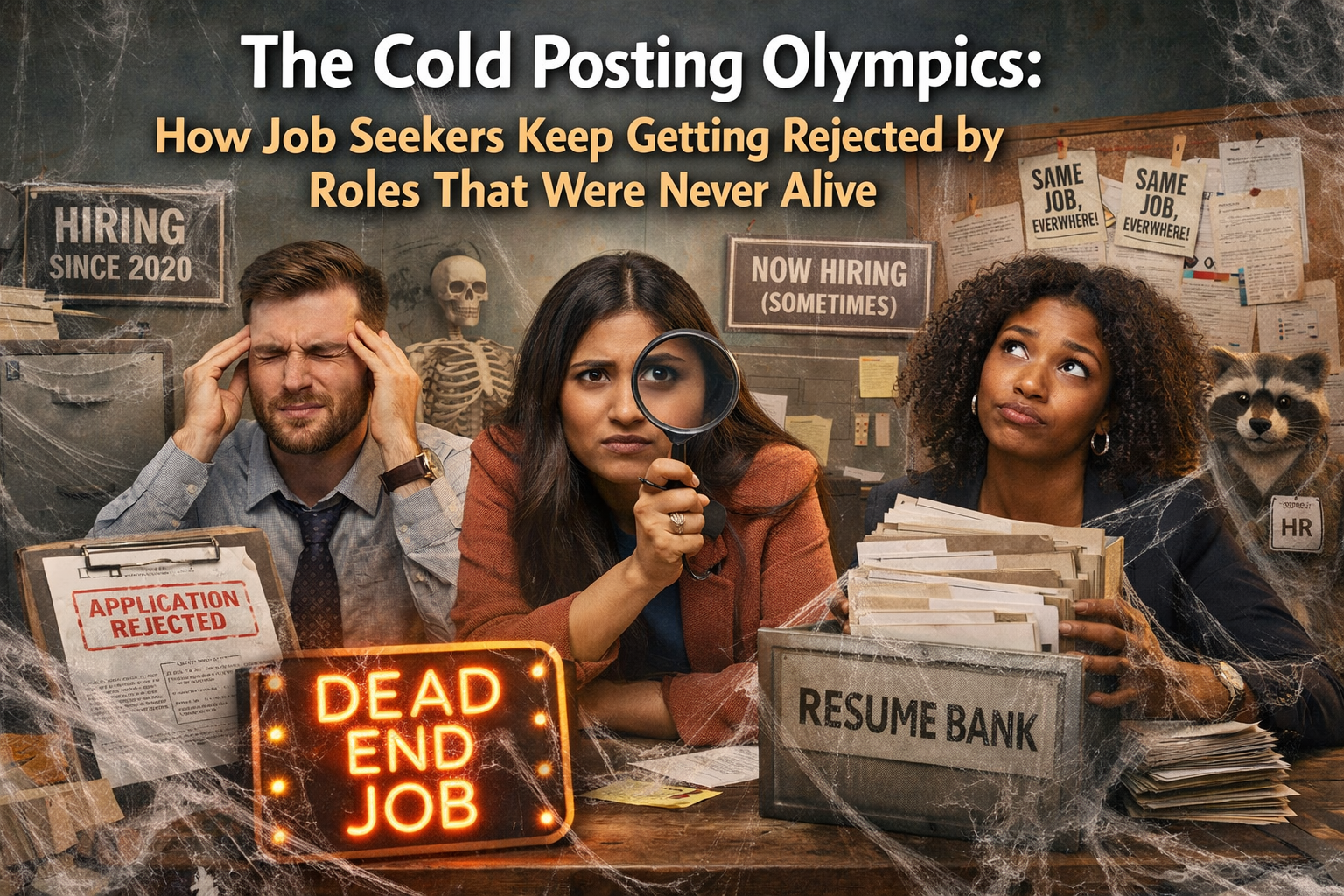
There is a special kind of rejection that doesn’t even feel personal, because it isn’t personal, and that’s exactly what makes it so insulting, because at least a personal rejection suggests there was a person on the other side of the table who looked you in the eyes, weighed your skills, and decided you weren’t the one, which is painful but honest, like being told you can’t come into a club because the bouncer thinks your shoes are ugly, whereas the modern job hunt is you confidently walking into a building that looks like a club, sounds like a club, has “WE’RE HIRING” neon in the window like a promise, and then discovering it’s an abandoned Sears with a single flickering lightbulb and a raccoon wearing an HR badge whispering, “Submit your résumé to the void, it helps the brand.”
Because most job seekers are not being rejected because they are missing some magical competency that only appears after you complete the eighteenth LinkedIn course titled Strategic Synergy in the Age of Strategic Synergy, and they are not being rejected because they didn’t use the exact right verb in bullet number three, and they are definitely not being rejected because they forgot to include that one skill that every listing demands but no one can define, which is “executive presence,” a phrase that sounds like a candle scent sold in the lobby of a Marriott; they are being rejected because they are applying to roles that are stale, duplicated, already filled, already frozen, already “active” only in the sense that the posting is still breathing on the internet like a ghost with Wi-Fi, and if you’ve ever wondered why you can do everything “right” and still feel like the universe is swatting your applications out of the air like beach balls at a concert, congratulations, you have met the cold role, the duplicate role, and the not-really-a-role role, and they are a trio that travels together like an annoying boy band of corporate nonsense.
And yes, it’s exhausting, because job searching is already a full-time job you’re not allowed to put on your résumé, and now we’ve added a second job on top of that job, which is becoming an investigative journalist who specializes in one beat only: figuring out whether the thing you’re applying to is an actual opportunity or a decorative listing posted for vibes, metrics, internal politics, or the comforting illusion that the company is growing even when it is quietly rearranging the deck chairs of headcount budgets like it’s the Titanic but with more stand-up meetings.
So if you’re feeling like you’re drowning in “rejections” that don’t even make sense, you’re not losing a skills contest, you’re stuck in a filtering contest, and the rules have changed while everyone is pretending they haven’t, which is why filtering isn’t optional anymore, it’s survival, and it’s also the only way to stop donating your energy to roles that were never going to call you back because they were never going to call anyone back, except maybe the CEO’s nephew who “networked” by being born.
Stale Roles and the Corporate Refrigerator of Dreams
A stale role is not a role that has been open for a long time because they’re being careful; a stale role is a role that has been open for a long time because it’s functionally dead, but the posting is still there like a leftover container in the back of the fridge that everyone keeps moving around because nobody wants to be the person who finally opens it and acknowledges what’s inside, and every week it quietly becomes more toxic while the company insists, “We’re still reviewing candidates,” which is corporate code for “We are keeping this listing up because removing it would require admitting something, and admitting things is not in our Q4 plan.”
You apply to a stale role and you do not compete against other candidates, because the only thing you are competing against is time, and time has already won, because the hiring manager already filled it, or decided they can’t fill it, or moved it to next quarter, or changed the scope into something unrecognizable, or got told by Finance that the budget is now a myth told to soothe recruiters at night, and somewhere in that chain of events nobody hit “close posting,” because the posting doesn’t live on their desktop as a real thing, it lives in a system that feeds other systems that feed job boards that feed aggregators that feed your Monday morning optimism.
And then the job seeker does the most human thing possible, which is believing the words on the screen, because the words on the screen look official, and the company logo is there, and there are responsibilities listed, and there is even a cheerful line about culture and values that implies a functioning organism, and you spend ninety minutes tailoring, refining, polishing, compressing your entire professional identity into a tidy document that can survive the ATS gauntlet, and you hit submit, and what you have actually done is place your résumé gently onto a conveyor belt that does not connect to anything, like you’re mailing a love letter to an address that was demolished two years ago, and the “rejection” you eventually get is not a judgment on you, it’s an automated courtesy note from a machine that has been trained to look polite while doing absolutely nothing.
This is why “apply early” has become the only advice that isn’t completely delusional, because early is when the role is warm, when the hiring manager is still nervous about the workload, when the recruiter still has a reason to respond, when the interview loop hasn’t gotten bloated with fifteen stakeholders who all want to “align,” and when the company is still operating under the fantasy that decisions can be made without a calendar invite titled “Decision-Making Sync.”
But “apply early” only works if you can tell the difference between early and dead-on-arrival, which is why filtering is now the skill, and the tragedy is that it’s a skill nobody teaches, because the entire economy of job boards depends on you believing that everything posted is real, and the minute job seekers get too good at spotting stale roles, half the internet loses its favorite hobby, which is posting jobs as if they are announcements of intention rather than evidence of action.
Duplicate Postings and the Mirror Maze of False Competition
Duplicate postings are the funhouse mirrors of job hunting, because they create the illusion of abundance while secretly shrinking the number of real opportunities you’re actually looking at, which is why you can scroll for an hour and feel like the market is “busy,” only to realize you have been seeing the same role wearing different hats, like a corporate version of that one actor who plays three characters in a movie and expects applause for the costume changes.
One company posts the same job in five cities even though it’s remote, because they want to catch candidates who only search certain locations, which is annoying but at least it has logic; another company posts the same job under three slightly different titles because internal teams can’t agree on what the role is called, which is already a red flag because if they can’t name it, imagine the onboarding; another company posts through multiple agencies and vendors, which means you might apply to the same role three times without realizing it, and now the ATS thinks you are either desperate, confused, or aggressively enthusiastic about their brand, and none of those is the vibe you intended to project.
Then there are the duplicates that are not even true duplicates, they’re “duplicates,” because the posting gets scraped and reposted and syndicated until it becomes job-board folklore, like a campfire story told with slight variations, and you apply to the variant that looks most real, and the application goes to a third-party black hole that doesn’t connect to the company at all, and later you see the exact same role on the actual company site and you wonder whether you should apply again, and you hesitate because job seekers have been trained to fear looking “spammy,” even though the entire system is literally built on spam, only it’s corporate spam, which gets called “distribution.”
This is how duplicate postings steal time, because they make you feel productive while you are repeatedly performing the same labor on the same target, and then you start to internalize the silence as feedback, because when you’ve applied to “twenty roles” and heard nothing, you assume the issue is you, when in reality your “twenty roles” were actually seven roles in a trench coat pretending to be a bustling market.
The emotional damage here isn’t just the wasted effort, it’s the erosion of trust, because the job seeker starts to feel like their own judgment is broken, like they’re bad at reading reality, like they’re behind some secret curve everyone else understands, when really the truth is that the system is designed to look like motion even when nothing is moving, because motion attracts applicants, applicants attract data, data attracts internal “pipeline” reporting, and pipeline reporting attracts leadership applause, and leadership applause is the only renewable energy source in corporate America.
So you want a survival mindset, you start treating duplicates like noise, and you become ruthless about counting unique opportunities rather than postings, because postings are confetti, and your time is not.
“Openings That Aren’t Actively Hiring” and the Corporate Hobby of Pretend Growth
Now we reach the most demoralizing category, which is the opening that is not actively hiring, because this isn’t just a stale posting that nobody cleaned up, and it isn’t just a duplicate created by distribution; this is a posting that exists as a strategic object, like a prop in a play, and your application is not entering a hiring process, it is being collected for reasons that have nothing to do with filling the seat you thought you were applying for.
Sometimes it’s resume banking, which is when a company is “always hiring” in the same way a person is “always open to love,” meaning they are not actually going on dates, but they want to keep the option alive for the future, so they create a listing to collect candidates, not because there is a vacancy today, but because they don’t want to scramble later, and from a business perspective it makes sense, but from a human perspective it feels like being asked to audition for a role in a movie that hasn’t been greenlit, which means you’re spending your energy proving yourself to a production that may never exist, while you still have rent due in a world that does, in fact, exist.
Sometimes it’s internal politics, where a hiring manager posts a role to prove a point, or to demonstrate need, or to pressure leadership, or to signal “we are growing,” and the job seekers become the supporting cast in an argument they didn’t consent to join, because the manager can now say, “Look at all these applicants, this role is necessary,” while never actually being allowed to hire anyone, and when you don’t hear back, you assume you lost, but really you were never in the game, you were just a statistic in someone else’s PowerPoint.
Sometimes it’s compliance theater, where a company already knows who they want, often an internal candidate, sometimes a referral, sometimes the CEO’s neighbor’s cousin’s dog walker who “really showed initiative,” but they still post externally because policy demands it, and you apply and you are technically considered, in the same way a lottery ticket is technically a retirement plan, and then you get rejected after the role closes with breathtaking speed, and the company says, “We have decided to move forward with other candidates,” which is true if you consider “other candidate” to mean “the one they already chose before you ever clicked apply.”
And the part that makes job seekers furious is not that companies have internal candidates, because internal mobility is normal and often good; the part that makes job seekers furious is the masquerade, the performance of openness, the insistence that your time was requested in good faith when really you were being used as a line item in the narrative, which is why people start to feel cynical, and tired, and suspicious of everything, and then someone on LinkedIn tells them to “stay positive,” and they briefly consider setting their laptop on fire and walking into the woods to become a folk legend who only communicates via handwritten rejection letters sent to CEOs.
So yes, openings that aren’t actively hiring are the silent killers of morale, because they look like hope, and hope is expensive, and the bill always comes due.
Final Thoughts: Filtering Isn’t Optional, It’s the Only Way to Stay Sane While the System Pretends It’s Functional
If you are a job seeker right now and you feel like you are doing everything you were told to do, and you are showing up with skills, and you are tailoring, and you are networking, and you are trying to be both confident and humble in the exact proportions that the internet demands, and yet your applications are disappearing into silence like you’re throwing paper airplanes into a hurricane, you are not imagining it, because the job hunt has quietly shifted from a skills marketplace into a signal-detection problem where your first task is determining whether the job is real, warm, funded, and actively moving, and only then do your skills actually matter, which is why it feels like you’re being “rejected” when you’re really just bouncing off dead listings, duplicates, and corporate props that were never designed to produce an offer.
And the hard truth, the kind that doesn’t fit neatly into a motivational caption, is that a lot of your effort is being consumed by noise, and noise is not neutral, because noise costs time, and time costs hope, and hope costs energy, and energy is the resource you cannot replace with a better résumé template, which is why filtering has become the real career skill, because the job seeker who learns how to identify freshness, legitimacy, and momentum will outperform the job seeker who simply applies harder, faster, and more often, and not because they are better, but because they are no longer donating their life force to roles that were cold before they ever arrived.
So if you take anything from this, let it be this: your job is not to apply to everything, your job is to find the small number of roles that are actually alive, and then show up like a professional with a pulse and a point of view, because the market is not rewarding volume anymore, it is rewarding precision, and precision starts with the willingness to stop treating every posting like a promise, and start treating it like a clue, because survival in this system isn’t about being more qualified, it’s about being more selective, and that is not you being “picky,” that is you refusing to audition for ghosts.