It all started the way most modern tragedies do, with Wi-Fi, delusion, and a fresh cup of coffee that went cold faster than my optimism. I was sitting at my desk, resume open, LinkedIn glowing, and Spotify softly playing a “Focus for Professionals” playlist that has now become my personal soundtrack for rejection. Somewhere between my third espresso shot and my fifteenth rewording of “team player,” I realized something: the job hunt isn’t a career phase anymore. It’s a lifestyle. A full time unpaid internship in emotional resilience.
I used to think applying for jobs was a transactional process. You submit a resume, maybe a cover letter, and if the universe is kind, a human being reads it. Now? It’s a dystopian talent lottery where 400 applicants enter, one gets a callback, and the rest get emotionally vaporized by the words “We’ve decided to move forward with other candidates.” You don’t even get closure. Just a corporate haiku written by a robot:
“We appreciate your interest. You are not the chosen one. Best of luck elsewhere.”
That’s when I knew this wasn’t a job search anymore, it was performance art. A ritual of self-expression carried out in professional fonts and desperate optimism. So I did what anyone in my position would do: I turned my misery into a cinematic universe.
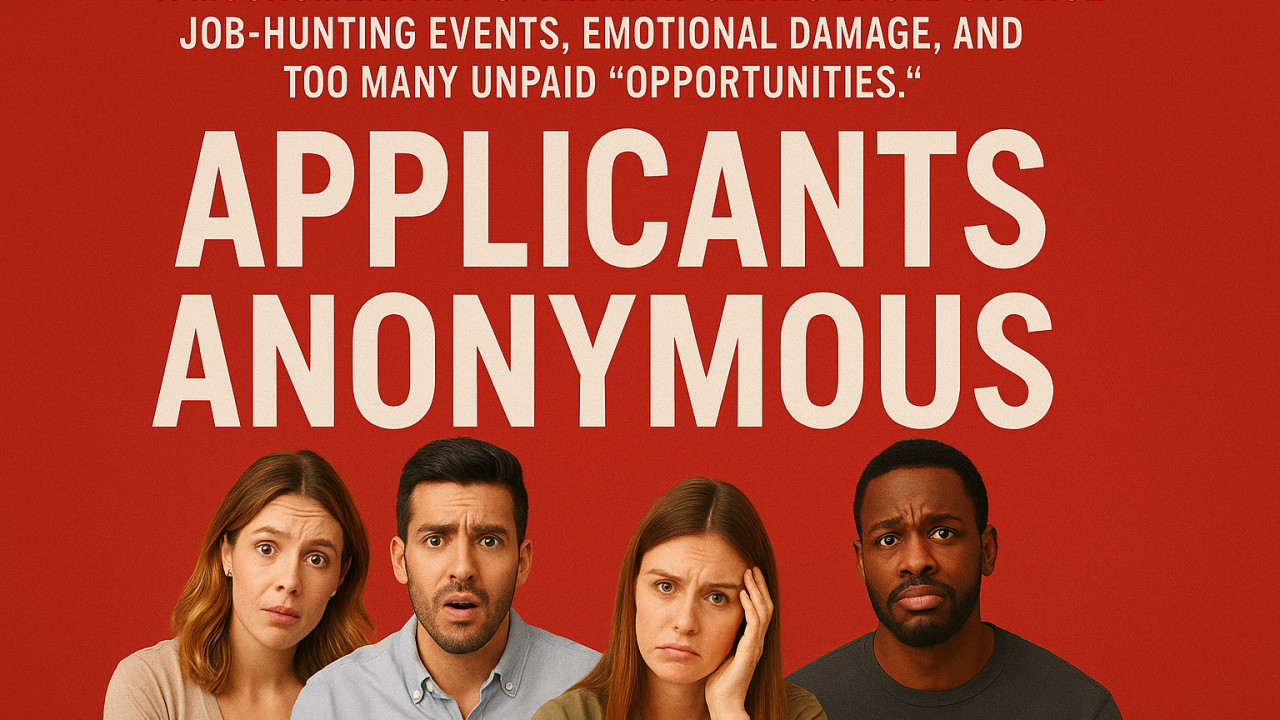
Thus was born Applicants Anonymous — a Netflix style mini- eries starring the greatest characters ever produced by LinkedIn and late stage capitalism: Sally, the HR crusader with a moral compass and a caffeine addiction; Jose A. Calves, Esq., the self-appointed legal defender of the unemployed; Keith, the professional optimist who refuses to give up on “manifestation”; and me, your narrator, the person who accidentally discovered that a blank cover letter could go viral and get thanked by recruiters.
Every episode begins the same way, with hope, coffee, and a delusion that “this application feels different.” And every episode ends with reality: a polite rejection, a spreadsheet of despair, and a group chat full of memes labeled “coping mechanisms.”
Welcome to our story, where unemployment meets unfiltered comedy, and the dream job remains the ultimate unsolved mystery.
Episode 1: Sally and the 87 Applications of Doom
It’s Monday morning, and Sally is already at war. Not with people, with platforms. Indeed, LinkedIn, ZipRecruite — she’s opened so many tabs that her computer fan sounds like it’s about to lift off. She’s been unemployed for four months but refuses to call it that. “I’m in career limbo,” she insists. Her version of self-care is rewriting her cover letter every morning like a love note to capitalism.
She sits in her kitchen turned office, hair in a bun that says “productivity,” pajamas that say “defeat,” typing furiously: “Dear Hiring Manager…” because, as always, the name is hidden behind a wall of corporate mystery. She’s applying for jobs she wants, jobs she doesn’t want, and jobs she’s pretty sure are fake. There’s one company that’s posted the same opening six times in two weeks. She applies every single time, just to prove a point.
By noon, she’s applied to eighty seven jobs. She’s proud. Then, at 12:07 p.m., her inbox pings. It’s a rejection from one of those applications. Timestamp? Three minutes after she submitted it. She stares at the email like it just slapped her across the soul.
“We’ve decided to move forward with other candidates.”
Sally blinks, mutters something about karma, and throws her coffee spoon into the sink with the quiet rage of a woman on the brink. Then she opens her group chat and types, “Got rejected in under five minutes. That’s a new record.”
Keith replies: “Speed is efficiency. They’re just helping you move on faster 🌈.”
José replies: “Legally, that’s defamation of potential.”
Sally doesn’t respond. She just posts a meme of a raccoon holding a coffee cup and whispering, “Maybe next week.”
That night, she tapes a note to her fridge that reads: “Keep applying. One day, HR will develop empathy.” Cue sad violin.
Episode 2: Jose A. Calves, Esq. — The Lawyer Who Sued the Algorithm
Across town, Jose is in his apartment, surrounded by legal textbooks, scented candles, and what he calls “evidence.” He’s wearing a suit jacket, pajama pants, and the haunted look of a man who has read one too many job descriptions that start with “we’re like a family.”
Jose has declared war on the modern hiring system. He’s drafting a lawsuit — Jose A. Calves vs. The Applicant Tracking System (ATS) — citing emotional trauma, time theft, and “intentional ghosting with malice.” He argues that no human could read 437 applications in 20 minutes, and therefore, justice demands accountability.
“Your honor,” he says dramatically to his cat, “the defendant, also known as ‘the system,’ has systematically filtered out my resume for failing to include the word ‘synergy.’ This is discrimination against authenticity.”
Every rejection fuels him like espresso. When recruiters ghost him, he writes cease and desist letters. When he sees “must be comfortable with a fast paced environment,” he highlights it and writes in red pen: “Translation: Chaos. Poor management. Emotional damage.”
But Jose’s true superpower is his LinkedIn presence. Every post reads like a monologue from Law & Order: HR Unit.
“The hiring process has become a game of emotional roulette, and yet we keep playing — because rent, like rejection, waits for no one.”
His followers adore him. HR professionals block him. Recruiters fear him. He’s the Batman of job seekers, not the hero they want, but the one they deserve.
Before bed, he looks out the window, whispers, “Justice will be served, preferably with benefits,” and takes a sip of boxed wine like it’s victory champagne.
Episode 3: Keith — The Motivational Speaker Who Motivates No One
Every cinematic universe needs comic relief, and Keith provides it in abundance. His weapon of choice? Toxic positivity wrapped in Canva quotes. He’s been “between opportunities” since 2018 but treats unemployment like a personal growth retreat.
He wakes up at 5:30 a.m. every day because “discipline breeds destiny.” Then he spends the next hour journaling, meditating, and staring at his vision board, which features Oprah, a Tesla, and the words “Dream Job: TBD.”
Keith applies for jobs like he’s entering a raffle. He keeps a color-coded spreadsheet titled “Journey to Greatness.” When he gets rejection emails, he doesn’t get discouraged, he gets inspired.
“They said they were impressed. That’s a win!”
His LinkedIn activity is relentless. Every post starts with “Feeling grateful today 🙏” and ends with “Who’s hiring?” He once went viral for writing, “Rejection is redirection and sometimes redirection comes with better snacks.”
Sally finds him exhausting. Jose calls him “spiritually delusional.” But deep down, they both need him. Because when the job hunt feels like drowning in a sea of buzzwords, Keith somehow finds the rainbow colored life raft.
He ends every night with a motivational speech to himself in the mirror:
“You are not unemployed. You are pre-employed.”
The mirror cracks slightly.
Episode 4: The Group Chat Strikes Back
It’s Friday night. The group chat, titled Unemployed but Unbothered (Mostly) — is active. Sally’s venting, Jose’s ranting, and Keith’s sending GIFs of pandas doing yoga. I’m there too, sipping my cold brew and reading their chaos like it’s my favorite reality show.
Sally: “Got ghosted again.”
Jose: “Name them.”
Keith: “Maybe they’re just manifesting the right time to reply ✨.”
That’s when I propose something outrageous:
“What if we all apply to the same company, with the same blank cover letter?”
The group goes silent for five seconds, then erupts.
Jose: “As a statement of defiance.”
Sally: “As a social experiment.”
Keith: “As an art piece.”
And so, The Great Upload begins. We each attach the same empty Word document — no greeting, no paragraph, no lies about “strong communication skills.” Just a clean, blank page. Pure rebellion.
The next morning, all four of us get identical responses:
“Thank you for taking the time to upload your cover letter.”
We stare at our screens in disbelief, then burst out laughing. It’s absurd. It’s beautiful. It’s freedom. For once, the rejection feels like victory.
Sally raises her mug and says, “To everyone who’s ever been ignored by HR, may our blank pages speak louder than their buzzwords.”
Jose clinks his glass. Keith smiles like he just discovered enlightenment. And me? I sit back, grinning, because in that moment, the job hunt became art.
Cue the Netflix “dun-dun.”
Episode 5: The Callback That Never Was (Season Finale Energy)
The story begins, as all tragic comedies do, with hope. It’s been six weeks since The Great Blank Cover Letter Experiment. The group chat “Unemployed But Unbothered (Mostly)” has evolved into a full-fledged support group complete with memes, Monday check-ins, and a collective spreadsheet titled “Rejections That Shaped Us.” Sally’s added color coding, red for heartbreak, yellow for confusion, and green for “almost got it but lost to the CEO’s nephew.”
And then… it happens. Sally gets an email. Subject line: “Next Steps in the Hiring Process.”
The group loses it. Jose drops his coffee. Keith lights a candle. I refresh the group chat like it’s the Super Bowl. Sally’s typing bubble keeps appearing and disappearing like she’s negotiating with destiny. Finally, she sends a screenshot, it’s a legitimate recruiter from a legitimate company, and they actually want to schedule a real interview.
Jose immediately starts preparing her legal strategy (“Do not speak without recording the call. Emotional liability is real”). Keith begins manifesting through interpretive dance and motivational audio affirmations. I, ever the realist, just say, “Make sure your Wi-Fi doesn’t betray you.”
The big day arrives. Sally’s outfit screams “professional but approachable.” Her Zoom background is perfectly curated, one strategically placed plant, one motivational quote that reads ‘You Got This’ (even though she doesn’t believe it). She logs in five minutes early. Camera on. Microphone working. Vibes immaculate.
And then, the recruiter appears, smiling, professional, and clearly multitasking on six screens. “Hi, Sally! Thanks for joining. Before we begin, just a quick note, this position has been paused for internal restructuring, but we still wanted to meet you!”
Everyone in the group chat feels the spiritual earthquake. Paused. For internal restructuring. The phrase hits harder than any breakup. Sally smiles through the pain, her voice cracking like a motivational podcast host on the edge:
“Of course! I completely understand. I love that you’re being… transparent.”
The recruiter nods sympathetically, which only makes it worse. Sally’s plant leans slightly, as if even it’s lost the will to photosynthesize.
After the call, she joins the group chat, where we’re already drafting condolence memes.
Jose writes, “This is actionable trauma.” Keith responds, “This is character development.” I write, “This is why Netflix needs to buy the rights immediately.”
Because honestly, at this point, Applicants Anonymous isn’t just a story, it’s a movement. The world deserves to see Sally, Jose, and Keith on-screen, navigating the absurd chaos of modern job hunting like it’s The Office meets Black Mirror.
Imagine the trailer: 🎵 Slow piano music plays. Narrator: “In a world where effort is optional and HR is automated…” Cut to Sally: “I once wrote a 600 word cover letter for a company that didn’t exist.” Cut to Jose in a suit: “I sued the algorithm. I lost.” Cut to Keith with a whiteboard: “Step one: believe. Step two: cry.” Smash cut to dramatic title: “Applicants Anonymous, streaming nowhere, because nobody’s been hired yet.”
The group agrees: the only logical next step is to turn the job hunt into a series pitch. Sally drafts the concept deck on Canva (“I’m using my transferable skills”). Jose files an LLC (“For emotional protection”). Keith starts writing the tagline:
“When your career hits rock bottom, at least make it binge worthy.”
We submit it to Netflix, and for the first time, we get an auto-response that doesn’t start with “Unfortunately…” It says: “Thank you for your submission. Our team will review and get back to you.”
We all scream. Keith starts crying into his vision board. Jose declares, “We’ve entered the narrative.”
Weeks later, we still haven’t heard back, but honestly, that’s fitting. The silence? The suspense? It’s poetic. It’s the truest ending of all. Because if Hollywood has taught us anything, it’s that the best shows end on a cliffhanger.
So as the credits roll, Sally sips her coffee, opens LinkedIn, and mutters:
“Season Two: The Interview Loop.”
Cue dramatic orchestral music.
Now streaming in our imaginations, because Netflix hasn’t called yet.