
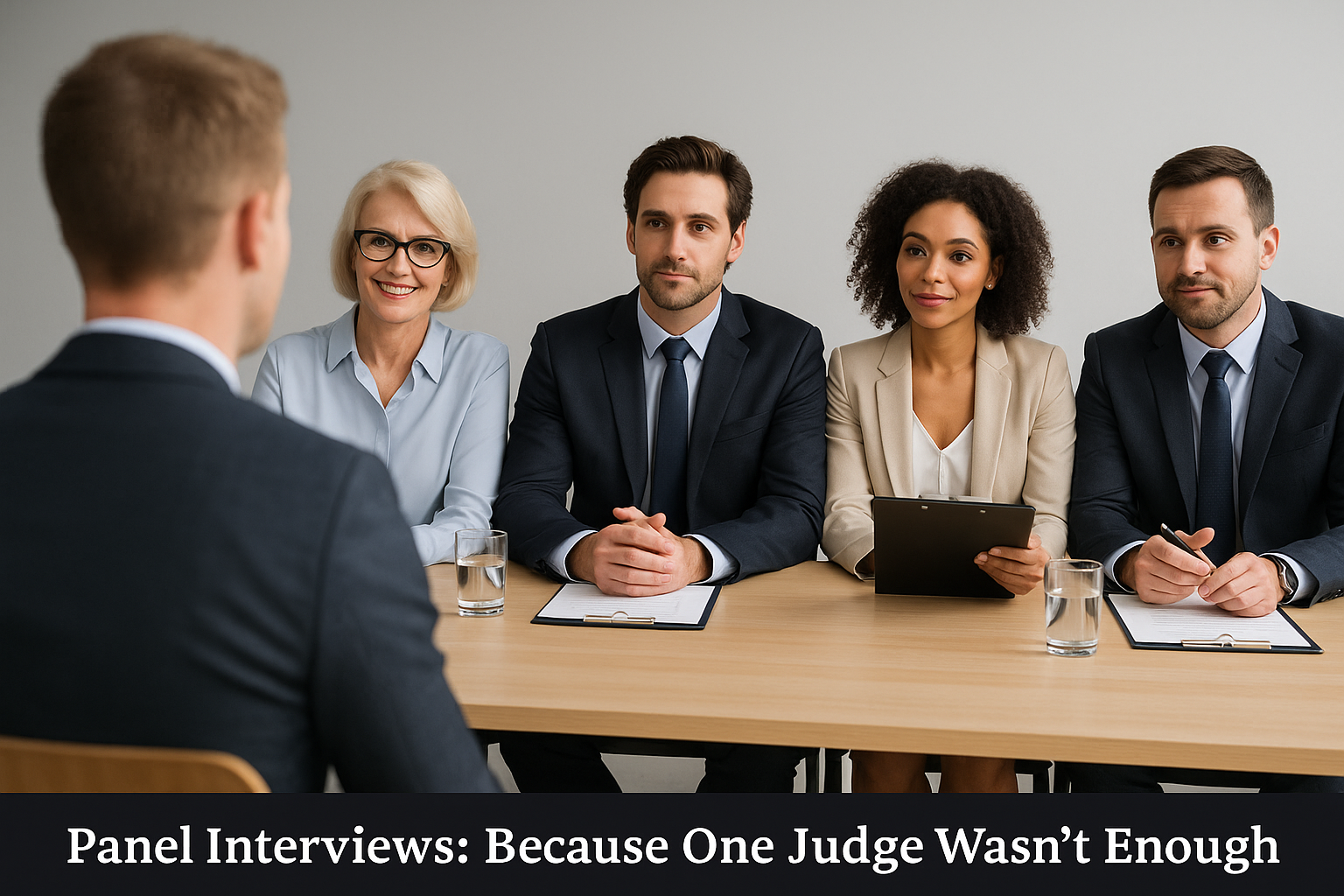
You’ve survived résumé roulette, conquered the online application labyrinth, and even charmed the recruiter who promised to “get back to you soon.” And now, dear job seeker, you stand at the gates of the final arena — the panel interview. The term alone sounds like something out of a medieval court or an episode of Shark Tank: five strangers with notepads and polite smiles, silently deciding your professional worth based on how well you can answer “Tell us about yourself” without crying.
Panel interviews exist because someone in HR once said, “Why have one person assess a candidate when we can make it a group project?” You’ll walk in armed with your best outfit, a desperate smile, and three rehearsed fun facts, only to realize you’re facing an audience that includes the hiring manager, a random intern, someone from accounting who just wanted free coffee, and a senior VP who hasn’t updated their résumé since Windows 95.
Each one has a different agenda. One’s judging your teamwork skills, another your technical ability, one’s just here to observe your body language like it’s a nature documentary. The result? You’re playing emotional chess while they collectively take notes on whether you made “sufficient eye contact with all parties.” Congratulations — you’ve entered the gladiatorial stage of job hunting. There are no lifelines. Only judgment.
The Circle of Smiles and Sudden Death
The first few moments of a panel interview feel eerily like meeting your partner’s entire family at once. Everyone’s smiling, but you know deep down at least one person already hates you — you just don’t know who yet. You shake hands, thank them for their time, and sit in the chair that suddenly feels like it’s made of guilt and polyester.
Then comes the classic warm-up question: “So, what brings you here today?” You want to say “Capitalism and a need for health insurance,” but instead you deliver your pre-rehearsed answer about passion, growth, and wanting to “make an impact.” As you speak, your eyes dart from face to face, trying to distribute attention equally like a confused sprinkler system.
One panelist nods approvingly. Another scribbles something down (never a good sign). One checks their phone, and you try not to interpret it as a sign from God. By the time you’re halfway through your response, you’ve forgotten your own name, career goals, and the meaning of happiness.
Panel interviews are less about testing your qualifications and more about testing your emotional endurance. Can you maintain confidence while six people silently stare at you, each radiating a different kind of skepticism? It’s less an interview and more a personality stress test disguised as professionalism.
And let’s not forget when they ask questions in rapid-fire succession. “Tell us about a time you faced a challenge.” “What are your weaknesses?” “How do you handle conflict?” “If you were a fruit, which one would you be?” You start answering one, get interrupted by another, and end up explaining how being a pineapple symbolizes leadership.
The Hunger Games: Corporate Edition
Somewhere around minute twenty, you realize this isn’t an interview — it’s a social experiment. The panelists are less like coworkers and more like judges on a dystopian reality show. You’re the contestant, and your performance will determine whether you’re employed or spending another three weeks refreshing Indeed.
Every panel has archetypes. There’s The Silent One, who says nothing and makes you paranoid. There’s The Friendly One, whose laughter feels like mercy. Then there’s The Devil’s Advocate, who interrupts every answer with “But what if that didn’t work?” You’ll also meet The Senior Executive, who joins halfway through, asks one vague question about “vision,” and then leaves early because they “have another meeting.”
Half the time, the panelists haven’t even read your résumé. You’ll reference an achievement, and someone will say, “Oh, interesting, I didn’t see that.” You resist the urge to respond, “It’s literally the first bullet point.” Instead, you smile like a hostage and elaborate enthusiastically.
Then comes the group discussion phase — not among them, but with you. One person disagrees with another’s interpretation of your answer, and you just sit there like a bystander at your own trial. You start to realize that this is less about you being a good fit and more about whether these people can agree on anything at all.
The worst moment? When they say, “We’ll be comparing you to other candidates.” Translation: there’s someone else who also pretended to love teamwork and “thrives under pressure,” and your only chance of survival is to smile harder.
After the Panel — The Post-Mortem of Sanity
When it’s finally over, they all smile, thank you for your time, and say those cursed words: “We’ll be in touch soon.” You shake hands again, trying to maintain dignity despite the puddle of stress sweat forming under your collar. Then you walk out, replaying every sentence in your head like a bad movie. Did you talk too much? Too little? Did you forget someone’s name? Did you accidentally agree to relocate to Nebraska?
By the time you reach your car, you’ve convinced yourself you either nailed it or destroyed your entire professional reputation. There’s no middle ground. You open your email obsessively for days, hoping for the subject line that reads, “Next Steps.” Instead, you get silence — that haunting void known as corporate purgatory.
Weeks later, you’ll get a short email: “Thank you for your time. We’ve decided to move forward with other candidates.” You’ll stare at it like an ancient prophecy, trying to decipher which one of the five panelists hated you enough to write that line.
Panel interviews are where optimism goes to die. You start out believing in the idea of meritocracy and end up understanding that your fate was decided by a spreadsheet and a “team vote.” You’ll never know whether you lost points for fidgeting, for saying “um” too often, or for simply existing in the same world as another applicant who brought color-coded charts.
Final Thought: The True Test Was Surviving It
Panel interviews aren’t about finding the best candidate. They’re about endurance — emotional, psychological, and spiritual. If you can survive forty-five minutes of synchronized judgment from multiple directions while maintaining eye contact and pretending to love “collaboration,” you can survive anything corporate America throws at you.
So if you’ve been through one, congratulations. You’re no longer just a job seeker — you’re a veteran of the corporate coliseum. And one day, when you’re finally on the other side of the table, remember what it felt like to face the firing squad. Smile, offer water, and resist the urge to ask, “If you were a fruit, which one would you be?”
Because in the end, panel interviews aren’t about evaluation — they’re about entertainment. And the only thing more corporate than teamwork is watching someone else sweat under fluorescent lights while trying to sound “passionate about synergy.”