
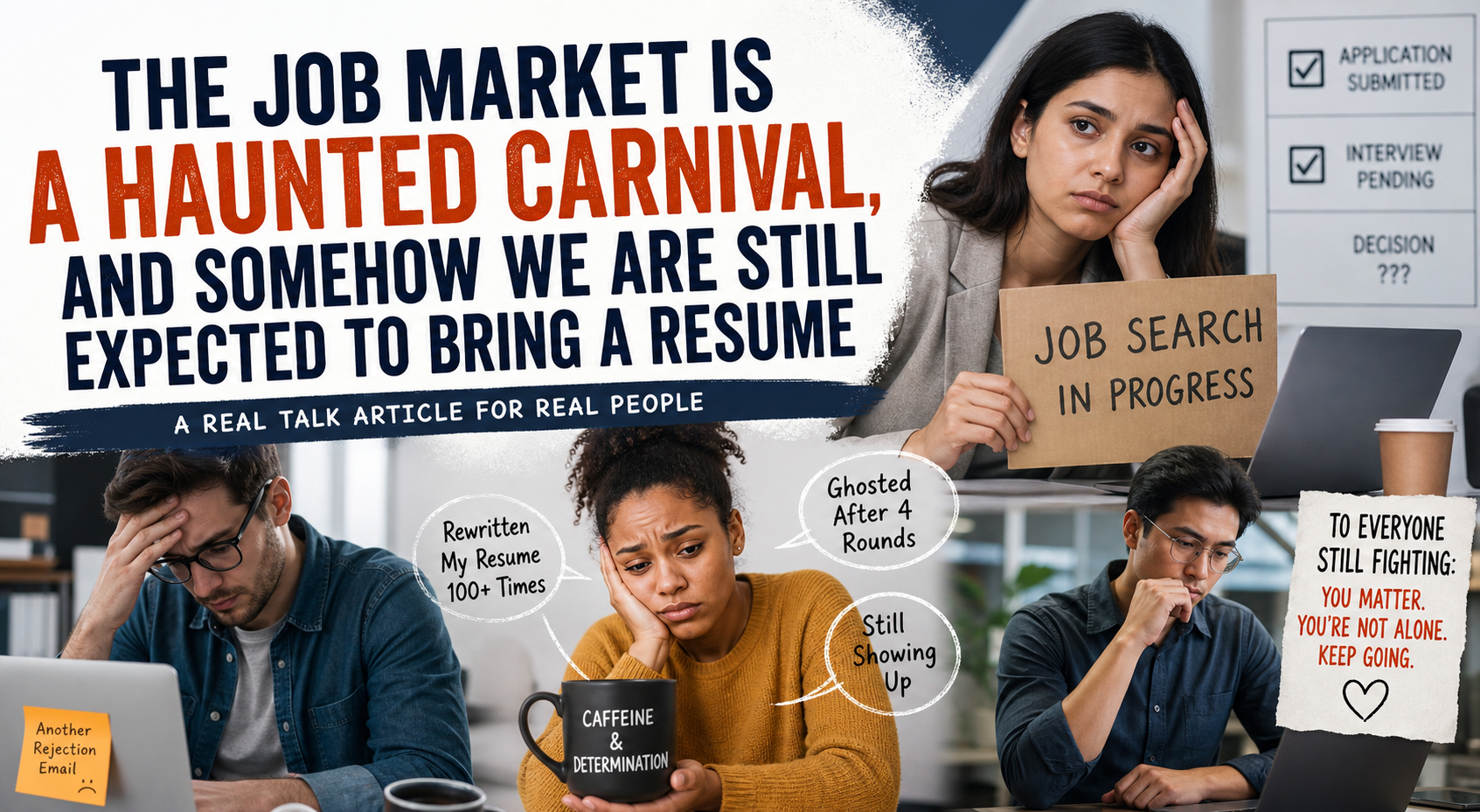
To everyone looking for a job right now, I know you are tired in places coffee cannot reach, and I do not mean the cute kind of tired where someone says, “I need a nap,” then curls up under a blanket like a lifestyle influencer sponsored by emotional regulation. I mean the deep, ancient, password-reset tired that settles into your bones after you have applied to so many jobs that LinkedIn starts recognizing you not as a person, but as a returning weather pattern. I mean the kind of tired where your laptop opens and you immediately feel like you are entering a courtroom, a casino, and a DMV at the same time, except somehow the DMV has better communication.
Job searching has become a full-contact emotional sport performed under fluorescent lighting by people pretending they are “excited to connect” while internally negotiating with their nervous system like it is a disgruntled union. You wake up, open the computer, and there it is again: the same circus tent, the same clown car, the same job description written by a committee of people who clearly met once during a fire drill and decided the ideal candidate should be strategic, tactical, visionary, humble, aggressive, collaborative, independent, data-driven, emotionally intelligent, able to lift forty pounds, fluent in Salesforce, and willing to accept “competitive salary,” which apparently means the compensation package is in witness protection.
And still, you try.
You rewrite your resume until it stops looking like a record of your career and starts looking like a hostage note assembled from action verbs. You “tailor” it for each company, which is a polite way of saying you rearrange your professional life into whatever shape the algorithm appears to be worshipping this week. You upload the document. Then, because the applicant tracking system was built by someone who clearly lost a bet with humanity, you retype the entire thing into tiny boxes that ask you to confirm whether you worked at the company you just listed, during the dates you just listed, in the role you just listed, doing the responsibilities you just listed, while somewhere in the background a server named Kevin decides your career does not have enough keywords to be loved.
Then comes the rejection email.
“After careful consideration.”
Careful? Please. The only thing carefully considered was how quickly they could automate the sentence without accidentally sounding human. That email flew out so fast it should have had a spoiler alert. You applied at 10:02. You were rejected at 10:04. Somewhere, a robot skimmed your resume like it was a terms-and-conditions agreement and said, “Unfortunately, we have decided to move forward with candidates whose souls more closely match the spreadsheet.”
And yet the strangest part is that rejection is not always the worst part. Sometimes the worst part is hope. Hope is where they get you. Hope walks in wearing business casual and says things like, “We loved speaking with you,” and “You are a strong candidate,” and “The team was really impressed,” and suddenly you are sitting there imagining health insurance, direct deposit, and a future where your checking account stops looking like it is holding its breath. Then they disappear so completely you begin to wonder if the company was ever real, or if you interviewed with a very organized ghost.
That is the emotional violence of the modern job search. Not just the no. The almost. The maybe. The “we will be in touch soon,” which apparently means after the next solar eclipse, two leadership restructures, and a recruiter leaves to become a wellness coach on Instagram.
The Resume Is Now a Legal Deposition With Fonts
There was a time when a resume was supposed to be a simple document explaining who you are, where you have worked, what you have done, and why someone should maybe invite you into a building without making you prove your personality through five assessment games and a one-way video interview recorded in your kitchen like a hostage proof-of-life tape.
Now your resume has become a sacred offering to the hiring gods, and nobody can agree what they want from it. One expert says it should be one page. Another says two pages. Another says it must be formatted for ATS. Another says it must tell a story. Another says it must show metrics. Another says it must not look too designed. Another says it must stand out. Another says standing out is dangerous because the system might reject it for having a line break with self-esteem.
So you revise it. Again. You remove the summary. Then you add the summary. You take out “results-driven” because apparently that phrase has committed crimes. You add numbers. You change “managed” to “led.” You change “led” to “owned.” You change “owned” to “spearheaded,” then immediately feel like a medieval knight applying to a SaaS company. You spend forty-seven minutes debating whether “cross-functional collaboration” sounds professional or like something people say right before scheduling a meeting that could have been a text message.
And then, after all that, you upload it to a company website that says, “Great, now please manually enter your entire work history.”
That moment should qualify as psychological warfare.
You sit there retyping your life into a portal that has the emotional warmth of a parking ticket. Company name. Job title. Start date. End date. Responsibilities. Reason for leaving. Salary expectations. Cover letter. Diversity questions. Veteran status. Disability status. Are you legally authorized to work? Will you now or in the future require sponsorship? Are you willing to relocate? Are you willing to commute? Are you willing to give a small piece of your soul to Oracle Taleo in exchange for a confirmation email?
And after doing all of this, the system still asks if you would like to upload your resume.
Sir, I already did. That resume is the reason we are both here.
Then there is the cover letter, which is just emotional fan fiction for a company that may reject you before lunch. “Dear Hiring Manager, I have long admired your organization’s commitment to innovation,” you write, despite learning about the company twelve minutes ago from a job board and a Glassdoor review that said, “Run.” You try to sound enthusiastic but not desperate, confident but not arrogant, warm but not weird, professional but not dead inside. You write, “I am excited about the opportunity,” when what you really mean is, “I would like to exchange labor for money before my bills form a committee.”
And the entire time, you are told to be authentic.
Authentic? In this economy? During an application process where the company uses a robot, a personality test, a keyword scanner, and a recruiter who messages you “Happy Monday!” before vanishing into the corporate fog? Authenticity is apparently required from candidates, but optional for employers. You must be transparent about your gaps, your goals, your strengths, your weaknesses, and where you see yourself in five years, while the company gets to say the salary is “competitive,” the culture is “fast-paced,” and the role is “hybrid,” which may mean three days in office, four days in office, every day in office, or spiritually remote from a desk under a vent.
The resume is no longer just a resume. It is a survival document. It is a confession booth. It is a tiny museum of your professional life arranged in bullet points for a system that may or may not know how to read.
And still, you keep updating it, because some part of you still believes the right person will finally see the human behind the formatting.
That part of you is not foolish.
That part of you is brave.
Possibly exhausted, slightly over-caffeinated, and one rejection email away from naming your laptop “Traitor,” but brave.
The Interview Process Has Become a Reality Show Without Prize Money
The interview process used to be simple in theory. Someone liked your resume. They called you. You talked. Maybe there was a second conversation. Maybe you met a manager. Then either they hired you or they did not, like adults participating in a shared social contract.
Now the interview process has become a limited series on a streaming platform nobody subscribed to.
First, there is the recruiter screen, where someone asks you to walk them through your background even though your resume is sitting right there like an unpaid witness. You do it anyway. You smile. You explain your career journey with the energy of a person trying not to sound like they have repeated this story so many times it now has seasonal depression. The recruiter says you have a “great background,” which is nice, although in job search language that phrase can mean anything from “you are moving forward” to “I am about to place your hopes gently into a shredder.”
Then comes the hiring manager interview. This is where you try to determine whether the job is real, whether the manager knows what they want, and whether the role has been open for eight months because they are searching for a unicorn ninja who can rebuild the department, fix morale, mentor the team, automate the CRM, reduce churn, increase revenue, create strategy, execute strategy, and be “comfortable with ambiguity,” which is corporate language for “the last person quit during lunch.”
You ask thoughtful questions. They answer with phrases that sound expensive but mean nothing. “We are looking for someone who can come in and take ownership.” Ownership of what? The job? The process? The haunted basement where this role has been living since Q2? Then they say the environment is “dynamic,” and suddenly you hear boss music.
If you survive that, you get the panel interview, which is really just a professional dinner party where nobody brings food and everyone asks you a different version of the same question. One person joins late. Another keeps their camera off. One person clearly has not read your resume. Someone asks you about a job from 2014 like they are investigating a cold case. Someone else asks, “Can you tell us about a time you dealt with conflict?” and you resist the urge to say, “Yes, right now, internally, with this process.”
And still, you perform.
You sit there in your nice shirt, which is paired with emergency sweatpants beneath the camera line, nodding like your Wi-Fi is stable and your soul is hydrated. You say things like, “That is a great question,” even when the question is not great, not new, and may have been printed from a leadership blog in 2009. You describe your strengths without sounding like you are bragging. You describe your weaknesses without giving them ammunition. You tell stories using the STAR method until your life becomes Situation, Task, Action, Result, Trauma.
Then comes the assignment.
Ah yes, the take-home assignment, also known as unpaid consulting in a trench coat. They say it should only take “a few hours,” which is adorable, because a few hours in employer language is anywhere between one evening and the complete collapse of your weekend. They ask you to build a strategy, analyze data, create a presentation, solve a real business problem, and provide recommendations, all before they have even decided whether your salary expectations are illegal in their budget religion.
You do it because you want the job. You put effort into it because you care. You make slides. You research. You think. You polish. You send it in.
Then silence.
Not even a “thank you.” Not even a “we received it.” Not even a carrier pigeon with a branded hoodie. Just nothing. A void. The kind of silence that makes you check your sent folder, your spam folder, your internet connection, your life choices, and whether Mercury is doing something disrespectful again.
And if they do respond, sometimes it is weeks later with, “We decided to move forward with another candidate,” which is fine, except you would like your weekend back, your intellectual property returned, and perhaps a small fruit basket from the executive team for the emotional labor.
The cruelest part is how often they make you feel close. Third round. Fourth round. Final round. Meet the team. Meet the director. Meet the director’s director. Meet the person who once parked near the CEO. Everyone says nice things. They ask when you can start. They discuss next steps. They tell you they are “wrapping things up.”
Then the role gets reposted.
That repost is a special kind of insult. It is the hiring equivalent of being ghosted, then seeing your ex back on the apps with the caption “Looking for someone honest.” You stare at the posting like it owes you money. Same title. Same responsibilities. Same “urgent need.” Same cheerful language about culture and growth. Meanwhile, you are over here holding four interviews, one assignment, and a customized cover letter like evidence at a trial.
This is why job seekers are tired.
Not because they do not want to work. Not because they lack motivation. Not because they need to “network more” with a stranger who posts leadership quotes over stock photos of mountains.
They are tired because they are being asked to keep proving their value inside a process that often refuses to prove its own basic decency.
Ghosting Is Corporate True Crime With Calendar Invites
Let us speak plainly. Ghosting candidates after interviews should not be normalized, especially after multiple rounds, assignments, references, and emotional TED Talks about company culture. At a certain point, silence is not an oversight. It is a managerial escape room where accountability cannot find the door.
And yet it happens constantly.
They send warm emails. They compliment your experience. They ask about availability. They say the team enjoyed meeting you. They tell you decisions will be made by Friday. Then Friday arrives, looks around, sees no decision, and quietly leaves town. Monday comes. Nothing. Tuesday comes. Still nothing. By Wednesday you are reading the original email like it is ancient scripture, trying to decode whether “soon” meant soon in human time or corporate glacier time.
You follow up politely because candidates are trained to be polite even when they are being treated like a browser tab someone forgot to close. “Hi, just checking in,” you write, which is the professional version of tapping on the glass and asking if anyone inside is alive. No response. You wait. You follow up again. Still nothing. The recruiter who once replied within six minutes now has the communication pattern of a lighthouse with budget cuts.
This is where the mind starts doing gymnastics. Maybe they are busy. Maybe the hiring manager is out. Maybe the role is on hold. Maybe they chose someone else. Maybe the company got acquired by raccoons. Maybe your email went to spam. Maybe your assignment was so good they needed extra time to recover emotionally. Maybe everyone involved entered a witness protection program called “Talent Acquisition.”
But eventually you realize the answer is simpler and worse: they just did not think you deserved closure.
That is the part that makes people angry. Not every rejection is personal, but silence after investment feels personal because it asks you to carry uncertainty they created. It costs a company almost nothing to send a respectful update. A short message. A clear no. A timeline change. Anything. Candidates are not asking for a parade, a handwritten apology, or a LinkedIn endorsement from the CFO. They are asking for basic communication after participating in a process the company designed.
And when companies fail to do that, they should not be surprised when candidates start comparing notes.
Because candidates are not isolated little resumes floating through the void anymore. People talk. People share screenshots. People recognize patterns. People remember who treated them like humans and who treated them like abandoned shopping carts in the applicant tracking system parking lot.
The job market has turned job seekers into amateur detectives. Everyone has receipts now. Recruiter messages. Interview timelines. Assignment requests. Reposted roles. Calendar invites. “We loved your background” emails. “The team was impressed” emails. “We will circle back” emails that apparently got lost somewhere between Saturn and the HR shared drive.
And while humor helps us survive it, the frustration underneath is real. Behind every joke about being ghosted after five rounds is a person who prepared, hoped, rearranged their schedule, researched the company, practiced their answers, took time away from family, maybe spent money on gas, childcare, clothes, coffee, printing, parking, or sanity. Behind every rejection is someone trying to keep going while pretending they are not slowly being sanded down by the process.
That is why encouragement matters.
Not the fake kind. Not the “everything happens for a reason” kind, because sometimes the reason is a broken process, a bad manager, a budget freeze, or a recruiter who has confused “talent acquisition” with “hide and seek.” I mean real encouragement. The kind that says, “You are not crazy. This is hard. You are allowed to be tired. You are allowed to be angry. You are allowed to rest. And none of this means you are worthless.”
Because you are not.
You are not lazy because a company did not respond. You are not behind because a hiring team could not make a decision. You are not broken because an ATS did not understand your resume. You are not dramatic because ghosting bothered you. You are not unprofessional because you noticed unprofessional behavior wearing a company logo.
You are a human being trying to find stability in a system that often acts like humanity is an optional feature.
And somehow, even after all of that, you keep showing up.
That is not weakness.
That is endurance with a coffee stain.
Final Thoughts: Keep the Humor, Keep the Receipts, Keep Yourself
The job market right now can feel like a haunted carnival where every ride requires a login, every clown has a Calendly link, and every booth says “great opportunity” while quietly hiding the salary under a tarp. You walk in with hope, a resume, and a reasonable desire to exchange your skills for money, and suddenly you are being asked to complete personality assessments, record videos, perform enthusiasm, decode vague feedback, survive panel interviews, and thank everyone for the opportunity to be emotionally drop-kicked by an automated rejection email.
So yes, be strategic. Tailor the resume when it makes sense. Apply with intention. Follow up professionally. Network with people who seem genuinely human and not like they were assembled from leadership podcast transcripts. Prepare for interviews. Ask smart questions. Protect your energy. Do the practical things.
But also, please do not let this process convince you that your worth lives inside someone else’s delayed response.
Your value is not measured by the ATS. Your intelligence is not measured by whether a recruiter remembered to email you back. Your experience is not erased because a hiring manager wanted someone with ten years of skills, three years of salary expectations, and the emotional availability of a golden retriever. Your future is not canceled because one company treated your application like a decorative PDF.
Keep your standards, even when the market tries to make standards feel like a luxury item. Keep your receipts, not because bitterness should become your full-time job, but because reality matters, patterns matter, and sometimes the only thing standing between gaslighting and clarity is a screenshot. Keep your humor, even if it is limping into the room with cold coffee and a grudge, because humor is not denial. Sometimes humor is how the truth gets through the locked door.
And rest when you need to. Seriously. Rest is not quitting. Taking a day away from applications does not mean you lack discipline. It means you are a person, not a productivity appliance with LinkedIn notifications. There is no award for emotionally crawling through the job market until your nervous system files a complaint with management.
One day, the real offer will come. The one that does not require you to shrink, beg, decode, perform, or prove your humanity through six rounds and a worksheet. The one that sees your experience without treating it like a liability. The one that communicates clearly, respects your time, and understands that hiring is not a game show where candidates are eliminated by silence.
Until then, keep going at a pace that lets you stay whole.
Laugh when you can. Rage when needed. Apply with intention. Walk away from nonsense when your instincts start waving flares. Let rejection be information, not identity. Let ghosting be evidence of their process, not proof of your value.
And remember this: if the job market insists on acting like a haunted carnival, show up with popcorn, boundaries, and the quiet belief that somewhere better still exists, even if you have to pass three clowns, two broken portals, and one recruiter named Kevin to get there.