
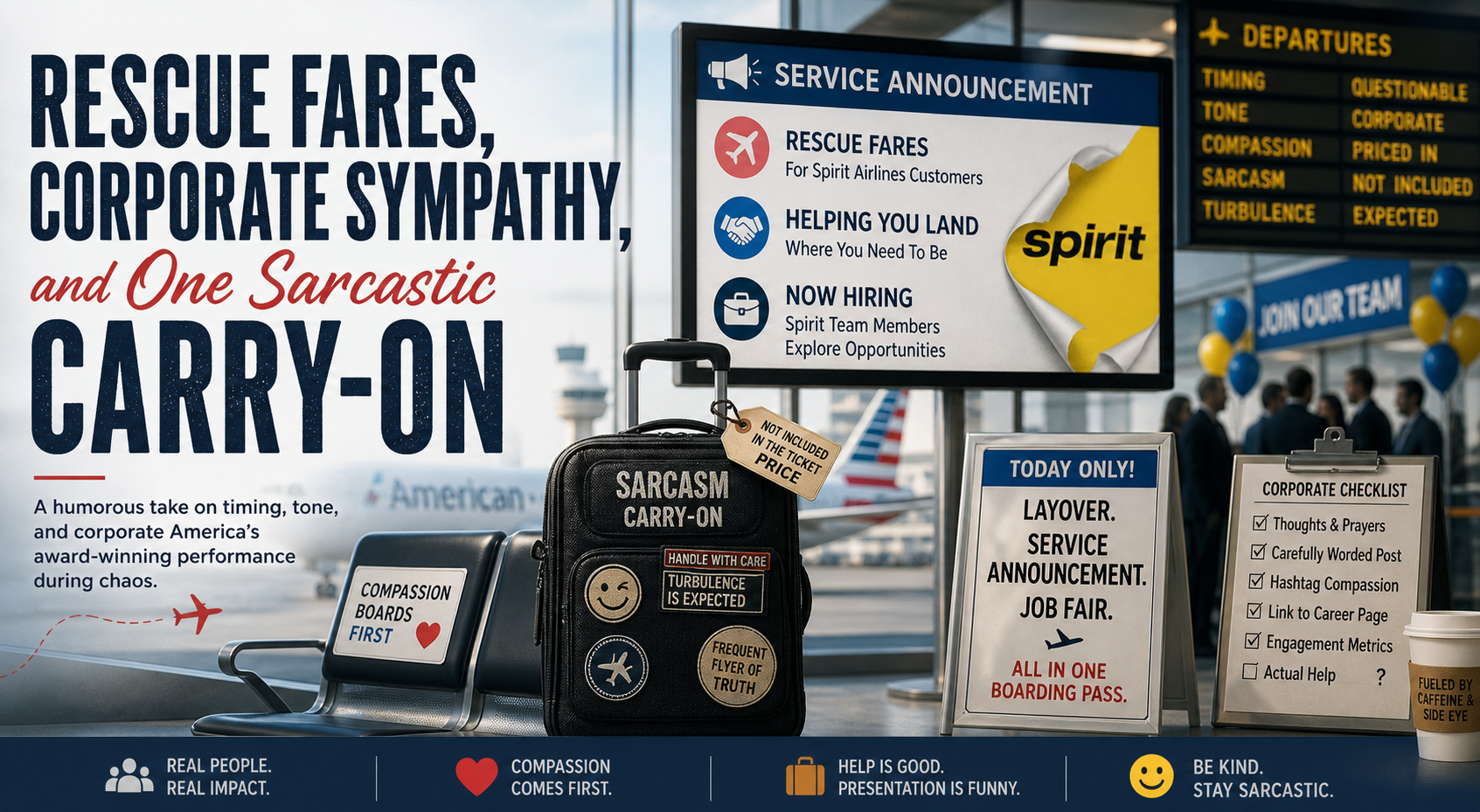
Sometimes you make one little joke about a corporate post and suddenly LinkedIn turns into a fully staffed town hall meeting with assigned seating, emotional boarding groups, and one person near the emergency exit standing up to announce that sarcasm is not included in the ticket price.
And honestly, that is LinkedIn at its most LinkedIn.
You post one sentence with a little timing, a little eyebrow raise, and a little “wow, corporate America really does know how to turn a crisis into a branded opportunity,” and suddenly people arrive in the comments like they were personally assigned by the Federal Bureau of Professional Seriousness to inspect your tone. They do not ask what you meant. They do not consider context. They do not pause long enough to separate the human tragedy from the corporate theater surrounding it. No, they simply grab the nearest microphone, clear their throat like a substitute principal at an assembly, and begin explaining that thousands of people lost jobs and this is not the time for jokes.
Which, to be very clear, is a fair point.
When Spirit Airlines abruptly shut down operations, reports said thousands of passengers were left scrambling and roughly 17,000 employees were affected, with other airlines stepping in through capped or discounted fares and employment outreach. That part is not funny. That part is devastating. That part is families sitting at kitchen tables doing math with faces that no spreadsheet should ever cause. That part is people who wore the uniform, handled angry passengers, comforted nervous flyers, worked impossible schedules, and somehow kept smiling while someone tried to bring a duffel bag the size of a studio apartment onto a budget flight.
That part deserves compassion.
But the corporate presentation around it?
That deserves at least one raised eyebrow, one small cough into a napkin, and one sarcastic carry-on placed gently under the seat in front of me.
Because the thing about corporate America is that even when something genuinely terrible happens, the machinery immediately begins polishing the language until it shines like a freshly mopped airport floor. Nobody is “stranded.” They are “supported through alternative travel options.” Nobody is unemployed. They are “encouraged to explore opportunities.” Nobody watched their livelihood vanish overnight. They are “entering a transition.” And somehow, in the middle of people trying to get home, keep insurance, preserve dignity, and remember their passwords for job portals they never wanted to reopen, another company appears with a post that says, essentially, “We are here to help,” while also holding a recruitment clipboard like a youth soccer coach looking for midfielders.
Is the help good?
Yes.
Should airlines help stranded customers and displaced workers?
Absolutely.
Should American, Delta, United, Southwest, Frontier, JetBlue, and everyone else open doors, offer real interviews, reduce fares, waive nonsense, and treat experienced airline workers like actual professionals instead of making them explain teamwork through a personality assessment designed by a haunted vending machine?
Yes. Immediately. Without requiring a login code sent to an email address that was deactivated four minutes after the shutdown.
But am I still allowed to notice that the public announcement sometimes feels like a layover, a rescue mission, a brand campaign, and a job fair all printed on the same boarding pass?
Also yes.
That is the space where satire lives. Not in mocking people who are hurting, but in pointing at the enormous corporate machine behind them, the one that knows how to say “we care” in font size 18 while the people affected are trying to figure out whether COBRA coverage costs more than rent, groceries, or their remaining belief in professional stability.
So, please, allow compassion to board first.
Let empathy take the aisle seat.
Let displaced workers have priority boarding, free bags, no nonsense, no fake culture interviews, and no recruiter asking, “Tell me about a time you handled pressure,” when the applicant has literally handled cabin pressure while a man in 12C tried to argue with physics.
But I am keeping one sarcastic carry-on.
Because this is LinkedIn, turbulence is expected, and somebody is absolutely about to post, “Grateful for this unexpected transition and excited to see where the runway leads next,” while privately Googling whether ramen qualifies as a financial strategy.
The Corporate Statement Has Entered the Chat Wearing Noise-Canceling Headphones
Corporate statements are a genre of literature that deserve their own shelf at the airport bookstore, somewhere between leadership memoirs written by people who outsourced empathy and self-help books titled things like Disrupt Yourself Before Payroll Does It for You.
They all have the same rhythm.
First comes the sadness.
“We are deeply saddened.”
Then comes the inevitability.
“After careful consideration.”
Then comes the passive voice, which is where accountability goes to lose its luggage.
“Difficult decisions were made.”
By whom? Nobody knows. Apparently the decisions assembled themselves in a conference room, voted unanimously, and walked out carrying branded tote bags.
Then comes the compassion paragraph, where the company mentions employees with the emotional intimacy of someone reading a warranty disclaimer.
“Our team members have always been the heart of our operation.”
Beautiful. Moving. Tender. Also, if they were the heart of the operation, why did the operation need a security badge to stop beating?
This is where the airline situation became so perfectly modern that it almost felt written by a satirical committee trapped inside Terminal B. One airline collapses. People lose jobs. Passengers need help. Other airlines step in with rescue fares, employment links, and public-facing support. Again, the assistance matters. It truly does. When travelers are stranded, a capped fare can be the difference between getting home and turning an airport gate into a temporary apartment. When workers are displaced, an actual hiring pathway can be the difference between panic and possibility.
But then the corporate language arrives wearing a fresh blazer and says, “We welcome Spirit team members to explore opportunities.”
Explore opportunities.
That phrase always sounds like someone opened a cave and handed you a flashlight with weak batteries.
Explore opportunities where? In a portal? In a database? In a talent community? In the same career page where you upload your resume, retype your resume, summarize your resume, attach your resume, then answer whether you have ever used Microsoft Excel like you did not just operate emergency procedures in a flying metal tube with snack logistics and weather delays?
“Explore opportunities” is corporate for “please enter the maze, the cheese may or may not exist.”
And I know someone will say, “But at least they are helping.”
Correct.
They are.
Good.
Now let us make sure the help is real help and not just sympathy with a hyperlink.
Because workers do not need a poetic post. They need hiring managers who recognize transferable skill without making someone beg for it. They need recruiters who understand that airline workers have more crisis management experience than half the leadership consultants selling resilience workshops. They need companies to stop acting like a flight attendant with twelve years of safety, customer service, conflict resolution, scheduling flexibility, compliance training, emergency response, and human patience somehow needs to prove they can multitask.
Multitask?
A flight attendant can calm a nervous passenger, enforce federal rules, locate a missing seatbelt extender, handle a medical concern, serve beverages, decode human irrationality, and still identify which overhead bin contains the bag that definitely should have been checked.
Meanwhile, corporate America calls a meeting to discuss whether another meeting is needed.
So yes, let the airlines help.
But let the help come with urgency, dignity, and common sense.
Do not make displaced Spirit employees perform LinkedIn gratitude theater for the privilege of being considered. Do not make them write cover letters that begin, “I have long admired your commitment to operational excellence,” when everyone knows they are applying because their airline disappeared like a Wi-Fi signal over Nebraska. Do not ask them to describe a challenge they overcame. Their employer ceased operations. They have enough challenge content to publish a trilogy.
And please, for the love of all things boarding-related, do not make them take a personality test to determine whether they are a “team player.”
They worked in aviation.
They already played on the team.
The team was just sold, grounded, liquidated, restructured, rephrased, and converted into a national conversation with comment-section moderators.
LinkedIn Compassion Comes With a Boarding Group and a Comment Strategy
The funniest part about making a joke online is that the internet never responds to the joke you wrote. It responds to the emotional lawsuit it imagined you filed against humanity.
You say, “This corporate post has weird timing.”
Someone replies, “So you hate workers?”
No, Barbara, I hate performative branding during mass instability, but thank you for sprinting through six security checkpoints to arrive at the wrong gate.
This is the curse of LinkedIn comedy. You are trying to make a point with a little humor, and someone arrives with a clipboard, a laminated code of conduct, and the wounded expression of a person who believes every joke must include a compliance appendix.
They want every satirical observation to come with disclaimers.
“Before I begin, I would like to state that I support workers, travelers, safety professionals, aircraft mechanics, pilots, flight attendants, customer service agents, gate agents, baggage handlers, dispatchers, airport coffee workers, emotionally exhausted passengers, and the concept of arriving home in one piece. The following joke is directed only at the absurd machinery of corporate language and not at any individual harmed by the collapse of an airline, the economy, capitalism, weather delays, seating policies, or the suspiciously warm sandwich sold near Gate C14.”
By the time you finish the disclaimer, the joke has filed for bankruptcy.
But that is the problem with platforms built around professional performance. Everyone is trying to be seen as compassionate, strategic, employable, insightful, emotionally intelligent, and not currently screaming into a tote bag. So when a crisis happens, LinkedIn becomes a theater of carefully arranged feelings.
One person posts, “Thinking of all impacted employees.”
Another posts, “Proud to see the industry come together.”
Another posts, “This is what leadership looks like.”
Another posts, “As a former aviation professional, here are seven lessons we can learn from this moment,” and somehow lesson three is about personal branding.
Then, inevitably, someone posts, “To the Spirit employees affected today: your next chapter is just beginning.”
And listen. I understand the intention. I do. People want to encourage. People want to help. People want to say something hopeful because silence feels cold. But there is a difference between encouragement and turning someone’s crisis into a motivational airport mural.
Sometimes the next chapter is not beginning.
Sometimes the next chapter is sitting on hold with unemployment while your laptop asks for an update.
Sometimes the next chapter is looking at your uniform and realizing it went from professional identity to closet artifact overnight.
Sometimes the next chapter is deleting the sentence “I am excited for what comes next” because you are not excited. You are tired. You are angry. You are scared. You are trying to remember which version of your resume is the good one, the one called “Resume Final,” “Resume Final Final,” or “Resume Final Use This One Seriously.”
That is why the sarcasm matters.
Not because pain is funny.
Because the performance around pain is ridiculous.
Because corporate America has perfected the art of turning human disruption into brand-adjacent messaging. A company can say, “We are offering rescue fares,” and that is helpful. But the same sentence also sounds like it was workshopped by twelve people, approved by legal, optimized by comms, and blessed by a vice president of “moments that may perform well on social.”
And then, once the post goes live, everyone watches the engagement like air traffic control.
Likes are landing.
Shares are taxiing.
Comments are delayed due to weather in the ethics department.
Someone from marketing is saying, “The compassion angle is tracking well.”
Someone from talent acquisition is saying, “Can we pin the careers link?”
Someone from legal is whispering, “Please remove the word rescue from the second paragraph unless rescue is defined.”
And somewhere, a displaced worker is thinking, “I do not need the brand voice. I need a paycheck.”
That is the tension.
That is the joke.
That is the part where my sarcasm checks in, removes its shoes, places its laptop in a separate bin, and walks through the scanner with dignity.
Please Describe a Time You Handled Pressure, Preferably Without Mentioning Cabin Pressure
The hiring process is already absurd under normal conditions, and there is nothing normal about thousands of experienced airline workers suddenly being pushed into the job market like luggage down a carousel nobody asked for.
These are not people who need to prove they can work under pressure.
They are people who have worked inside pressure.
Literal pressure.
Cabin pressure.
Emotional pressure.
Passenger pressure.
Delay pressure.
Weather pressure.
Holiday travel pressure.
Pressure from a man demanding to know why his personal item cannot be the size of a refrigerator.
Pressure from someone who thinks “the seatbelt sign is on” means “personally, I feel exempt.”
Pressure from parents, business travelers, bachelor parties, nervous flyers, medical emergencies, maintenance delays, tight turns, impossible schedules, and the constant knowledge that if something goes wrong, you must remain calm while everyone else turns into an unsupervised group project.
And yet, you know some corporate application system is still going to ask:
“Are you comfortable in a fast-paced environment?”
No, Brenda, I only worked in aviation, where time zones, weather, federal regulations, mechanical realities, and human chaos all fought in the parking lot before breakfast.
“Tell us about a time you dealt with a difficult customer.”
Would you like the regular difficult customer, the holiday difficult customer, the delayed-flight difficult customer, the missed-connection difficult customer, or the difficult customer who tried to make a budget airline experience feel like a constitutional crisis?
“Describe your communication style.”
Professional, calm, legally aware, safety-focused, and occasionally powered by caffeine and divine intervention.
“Where do you see yourself in five years?”
Employed, ideally by a company that does not describe layoffs as “unlocking future value.”
This is where the airlines stepping in can do something meaningful. Not just public-facing helpful. Actually helpful. Fast-track these people. Recognize the experience. Skip the nonsense. Build dedicated hiring lanes. Stop hiding behind portals like every applicant is a mystery novel. If someone spent years moving humans safely through the sky, maybe they do not need to record a one-way video interview answering why they are passionate about customer experience while staring at a webcam like a hostage with ring lighting.
And for stranded passengers, same principle.
Help should be practical, not poetic.
A rescue fare should not require the customer to decode an ancient riddle, provide proof of itinerary, call three numbers, refresh a broken website, sacrifice a boarding pass under a full moon, and then discover the fare only applies to flights leaving from airports located emotionally near them.
Make it easy.
People are already stressed. Their travel plans collapsed. Their airline disappeared. Their vacation became a logistics seminar. Nobody wants to participate in The Amazing Race: Bankruptcy Edition.
But this is where corporate America often fails. It confuses announcing help with delivering help. It thinks the post is the action. It thinks the statement is the solution. It believes that once the press release says support is available, support has magically happened, like workplace culture improving because someone added “belonging” to a PowerPoint slide.
The post is not the help.
The help is the help.
The fare that gets someone home is the help.
The hiring manager who calls back is the help.
The recruiter who says, “Your aviation experience absolutely counts,” is the help.
The company that does not make someone beg for dignity through seven interview rounds is the help.
The leader who understands that laid-off workers are not “talent pools” but human beings with rent, children, medicine, car payments, aging parents, grocery bills, and pride is the help.
Everything else is branding with better posture.
And still, because life is ridiculous and LinkedIn is a haunted airport lounge with Wi-Fi, the comments will continue.
Someone will say, “This is not the time for jokes.”
Someone else will say, “Actually, humor helps people process.”
Someone will write a leadership thread.
Someone will tag a recruiter.
Someone will announce they are “humbled” by the resilience of aviation professionals, which is usually corporate language for “I observed suffering from a safe distance and it performed well.”
Someone will write, “This is a reminder to always own your career.”
Which is technically true, but also deeply annoying when someone’s career was just shoved out of the emergency exit by fuel costs, failed deals, leadership decisions, creditor math, and an economic system that treats workers like carry-on luggage: useful until capacity changes.
So yes, let us talk about resilience.
But let us also talk about responsibility.
Let us talk about how companies love experienced workers right after another company collapses, but somehow still reject those same workers for not having the exact internal software experience listed on line seventeen of a job description written by a committee that has not met the actual team.
Let us talk about how “opportunities” should not mean “please re-enter the maze.”
Let us talk about how workers deserve more than applause after being “impacted.”
And let us definitely talk about how a person who can handle turbulence, passenger conflict, emergency protocols, and an aisle full of people pretending not to hear instructions can probably handle your customer success role without taking a workplace astrology quiz.
Final Thoughts: Compassion Boards First, But Sarcasm Has a Valid Ticket
At the end of the day, the people hurt by this deserve every ounce of compassion, practical help, and professional respect available. The workers deserve jobs, not pity dressed up as networking. The passengers deserve a way home, not a scavenger hunt through fare rules and customer service disclaimers. The aviation community deserves credit when it actually steps up, because help matters, especially when everything goes sideways at cruising altitude.
But compassion does not require us to pretend corporate messaging is not weird.
We can care deeply about people and still laugh at the choreography.
We can support rescue fares and still notice that “rescue fare” sounds like a phrase that walked out of a crisis meeting wearing cologne.
We can appreciate companies opening doors and still ask whether those doors lead to real interviews or just another applicant tracking system with abandonment issues.
We can hold empathy in one hand and satire in the other, because sometimes that is the only honest way to look at modern work without turning into airport carpet.
So yes, to the person who said, “Take your skepticism elsewhere,” I hear you.
The human part comes first.
Always.
No jokes about people losing jobs. No jokes about families scared about bills. No jokes about workers who gave years to an airline and woke up facing a job market that treats experience like a suspicious liquid over three ounces.
But the system?
The messaging?
The public relations ballet?
The sudden transformation of corporate competition into “community support” while everyone quietly checks available routes, open roles, market share, and brand sentiment?
That gets jokes.
Because if we cannot laugh at corporate America turning a collapse into a polished LinkedIn moment, then what are we even doing here besides refreshing job boards, pretending “talent community” means something, and watching another executive use the word “resilience” like it pays rent?
Let compassion board first.
Let displaced workers stretch out in first class.
Let stranded passengers get home safely.
Let recruiters answer quickly, hiring managers move faster, and companies treat aviation professionals like the crisis-tested, customer-facing, safety-minded adults they are.
But I am keeping my sarcastic carry-on under the seat in front of me.
Because this is LinkedIn.
The seatbelt sign is always on.
The turbulence is never actually temporary.
And somewhere, before this day is over, someone is absolutely going to post an appreciation note thanking an aircraft, a merger, a restructuring, or a failed business model for the opportunity to grow.